


9xsolar
Members
-
Joined
-
Last visited
-
Hi everyone, nameste again from India. I've searched the forum for past threads on Deye and Victron and which is better/the way to go recently but I think this warrants a new thread for my specific requirements. I've been in hibernation in the forum and the last time I installed solar, I started with a 24v Axpert and upgraded to 48v with Victron multiplus - that journey is documented here if anyone's curious: (I was a solar novice back then, not so much now!) Fast forward to 2024, my Victron multiplus 48/3000 died unexpectedly during a grid outage and is out of warranty. I've been in touch with the distributor and hoping to get some help on this. Meanwhile, the 24v axpert is back in action saving the day several years later Fortunately, I'm moving places in a few months and have been exploring what kind of options I have now and Deye inverters have caught my eye. I was looking at the 6kw SG04 deye hybird inverter, costs around 1.10L INR (25k SA money) ~ however, my searches in the forum revealed drastic support experiences with Sunsynk (rebranded, different market, I know) but the number of reports with inverters being out of commission just weeks/months in is upping my anxiety a bit. Coming from victron with a failed inverter, albeit 7 years later.. I'm fully invested in the Victron ecosystem (MPPT, BMV, RPI with venus, etc) but depending on how the repair of my Multiplus goes, I wanted to see if anything else is better. The new system has to be everything new since all my other equipment is out of warranty and won't support high voltage panels anyway. In terms of battery, I've custom built lifepo4 packs and use it already, so expect to have around 20kwh (usable) of battery storage in same 48v. I choose to custom build because ready made packs are more than twice as expensive and use more or less the same cells anyway and I prefer to have some control. This is what I have come up with in terms of inverter options that I potentially have (solar to be updated, so this thread is only on inverter capacity): 2x Deye 6KW SG04 in parallel (12kw usable) (costs 2.20L INR or 51k SA money) (5kw version is slightly cheaper but this one has a fan so I chose this) OR 2x Victron Multiplus II 48/3000 in parallel (4kw usable) (costs 1.88L INR or 44k SA money) My actual usage is 4.5kw max peak, with 2.5kw mostly. If I wire the geyser on the smartload/2nd output of the multi, I will likely stay well below the 4kw limit I think. Unfortunately I missed the victron 3 phase promotion (buy 2 get 1 free), would've been nice to have that now. Redundancy is important for me, that's why I picked two for both inverters in the equation. However, with victron, if 1 were to die, I cannot use all of my loads anymore unlike the deye where 1 is enough already. My mind says to go deye (12k output... don't have to spend on MPPT) but the heart says to go victron. Perhaps some input from the community will help sway the mind Thanks everyone in advance. PS. I asked around about the RS models from victron (48/6000 and the likes) but it is not available here. The inverter RS is available (more or less same price as Multiplus II due to a promotion) but it does not have a grid input.
-
I've been talking to a local supplier (relatively speaking, they're 1200km away lol) for a custom built 48v Lifepo4 battery pack to use with my Victron Multiplus 3000 / MPPT 150-70 / BMV-702. Since it's not a branded off-the-shelf product, I've been trying to get more information on the pack itself -- 1) Total size of 210ah using 45 CALB CAM72 cells (15s3p) 2) Some OEM BMS (I'm trying to push for bluetooth/connectivity based one) so I can get all the voltage information a bit easily -- but I understand it's not gonna be able to talk to my inverter Now, I have some interesting questions that (I need @plonkster's and everyone else's opinion on!) -- 1) Do you think 15s makes sense? I've seen people building 16s -- I guess both can work either way right with a Victron setup? Does the axpert not care too? (I'm thinking of getting an Axpert to run off of the same battery, but that a very future setup, just poking my brains into it) 2) Is it possible to identify the "cell" more accurately? I know this is a stupid question, but how to ensure I'm not being taken for a ride with a cell that isn't what is being promised? 3) Is there a preset (in Victron) that I can use to specify a custom charge profile? (i.e let's say I want to charge only up-to 90% and not discharge beyond 20%, for example) -- I'm not sure how reliable it would be to use voltage for this calculation? 4) Do you think it's possible to parallel with a similar pack in the future (provided both packs are same voltage during connection?) 5) Instead of a complete pack of 210ah, do you think it'd make sense to have 3 different packs (i.e 3 separate packs with their own BMS)? Different packs mean higher cost but I'm not sure how common it is to use the same BMS for a parallel pack. Thanks -- look forward to everyone's feedback! Hope y'all are safe. (sorry I haven't been so active here, life is pretty hectic ... hoping to be a regular member again!)
-
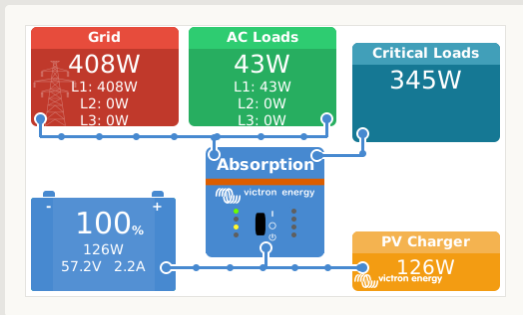
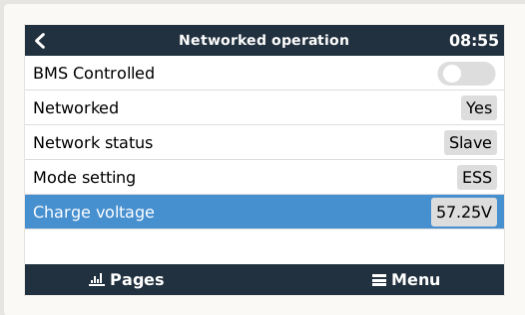
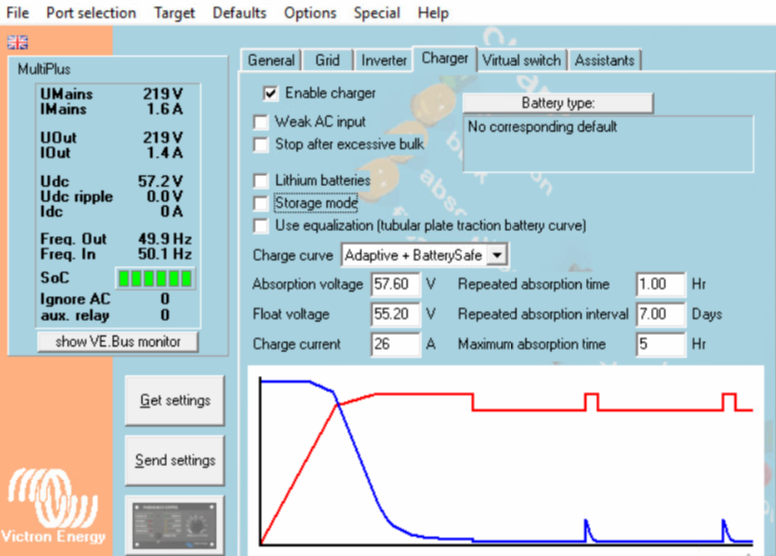
Alright, I resetup everything from scratch again and now the Multi doesn't support loads at all (not even from the battery) and no matter what limit I put in RPI for discharge it doesn't do anything. Also, now the voltages are different. (screenshot below with no limits on discharge, and plenty of sun and yet nothing's happening) Here's the networked operation charge voltage from the MPPT : Setting from VEConfig : DVCC is enabled right now. I will pm you my email. Edit ---------------------- Reverted back to my old SDCARD for the time being and everything works as intended (with your script)
-
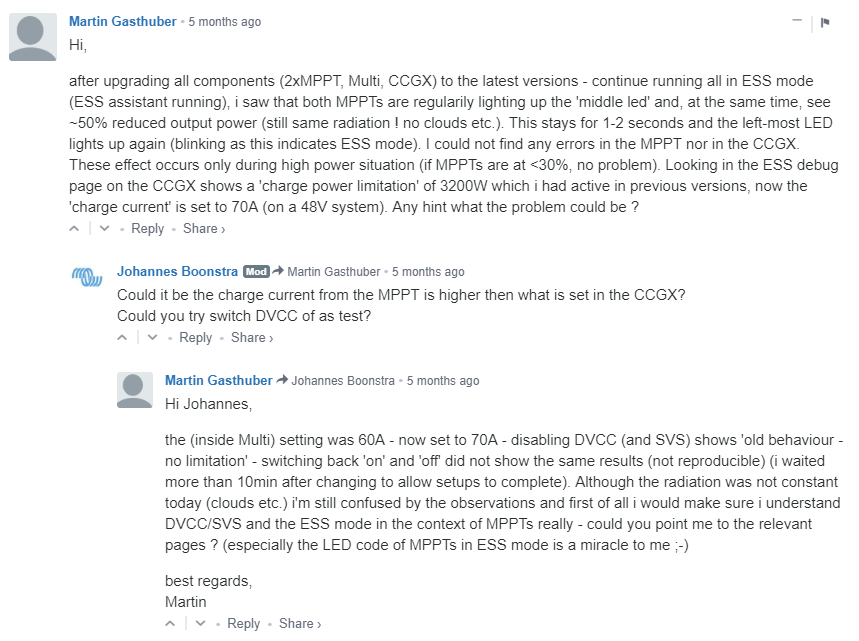
I can confirm Assistant loaded (ESS) is up-to date. Gotcha - I also see that the wattage displayed (especially for Grid meter) are 1s delayed. L1/L2/L3 values below the main value appears faster than the global value. Just nitpicking as this didn't happen before too. Thanks, that explains number 7. I tried to power cycle everything (including the MPPT) and had no effect on this. In addition, I see that the MPPT flashes "absorption" orange LED in-between the blue "float" LED that flashes in accordance to "being in control of ESS". I haven't seen this before, and this happens to be at the same time when I see "discharging" happening as PV power drops. I've noticed this to drop even when there's no change of sun (i.e no cloud). Got one more customer in the link below who mentioned it too : https://www.victronenergy.com/live/ess:ess_mode_2_and_3 (had to attach screenshot as Disqus doesn't allow linking by comment) I also double checked the values in VEConfigure and they're lower than what's in the MPPT settings. For now, I have disabled DVCC and will try to monitor tomorrow to see how it works.
-
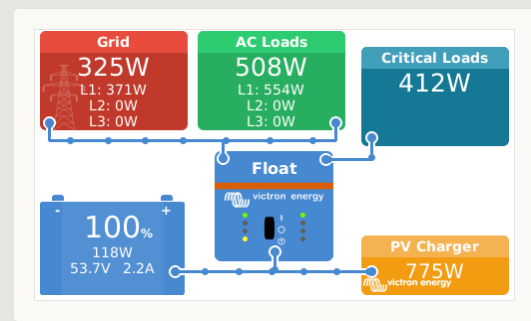
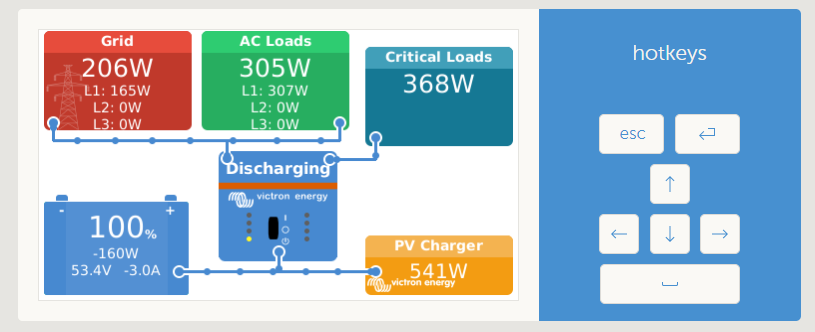
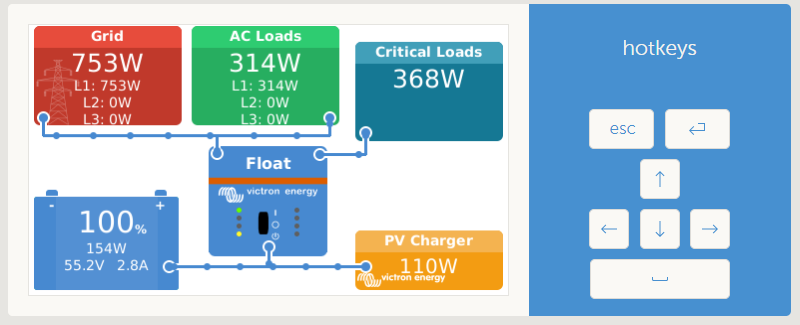
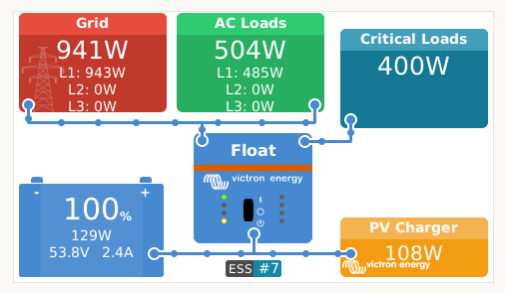
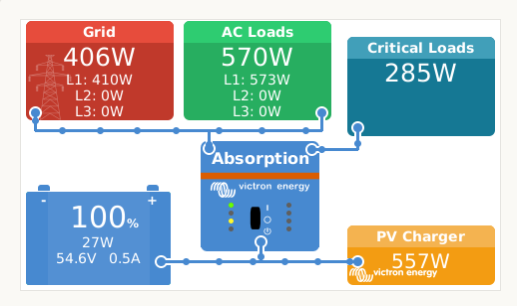
Yes, I updated the inverter to 430 (with ESS Assistant). Here's the exact steps I did: Update MPPT to latest (via Victron bluetooth) (reconnected to old RPI SDCARD after update and it worked) Attempt to update Battery monitor (no update) Disconnected inverter from old RPI SDCARD Updated inverter to 430 after backup, and reconfigured using VEConfig - also added back ESS assistant Replaced the SDCARD with latest image you linked, added ssh, updated wifi, etc Connected everything to new image on RPI Now, I have : DVCC enabled / STS shared temperature sense enabled Mode - Keep batteries charged Grid Meter Installed (yes) With this, the inverter only floats the batteries using very little solar. When I move back to Optimized, it uses all available solar. I use this mode in combination with your script above in order to use the additional solar available with 100% SOC (float). However, this is no longer stable unlike before, as the inverter constantly moves from "float" to "discharging". Granted, there's way too much cloud movement today, but I haven't seen this behavior before. Added screenshot (shows discharging issue) whilst using the script. Screenshot that shows excess energy not being used when using "Keep batteries charged". Both taken at same time, so you can see difference in power. Edit. I now see a weird 'ESS #7' in the image below, any idea what that is?
-
Thanks again - I've updated everything and have enabled DVCC and 'Keep batteries charged'. However, that doesn't seem to use the excess solar available. Instead, it only uses the exact amount required to float/absorb the batteries. When I use 'Optimized with battery life' I can see the solar power increase drastically (200w to over 700w). Is this normal? Edit: Inverter keeps changing from 'float' to 'discharging' constantly (and I can see battery discharge for a few secs and charge again whenever I use the script above).
-
I don't have the DVCC feature - looks like I need to spend some time upgrading the firmware of Inverter, MPPT, Battery monitor(?) along with my PI. It's been quite a while. I'm on 2.09~03. Thanks. But if I understand it correctly, it's still a lot low if we compare it to Fronius (at least in the price point). If I for some reason get Fronius in the future, will it work when there's a power outage when paired with Victron?
-
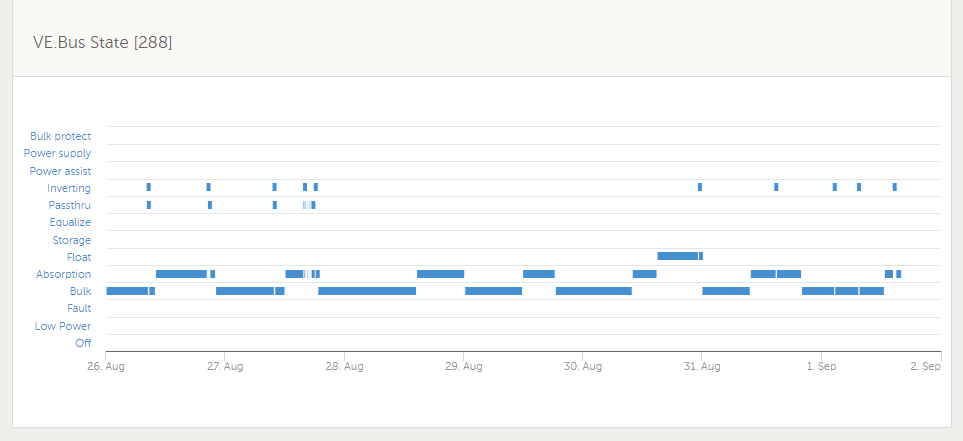
@plonkster Just to update and a few questions - the system has been working pretty good so far. I only had to intervene to make adjustments to the temperature sensor; it seems to be causing too many errors (only happened a few times so far) and whenever I just move the cable a little bit on the battery, it goes back to normal. Now that rainy season is approaching - I tried to make the battery stay at 100% and use solar only directly. I noticed that when the batteries are floating yesterday, they still go back into the Bulk state the next morning, and Absorption state, and so on. Why can't they stay in Float when they're not used? I feel like I'm putting in too much into an already full battery. Any tips appreciated - thanks :) Also, we have Grid-tie getting popular here and I might have the option of enabling this (although I'm not 100% sure if I should, too much bureaucracy) - what do you think theoretically, the amount of power I can feed back into the grid with my MultiPlus? Is it going to be 2200w or perhaps much higher?
-
In the inverter or the RPI? In case of former, am I theoretically reducing the lifespan of the flash inside the inverter by too many read/writes? Should I be worried? Also, my batteries never reach float (usually they'll just be in Absorption for a few hours) and then sun will be down by then, and the cycle repeats. Should I make sure they float more often? Can we make adjustments to your script so that the batteries are being fed whatever they want to eat, and only the remaining gets sent to load? Any tips appreciated The firmware has been amazing, the overview screen never defaulted; and more importantly, neither the MPPT or the inverter disconnected from the RPI even once!
-
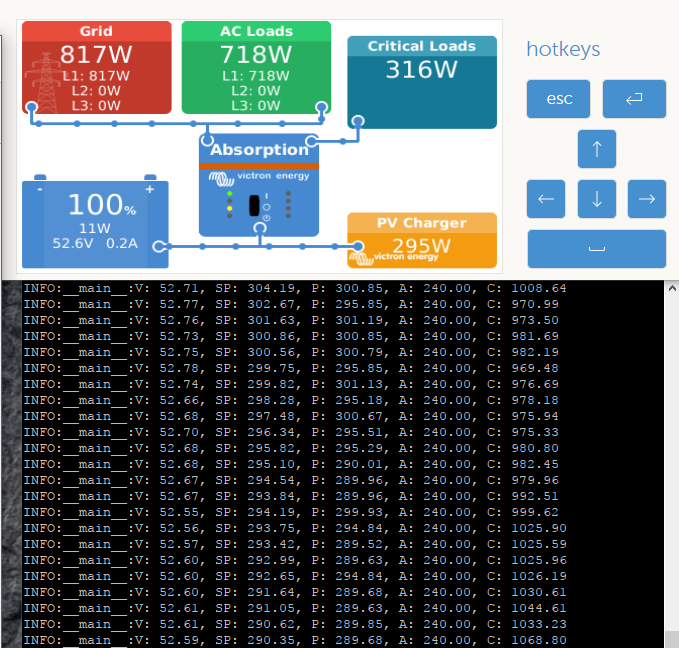
So far so good, I have not seen any weird behaviors so far. Edit : Started monitoring w/ your script - so far so good too! I've changed the default 60s to 5s as I felt more updates the better as the clouds here are wrecking havoc.
-
-
Bingo - works in release candidate v2.09~3 I've had some issues with the previous firmware, like randomly the screen view (?) changes to the default one randomly throughout the day as if the venus hardware itself was restarted (which is wasn't). Plus, Multi and the MPPT will constantly disconnect and reconnect randomly throughout the day... nothing serious, but still concerning. Hope this firmware works better haha.
-
-
-
@plonkster - I've updated the venus image to version 2.08 (directly via venus, no manual flash) and since then, Multi has disappeared from venus. I've rebooted Multi, tried disconnecting all the cables and connecting one at a time. Energy meter, MPPT and BMV are the only ones connecting. Should I upgrade the firmware for the Multi? I've upgraded the firmware of the MPPT from 1.23 to the latest via bluetooth; obviously can't do that to the Multi.. any assistance appreciated. Thanks! Edit: Rolled back firmware to 2.07~26 and Multi connects immediately. Super awesome to have backup firmware within venus, super helpful!
-
Sorry for the rather long delay! Haven't been in the country and couldn't do this remotely ;( Will experiment and get back - unfortunately the weather has not been so kind lately and I'm barely charging the top 20% battery usage these days.
-
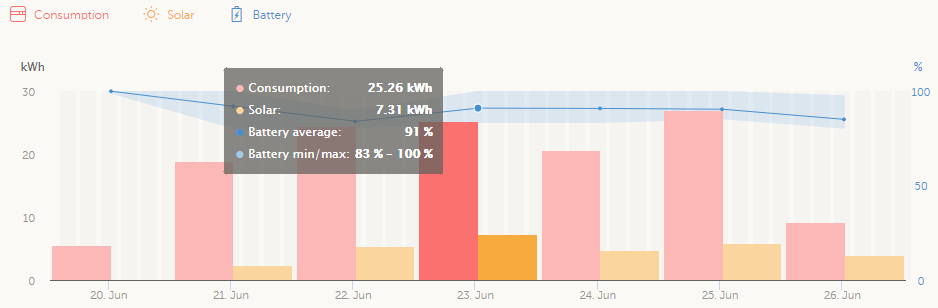
That would be something that will make this perfect! Right now, I'm finding that as long as I keep the battery charging in Bulk, the MPPTs are maxed - things get tricky once they enter Absorption or Float in which case I manually change the Max Inverter power to keep things balanced. It seems I'm just too paranoid to use batteries above their C20 rate, and the ability to maintain battery + grid in parallel is something that I absolutely love so far. Week long data:
-
This still ensures the Inverter continues to run, except it will be in bypass mode and is ready to kick-in when the Grid fails, right? I think I may have triggered that as I was messing around the SoC levels. In that case, the Min Discharge SoC if set to 80%, means if it drops less than that (let's say, Grid failure) and then Grid comes back, the inverter will charge to 80% and then leave it alone? Is that how it works? What if I don't want the inverter to charge anything at that level, and only want it to interfere at the Sustain level? Edit> You've talked about it just before, I misread! What if the Min Discharge SoC is 100% - will that trigger the MPPT to power down? Because at some point in my tinkering, the MPPT went all the way down to 0W. I don't remember if it was when I had it on 100%.

