WeNotGood
Members
-
Joined
-
Last visited
-
Hi Rehaan, i am sure someone on the forum will be able to recommend an installer, have you already indicated where you are based?
-
Hi Rehaan, The non essential loads will not run “through” the inverter but should be detected by the CT meter in a correctly installed system. The reason is that while grid connnected, the Goodwe will also supply the non essential loads, up to the maximum capacity of the inverter, in order to maximise the self usage of the generated “and stored” energy”. Agree with @Bobsterthat there most likely appears to be an installation problem, based on the data you supplied.
-
Hi Rehaan Possible issues for the CT test failing may be due to: 1. Position of the CT clamp 2. Direction of the CT clamp, The clamp is directional so will need to be the correct way around, perhaps the easiest (alternative) way to check is to switch on e.g. the geyser and see if the change in consumption on PV master corresponds to the load, e.g. for a 3kW geyser the consumption should be > 3kw as it will be the total of the Geyser and the other loads, if after sunset this will be supplied by the grid and / or battery (if the battery still has capacity) . If you look at the below youtube video @ around 1:14, it will give some pointers on doing the CT test: Below a diagram showing the ideal position of the CT clamp:

-
-
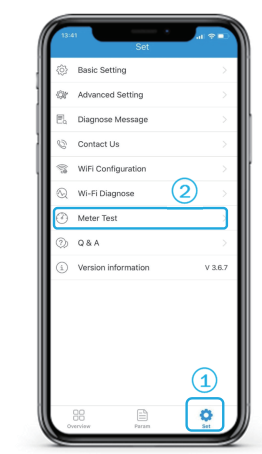
Hi Rehaan, agree with Bobster and Tinuva that there is something really odd with your system, Not to sure what your loads are like but your bill is extremely high, especially with your spec system. Looking at the below, It almost looks like your load "follows" or "ride on top" your PV output, i.e. as the PV output increases, the load below seems to increase, also the imported current (yellow) does not seem to be affected by the P.V. The two load areas marked with the red circles seems to nicely mirror the PV output. This may also have something to do with your load "jumping" to discharge the battery. Have you perhaps done the CT meter test by any change and did it pass? PV Master -> Settings -> Meter Test Below from the manual

-
-
-
-
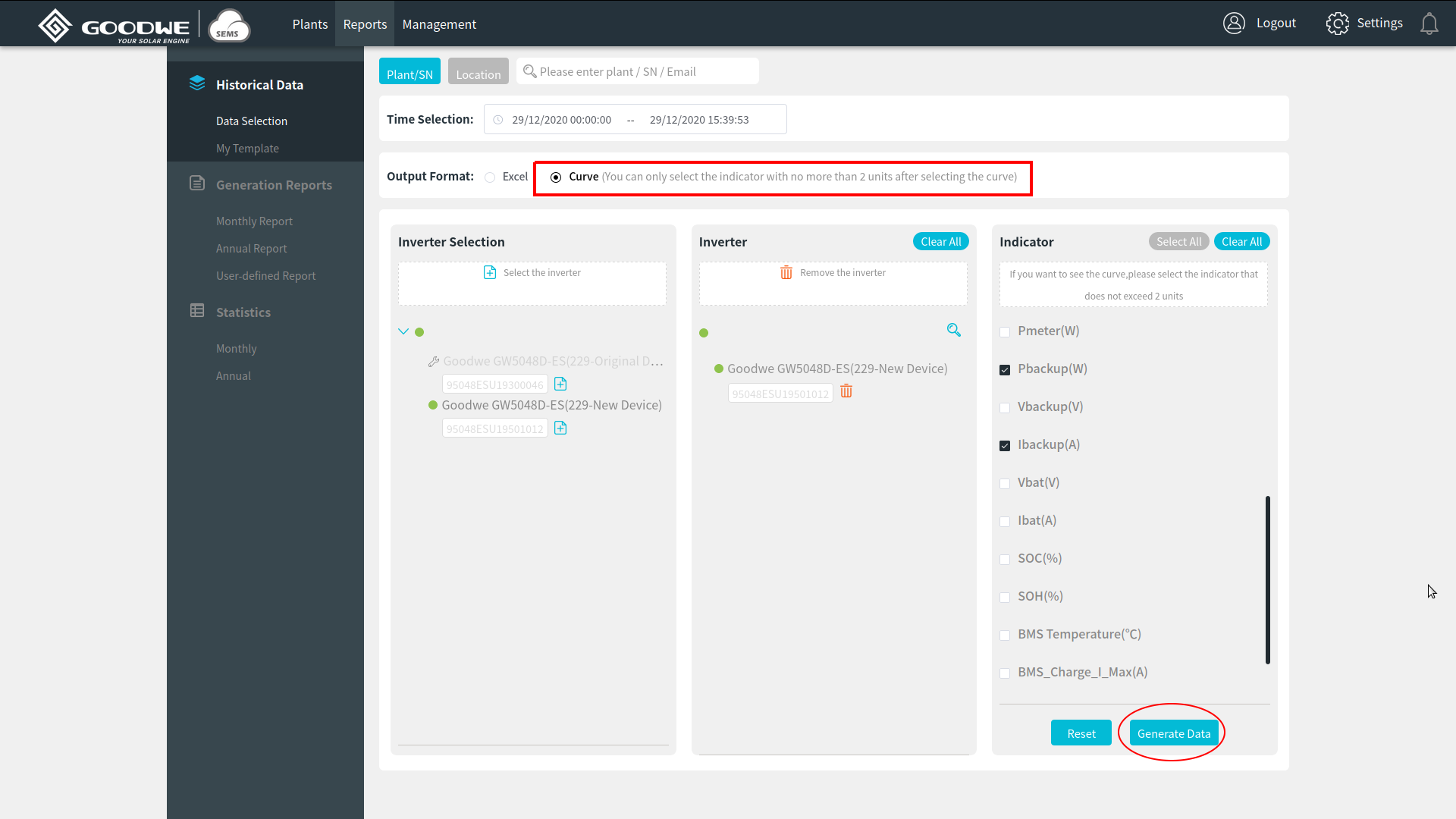
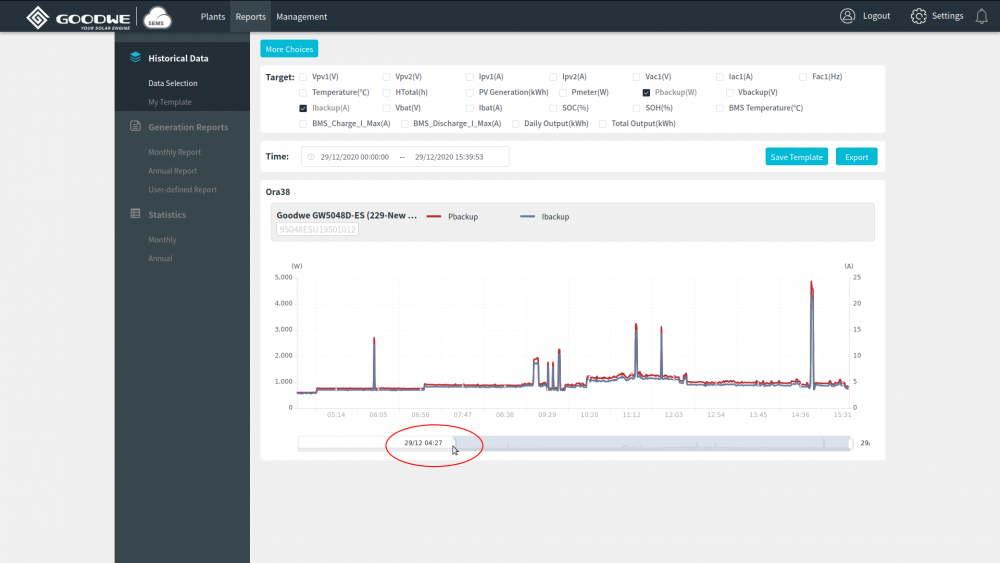
You could perhaps also generate a graphical report from SEMS from the time you are having issues, suggest start of with a wider date range, I also suspect SEMS is based on a time zone in Asia so you may have to select a time a few hours ahead for a recent event: Make sure to select curve along with max 2 parameters (when generating a curve) You can Zoom in and out of the area of interest using the sliders below:


-
-
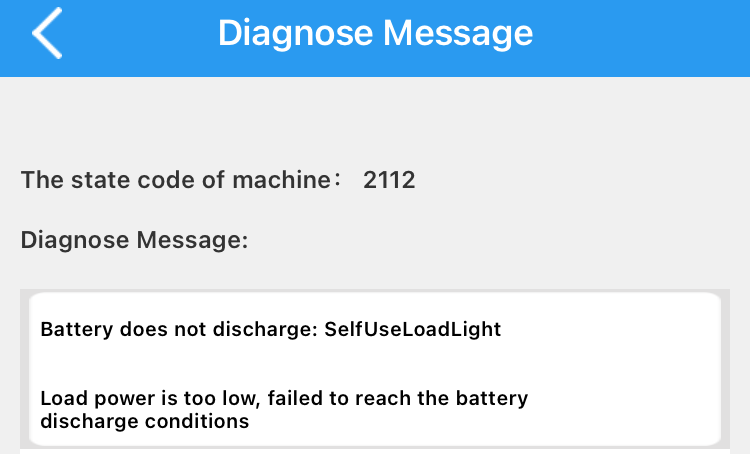
Some additional hypotheses: If some of the loads are not part of the "backup" output of the inverter, the accuracy of the CT (current) sensor could also potentially cause "leakage" in either direction i.e. exporting or importing, would expect this to be fairly low but more obvious during low power consumption scenario's. If the consumption is very low, the battery may simply not supply any current at all, and just use energy from the Grid, I have got this under my "Diagnose Messages" which can be accessed in PV Master from under SETTINGS -> Diagnose Message
-
My current battery capacity is a bit low so normally drained by the time it gets to the wee hours of the morning, will monitor what happens once the capacity has been increased
-
Thanks for the link, from the last report from the link: The only two battery packs that made it through unscathed during phase 1 and are still going strong are: Samsung Sony GNB PbA The only two battery packs that made it unscathed through phase 2 are: GNB Li-ion Pylontech These large price tag batteries available also in SA, alas, did not manage to go all the way through phase two, which is worrying: BYD LV - Suspected internal BMS failure of one battery module. BYD states all modules faulty due to cell imbalance Tesla PW2 - Battery not cycling as it cannot be externally controlled, but could have been a dud and was replaced, the replacement is still going strong. These once does not seem to like the higher temperatures, maybe best for the coast then: Alpha ESS - Battery pack cycling affected by over temperature, Alpha removes its batteries The survivors from phase 1: The survivors from phase 2 The Round Trip efficiency for the contestants Hysterical laughter when you realised your overpriced, premium battery did not survive its phase and was outperformed by a battery that now cost 50% less!: 🤪😂


-
-
-
Hi @Bobster I have noticed the same both with importing and exporting, From observations the "leakage" seems to be a bit more pronounced when there are large loads switching on and off, e.g. our one 4kW geyser, and the larger the load the more the "leakage". While most of the PV generated goes into charging the battery the "leakage is much lower if not zero, once the system start to export and the loads come online, the "leakage" seems to increase. Purely a guess (without running tests), is that this is a way for the inverter to help balance and protect itself, rather than absorbing the surges (and compensating for short "dips") caused by especially the larger loads switching on and off and which will require extremely fast "reaction times", it uses the grid, while connected, as a bit of a buffer.
-
Hydrogen seems to be part of a huge drive to find a clean alternative for fossil fuels especially for use in ships, planes and even trucks, and the energy density makes Hydrogen a worthwhile contender. There is a commitment from the “top” in many countries incl. the EU to make it work.
-
-
-
Tried something similar a few years back with a normal UPS and large battery and my UPS did overheat and shut down. Depending on budget, and as a suggestion, you could perhaps consider getting a low cost or used hybrid inverter e.g. something like this? https://www.victronenergy.com/inverters-chargers/multi-500-va or perhaps slightly larger depending on the consumption of the TV which most probably uses most of the energy https://www.dixonbatteries.co.za/multiplus-c-12-800-35-16 One of these may be another option, not too familiar with them however: https://mustek.co.za/mecer-axpert-family/
-
The Goodwe does report that the SoH is 100% as per the attached, would be nice to directly interogate the BMS as well.

-
Hi @billythekid I suspect that is the 26K question 🙂 Not a very good sales person but perhaps some of the other members can perhaps help with this one. You mentioned in a PM you can get new Byd's for approx R22k. The cost for upgrading the existing Byd 5 kWh stack to 10kWh will be around R44K Getting another complete 10 kWh stack, that can "talk" to the Goodwe inverter will cost between R50K - 55K (Pylontech / Alpha Smile) less whatever can be be gotten for the Byd stack. Should one be able to get at least R13k per battery that it will be R26K for the two batteries (that will be only for the batteries without the cabinet which could perhaps be reused, but including the BYD comms box which will no longer be needed, if you do not already have a cabinet we can discuss that) In which case the new stack will leave one (R50K to 55K) - R26k = R24 to R29K out of pocket which is at least still better than the R44K for upgrading the Stack. Somewhere in the above, shipping etc. also needs to be factored in, as a guestimate it should not be more than R1K to R1.5K Guess that should make the maths worth the while for both buyer and seller give or take? In terms of info on the batteries, mine was installed about 19 months ago and during that the time the inverter was out of action for about 3 months, while waiting for the faulty inverter to be replaced so it will have been in active use for about 16 Months, which I have read before is about the limit if you want to add new batteries to the mix of used batteries (but stand corrected). General question, are there any other "checks" which will be useful for Lithium batteries that has been in use? Does anyone perhaps know how to directly "interrogate" the BYD's (or other lithium batteries) to obtain a SoH report or something similar from the BMS? Will be happy to share the link to my system.
-
Interesting results out of Oz, not sure if Sony, Samsung is available in SA and how the prices compare with e.g. Pylontech Would imagine that in terms of price vs. performance Pylontech must be the clear winner out of the below bunch, pity we do not have something similar for the batteries available in SA. Top performers Models that demonstrated superior performance: The Sony and Pylontech battery packs have so far demonstrated superior capacity retention; that is, their claimed capacity didn't significantly diminish over time. The Sony, Samsung, Tesla Powerwall, BYD and Pylontech have shown high reliability. The Samsung and BYD have shown consistently high efficiency. This is a measure of how much of the energy put into the battery is actually stored and able to be extracted for use again. Most of the batteries have efficiencies around 85% but these two achieved about 95% efficiency. Added the price per kWh that i could find in brackets below BYD B-Box < R8400 / kWh (not sure if the price is incl. VAT) This battery has run without problems, and demonstrated high efficiency, though its capacity fade appears to be accelerating over time. Pylontech US2000B < R5100 / kWh (not sure if the price incl. VAT) This battery has had no problems in the test, and so far is showing very good capacity retention. Samsung AIO10.8 - Available in SA? This battery has proved very reliable and has had no operational issues. It's showing excellent efficiency so far. The battery is now sold under the brand name Hansol (a Samsung partner). Sony Fortelion - Available in SA? This battery has had no problems in the test, and so far is showing excellent reliability and capacity retention. Unfortunately, it appears to no longer be available in Australia. Tesla Powerwall This sample of the first-generation Tesla Powerwall has proved challenging to control for testing purposes, as it is not compatible with the SMA inverters used in the test lab. A Solar Edge inverter was used instead. While ITP is able to control the Powerwall to some extent, their only option was to have the Powerwall charge and discharge at its maximum rate, which is not ideal and may be accelerating its capacity fade. Nevertheless, so far this Powerwall has performed reliably and in line with its claims, with no operational problems. This model is superseded by the Powerwall 2. Tesla Powerwall 2 < R10600 / kWh Similar challenges were encountered as with the original Powerwall above. Also, a fault occurred with the first sample delivered to ITP; this was replaced by Tesla. The new sample has been on test since November 2018. There's not enough data to comment on its performance to date. https://www.choice.com.au/home-improvement/energy-saving/solar/articles/solar-battery-trial
-
Thanks for the points mentioned: 1. The battery's warranty: as per data sheet it is a 5 year product warranty and a 10 year performance warranty. I am not sure exactly what this means, does this include the 8000 cycles quoted, and at what capacity level? Further research required. Yes the warranty terms is expressed somewhat oddly and it would be worthwhile to clarify before jumping in and buying one. 2. It's a large "chunk" to buy in one go, and further expansion would probably mean another one of the same size (and cost). By contrast, the other options listed in the possibly outdated Goodwe datasheet (such as Pylontech) are smaller and thus easier on the pocket when expanding. The price per kWh (~ R5000) is pretty good and kicking of with 10kWh capacity (at a similar price to what my 5 kWh modules cost just over 18 months ago) should be sufficient for most, sure the price will come down even more the next 12 -18 months should someone wish to expand. In terms of Size, the narrower depth may even be an advantage for some installations The Goodwe GW5048D-ES specs look quite strong and can handle a significant amount of PV (550V). Is it possible to put multiple units in parallel like the Sunsynk 5.5K? Unfortunately the Goodwe does not Parallel, not to big an issue for myself and probably the majority of people who have one. The 4.6 kW Back Up output is a decent amount and with a bit of planning using appliances during load shedding it can easily support either using the Washing machine or Dishwasher or Microwave / Kettle during load-shedding (although not all a the same time 🙂 and the mix will need to be chosen carefully). Another advantage of the 5048D-ES is the ability to charge at a decent 100A, while not the only 5kW Inverter able to do this, it is one of the few I have noticed withthe ability.