
Chris Hobson
Members
-
Joined
-
Last visited
Everything posted by Chris Hobson
-
Hi Don Pienaar who was a member here for quite some time passed away yesterday. I never met the man and he ruffled more than a few feathers by he was helpful with information from his own experiences. RIP
-
One should not be mixing batteries of different capacities. They will charge and discharge unevenly. A balancer would even out batteries but remember balancers shuffle tens of Watts between batteries not the hundreds of Watts needed in your envisioned scenario.
-
Hi Coulomb The U1 firmware version is 71 61
-
It's one of the newer inverter where program 16 settings are slightly different. However enabling/disabling grid charging has no influence on this behaviour.
-
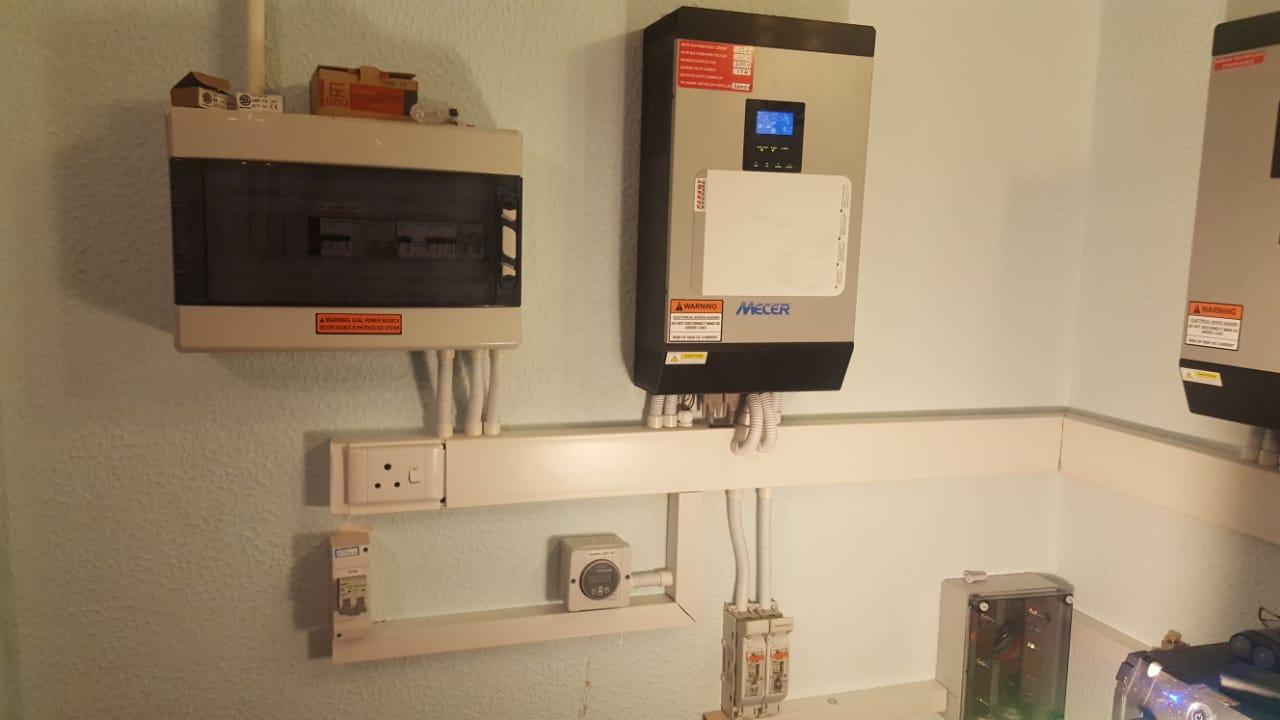
Hi all I have unusual behaviour to report with a rebranded Axpert paired with 2 BP series Blue Nova lithium batteries. The Axpert has worked well as a measure to alleviate loadshedding. Now PV has been added and once the battery is in float the battery charges and discharges. One can hear the fans ramp up and then go quiet. Charging rate climbs to about 17A and then drops off. The source of the power is PV. This is reported by the inverter and has been confirmed using a DC clamp ammeter at the combiner box. The inverter only does this in the presence of grid power. I have tried disabling grid charging to no avail. Switch off grid power and the inverter behaves normally. Anyone had similar experiences or a possible solution?
-
Hi All After a period of absence I am back without my much loved dual Axpert install. I now lived in (clears his throat) Gqeberha (Port Elizabeth for those of you without a throat infection). My new home has a 3 phase supply and a massive 30 kVA 3P generator for the regular power outages. Heaven help us once loadshedding starts. The roof is slate and probably singularly unsuitable for a PV install. Not to be defeated I do see there is space for a double carport which will then accommodate PV on the roof. At this stage I am looking at a Solis 3P GTI. Anyone have a system that they find superb? Chris
-
cheap and simple.... CT Ammeter.

-
I just want to check you have a combiner box for your 5S/2P array.
-
OK CB on PV to MPPT and depending on load CB/battery disconnect between battery and load I have seen a 125A DC CB but they are not common.
-
Use the direction of current flow into the switch i.e. the source side (PV in this case). You understand why you cannot use a DC CB between MPPT and batteries as sometimes the MPPT is the source and sometimes the batteries are the source. If you have a separate set of wires directly from the battery to load then you can have a CB between MPPT and batteries but then you need a CB/battery disconnect on the load cables depending on the maximum possible draw. I think you have a Victron MPPT. Some Victron MPPTs have terminals for load and others do not. I would be inclined to have a DC CB between PV and MPPT and a battery disconnect between batteries and load. A second DC CB would be superfluous between MPPT and batteries. Just make sure your cables are specced properly.
-
Morning you need to be careful wiring up DC breakers so that the magnetic field directs the DC spark into the catch cage. If the source is your PV you can bring the wire into the CB either at the top or at the bottom like an isolator but then you must be consistent and ignore the + and - on the other side. Your current flow between MPPT and battery is usually bi-directional and DC circuit breakers are not designed for bi-directional use. The Amps you are going to draw from your battery is could exceed what a DC breaker is able to switch. So I would recommend you have a DC breaker between PV and MPPT and a battery disconnect between battery and MPPT. You don't mention what size you PV array is and whether the array is made up of several strings or the size of your inverter. So my recommendation is made with incomplete facts. https://www.youtube.com/watch?v=Cup5fMGaE2g
-
The fan speed is definitely related to the SCC. We are having a day with broken cloud and the fan speed is varying all the time. Since I have the model with external SCC heatsink the increased fan speed seems unnecessary although I would admit the heatsinks are considerably cooler.
-
I am going to have to go back to 72.70c. The noise levels are too distracting and although the ability to go into standby is really convenient the noise trumps it. I don't think the fact that the machines run 8 degrees cooler can be used to argue in favour of the more responsive fans. Reversing the fans in 2016 has already got the machines running 15 degrees cooler.
-
Morning Gerrie - the inverter not switching back on is due to the battery voltage being too close to the battery low cutoff voltage. What the difference needs to be depends on what firmware you have. With @Coulomb's lithium firmware I think it is 2V and vanilla it's 4V. It may be 1V and 2V respectively I can never remember. You can solve this by temporarily lowering the setting of Program 29, switching on the inverter and raising the setting back to its recommended value. There are scenarios where the battery voltage is low and if the inverter was on it would run but the voltage is too low and the firmware prevents the inverter from switching on.
-
I noticed yesterday that the SCC heatsinks were considerably cooler and that the inverters became quiet when we were in float even though I was still drawing 2kW. I have 3000W of PV on the one inverter and 1500W on the other.
-
My inverters are in our family room/TV room/office next to my desk. The inverters have never bothered me before - when someone used the microwave the fans would be noticeable but other that that the PC made more noise than the inverters. Now with the 2kW baseload I have during the day the inverters are 8 degrees cooler but irritatingly noisy.
-
A DC contactor where the coil is closed via AC would be ideal NO would power off grid NC would power grid tie. ABB make a DC compliant contactor or you could use a ordinary contactor with a snuffing capacitor.
-
Hi @wolfandy it works perfectly an switches immediately. Since I have not integrated the script into Node red yet I am using SSH at the moment at the appropriate times. I will after a while be able to see how much I am saving. When I flashed 73.00e I had a "jelly bowel" inducing moment where the flash failed and the inverter appeared to have been bricked. I re flashed again and the inverter came to life with myself being the only thing suffering from the ill effects of the failed flash. @Coulomb is there a version of the firmware that has the standby features of 73.00e and the fan algorithm of 72.70c? I find the fan noise now excessive.
-
Ok finally I have it working wake.py One could include a loop to ensure you have an ACK but I'll leave that for the weekend. Thank you so much @Coulomb
-
Lol yes in between all the madness I find I have a little development time for myself.
-
Hmm @Coulomb I have been looking at your documentation and am not sure whether dynamic load control is implemented by 72.70c or not. I have found my USB to serial cable and can reflash to 73.00e but am a firm believer in "If it ain't broke do fix it" principle. How is the integer used in the MNCHGC0497/MNCHGC0498 pairing derived?
-
The old PF 0.8 Axperts had a quiescent power use of about 50W - which would be 1200Wh per day. Perhaps the newer inverters are more efficient or the quiescent consumption is lower in bypass mode.
-
I would have a change over switch an run solely on generator until solar/battery is restored. A Pylontech 3000 can charge at 34 A or roughly 1700 W. I charge my Pylontech (4 x 2000s) at perhaps half their rated maximum of 100A. I have a 1.2 kW pump that runs everyday and a 1500W geyser element that mops up any excess energy, so I probably charge at about 40 A for large parts of the day. I find mid summer the bank of Pylontechs charging at 90 A can ramp up their temperatures.
-
These are a pair of PF0.8 models running LF1 72.70 C patched software. So reflashing with your latest firmware (73.00e) will enable these commands?
-
After 5 years (yes one of those back burner projects) I am communicating with my Axpert using my own scripts. A Czech Axpert user, Josef Kriegelstein has a pair of commands MNCHGC1497 and MNCHGC1498 to cause the Axpert to go into standby mode and revert to normal. They look more like charging current commands. I have used them to no success, getting a NAKss response from the inverter. Anyone had any success getting a inverter to switch off. I have a pair of inverters and after 6pm there is not much sense having both running.