Gerrit84
Members
-
Joined
-
Last visited
Everything posted by Gerrit84
-
Thanks for the feedback. Seems that you have your setup tuned perfectly. When I get to upgrade my system I will definilty invest in getting a setup that allows me to monitor everyhting more accurately. For now it's really a hit and miss at what SOC my battery is and because of my modest setup I can't afford having the battery too low. I will HATE myself if we have 4 hours of LS and the battery dies.
-
My idea was mainly to keep the battery at about 70-80% SOC when we don't experience any load shedding, instead of keeping it full all the time. I understand from what you explained that it is basically impossible to accurately determine SOC just form voltage alone since the voltage curve is so flat. Unfortunately my setup isn't able to accurately determine what the actual SOC is, therefore I will stick to the charge voltage that you recommended. Thank you (again) for explaining everything so clearly!
-
On my Axpert inverter I've been using it in SUB mode during the day and switching it to USB at night by using software called "MultiSIBcontrol". It allows me to set a timer to switch between different modes which is very convenient since on it's own the inverter stays on SUB mode until there is literally no sunlight before switching to USB mode automatically. @Coulomb recommended me to lower the bulk voltage from 28.4V (as recommended by the battery manufacturer) to 27.6V and like he said I would, I haven't noticed any capacity loss. Since my inverter is "dumb" I can't disable "float charge" so I decided to lower it to 27.4V. Everything seems to work perfectly fine and it's good to know that the lowered voltage will insure my battery doesn't degrade prematurely. I am curious though, if I lower the "bulk" and "float" voltage even more would that be bad for the BMS in the battery? The reason I'm asking is that I've noticed at night when the battery isn't charging it always settles on 26.6V and there it will stay. What if I lower my charge voltages to 26.6V. Is it safe? Will I mess up the BMS feeding it a too low voltage than what it recommends?
-
I think I should look at at getting an upgrade in the near future. More capacity and a more capable inverter. I've learned a lot in the past year. I'll put that knowledge and all the advice you've given me the last couple of days to good use. Thank you very much for taking the time to patiently educate me on all of the question I had. I highly appreciate it.
-
OK. That sounds good. Think I'll keep it at 27.2 for now and see how it affects runtime, if at all. Yes, that's what I meant. Sorry about that. OK, I'll leave it off for now and see how the battery holds up. The last year of use has given me a pretty good indication of how long it can last, so it should be easy to see if it's not lasting that long after dropping the voltage. Just wish their was a more accurate way of telling the actual state of the battery. The inverter obviously only shows the voltage and that is not accurate in any way. The only other way I know is to test the voltage directly on the battery by completely disconnecting it from the inverter, which is quite the hassle. Sorry and yes, again. That's what I meant. I see that in other posts there is custom software you can run of PC or a raspberry pie to have better control of the inverter. Maybe I could try that?
-
How much less than the bulk charge would you suggest. I have it at 27.2V at the moment. Wow! That is nothing! OK. I'll activate the float setting at 28.4V and have run once a week for 10 min? You are correct. The lowest I can go is 24V. I'll keep it at that.
-
Thanks again for your very detailed explanation and advice. I can't tell you how much I appreciate it. Oh wow! OK! And here I was thinking that I’m not over charging the battery and that the manufacturer was actually trying to be wise enough about it and help me as customer to get the best performance out of their product. After reading your post I immediately changed the “bulk” and “float” charge down to 27.6V. I have had the battery for about a year. I just hope that I haven’t degraded it too much by charging it to 28.4V all the time. You mentioned that Axpert inverters tend to overshoot their voltage targets. I have witnessed this myself. Especially when the battery is charging from the solar panels and not the grid. It always goes over the 28.4V to at least 28.6V before it backs off, sometimes even 29.2 for a brief moment. I completely agree with what you said about keeping the voltage at 28.4V can cause other issues apart from just accelerating the aging process. My thinking was as simple as, the more voltage the “fuller” the battery will get. Obviously it doesn’t work like that. I also understand that if I drop the voltage just a bit to say 27.6V like you mentioned. I won’t loose much capacity but would increase the life of the battery. You asked to rephrase the sentence where I said: “I can only assume that this is a "cheap" way of the battery manufacturer to ensure that if the battery doesn't get cycled enough it's not sitting at 100% charge all the time? “ English is not my first language so I understand that I could have come across unclear. Let me try again. What I was trying to say is that, after reading online that a LFP battery is “full” at 29.6V. It gave me the impression that the manufacturer of my battery was being modest in the sense that they don’t “want” me to “fully” charge the battery to 29.6V. They are actually trying to help me take care of the battery by suggesting to not charge it to 29.6V (what I thought was 100%) but to “only” 28.4V. I was completely wrong here. The questions I have are: 1. Should I keep the “bulk” and “float” charge setting at 27.6V or should they be different, meaning that the “float” should be lower than the “bulk” setting? 2. How much capacity do you think I will lose if I only charge to 27.6V? 3. I was under the impression that if I set the charge voltage lower than what the battery states it requires, it won’t be able to fully charge, that somehow it could possibly “confuse” the built in BMS of the battery? Maybe I just don’t fully understand how a battery actually absorbs charge? 4. Do I need to equalize the battery? I see that some sites suggest 29.2V, and that if you don't do it often enough the cells in the battery will become unbalanced. How will this work, won't the BMS equalize the cells automatically? 5. What would you suggest as a safe cut-off voltage? At the moment mine is at 23.2V. Not sure if that was the default setting on the inverter.
-
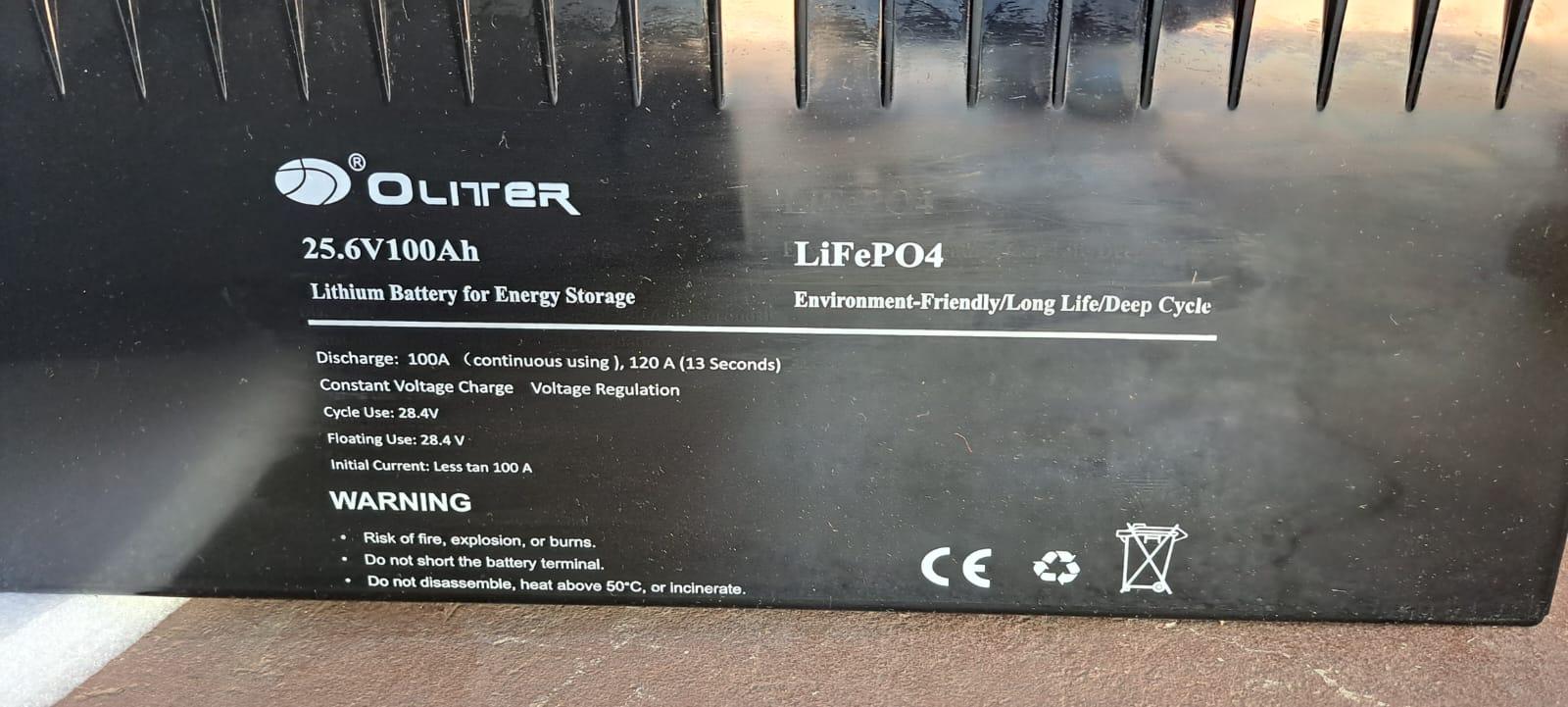
That's a very good point. I wish that I had a propper way of preventing it from being fully charged all the time, but maybe there is some hope. From what I could find on the net is that 24V (25.6V) Lithium batteries are made up of 8 cells. So at full charge it's 3.7V per cell or 29.6V for the entire batttery. My battery states that I should keep bulk and float charge from the inverter at 28,4V wich means that the battery is never completely full, but only at 90-95% state of charge. So if my inverter is feeding the battery only 28.4V it's not being fully charged? Another issue is that my battery isn't "smart", so it can't communicate with the inverter on what state of charge it is at. It has it's own built in BMS that I also have no control over. I can only assume that this is a "cheap" way of the battery manufaturer to ensure that if the battery doesn't get cycled enough it's not sitting at 100% charge all the time?
-
Wow! That's a lot of great info. Thank you very much for the great explanation. Just shows me how much I still need to learn. Like you mentioned. I do have a very modest system, but I'm SO impressed with how far it has taken me and if you take care of it how much it's actually capable of. Especially after I swopped out the Lead Acid batteries for a Lithium. Unfortunately I'm not sure whether the battery is 1C or not. I'll attach a picture of it. If you are able to tell me from the picture I'd really appreciate it. My knowledge is quite limited.

-
Mine is definitely not that quick. Maybe 10 seconds before it matches the the new load. Now that you mention it. I never thought of it. I've got setting 02 at 30A. Maybe that's why it never reaches 1000W. Also, the fuse for the PV is 30A (I popped the 20A that was in there before when I raised setting 02 from 20A to 30A without realising what I was doing) so I won't be able to go higher unless I swop them out for higher capacity ones.
-
Thanks for your reply. Mine also behaves exactly as you described, although I have never seen it get to 1000W. Max for me was 850W and around 28A from the PV. What I was trying to point out is that when the load on the inverter increases, it takes a couple of seconds for the inverter to raise the output from the PV to match the required load. When this happens whilst the battery is charging, I can see that less amps are going to the battery. My concern about battery life is when I'm running the inverter in battery mode and the battery is already fully charged, the PV might be taking care of the load at any given moment, but when the load suddenly goes up the PV can't adapt quick enough to match it and it starts using battery to make up the shortfall. When the PV eventually does match the load it immediately starts charging the battery irrespective of how much capacity was used. It's this constant charging and discharging of the battery that has me concerned that it might accelerate the ageing of the battery significantly.
-
Thank you very much for your feedback. I'm going to leave it in "battery mode" to see how much it affects my utility bill. If you don't mind sharing your thoughts as well on the following. I don't use all that much power at once. In my case it's either the dishwasher, microwave or the wife's hairdryer that uses the most power. I make sure not to use these at the same time, since neither the inverter or battery will be able to cope with more than any one of these loads at the same time. I've been doing al lot of reading regarding Lithium batteries and all the do's and don't. I know that Lithium batteries don't like a high discharge rate, the lower the better. During load shedding I avoid using anything that has a high power draw, but it often happens that we might have load shedding during 18:00-20:00 when my wife needs to use the microwave. (I obviously don't want to have my dinner cold so I'm not going to stop her from using the microwave. Hahaha!) It seems to use about 1500W according to the inverter, with the rest of the lights in the house and TV it ads up to about 1800-2100W or around 80-90A. Normally she would use the microwave for only 10min max to quickly warm something. Having such a high load on the battery isn't great, but if I keep it to short periods like 10 min or less shouldn't be a problem right?
-
1 hour ago, Coulomb said: I'm pretty sure that this has only a fairly small effect on battery life. Personally, I would not go to a utility first priority mode just to save that little bit of wear on the battery. The battery has a calendar life as well as a cycles life, so you may as well use it and save the cost of the utility power. Thank you very much for your feedback. I'm going to leave it in "battery mode" to see how much it affects my utility bill. If you don't mind sharing your thoughts as well on the following. I don't use all that much power at once. In my case it's either the dishwasher, microwave or the wife's hairdryer that uses the most power. I make sure not to use these at the same time, since neither the inverter or battery will be able to cope with more than any one of these loads at the same time. I've been doing al lot of reading regarding Lithium batteries and all the do's and don't. I know that Lithium batteries don't like a high discharge rate, the lower the better. During load shedding I avoid using anything that has a high power draw, but it often happens that we might have load shedding during 18:00-20:00 when my wife needs to use the microwave. (I obviously don't want to have my dinner cold so I'm not going to stop her from using the microwave. Hahaha!) It seems to use about 1500W according to the inverter, with the rest of the lights in the house and TV it ads up to about 1800-2100W or around 80-90A. Normally she would use the microwave for only 10min max to quickly warm something. Having such a high load on the battery isn't great, but if I keep it to short periods like 10 min or less shouldn't be a problem right?
-
Hi everyone. I have a 25.6V 110Ah LiFePO4 battery connected to a 3kW non-hybrid Axpert inverter. I've been exclusively using it in "line mode". (the inverter prioritises drawing power from the grid and resorts to solar and battery backup only when grid power is unavailable.) Recently, I decided to test the inverter in "battery mode". In this mode, the inverter is supposed to prioritise the solar panels and the battery to supply power, reverting to the grid only if the battery reaches a set voltage threshold or if no power is generated by the solar panels. In "battery mode" I've noticed that the inverter is constantly charging and discharging the battery. For instance, when the house's power consumption is at 300W, easily manageable by the solar panels alone, but as soon as the power draw increases, even if it's by just a couple of watts, the inverter indicates that the battery is discharging. Basically assisting the solar panels to supply power. I presume this occurs because the inverter cannot instantly match the load required, by only using the solar panels, leading it to utilise the battery to bridge the gap? Whilst the battery is "filling in" the extra load needed, the inverter slowly raises the output from the panels to match the new load and the moment it achieves that, it starts charging the battery again to replenish the little that it used. The process obviously keeps going back and forth as the load fluctuates from appliances that are being switched on and off during the course of the day I'm just curious how this would affect the life of the battery, by being constantly charged and discharged? Will it be better for this type of inverter to be left in "line mode", and only use it as backup instead? I'm just getting the idea that this is not really the optimal way to use this type of inverter. I guess the bottom line is that I'm trying to use it as a hybrid inverter which it's not.