


Koch903
Members
-
Joined
-
Last visited
-
Exactly what I’m getting - although still be useful to some extent. Geyserwise would be better - does anyone know of any other thermostats that are HA compatible? I just don’t need all the other Geyserwise components (control box etc)
-
 Jacques Ester reacted to a post in a topic:
New to Solar - Trying to decide how best to spec a system
Jacques Ester reacted to a post in a topic:
New to Solar - Trying to decide how best to spec a system
-
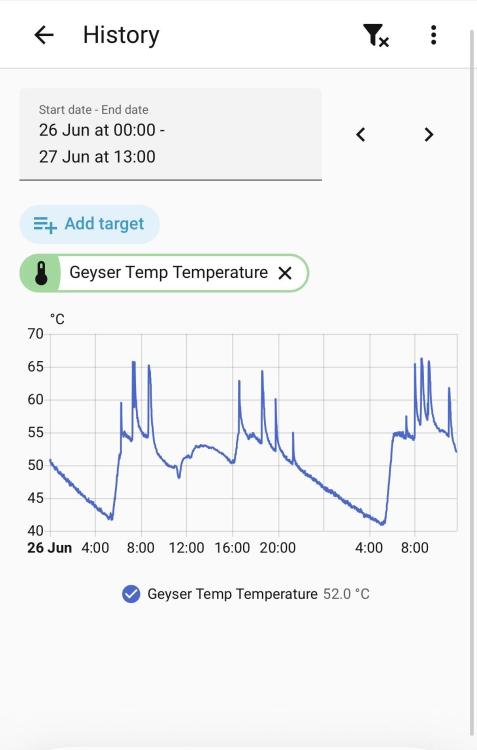
Finally all installed at the end of last week (to not much sun over the weekend). Everything has been running smoothly the past few days and service has been great from the installer - today he brought the team to move a panel as it was getting a shadow on it and not generating. I also installed Home Assistant and some smart switches on most lights, the pool and garage doors - the convenience is great. I also installed one Shelly with a temperature probe that it attached to the geyser outlet pipe - might consider a geyserwise to get a more accurate picture. Excited to start setting automations and optimizing, although I fear it’s a slippery sloop i have a spare temperature probe so if anyone has any ideas on how to get a more accurate sense of the geyser temp I am all ears!
-
-
I have made the choice to go with the Sungrow system - Installation will start after the public holiday next week, and I should be up and running at the end of that week. Now to start thinking if I incorporate Home Assistant and automations from the get-go - especially for the geyser.
-
Yes it’s the SH10RS and SBH batteries. a bit of research has shown me that I that the max discharge rate is 50 amps which given the high voltage would limit me to approx 7kw in off grid and no solar, similar as @Mattyboy put it the Dyness is limited to around 10kw in off grid mode given its discharge rates. I don’t think this is a limiting factor. I’m really leaning to the Sungrow based on the feedback
-
-
Thanks to everyone for the input so far. I have now received 9 quotes across 5 (what I believe to be) credible installers. I am trying to decide between the following two options: Sungrow 10kw system - Sungrow 10kw inverter (4 mppts), Sungrow 10kwh battery and 10 * 620w panels - R129 979.90 (with the option to add an extra 5kwh battery for R19 500) Sunsynk/Dyness system - Sunsynk 12kw inverter (3 mppts), Dyness 16kwh battery and 12*600w panels - R144 050.07 I am leaning towards the Sungrow system as it is (1) cheaper and (2) the battery/system is fully warrantied with 100% DoD - I am slightly worried that 10kwh battery is not enough, but the installer has also told me that the way the Sungrow system works, adding additional batteries is very simple in the future. On the other hand, the Sunsynk system does have slightly more inverter capacity, solar genetration and battery capacity, but I am not sure that is worth the additional ~10% in spend. Edit: The second thing I am considering is whether I convert to a prepaid meter before doing the install to limit connection costs, however I am confused about the rules, regulation and enforcement of this from the COJ.
-
Thanks for this, I do have an initial quote from Wimpie for 10 panels but I guess it may make sense to up the panel count if possible - a couple of questions If I go 12 - 14 panels, what would the strings look like 2x 5 string north and 1x 4 string east - would this be large enough or would I struggle on the start-up voltages? On 12 panels at say 600w panels I have a 7.2kw potential - would this not be too low to be effective if I went on the 2x15kwh batteries?
-
-
That makes sense - I do see the redundancy need for low/no production days and agree there is a balance to how much time we can survive on low to no generation but also balancing the budget. I was more talking to the idea of having 2 batteries in the system to build redundancy if one were to fail at least the system then would not be completely out of battery.
-
Thanks very helpful - This sounds like a good start and more or less in line with what I was thinking. I was just wondering if it is worth spending slightly more and getting 2x 10kwh batteries to build in some redundancy? Roof is north facing and no trees to cause shadows - Although I am not sure all panels would fit on the north roof so could put some on the east facing roof (I understand this would allow for earlier generation too). The other option is a flat section of roof on the north side that may be able to fit some panels. I also had an installer visit that is suggesting a high-voltage Sungrow system. He is suggesting that the high-voltage systems are more efficient and based on newer/better tech, for a minor premium. I am not sure of this and still need to do my research.
-
Thanks for the information and responses. I guess I need to weigh up the pro/cons of a 12kw inverter now for future flexibility or rather a second 8kw in parallel down the line. On the point of export to the grid - is this something we can do/viable in Joburg?
-
Posted a similar time to you and looking at a similar set up it seems - I guess I should be deciding between an 8kw and 12kw inverter now. I haven't had solar but I have had gas in my last 3 homes - one was fortunately municipal/building piped gas, the second was the set up you describe with a bottle outside and then I have also had the set up where the gas bottle is in a vented kitchen cupboard. All have worked really well, with no issues (save for the gas running out while cooking) and I actually prefer cooking on a gas hob than an electric.
-
Hi everyone, Longtime lurker, first-time poster. I’m based in Joburg and am starting to look seriously at installing a solar/battery backup system for our home. I’ve learned a huge amount from reading through this forum already, but I still have a few questions before pulling the trigger. The goal is to build as much energy independence as possible without completely blowing the budget. Ideally, I’d like to keep the total installed cost under around R150k if possible. We currently average somewhere between 15–20kWh per day, although that has only been monitored over roughly a month since we recently moved in, so I realise that may still change. I have been trying to monitor a bit more accurately with the Itron municipal panel installed and the max draw I have seen is just under 6kW(+- 5.8 - 5.9) At the moment I’m thinking along the following lines: 10–12kW inverter (currently considering Sunsynk or Deye) 15–20kWh battery capacity (not sure which battery brands are considered best value/reliability) 10–12 x ~600W panels (again, unsure on best brands/specs) A few technical questions: My understanding is that most inverter setups separate “essential” and “non-essential” loads. If something like a geyser is connected to the non-essential side, does that mean it can still use solar power during the day but will never draw from the batteries? Or is the non-essential side always purely grid powered? I often see people using batteries of identical sizes/capacities in parallel. Is there a technical reason for this? For example, is it a bad idea (or even possible) to combine something like a 15kWh battery with a 5kWh battery? Any general thoughts on the proposed setup above would be greatly appreciated, especially whether it seems appropriately sized for our usage and which products/brands you’d recommend. And lastly, not sure whether this is against forum rules, but if anyone has recommendations for reputable installers/providers servicing the northern suburbs of Joburg, I’d really appreciate it. Thanks in advance.
