Ismail
Members
-
Joined
-
Last visited
-
Hi there, Similar question to the above but my battery is smaller. Can I install 2 * MKSII 48v inverters on 1 * 4.8kw 100ah Narada Lithium Iron Battery? I would like to do this to increase the peak load capability of the system Regards
-
Hi Coulomb, I've managed to resolve the issue. It's a simple setting on the ICC software. The user selects "Back to Grid" percentage and "Back to Solar" percentage. This has nothing to do with the settings programmed on the inverter. The setting only works if you have the Narada communication cable that reads the actual battery SOC and not just the estimate in terms of the voltage
-
Thanks Coulomb. I will change accordingly. I will work continue looking for a solution and post once found
-
You are correct. Each time the battery goes to the 80% the utility takes over to feed the house and the battery is charged. My battery is set to charge at 40A, It seems like I don't really need to charge the battery this fast. Would reducing this current to 30A or 20A for example increase the life span of my battery? This will also result in a lower number of cycles because the battery will be charging for longer instead of continuously charging and discharging Thank you. I will investigate this further
-
As far as I understand it is according to the battery. There is an RS485 that is connected from the battery to the Raspberry Pi. Looking at the spec sheet attached, it shows that the discharge end voltage is 40.5V. Would this correspond to a fully depleted battery and does this mean that the Narada just runs at a much lower voltage? Sure, this todays graph. The 80% corresponds to 49.5V. Today was a gloomy day in JHB and we only got good sunshine in the afternoon 100% as it's on the manual and cover of the battery Thanks, I will try and find the local battery supplier find out if the battery is being charged properly. I do however think the battery is actually full since I have never run out of battery power and I use power liberally even if there is no grid feed for over 4 hours at night. 48NPFC100.pdf


-
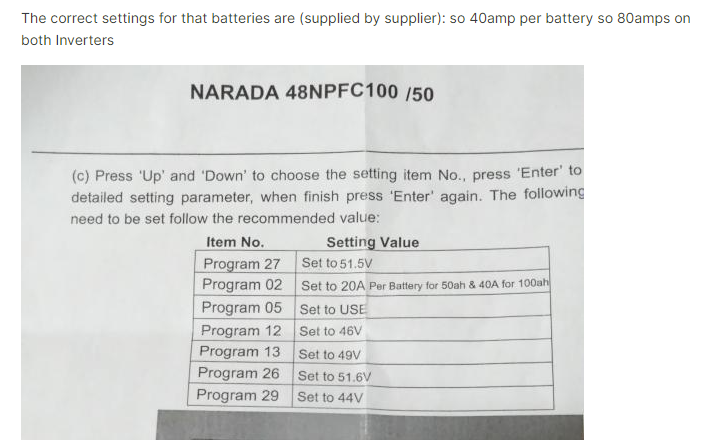
Hi all First post... here goes I have solar power system installed at my house for just over a year now and my issue is that I am not maximising my solar production since my battery almost never drops below 80% and is fully charged before 12am on most days (attached images refer). The system uses grid power to charge the battery once it goes below 80% Unfortunately my installer has passed away so I now need to change the setup myself and I'm hoping to get some assistance from the solar gurus on this forum. My system details are as follows 1 * Axpert Type MKII 5kVA 1 * Narada Lithium Iron 4.8kW 100ah battery 4 * 330W Polycrystalline Panels connected in 1 string 1 * Raspberry pi monitoring software My inverter settings are as follows 01, SBU [SBU Priority] 02, 40A [Maximum charging current] 03, APL [Appliances (Default)] 04, SDS [Power saving mode disabled (Default)] 05, USE [Battery type] 06, LTE [ Restart when overload - Enable] 07, LTD [Restart when over temperature- disable (Default) ] 09, 50Hz [Output frequency] 11, 40A [Maximum utility charging current] 12, 46 [Back to utility setting] 13, 49 [Back to battery mode setting] 16, SNU [Charger source priority - Solar and Utility] 18, BON [Alarm control - ON] 19, ESP [Auto return to default display screen] 20, LON [Backlight control] 22, AON [Beeps while primary source is interrupted] 23, BYE [Overload bypass- Enable] 25, FDS [Record fault code - Disable] 26, 51.6 [Bulk charging voltage] 27, 51.5 [Floating charging voltage] 29, 44 [Low DC cut-off voltage] 31, SBE [Solar Power Balance - Enable (Default)] 33, EDS [Battery equalization - Disable (Default)] 34, EV [Battery Equalization Voltage - 58.4 (Default)] 35, 35 [Battery Equalized Time - 60 (Default)] 36, 36 [Battery Equalized Timeout - 120 (Default)] 37, 37 [Equalization Interval - 30d (Default)] 39, AdS [Equalization activated immediately (Default)] These settings correspond to the Narada recommended settings which I also found on this forum (see attached image) I looked at a friends installation (done by the same installer) and the settings on his inverter are identical to mine but his batteries drop to 60% and this was setup by the installer remotely. What software do I need to do the changes remotely and what values will I need to change? Further, do my settings look fine? are there any changes that could be made on the inverter itself that will get me more solar power production?