Tinbum
Members
-
Joined
-
Last visited
Everything posted by Tinbum
-
That looks ok from a balancing point of view. (It looks like a Seplos BMS in them). If you are worried you could try using just the new batteries for a little while (for about the same length of time you used the old ones). That may equalize them a bit.
-
You shouldn't have to. In you last picture it's not surprising to see large differences in current as 2 and 3 are nearly full. In you first post I wouldn't expect to see such differences. Batteries 2 and 3 are certainly being worked harder. Can you post a photo of your wiring from the batteries to the inverter?
-
Any Li battery requires a balancer and a BMS. His battery has a balancer so cells should not be no more than mV apart as in ANY other battery. Cells in any battery should be matched. The reason for a manual balance is because either the cells are U/S or the balancer hasn't been able to supply enough current to keep the cells balanced. (eg undercharging or damaged cells).
-
Totally agree. If your not going to size it right then you need to set / limit the max current in the inverter, if you can.
-
No, sorry, it's you who are incorrect, look at the pylontech protocol. The protocol will send error codes for the inverter to react to. That's on top of the actual normal instructions that it sends to the inverter. eg. by limiting the currents. (0X351 bytes, 2,3,4,5) (That's if you have a decent inverter. I am using inverters that are over 12 years old that have no problem with Pylontech batteries. That's because they were designed properly and are a quality inverter). It blatantly obvious that the inverts in this thread can't control the voltage correctly and that's not Pylontechs problem. They say the inverter should be approved and their is a reason for that.
-
Thats what I'd do, but parallel all of them together.
-
Really, i don't think so at all. They should only be mV different.
-
Yes the BMS is supposed to protect the battery but it seems with these inverters the inverters don't control the voltage correctly and the battery BMS is unable to turn the inverter off. Most people have no problems at all but it seems people with this inverter do. I think that says it all.
-
I'd change the inverter!!
-
I'm not saying that, It's just a carry over from lead acid and as such is still used but it really isn't applicable to LiPo. That's why Pylontech dont give values for them.
-
Float bulk and equalise are really terms used for lead acid and are really not applicable to lipo. I'd worry if my inverter wanted those settings.
-
They have been posted in another thread and show overvoltage.
-
Can you post the log files? Can you post the log files?
-
However you do it you still need the longer cables. They are just standard network cables. Straight through. Pretty sure one of the long ones in the Pylontech cable kit will work. If you looked at the short cables supplied for that 0 - 1 link you can see from them what they are.
-
You don't set it up like that. You don't have 3 master batteries you only have one. You have one cable from the master battery to the inverter using the CAN port. Then all the other batteries are linked using the LINK 0 and LINK 1 ports. The master battery is the battery that has LINK 0 port empty. That is the way for up to 16 batteries, after that you then do as you say. (The only exception would be if you are also using some none C type batteries and you have more than 7 of them).
-
I think this just shows how lucky you have been and how good Pylontech have been to issue you a refund on your damaged batteries. Their warranty says that you must use an approved inverter and I'm pretty certain all their approved inverters require communication between the battery and the inverter. I would certainly set your inverter to lower than 53.2v as that setting on your inverter has taken the batteries over voltage. In a document that I have previously attached to a post Pylon actually say 52.5 to 53.2v. I'd go with the lower. Remember that without the communication you are relying on the inverter measured voltage which seems inaccurate on your inverter. I can't recommend any in between BMS as I've never looked into it. So I'd go with the above recommendation or personally I'd swap for a better inverter and sell that one.
-
It won't, it looks as if the BMS is faulty.
-
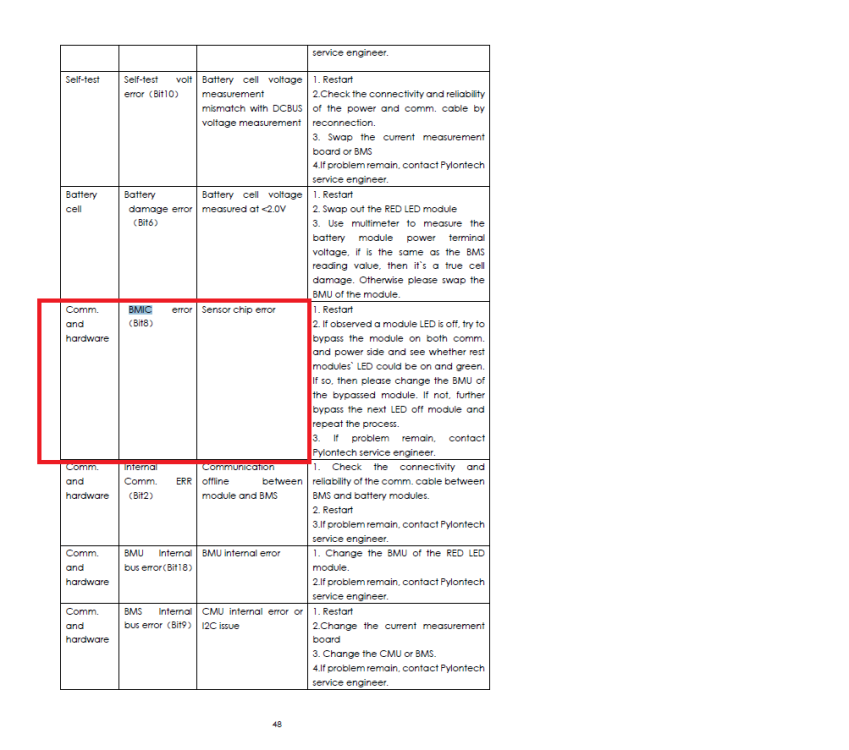
I'm not sure what it means but looking at the cell voltages you have a very wide variation 3.329 - 3.237v and at an overall voltage of 49.023v. They really should all be nearly the same. It's only at higher voltages, near 90- 100% SOC, that they will show differences, but even then, only of something in the region of 0.030v. Have you been charging to 100% SOC regularly? Can you download the log files and post? BMIC- Battery Management IC EDIT just found this in another Pylotech manual that may give a hint.
-
I dont know that one. Pylontech do the Force range which is HV.
-
No and you shouldn't do it. Buy HV batteries that are right for the job.

-
It will be either CAN or RS485 even though the port will do RS232. (Pylontech won't do RS232 inverter communication). (From what I've read before I don't think all those inverters will do CAN even though it's mentioned in the manual. If you do a search on here you may get an idea). As to float voltage, do a search on here to see what people recommend. (I don't have any manual settings on my inverter, it's all done by the battery communication).
-
Balancing can actually start at 50.4v when their is 30mv difference. I got shouted down for saying 53.2v was too high. I agree with you!
-
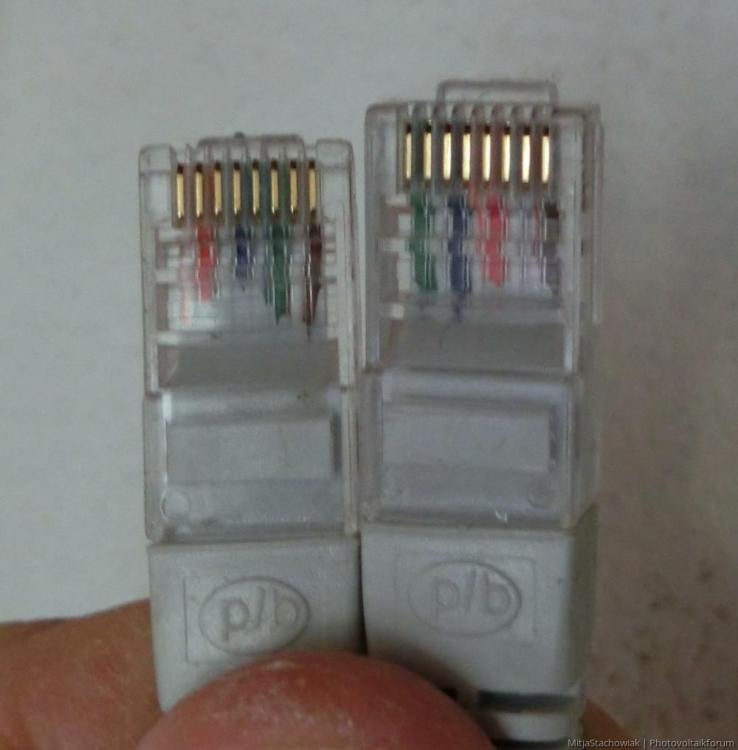
Are you using the batteries as a single pack? I presume you have a master inverter and a slave inverter connected with an interconnecting communication cable. I don't know your inverter but looking at the manual it seems to use RS485 communication to the battery. If your using the US3000C as a master (which you should be) then your communication cable is wrong judging from a picture I found online for that cable. See attached. Have a look in the manual for the US3000C battery for the battery cable end. (pins 1 to 3 should not have any connections on them!).
-
I also looked in great detail at your data logs and I really think you need to look at how your system is set up for what ever batteries you next use and the ones you still have.. I think you have been very very lucky. (I'm sure I asked for the logs for the time before the ones you supplied).
-
It should be figure 2. It's to do with the cable lengths to each individual battery from the inverter. This way they are all the same so batteries should charge and discharge more evenly.