Scra
Members
-
Joined
-
Last visited
-
No, the old geyser is still there What we did was : they installed a non-return valve on the hot water out of the elec.geyser - so that the hot water from the gas geyser cant go into the elec.geyser the cold in to the geyser is closed with a valve. and the power shut down to the old geyser. so basically the electric geyser is still usable when something had to go wrong with the gas, all i need to do is close the water inlet to the gas geyser, open the valve to the elec geyser and switch it on at the DB and then i can use the old geyser if i need to. I dont think you will be able to run both in the same time, its not a bad idea, but i think you will burn gas for no reason, the water heats up in about 15-30 seconds max, and its a fairly constant flow of hot water,
-
-
Had my Gas geyser installed today Went with the 20L Fan Forced Outdoor Room Sealed unit from Dewhot. SKU OD20DH Unit cost : R 13000 Gas piping and installation: R3100 (with COC) Plumbing materials and installation : R2200 2 x 19L Gas bottles R1900 including the deposit : R1900 The unit is using 220v AC - So the solar backup system is going to take care of power to the unit Fun Fact: I connected a AC power meter to my old geyser circuit the last few days just to verify the power needed to keep the 200L geyser with warm water I left it over a period of 3 days to get some level of consistency of power over a 24h period. considering the load shedding schedules etc. This was important for me to know what I ACTUALY use from Eskom to power my geyser before they disconnect it. Consumption Electricity : Sun: 19.9Kw pd Mon: 20.1kw pd Tue: 18.7kw pd Think about the numbers +/- 20Kw per day - 600Kw less to pay towards electricity bill My unit rate is around R2.00 per KW - this is R14,400 per year. Sure, I will spend money on Gas, but less dependency on a single point of failure. I can highly recommend my installer - ping me if you need details Will post some pictures in the next week.
-
Hi, (Audience) Please check my numbers if I'm correct in this - maybe this will answer my question and Mohammed_riaz A. The inverter and Battery manuals should be read together to get to the correct charge, discharge, capacity settings for the Deye/SunSync inverters For my Deye 5Kw - the inverter spec from the manual is 120A max charge / discharge - so that is the max I can ever set it even if I had 10 batteries (120A is the top) For the US3000C - the battery recommended charge /discharge is 37A each 1 x Battery your max charge / discharge rate is 37A 2 x Battery your max charge / discharge rate is 74A 3 x Battery your max charge / discharge rate is 111A 4 x Battery your max charge / discharge rate is 120A < max cap from the inverter > 5 x Battery your max charge / discharge rate is 120A 6 x Battery your max charge / discharge rate is 120A (picture for reference only) Battery Capacity in the settings [Batt Capacity] The US3000C has 3552 Wh Nominal Capacity The Voltage is 48V Ah rating is [3552 divide by 48 = 74Ah per single battery 1 x Battery your Capacity is 74 Ah 2 x Battery your Capacity is 148Ah 3 x Battery your Capacity is 222Ah 4 x Battery your Capacity is 296 Ah 5 x Battery your Capacity is 370 Ah 6 x Battery your Capacity is 444 Ah ___ from the next section this is where you specify the max GENERATOR and GRID charging current this is more about the current it will draw from the gen and grid - nothing to do with the battery settings in a parallel setup of the battery bank itself so no matter how many batteries you have the gen / grid in this page is capped to 40A (picture for reference only) Hope this is correct and if it is i hope it make sense...


-
AC on Backup side N + E = 0.4 V when no load from the Grid
-
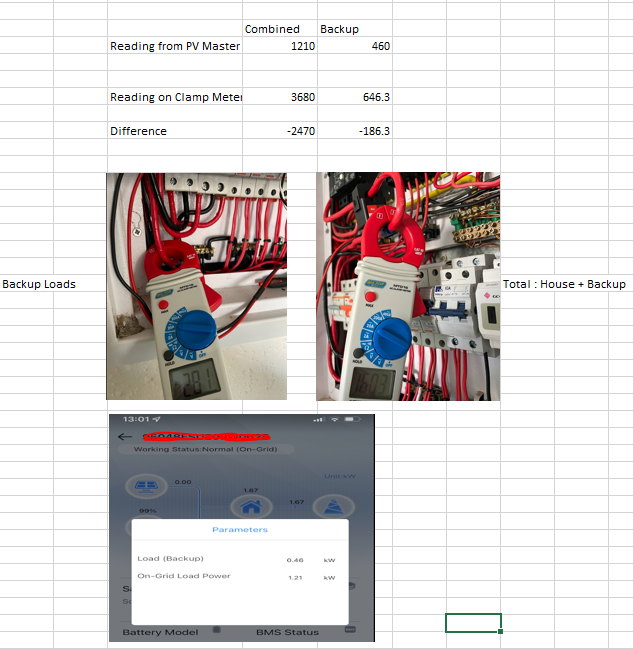
My experience recently and still ongoing : - Replaced 4 x 16VAC 50VA Alarm Transformers (R350. per pop) excuse the pun - Replaced 1 x Electric Fence AC Transformer - (R750.) - Replaced 1 x Battery charger board inside my gate motor. (R600) - Installer call out (R500) since he is a friend of the family I suspect the EZ meter is the guilty party here, but we will know once i receive the replacement meter to confirm and compare to my current meter Long story short, Meter reports lower current than actually on the circuits, once you start adding higher loads - kettle, oven, geyser, then the meter shoots up to where its not able to support those loads, but in reality the load have long passed the actual currents - in general i could see about 2.5-2.8Kw under reported by the Meter. More on this in a few days when i can give actual confirmation Hope this helps someone to investigate if you have similar experience