Carl
Members
-
Joined
-
Last visited
Everything posted by Carl
-
About 57 500 City of Cape Town Customers to Potentially lose Lifeline Tariff: The new proposed tariff for 2016/2017 states that as of "1 October 2016 all Lifeline customers with municipal property evaluations of R1 million or more be migrated to the Domestic Tariff." The good news is that the money recovered from the above (about R72 million) will allow the tariff increase for residential customers to be reduced to 6.62% across all blocks on both Residential tariffs. I am going to miss those 60 free units and R1.04 / kwh.
-
Our house has a more diverse product range, General Motors (very old) and Ardo fridge, bosch washing machine, AEG dishwasher, Smeg stove, Dell PC Screen, Panasonic projector, Samsung & iPhone.
-
Would most grid tied systems not pick up this situation with active impedance monitoring? Inject a current and measure the resultant change in grid voltage.
-
Yesterday I checked my energy harvesting from my solar PV system and solar thermal system and found the following: Cape Town (Southern Suburbs) - 11/05/2016 System Solar PV Solar Thermal Energy Produced 7.8 Kwh 4.4 Kwh Array / Collector Area 10m2 3m2 Approx. Costs to Install Today R120 000 R20 000 Specs 1.8 Kwatt Array, Outback MX 60, 48 Volt Battery, MLT 6 Kwatt Inverter Energy produced at the 48 V DC level. So inverter and battery losses not considered. 200L Solar Geyser, 3m2 Collector - Thermosyphon System raised 200L of water from 36 – 55 ◦C (∆T = 19◦C) Q = (mCP∆T) CP = Heat Capacity of water = 1.16 kWh/m3K
-
OK, so i am pretty confused with your setup. Do you have a pre-feed system with the cold tank supplying the hot tank and the ET collector and heat pump sitting between them?
-
@jdp I am almost certain that the hot outlet from the heat pump goes to the top of the geyser. The retrofit kit normally consists of a Banjo valve that creates an extra hot water connection point at your TP valve. The extra cold water connection is normally just created with a T piece at the cold inlet to the geyser. ITS use a "Loading Valve" that's preset at about 48 0C on the hot water output of the heat pump.
-
 Yip
Yip -
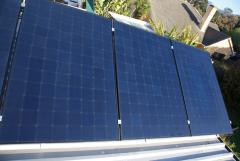
 Thanks Jay, they are 300 Watt Sunpower modules. (E18 Series)
 -
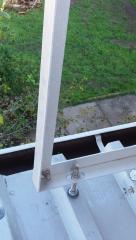
Bypass Box Drawing
-
From the album: Carl Solar
-
From the album: Carl Solar
-
From the album: Carl Solar
-

From the album: Carl Solar
-
-
-
-

From the album: Carl Solar
-
Based on my experience and for my personal situation a solar collector plus electricity backup will beat the heat pump scenario hands down. Last year our total water heating bill was R43, (42 Kwh at R1,03 / unit) so it would be hard to justify spending R17 000 on a heatpump. For households or guest houses that need hot water 24/7 i am sure a heatpump will make more sense.
-
@Kloon forgot to mention that Sunscan , ITS solar & SolarJoy seem like very good solar thermal companies and they are all located in Cape Town.
-
@DeepBass9 i was wondering if it really does do no harm? Every time your geyser boils it puts your system under undue thermal stress and the question for me is how long will it last?
-
Hey TTT you were meant to look at the sunset and not those sheets. Am dreading replacement day. Have tried some rust converter products and also a special metal paint but no luck. Green Bum suggested NS4 so that's my next attempt. Any suggestions?
-
Hi Kloon, i have a suntank solar system that was installed as part of the Eskom Pilot project, before the rebate scheme was introduced, and can make the following comments: 1) The suntank system (right hand side of pic) has given me 8 years service so far at a system pressure of 400 kPa. 2) As the tank inner is made out of stainless steel, it has a sacrificial anode that has to be periodically replaced depending on your water quality in your area. (I replace mine every 3 years.) This entails isolating and partially draining the geyser. A new anode costs about R180. 3) The insulation on the tank is good. 4) The collector panels are quite flimsy and starting to show signs of corrosion on some of the copper pipework. If i was starting over i would probably go for a maintenance free geyser such as Tecron (full copper geyser), Solartherm (PEX lining) or maybe Xstream. (a friend of mines Xstream lasted just over 5 years so not convinced about there longevity) On the collector side i would look at the locally made Solarmax. (Have heard some good reports) Anyway these are just me opinions and would like to hear what other members suggest.

-
Spot on @Janma the efficiency is dominated by the radiation losses for both types of collectors. See below for a comparison of collectors and how they compare in efficiency. (Picture copied from Soltrain Training Manual) As expected the Evacuated Tube Collector performs very well and outperforms even a selective coated flat plate collector in most applications. But if you look a bit closer you will notice that for domestic hot water systems we are more interested in the left hand side of this graph where their isn't a huge difference between a vacuum tube and good selective coated flat panel. The fact that the flat plate collector gets less efficient the hotter it gets means that it naturally cools itself down as it heats up and therefore reduces the chances of overheating. In my opinion, for our Climate in South Africa, a simple flat plate panel that is painted black is good enough. It is cheap, will not overheat, and will do the job for most of the year.

-
Yip, but the TP valve is designed for emergencies and does not always seal properly after operation.
-
I think this picture shows what Chris was referring to. If you install a NRV valve on the cold supply side then it must be installed before the PRV (pressure control valve in pic below) and not after. On the geyser heating cycle the water expands and builds up pressure. The PRV controls this pressure by releasing some water (usually drips) through it's relief valve. So if you install the NRV after the PRV you will inhibit the valve from regulating the pressure in your geyser and associated pipework.