


Arzy
Members
-
Joined
-
Last visited
-
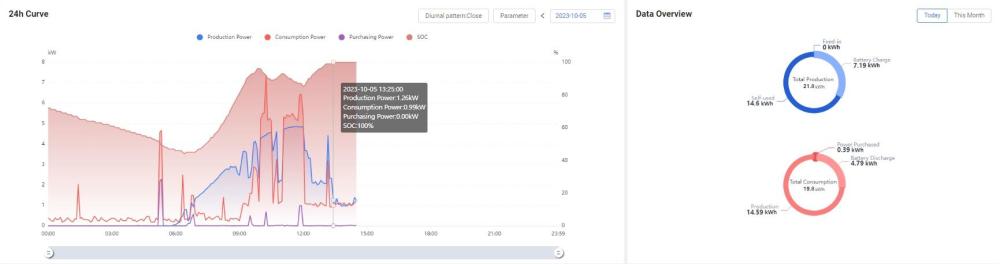
Per title my question is rather simple, will it benefit me to add another battery? I'm currently running Deye 12kW 3-phase Inverter, 6.37kW in PV and 2x Dyness 5.12kWh batteries. PV is unfortunately East/West facing with no opportunity to do any north. Per my screenshots below I've improved at managing my usage and have my geysers down to basically an hour each in actual run time per 24 hours. Currently my time of use lets the house run on battery from 8pm to 4am and discharge is set for 100% to 40% during that time. When the morning geyser kicks in it uses whatever is left. The idea of adding an extra battery would essentially be to expand the above period to possibly go from 6pm to 5am as, generally, we don't have anything big that draws power in that period. I'm unsure if this would improve my parabola though Despite running the swimming pool and both geysers now during the morning I get back to 100% charge by 14:00.

-
First of thanks for all the feedback and suggestions, given me way more to think about than I had anticipated. Short term option seems to be to push the geysers a bit during the day potentially upping the temp to 60 and letting the tubes carry on from there. Will have to see if this possibly caters for the morning. Connecting the geysers to each other may prove a tad more difficult as they are at opposite ends of the house in separate roof spaces. And then possibly look at either a technical solution with capacitors or just drop the elements down to 2kW
-
So our house currently has 2 200l (could be 150's) geysers with 3kW elements that are coupled to evacuated tubes on the roof and managed with the basic GeyserWise controllers. The temperature on both is set to 55c with timing done so that they don't run at the same time. Generally, they don't need to switch on in the late afternoon/early evening as they have reached the desired temperature which covers bathing the children etc. I have set the main bathroom geyser to run in the early morning to get ready for work etc. while the second geyser "tops up" between 8 and 9 so that there is hot water for cleaning. As of last week we now finally (also) have our own solar system installed consisting of a 12kW Deye 3-phase hybrid inverter, 10.4 kWh in batteries, and 6ish kW in panels. With that bit of background done, I am looking for advice on what to do about the geysers. As I am not around during the day I'm slightly concerned about drawing too much power at any given stage but I believe I've mitigated this by staggering the operating times of the geysers and setting a reasonable target temperature. On the flip side, I would also like to utilize my PV production more efficiently. For instance, my household consumption is currently only 364W all fed from the PV so there is surplus generating capacity available. This is low though as I switched the pool pump off this morning due to my concern above and the gardener being at the house today and I can't anticipate when he mows the lawn (electric lawnmower). I'm thus planning on replacing the 3kW geyser elements so that I can, safely, run them for longer periods during the day but have no idea what I should be stepping down to. Would really appreciate some input and wisdom on what to do considering the overall setup. The key times when hot water is an absolute requirement are around 19:00 at night and from 6:00 in the morning.
-
Right, so a few weeks ago I had a question about running a pool pump and heater on a solar setup and the advice received gave me a lot to ponder in terms of what I actually need. As it stands we’ll be moving into our new house come February next year and one of the first big ticket items I’ll need to do is some form of “beat load-shedding” setup as our new house does not have backup power. I’ve checked our power usage at our existing house which comes in at just over R3,000 per month or 35Kwh per day. At the current house I have a borehole, pressure pump, 2 pool pumps (only 1 runs daily), a heat pump (only switch it on selectively) and 2 geysers (one of which is solar). Stove is gas and oven electric along with the standard range of appliances: 1 Fridge, 1 Freezer, 1 chest freezer, microwave and kettle. All lights in the house have been replaced with LED inside and out. For backup power we could comfortably run the house off a 6Kw generator provided we switched the geysers off at the DB, even running the kettle when my wife wasn’t blow drying her hair. My estimation is that our usage in terms of units in the new house will be similar or slightly less than the current place. This will be measured though before committing to an installation. The differences being: No borehole and both geysers are already solar and could actually be switched to piped gas. I need to go and recheck the lighting in the new place but, should it not already be so, I’ll switch everything to LED. My main focus is to have backup power with the OPTION of adding panels someday. The area we’ll be staying in has Eskom direct supply so the tariff reduction in comparison to Ekurhuleni or City of Johannesburg has an impact on the payback period you’d normally expect. I accept that my DB would have to be split between essential and non-essential, non-essential basically being the geysers, stove, pool pump and aircons. I’d like to be in a position though where everything other than those items could be run with just a bit of common sense ie. don’t use the blow dryer, kettle and microwave at the same time. If you use them individually though it should be fine. All that being said I’m basically preparing myself to purchase: 1x 8kW Hybrid Inverter (Would appreciate suggestions on brands) 2 or 3 Lithium-ion Batteries providing 10-15kWh of storage which I hope will cover me for 4-6 hours of load shedding. (Suggestions on brands welcome again) My expectation is that this should cost between R100-R150k installed depending on how many batteries I go with. So, am I thinking in the right direction? Would appreciate input on if I have overspecced or underspecced based on my current usage. Is my expectation on what this may cost our of line? Should I possibly be adding some solar from the get go?
-
Saw a pool blanket on viewing the property so that's there at least. Will definitely be doing a basic installation for the house should we be successful in getting it and have a feel for the power consumption. No intention of going off grid at this stage but will really like to be able to get through load shedding at least. Guessing a range of 5-9kw heat pump will be fine in terms of size. Yes, in SA
-
Good day forumites! We're in the process of selling our house, just accepted an offer, and the house we are interested in buying doesn't have a solar installation. I'll eventually get advice here on doing a solar installation when we move in. The area has piped gas and the current owner has replaced the geysers with solar geysers, stove is run off gas but oven is electric. I have no idea what the electric consumption looks like. My first question though relates to the pool. I've seen a number of adds for solar powered pool pumps. Has anyone tried these yet? Apart from the pump we also can't stand a cold pool. Our current pool has an inverter heat pump as well as those black solar heating panels. Does anyone know if you can run a heat pump on solar power? Ideally I'd like to be able to run both the pool and heat pump independently from whatever system I end up going for for the house. My feeling though is that this is a bit of a pipe dream considering how much power the heat pump would require.

