JohannFer
Members
-
Joined
-
Last visited
Everything posted by JohannFer
-
Going to the 10kVa Kodak inverter will allow me to move more non-essential loads to the essential load side, therefore, utilizing the power from the solar system more effectively. This is basically the same as the Sunsynk inverter providing extra available power via the supply line. The load between the two DB's will change during the day but the total load should not exceed 40A. Another question is whether there should be an inverter isolator switch before a change-over switch in the DB as the change-over switch also isolates the inverter.
-
The problem is space to fit 2 units. The available wall width is 110cm. A Luxpower is 38 cm and the space between the should be 20cm.
-
I'm busy installing a permanent system and originally planned to install 5kVa Synsynk as it allows excess power from the solar panels to be fed back to non-essential loads. My DB is about 20 meters from the installation position and the CT lead needs to be extended. The inverter will feed two split DBs via 6mm wire capable of 40A each, which allows for enough power to be distributed. I spoke to an installer who recommends, for more or less the same price, rather installing a 10kVa Kodak inverter and adding some of the non-essential loads to the essential loads as more power will be available. I then spoke to a supplier who recommended I rather install two 5Kva Luxpower inverters. Are there any suggestions on what to do? I was also recommended not to go for Pylontech batteries. I don't want to feed power back into the grid which the Synsynk will allow.
-
The surge protection before the inverter is to protect the inverter. Yes, you can put in a DC circuit breaker but a fuze, if ever required to pop, is much faster. Yes, you run a ground wire from the output or the earth leakage wll not work.
-
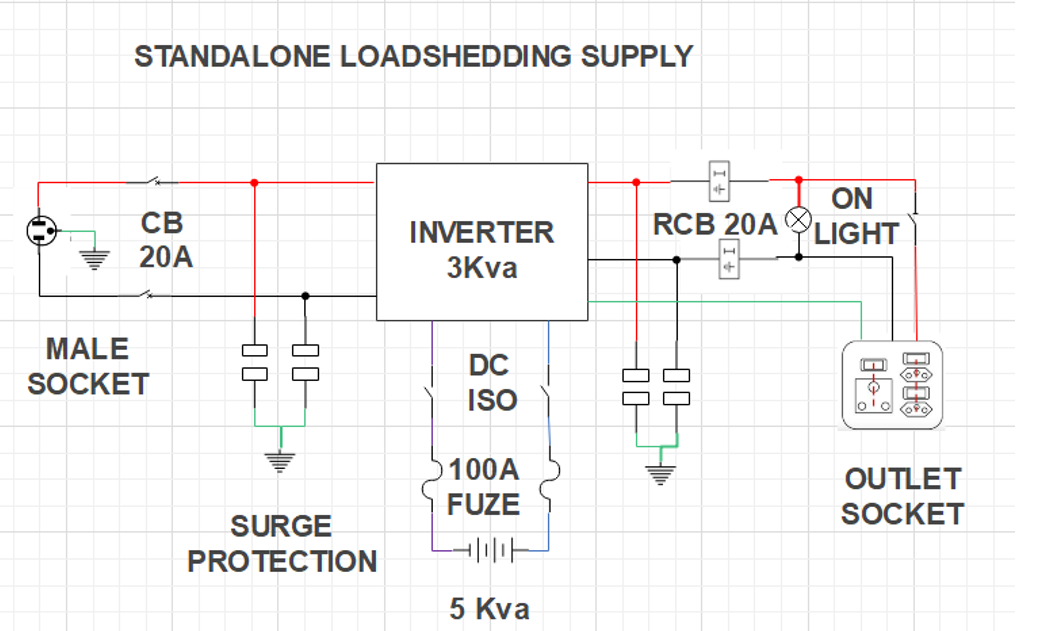
Proposed installation for stand-alone system. Don't connect the input earth to the input to the inverter but add an RCB on the output for protection

-
My proposed schematic for stand-alone system. To prevent the RCB from tripping in the DB box don't connect the ground to the inverter input but add an RCB on the output side for protection.

-
As it is a temporary installation and the inverter is plugged into an outlet socket, I removed the ground from the input to the inverter, With the permanent installation the supply to the inverter will be taken before the earth leakage in the DB and a new earth leakage will added be on the output side of the inverter.
-
I have removed the earth from the supply side and now it is not tripping the earth leakage. I know this is not safe but are adding an earth leakage to the outgoing side of the inverter. The system can now be used as a standalone system, like a generator, without changing the DB. The endurance and capacity are more than a UPS and this might be a solution for people renting apartments where generators can't be used.
-
It runs from the battery. I have set 10 (Operating logic) to "ON" Line Mode and 23(bypass function) to byF to prevent it from operating in bypass/ECO mode. The moment I plug the inverter into a the Eskom supply socket it trips the earth leakage.
-
I have installed the inverter, in the Cape, by providing the feed to the inverter before the Earth Leakage on the DB and everything worked. I moved the inverter to Pretoria and added a 15A plug to the supply side to use it as a temporary backup system until the wiring can be changed. When I switch the inverter on, it starts but after a period it trips the earth leakage on the main DB. No load is attached to the inverter and the battery is also disabled. Somewhere I saw a diagram that the inverter supply is always taken before the earth leakage on the DB.
-
Thanks
-
Thanks for your support. Everything is working and I don't notice any changes in the Eskom supply. Still can't understand why the flashing Battery Icon, which indicates the system is working correctly, is nowhere referenced in the inverter documentation or on the internet.
-
With PYL selected in program 5 the maximum charging current in program 2 is fixed at 10A and cannot be changed to 30A as proposed on the Pylontech data sheet. Is this normal,
-
I spoke to other Axpert users who told me their battery Icon is stable. The reason why I asked the question is that I could not find any information on the flashing LCD battery icon in the user manual or on the internet. Thank you for your response and I will respect my friend. Johann.
-
If I select Pylontech in Program 5 as the batery, the battery icon on the LCD flashes in line and battery mode. If 1 select user defined battery and add the following parameters (05) User select, (02) 30A (12) 48V (13)51V (26) 53,5 (27) 53,2 (29) 45 When this selection the battery icon is stable but the lCD charge indicator shows the battery is 78% and charging but the Pylontech US3000C shows it is fully charged. What am I doing wrong.