


tigger_na
Members
-
Joined
-
Last visited
-
-
-
-
-
-
-
Exactly. How many users invest in a third-party monitoring system to really be informed what's going on with their investment? Most will only know of their battery when it stops working, by which time it's way too late. Why don't these BMSSes have a default factory-activated *audible* alarm when the relevant limits like OC. OT, UV etc are exceeded? Reminds me of the missing temperature warning light in generations of older cars. EnerSol has been in touch. We're going to do firmware and calibration things. In the meantime, for until I can get a proper solution, diconnecting inverter to battery comms was the right choice:

-
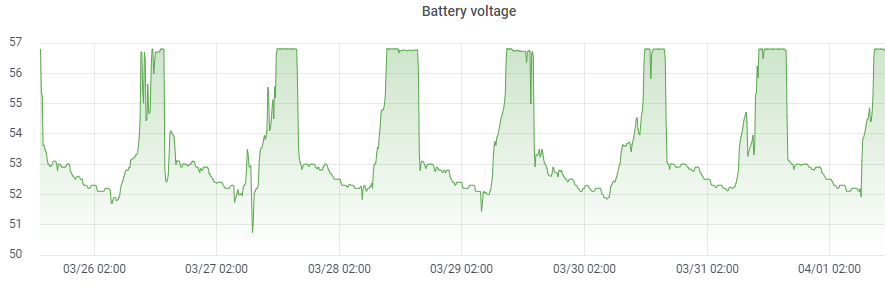
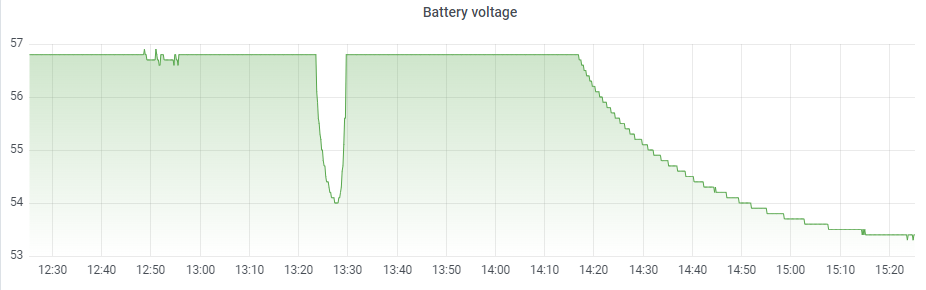
I can't say. I do remember that the bulk charging voltage for the Akkutech battery was higher than I liked, but not sufficiently high to terrify me as this does. As you can see, my bulk charging voltage remains from when it's being reached until the sun disappears. It looks like the BMS is programmed to keep the voltage in the stratosphere until it is starved by the inverter. Why this is is beyond me.
-
It is a warranty replacement from my supplier, who gave me a EnerSol instead of the Akkutech I fried, or which fried itself, depending on how you look at it. The BMS does indeed report that the SOC is at 100%, so this shouldn't be happening. I can't return the battery now, since, yeah. And it doesn't really matter what I ask, these's only silence from EnerSol.
-
Not without opening the battery case and destroying the guarantee all over again. I think the battery specs of 55°C max temperature are just something to get you worried about the whole setup going up in flames, not the lieftime of the battery being cut much shorter than it has to be. My temperature problem is sorted. We've had some cooler weather lately, but even before that I saw mcuh better values, after I installed my 7 fans. The issue now is a super-high bulk charging voltage, and, if I look at the readings, I have to wonder where the float voltage is in all of this. That nice voltage drop at the end is where I disconnected comms between inverter and battery. Let's see where this goes.
-
Hang on, you have to see this in pespective. The batterioes are getting warm because the BMS isn't correctly programmed. With no way to program the BMS, and with inverter control either on or off (as in BMS communicating and overwriting inverter settings, or not), disconnecting the BMS is the only and cheapest short-term solution. I cannot see how the battery will be destroyed, as the BMS is still there to protect it, albeit with limited control? Now, should EnerSol remain mute, and once you start getting on my bad side, I'm normally able to get the dead to speak, so there's little chance of that, I will consider swapping the BMS. A technical question: The existing BMS has two largish heat sinks. The JK BMS recommended by @TaliaB is a closed box. Where are the heat sinks? And without heat sinks, I ASSume that the original BMS does something that the JK BMS does not? A big shoutout to this forum. It reminds me of a time long gone, before the world moved onto Facebook, where the Internet used to educate, which enabled dimwits like me to develop and deploy knowledge we wouldn't have normally had.
-
-
-
-
Thank you, Scorp007! So, if I want to charge to 100%, but allow the batteries to keep at 95%, going down to 30%, I would need: Bulk charge: 56.8V Float charge: 54V Disconnect: 51.5V and monitor and adjust as needed?
-
See, There it is, the obvious expertise. Considering the answers on the forum, the fact that the guarantee is destroyed anyway, and the fact that the charging algorythm is obviously wrong, I will disconnect the communication between the BMS and the inverter. I have my Solar Assistant, so I can monitor and see whether I'm making the wrong choice or have the wrong settings. I can see one problem though, the inverter will disconnect when my battery is at less than 30%SOC, but without the inverter knowing the SOC, I will need on the BMS to disconnect, but that will probably be at a much lower SOC than I prefer. What voltages do you recommend I program the inverter for?
-
-
-
Thank you, that is a suggestion I never even considered. I have reservations though, I cannot imagine that a third-party BMS will regulate my battery as well as a manufacturer-designed and supplied BMS. The same goes for the inverter, which will cetainly not. But both together? Maybe. Then again, this "manufacturer designed and supplied" BMS is obviously programmed wrong, so if they missed that, what else did they miss? As to the manufacturer's guarantee, I doubt that they will honour that, ever, as my battery casing now looks like swiss cheese. Know that little sticker "warranty void if opened"? I scraped it off as good as I could, but the idea is still there. Now, if I come to them with a warranty claim with a third-party BMS, they won't only not honour the warranty, they may actually shoot me on the spot. I would, a customer like that.
-
I accept your obvious expertise and thank you for it, I'm just offering three use cases where a lower maximum SOC is backed and even required by the manufacturer: • My Samsung phone has a setting for limiting max SOC to 85% in favour of increased longevity. • The manufacturer of my drone guarantees their batteries for 400 cycles, if and only if they werent stored at 90%+ SOC for a cumulative total of more than x days. • The manufacturer of my electric pruning shears has a special storage charging procedure, and they will also not entertain guarantee claims if the battery has not been stored at that specific SOC.
-
-
-
Thank you Beat, I think exactly the same. My current draw spikes happened when my concentration slipped, so I can easily avoid those, but those charging currents are too high for my liking. Sadly, until now at least, I have no way of limiting either charge current or absorption voltage, as anything I program into my Kodak inverter is promptly overwritten by the BMS. Sadly, EnerSOL isn't too keen on answering my queries, but we live in (unsubstantiated) hope.
-
I divided the battery case with a plastic sheet, ventilated the front part, where the PCB is housed, with a filtered air supply, and the back, where the batteries are housed, with a recirculating 120W Peltier cooler. Then I installed a ventilation fan to the whole solar equipment alcove. Problem solved. The ventilation fan for the alcove had the most effect, the Peltier system comes last in effect. In the graph below, the system came online on the 19th of March. Before, peaks of 38°C where commonplace, I now have those down to 33°C. As to the charging or discharging behaviour, it mostly stays below 40A. I do not like that high absorption voltage (58.6V) and the long periods it is kept there. I've asked my supplier whether I can adjust the Enersol Lithium 48 – 100 BMS to charge to 95% SOC instead of a 100%. No answer yet...


-
I'm here to learn. The BMS of the Akkutech is not user configurable, so if it was indeed subjected to high charge or discharge currents, then it was the BMS that fried the battery, no? It was connected to a Kodak inverter, battery type wat selected as Lib, so I just let the BMS do what it's supposed to do.
-
Thanks PsyCLown. The supplier boasts that their batteries are developed for African conditions, something I find hard to believe, looking at how little effort is done with cooling. No, we don't get 45°C. Yet. 38 is just about the maximum, and that usually hits in the afternoon, after the battery is fully charged. I'm surprised that you say that ventilating your garage helped. Well, if your battery case has ventilation holes, it would, rather, this proves that having a ventilated case does help. What I plan to do now is to divide the battery case, force ventilate the front part where the PCB is housed, and cool the rear of the case with Peltier plates, and, if I can, limit the charging current. My thinking, less power pumped into the batteries will mean less heating, but over a longer period of time. If it works, then a better control solution than a thermostat will have to be designed. Peltiers are inefficient under the wrong conditions, so they're not something that should run at night, and constantly ventilating the PCB is not the brightest of ideas in freezing conditions either. I'll keep the forum updated.
-
There's a sticky plastic mat that sticks on this filler, then there's a large air gap, then there's the casing/steel housing. I'm inclined to agree with you about the filler haveing thermal conductive properties, but air is a good thermal insulator, so I doubt if any heat from the batteries will reach the casing if it's constructed this way. Here my battery temp today, I have no idea how this is supposed to last. The PCB temperature is 39.9°C now, while the graph (reported by the BMS, must be an average of different sensors) shows 36.9°C. Peak was when the charge cycle was complete at 38.8°C. All through the night, the temperature dropped to 29.9°C. Don't know how cool it was during the night, but definitely less than 20, so this thing is an effective heater box. I added a Peltier cooler, recirculating and cooling the air in the casing, can't see that it makes much of a difference, don't know it's rating either - best guess is 60W.

-
Dear Forumites Heat kills batteries, that's a fact. According to my battery supplier, my battery will last for 5,000 cycles at 80% DOD/25°C and 3,000 cycles at 80% DOD/45°C. That is a massive difference. But how do you keep batteries cool if they are in an unventilated enclosure, with an ambient temperature hitting 35°C on a regular basis? My previous battery, a 48V 100Ah Akkutech (also looks like a Leoch design) lasted all of 2 months before they started to deteriorate rapidly, before they became entirely useless after another 2. They expanded so severely that they bulged the steel enclosure, according to my supplier a sure sign of overheating. When I opened up the enclosure of my new battery, to see if there is anything I can do, I found this, I don't know, sticky, rubbery, grey goo spread over the side of the batteries. I don't understand its reason - My understanding would be that you need heat to dissipate as fast as possible, and spreading an insulating material over the side of the battery would definitely go counter to that. The next problem is the control board, which, according to the BMS, is a good 3°C warmer than the batteries themselves. Now why would you put batteries into a steel enclosure, and then add a heater to it? Why is the space of the control board not separate from the space of the batteries? Any advice?


