Nic Holmes
Members
-
Joined
-
Last visited
Everything posted by Nic Holmes
-
Thanks for the follow up. I am in the process of employing the services of an electrician with experience in the Axpert King inverters, I cannot figure out where all these neutrals go for the circuits I need, so time to pay someone to fix it correctly and get a new CoC!!
-
So... Finally I managed to get to the main DB and well, this is a total disaster! 1. The inverter is connected downstream of the ELD, both Neutral and Live, Both input to Inverter and Output from Inverter! 2. EVERYTHING in the house is connected downstream of the ELD.... 3. Cannot make heads or tail of the wiring!!

-
I think I have just clicked as to what the issue is... Live is taken to the inverter from before the Earth Leakage in the main DB, but if I recall, Neutral is connected to the Neutral bus on the output of the Earth Leakage unit in the Main DB, this same Neutral bus is then also connected to the Inverter AC output on the return feed. I shall have to open up the main DB and have a good look at how it is connected.... I must highlight, the original connection was done by a sparky, I simply replaced the Inverter and found a "new problem"
-
I will try that later today and feedback. If that is the case and there are mixed up neutrals, any idea how to rectify it? Thinking about it... If I turn the changeover switch to the off position (ie Neutral from Inverter & Live from inverter isolated from house DB) it does not trip the ELD when input power to the Inverter is removed.... I think this answers it!
-
Ah.... No its not, only on Live out!! So, I think you might be onto something.
-
I have just run this test. Turned the output 25A breaker off, tripped the incoming 25A breaker to the inverter to put it into inverting mode and well.. ELD still trips...
-
The purpose on the ELD in the Inverter AC DB was to feed the two plug circuits wired to the right of it. (2x10A) but it was also tripping and bypassed. The Main ELD lives in another DB, and the two neutrals come from the same neutral bus within the main DB so whether its house out or house in, if you check for continuity between them they tied together anyway.
-
I'm totally confused. I am a light current engineer and this floating earth/bonded story just doesn't compute in my brain My next question that arises then, is if you can't have an earth leakage breaker on the output of the inverter how do you make your plug circuits that are fed from the inverter safe? as fault that trips the earth leakage will only put the inverter into battery mode and still supply power onto that circuit.
-
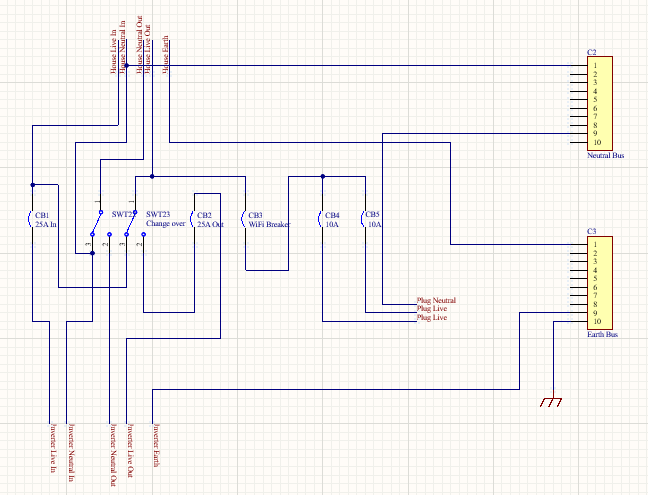
Yeah I agree... And the more I trace wires the more mess I'm making and the more confused I find myself. So what you are saying is that I can take the power to the inverter after the main EL and not before it like it is currently wired? then following my schematic should be fine?
-
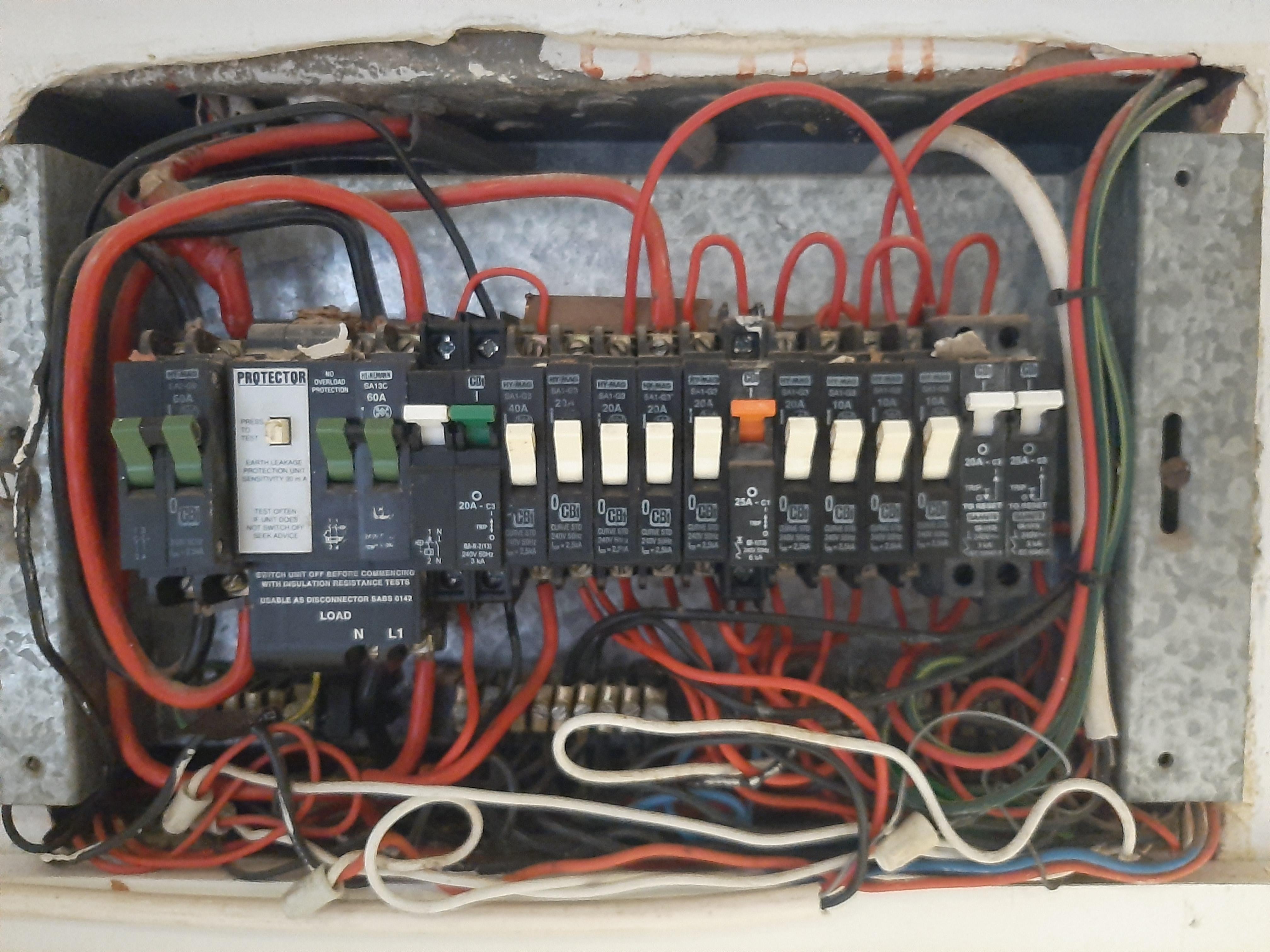
Previous inverter that was installed

-
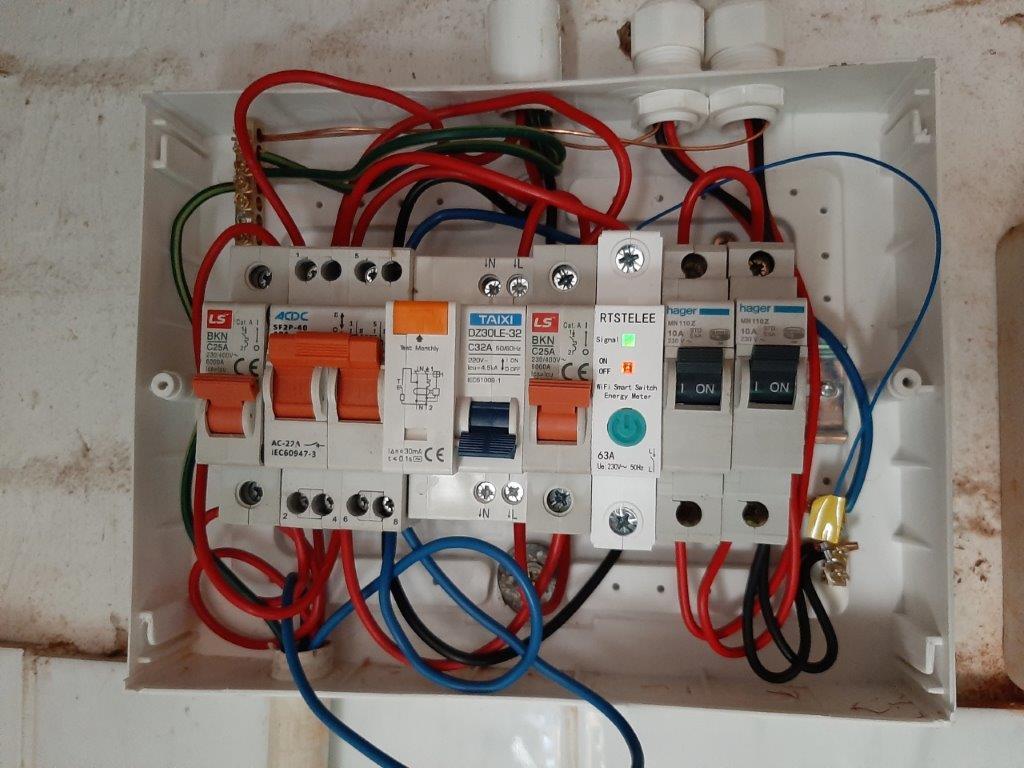
Excuse the disaster that is the Inverter AC DB, its a wiring mess that has resulted from trying to trace through this issue and will be tidied up once the fault is found and rectified. Attached is the data plate from the inverter, plus DB pics. Below is a schematic of the wiring.


-
Hi guys, I'm hoping someone here has either seen this before or can see what I am missing! So I had an RCT Axpert 3kVA 24V inverter installed for years, close to 6. But it became apparent that the 600W MPPT PV input just was not sufficient to make it viable as a long term Load shedding and power outage savior. Also it could only take the standard lead acid batteries - which I was replacing every 2 years and this just seemed counter productive. So fast forward to a month ago, I decided it was time to upgrade the system. I purchased a Kodak OG3.24 Inverter, 4 x 540W JA Solar Mono panels, and a lithium battery. I simply disconnected the RCT from the power and PV breaker boxes respectively, and replaced it on the wall with the Kodak and reconnected the AC and DC wiring. Now, when the power goes out the Earth Leakage trips, and the only way to reset the EL is to switch off the inverter, reset the EL and turn on the inverter again. I have run through the wiring over and over, and I just cannot figure out where there would exist a potential difference between live and neutral to cause this to happen. AC from Main DB leaves before the EL to AC Inverter DB where it goes into a change over switch, a 25A input breaker and then into the inverter. AC from Inverter goes to a 25A output breaker, into the change over switch and back to the main AC DB where is feeds all the lighting circuits and one plug circuit (Which is not on EL - and need to be rectified I know) If the change over switch is in the bypass position (i.e. incoming AC from main DB goes straight back to Main DB but also still goes to inverter AC in) and the AC breaker to the inverter is turned off the EL does not trip... What boggles my brain is that the inverter is totally independent of the EL in the Main DB yet cause it to trip as soon as the input power to the inverter is removed (25A input breaker turned off or load shedding/power failure)... And this never happened when the RCT Axpert was in place... Pointers of what to look for before I phone a sparky to come inspect everything??
-
The unfortunate part of all of this is that it seems like I need to throw more money at it to find out why its not functioning the way I believe it should be. Especially when compared to a similar installation next door... I do suspect there is a fault with my Axpert, but how to determine that exactly without spending nearly as much as a new unit I dont know... Currently I have set the unit to run off Utilities constantly and only use the solar to keep the batteries charged for the even of a power failure - as I really cannot afford to trash another set of batteries! Does anyone know if there are firmware upgrades for the 3KV units?
-
Yes - apologies that was a typo. When a single battery was connected to a 12V inverter (Trailboss) a 200W load lasted 7 hours before a turned off the system with a battery voltage reading 11.2V which recovered to a voltage 12.5V after a few minutes. Even at 20% discharge they really should last longer than 30min on 150W load though?
-
I have just run the inverter off batteries again now, after the earlier test was concluded and the batteries were left to be charged by remaining solar for the afternoon and then the Axpert charger. 150W load, 6A discharge current from the batteries and 32min later the low battery alarm was beeping...
-
So on the 200W load drawing 11A from the batteries it took 2.5 hours before the low voltage alarm started beeping....
-
That would equate to a 95% efficiency in your system is pretty reasonable. But that is not the problem I am seeing... Forget about how much solar is being generated or whether mains chargers are enabled. Simply put, full batteries on a 200W load as in a UPS arrangement lasts an 8th of the time the same load on the same battery (1 x 12V instead of 2 x 12=24 - both 200Ah) on another inverter.
-
Ok, so I have just connected everything back up with the new batteries. These were charged up to full by a separate charger to the Axpert. Solar and mains disconnected. First I placed a 215W load onto the system and the battery discharge current was 13A (applying a bit of maths P=VI at 24V that equates to 312W - but since batteries are 25.1V thats more like 326W!!) I then placed a 80W load onto the system and the battery discharge current was 6A (again P=VI at 24V equates to 144W, at 24.9V now thats more like 150W) Finally I placed a 200W load onto the system and have left that connected to see how long before the disconnect happens. But at 200W, discharge is 11A which at 24V should be more like 264W. Now remember I got 7 hours out of one of these batteries (12V and 150W load) so I should at least see 5 hours at 24V...
-
No I haven't. I will be sure to set it to that screen before doing the test. So I charged both the batteries now with Optimate charger - took less than 10min each before the charger said they were full at 13.4V per battery. Charger did not even enter bulk charge stage. I don't think I will get to doing the test tonight, I will attempt it tomorrow morning and report back.
-
Ok that makes sense. The Axpert 3KVa unit can only take 600W solar input, that is why there is only that many panels installed. But here is the curve ball. Firstly - the powered circuits in the house are lighting and TV - neither of which are used during the day, so the Solar energy is purely charging batteries. Maybe one or to ceiling fans are on during the day - thats less than 100W The Axpert (albeit is bad at charging) sits in float charge for about 70% of the day. Only from about 5pm onwards do we use more energy than the panels produce. The idea behind the system was for load shedding and power outages, which it is not handling currently. However when first fitted 5 years ago on used 200Ah batteries it ran extremely well, lasting a good 8 hours with no power... Secondly - then if the batteries are not being charged fully, how is that on a 160W load through the axpert I get 50min give or take run time. Allow batteries to charge again (on the axpert) and then put them on a 400W inverter and the same 160W load is powered for 7 hours and counting? What I will do tonight is charge both the batteries using an Optimate 20Ahr smart charger until it says that the batteries are full, then put them back into the system and see how long it powers that same 160W load.
-
The unit is configured to supply power to the house (lighting circuit and a few plugs) off solar energy during the day and utility at night except in the event of a power failure which then supplies off battery. (menu setting 1 - SOL) So this can at times and most evenings actually lead to some energy off the batteries being consumed - requiring a small top up when utility power takes over from the solar at the point the panels no longer produce enough energy. Just to clarify - all lighting is LED Plug circuit powers the TV, wifi router and one floor lamp. With all lights turned on, TV running and all ceiling fans turned on we can only just reach 500W... On average the load is no more than 200W However I am not sure how any of this relates to the problem I am seeing when the batteries are full and the mains power is removed without any solar present (ie at night) and 40min later the inverter disconnects due to "flat batteries" which at the time are showing nearly a full volt difference in level between inverter and external volt meters?
-
Solar panels are priority charge. there are 640W worth of panels. 2 x 320W in evening the batteries are topped up with AC side of the charger.
-
The batteries are charged by the Axpert inverter, set to the battery manufacturers specified charging conditions. Settings for batteries/charging are as follows 2 - 20A (maximum charging current for solar and utility chargers) 5 - USE (user defined battery conditions) 11 - 20A (maximum utility charging current) 12 - 23V (voltage point back to utility source) 13 - FULL (voltage point back to battery) 16 - CSO (solar priority charge) 26 - 28.8V (bulk charge as per battery label data) 27 - 27.4V (float charge as per battery label data) 29 - 22.5V (low DC cutoff voltage) all tests done on the batteries were using same charging method (Axpert on board charger)
-
Good evening! Forgive me if I have posted this in the wrong area of the forums, not much. of a forum person. Anyway - let me get into the nitty gritty, this will be a long post but I feel that it needs a lot of information and data to be hopefully solved! Almost exactly 2 years ago I posted in power forums about my Axpert 3KV 24V inverter not sustaining a load off battery (+/- 40min at 100W on 100Ahr batteries) - it was put down to the fact the batteries I had purchased were sub optimum and not actually able to supply their rated capacity - not being able to afford new batteries I wrote it off and just lived with it. Fast forward to now. My neighbour had solar installed (Axpert 5KV along with 200Ahr batteries), during the installation I chatted to the installers regarding batteries, they recommended the batteries they were installing next door (200Ahr AGM batteries from National Battery) So since I had been saving up for batteries fro the past 2 years, I took the plunge. Shelled out 10k and took delivery of 2 x 200Ahr AGM batteries - this was end of Feb. I installed them and set the inverter to the settings as specified in the battery manual, did a quick test to see that were working and left them be. two weekends ago we had a power failure in our area - we were watching TV and had 2 lights on - a total of 161Watts. 40min later the low battery alarm starts and within 10min the power is out! I go over to the neighbour and they are drawing 550Watts and still going (granted their system is 48V, but also 200Ahr). they had power for the full 4 hours of the power outage in our area. This lead me to do some testing and some digging. I connected 3 separate volt meters to the batteries - excluding the inverter display and monitored them all on a fixed 200W load. the results were as follows: Inverter - Meter 1 - Meter 2 - Fluke 77 27.3. 27.3. 27.2. 27.3 25.1. 25.2. 25.1. 25.2 24.1. 24.8. 24.7. 24.8 23.9. 24.7. 24.6. 24.7 23.2. 24.0. 23.9. 23.9 (low voltage alarm now sounding) This is all within 40min Disconnected load and recovered voltage on batteries after 5min rest = 25.2V Now that I am unsure of whether the previous batteries I purchased were indeed poor or if they were maybe damaged by the inverter - I remove the new batteries and put the old batteries back - which are now proper buggered. To ease my mind, I take one of the new batteries, connect it to a 400W Trailboss inverter I purchased from outdoor warehouse some time ago and connect the same 200W load up. 7 hours later I turn off the load with battery voltage indicated at 11.2V - recovered voltage after 5min rest = 24.5V I then take the second battery and repeat the test - 7 hours again I turn it off, similar voltage readings. I believe there is a fault with how the Axpert is reading voltage and sensing current in order to determine battery level - with this I do not believe it is charging the batteries correctly either and possibly damaging them. I have also noticed when looking for the firmware version this afternoon that only one version is being displayed on the display and not two like it should. Current version displayed is U1 02 51 Has anyone ever experienced anything similar? Is there is a fix for this? Any other pointers? Cheers!
-
Thanks! I also could not find any discharge graphs for the Royal batteries, they publish other curves that are useless in my opinion... I was told that all deep cycle batteries are rated over a 20hr discharge and all automotive/high cycle batteries rated over a 10hr discharge? Is this another BS story spun by salesmen? Well, I have set my inverter to switch over to main again at 23V, so then am I right in saying that my DoD is more like 30% at 23V than 50%? Edit: I do agree I am under batteried... These batteries need to last me til end of the year while I save up to install something big and decent... They cost R1300 each, so if they only last me 8 months, and they save me R2600 in utilities Im happy. I am concerned that the utility charger is going to overcharge these batteries with the minimum set current being 20A, so Im thinking about setting it to charge from solar only, this will also save costs as if it switches over during the night it wont be charging off mains for 4 hours...