SwitchVanDam
Members
-
Joined
-
Last visited
Everything posted by SwitchVanDam
-
Hi all, I am struggling to figure out what I am doing wrong or if my inverter is just broken. I have a Sna5000 luxpower inverter and it has 2 x dry contact relays at the bottom, 1 for the generator and 1 for low battery warning and battery float voltage reached. I have gone through all the settings on the inverter and on the web settings there is no place to active the dry contacts but when I take my multimeter I am not getting any continuity between any com, NC or NO. Is anyone here using these contacts and how did you get it to work? I have a sunsynk at my shop and is spoiled by it's CT's that gives it the ability to export excess solar power to non essential loads without exporting to the grid. So basically what I want to do with the dry contacts is to add the non essential loads via a smart changeover to the inverter load up until the gen relay clicks so that the non essential loads does not deplete my battery.
-
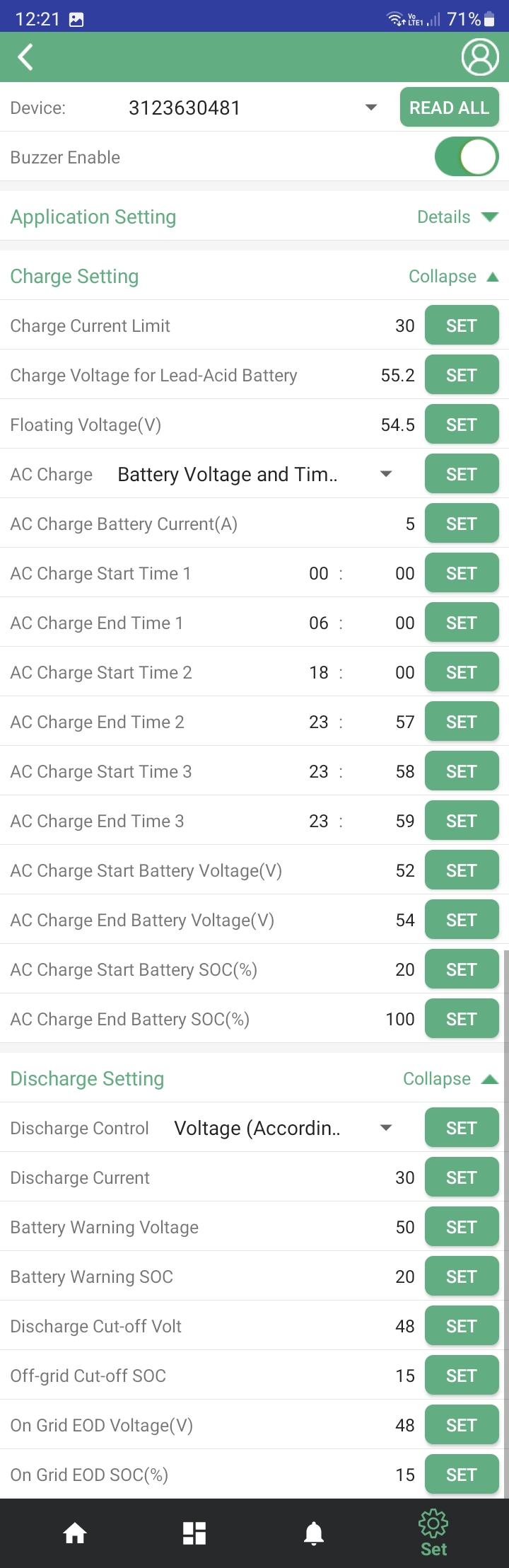
Hi @TaliaB I have increased my charging voltage, discharge cut-off and EOD voltage. Thanks for the suggestions. Can you please just double check what I have now. Now I just need advice on how to move the load to UPS even when GridA is available.

-
@Scorp007I am using Nenergy Lifepo4 batteries (2x24v in series) they don't have CAN or RS485 communication abality so yeah set them up as Lead acid and works great. I hear you regarding the reactive power and pf but my issue is the mismatch between the voltage protector and the inverter stats, if it was reactive power why does the inverter not show a negative watts amount at GRIDA? It shows 0watts I would really like to hear from @PsyCLownas he started this thread way back and maybe he has found the solution.
-
Thanks for the reply @Bobster. I know about the essential and non-essential loads setup as my Sunsynk at the shop works like that but the sna5000 lux does not work like that as it does not have an external CT clamp. So from Eskom the +live wire goes through the eskom meter then through my earth leakage then my voltage protector (the one that shows usage when it shouldn't) then through a breaker directly to the inverter gridA input. No other loads connected to that line. Same as @PsyCLowntests shown at the start of this thread the inverter shows zero watts imported from grid but in actual fact it does use grid according to the voltage protector and a clamp meter, and it's not a constant 1amp that one can say it's consumed by the inverter, it increases as the load increases as shown by my photos when I ran the microwave that drew 8amp from the inverter grid drew 3amp.
-
Thanks @TaliaBfor the info on the batter voltages as I thumb sucked those that I have but yeah always willing to optimize. Issue I have with the Lux setup is I installed it to save on my eskom bill but currently yeah I am saving but I am saving more when I manually switch the eskom breaker of each morning and switching it back on when I get home from work.
-
This is my current settings and I am using 2 x nenergy 24v batteries connected in series and have 2 x strings of 5 x 550w panels coming in
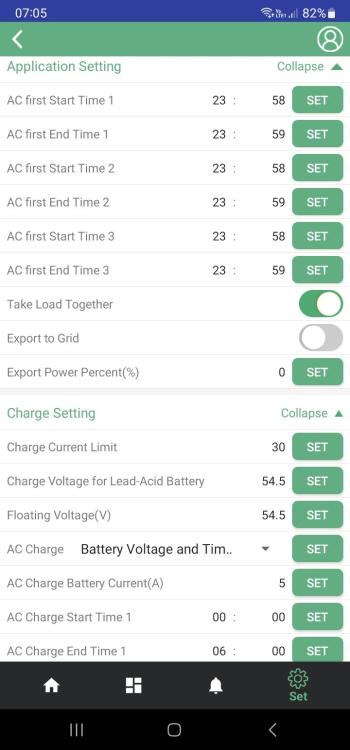

-
While this 8amp load was running the inverter was showing the following on its screen. No arrow from grida

-
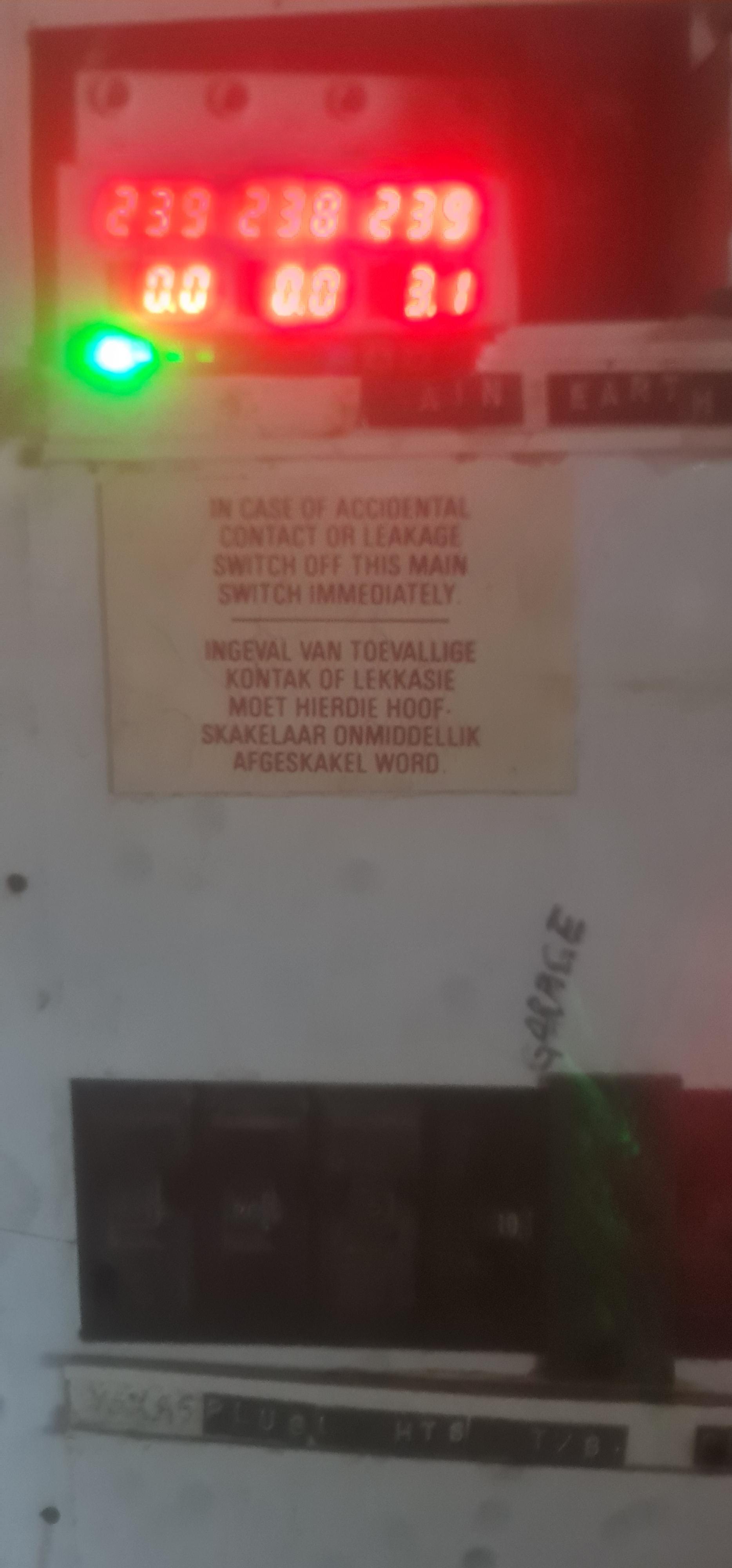
I am not smart enough to without a doubt say I know where the power is going but I definitely know that the inverter is lying. Did a quick test this morning where a switched on a moderate load and the usage on my eskom watcher increased from 1amp to 3amps but the inverter is in self consumption mode. As you can see on the attached pictures the 3phase monitor is what is coming in from Eskom and the single phase monitor is what is going out of my inverter to my loads

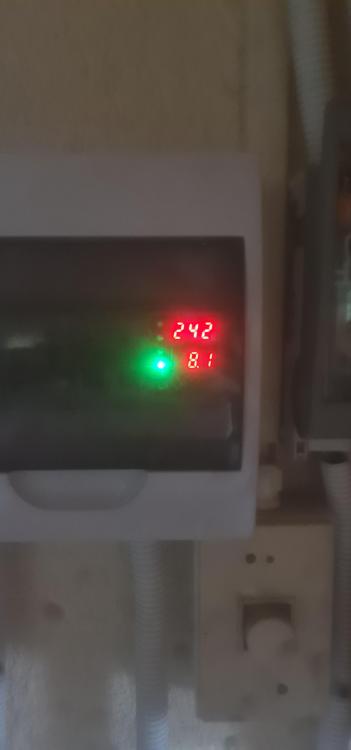
-
@PsyCLownI have the exact same issue, I thought there was something wrong with my settings but now you have confirmed I am not mad. Have you maybe found a solution to this usage? Is there not a way to let the inverter move the load from LOAD to UPS even when gridA is available? Otherwise I was thinking of installing a relay on the dry contacts that can disconnect GridA when the battery is in float stage and connect it again when not.
-
So it seems like everyone agrees. Supply to inverter should be before the earthleakage. Secondly. Does everyone agree that my pv panels are okay taking into mind what happend? Also noticed that when I switch of the dc breaker of the panels and measure dc volts between + or - of the pv panels and earth I get close to 200v and while I am holding the meter there the volt decrease to around 20v Is this normal?
-
Okay lets say there is a fault inside the inverter and somehow there is a leak to its metal body and you as a human touch that metal body you are going to get a shock or not?
-
Ahaa okay that looks cool. Thanks. I will give it a try
-
Yes you are correct I have 2 seperate curcuits for essential and non essential loads. But my issue is what protects my inverter? Should there be a fault inside the inverter with all those relays and switches what is going to trip before everything goes up in flames? We also have allot of lightning storms and I am of the opinion that the earthleakage provides some sort of protection against it
-
Thanks for your reply. Yes the lights flicker for a brief moment during changeover. I thought that was normal and that the inverter changeover was just a ms to slow.
-
Thanks for the reply and advice. I just want to challenge your advice, if you are correct by taking the supply before the earth leakage why is there a signal island mode function? If supply is taken before the earth leakage then there can be a permanent earth neutral bond on the inverter load and nothing would trip and also then no use for such function. Isn't there maybe a diffent fault that I should search for that would be the better solution or am I just being stubborn? Thanks again for your reply, I am just trying to get clarity and not just follow any advice without understanding it.
-
I have a 8kw Sunsynk inverter but sometimes when switching from grid to battery the inverter trips and alarms over current. My loads is a bunch of fridges that runs at about 4-5kw. How can I automate the startup process of 1 fridge at a time to eliminate this error?
-
I had a 8kw Sunsynk inverter, battery and 24 (12+12) 250w pv panels installed by our local sparky. I am also not to bad when it comes to electricity but where me and sparky differ is I want stuff done by the book and according to the manual nevermind how many systems you installed. So the install went good without a hitch but then i started to read and wanted to correct a few things. Sparky took the supply to the inverter after the main breaker in the main DB (that has surge arrestor after the earthleakage and a earth neutral bond on top of the earthleakage) to a sub DB that has another breaker and a changeover and another surge arrestor My argument is that the inverter has a metal case so it should be protected by an earthleakage, so I moved the supply to the bottom of the earthleakage and installed a earth neutral bond relay in the inverter on the ats port. (misread the specs of my relay and installed a 110vac coil relay) ticked the signal island mode setting and everything worked 100%. Return from the inverter also returns through a main breaker and then a second earthleakage before it goes to the loads. Solar panels also first goes through a fuse and surge arrestors before it goes through a breaker and then to the Invertor. The there was a storm one night and the main earthleakage tripped. That night still I tried resting the earthleakage but as soon as the inverter switches from battery to grid the earthleakage trips again. After struggling for a while i tripped the pv panels and the the inverter switched to grid without tripping the earthleakage. Switched on the first pv string and everything stayed on, but when switching on the second string sparks came out the top part of the inverter and the earthleakage tripped again. Then I found that I used the wrong relay (110vac instead of 220vac). But confident in my heart that there was a issue with the second string I left it off and the next morning before the sun rose I disassembled all the panels from both strings in search of the issue but not finding anything I assembled everything exactly like it was and switched everything on with no sparks. (removed the 110vac relay so there was no bond after the inverter) Baffeled we continued like this for a day or 2. Then There was another storm and loadshedding but when the grid came back the earthleakage tripped. Suspecting that it could be that there was no bond after the inverter I installed a time delay relay directly on the grid supply to the inverter (after sparks flied in the inverter the ats port constantly supplied 220vac no matter if grid was on or of or even if the setting was tucked or not) so when grid came on it delayed for 30sec and then broke the load bond and should grid go off the relay immediately creates a load bond. After installing the delay relay the inverter still tried the earthleakage when switching from battery to grid. Tripped the pv panels then The inverter can switch to grid with no issue. (panels, inverter, battery is earthed). When grid is switched of and inverter is trussing from the battery I can switch on the pv panels and everything works fine. I then moved my supply to the inverter to the top of the main earthleakage and then I can switch on everything with nothing tripping. So my question is, should your supply to your inverter go through an earthleakage? This issue only happens when there is a storm when everything is wet but I cannot find a broken seal on any of the Mc4 connections. Your advice and comments on my relay mistake would be greatly appreciated.