


frankvw
Members
-
Joined
-
Last visited
Everything posted by frankvw
-
Yes, you're right. Victron have no clue about how batteries work! I really have no idea how they have managed to stay in business for about half a century, most of that time as a leading vendor in that market. But not to worry; I'll forward them your URL so they can ask this blogger in Denmark to explain it to them. Once they do that, I'm sure they'll change the software in their products accordingly.
-
As far as the 85% is concerned, I'm basing that on the default "State of Charge when bulk finished" setting in my Victron Multiplus. Plus, it makes sense: the bulk charging stage ends and the absorption stage begins, as per the datasheet for my battery, at 28.4V, or 3.55V per cell. So I respectfully disagree with you: the cells are not fully charged when they reach 3.55V. Otherwise no absorption cycle would be necessary. Yet it is: During the bulk stage the battery is charged at a constant current until the voltage reaches 3.55V per cell. Then the absorption stage starts at which the battery continues to charge at a constant voltage of 3.55V per cell until the current drops to zero (or close enough as not to matter). So your statement that "To reach 100% capacity, you just need to reach +/- 3.5V per cell" is incorrect.
-
OK, I hear what you say. I've got BlueNova batteries which are the best I can afford but not top of the line; especially the BMS is a bit noddy. I don't think they're crap cells but BN definitely bears careful handling if you want to get the most out of them. I'm not discharging below 30%. However I have noticed that (due to varying loads and my MPPT set to apply an adaptive absorption stage duration) the batteries weren't being charged fully (my guess is not over 85%) and if that goes on for too long cells and batteries might require rebalancing. At least that's what the supplier has told me. So right now I'm fiddling with settings to ensure that the batteries at least get a decent absorption stage. Can't hurt...
-
As I understand it, the general recommendation is that LiFePO4 batteries in regular use should be charged to about 90%. However, there is also the matter of cell balancing. In this thread a post from @zivva states that: I believe (note how I phrase it) that this makes sense, but how often is "regularly"? How frequently should I charge my battery to the point where the charger switches from absorption to float in order to maintain proper cell balancing? // FvW
-
Wow. Lots of great advice here. Thank you all!! Based on what I read here I'm at least headed in the right direction here. During even mildly sunny days (it's a horribly grotty, heavily clouded winter's day right now) the battery gets charged to 100% (first bulk, then absorption, then float) and appliances pretty much run straight off the PV panels. So cell balancing shouldn't be in jeopardy. Normally the battery drops to about 30% remaining charge around midnight, at which point the charger kicks in to provide additional oomph for the appliances and recharge the battery to about 80%. I cobbled my system together from what I had (starting with a Victron Multiplus inverter/charger) which means I can't balance the appliance load between the battery or the mains - all I can do is to put an additional 15A on the battery which is then used for both charging and appliance load. Not ideal, but my budget is severely constrained and beggars can't be choosers. That said, from what you all write here I understand I'm not killing my battery in short order by doing this, and yet I'm able to achieve a considerable mains power saving. So I'm happy. Thank you all so much for responding - it's greatly appreciated!
-
The PV panels charge the batteries regularly to 100% so cell balancing should be taken care of. 🙂 It's only during the night when the charger kicks in to provide additional oomph (ideally I should have a bigger battery but the ship with money was hijacked by Somalian pirates) but that doesn't recharge the battery to 100% since that isn't needed. I'm keeping the DOD above 30% (barring emergencies) in order to get a decent service life out of the battery. I just wasn't sure that I'm not doing something stupid here. Which doesn't seem to be the case based on the above. That's heartening at least. 😜
-
OK. Just in case this will be useful to someone somewhere: I've done a lot of experimentation and I've pretty much worked it out. Determining the SoC on a LiFePO4 battery based on battery voltage is inherently somewhat inaccurate, since the battery voltage doesn't vary much between 10% and 90% or so SoC, while variations in load do cause voltage fluctuations that can easily exceed the voltage variation between 20% and 80% or so SoC. So this will always be a rather limited way of estimating the SoC. That said, sometimes it's better than nothing. I have found through trial and error that when the battery voltage on my 26V 108Ah BlueNova battery drops to about 25.3V under a load of 0.2-0.35C, that means the SoC has dropped to about 30% (give or take). Recharging it to a battery voltage of about 27V restores the SoC to about 70% (once again give or take). It's not perfect, but it helps. 😃
-
My LiFePO4 battery is spec'd as having a service life of 2000 cycles @100%DoD, 3000 cycles@80%DoD and 5000 cycles @50%Dod. Which is pretty normal for this type and price range of battery. However, this assumes that the battery is recharged to 100% after each discharge. What happens if the battery is recharged only partially? Let's say the battery is discharged to 80%DoD and then recharged back to 30%DoD. This moves as much energy in and out of the battery (50% of its total capacity) as it would while keeping it between 100% charge and a 50%DoD. The latter should give me 5000 cycles according to the specs, but the charging and discharging now takes place in a different section of the charge/discharge curve, so that the battery is drained to 80%DoD (which should give me 2000 cycles). So: is the "wear and tear" on the battery mainly a factor of how much energy moves in and out of it (which would mean that keeping the charge between 70% and 20% should give me about the same service life as keeping it between 100% and 50% charge) or is it more a factor of what the minimum charge level is (in which case a partial recharge would be worse in terms of service life reduction than a full recharge)? Any insights on this would be extremely valuable! // FvW
-
I'm trying to dial in my various Victron components on my DiY solar installation (still a work in progress) but I'd like to make sure I'm on the right track here. All advice would be appreciated. I've got a BlueNova 26V 2.8kWh LiFePO4 battery, a Victron SmartSolar MPPT and a Victron MultiPlus inverter/charger. The battery capacity is a bit on the puny side due to budgetary restrictions (sadly). This means that during the day everything pretty much runs straight off the solar panels but at night it all depends on the battery. In order to make sure the battery isn't drained too far (causing the inverter to shut down and wearing out the battery prematurely at the same time) I'm setting up the Multiplus to kick in (powering several appliances from the mains and recharging the battery) when the battery reaches about 70% depth of discharge. Since the Multiplus is not the only inverter in the mix that drains the battery nor the only charger that recharges it, its internal algorithm to determine SOC is not usable. This leaves the battery's clamping voltage as the only means to trigger a recharge from the mains. Unfortunately BLueNova doesn't publish discharge curves for their products. I can't afford a battery monitor at present so I'll have to make do with what I have. I've done some measurements using the VictronConnect app (which has limited options to export trends so all I can show here is a screenshot) and combined it with monitoring appliance consumption using a Kill-a-watt type plug-in monitor. An example of the graph produced by VIctronConnect is included with this post. The battery clamping voltage in the graph goes up and down because the inverter is currently powering only two freezers, so the load varies when the thermostat on a freezer switches on the compressor. My question: how reliable is the battery's clamping voltage as an indication for Depth of Discharge? Are all LiFePO4 discharge curves more or less the same (i.e. I can just use a graph for a different brand of battery since BlueNova doesn't provide one) or are there differences between brands? In the graph I'm attaching the voltage drops to a minimum of 25.62V until sunlight starts to provide additional energy again. I realize this is dependent on temperature and the amount of current drawn from the battery. Any advice would be greatly appreciated!! // FvW

-
I've got a Victron Multiplus 700W/800VA inverter/charger with a 26V/2.6kWh LiFePO4 battery. Currently the inverter is connected with plugs (230V in / 230V out). The battery is connected permanently via the obligatory red and black 16mm cables. The inverter currently powers laptops, lights, TV+accessories and the kitchen fridge which has a PWM based inverter and is therefore gentle in terms of startup and sustained current draw. I now want to add PV panels to the existing installation, using 4 PV panels, a Victron SmartSolar MPPT and a Victron Phoeix inverter. The latter will only power fridges, freezers and the water tank's booster pump. At this point I will also install isolator switches, breakers and the like. I will have a proper DC breaker and isolator switch for the battery (e.g. this one) and another one for the PV panel feed (e.g. this one). May these two DC breakers / isolators be located within the same DB box? Also, can the breakers for the 230V AC section of the installation be located within the same DB box as the DC breakers/isolators (suitably separated of course!) or must everything be located within separate DB boxes? (Note: this installation will be completely separate from the house wiring and not be connected to the existing DB board, save for the plug connected to the Multiplus, which will be configured to aid with battery charging only if solar proves to be insufficient and the battery voltage drops below the point where additional charging is required.)
-
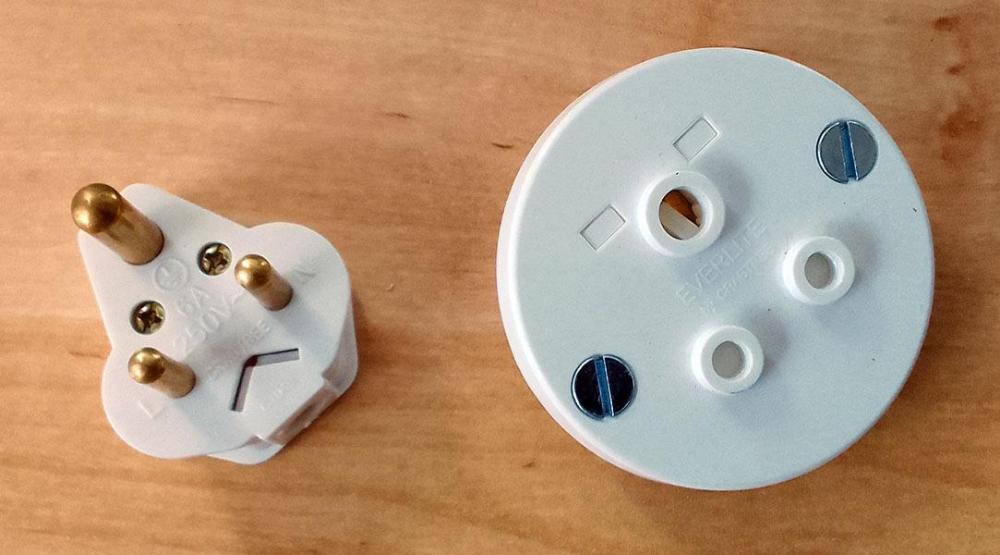
Not sure if this qualifies as an "invention" but it is a bit of a hack, at least... 😃 As a first step to get proper backup power, I've installed the Victron Multiplus 24|800|16 that a mate gave me for my birthday last year. We've been using it as a "portable" inverter, hooked up to a couple of 2nd hand deep cycle RV lead/acid batteries, but now that we've moved into our new house it was time for something more permanent. For the moment it's still hooked up with plugs; DB boxes with breakers and a main switch will come later when I put in the solar panels, MPPT and additional inverter. (Image 1 - the enclosure at the bottom houses the new 2.6kVA LiFePO4 battery.) However, I wanted to keep the Multiplus output completely separate from the house wiring. The Multiplus can deliver 700V/800VA which is enough for the fridge, TV, JoJo booster pump, ceiling and bedside lights (LED) and bedroom ceiling fan. But for obvious reasons I want to make sure the inverter doesn't get overloaded. Using extension cords would be a pain, but connecting the inverter to existing outlets in the wall leaves the very real risk of, say, an electric heater being accidentally plugged in. But while I was in the roof to sort out the house wiring I saw how the lights had been connected to the mains, and that gave me an idea. Other than the standard 3 prong plugs there is also a smaller version, rated for only 5 amps, and typically used to connect lights in the roof. The plug top is similar to the regular one but smaller in size, and the outlet is round and fits a standard conduit box. (Image 2/3/4) So I've used those plugs for the TV, fridge, water tank booster pump and bedside lights. In the lounge and kitchen I've taken a cover plate used to cover unused plugs, drilled holes to fit the round 5A outlet onto, and mounted it into the wall. It looks pretty good. (Image 5) In the boot room where the pump is connected I've just used a conduit box. (Image 6) Yes, I know, this is NOT according to code. But at least it solves my problem for now. We plan to leave our current home only once we're being carried out of it in a pair of pine boxes, so the executor of our estate can worry about the CoC when the property is sold off. 😜 Your opinions, please! // FvW




-
Yes, the fridge with the inverter is currently running off the Multiplus. I have a Kill-a-watt and it shows that the fridge has never drawn more than 150W, so there's obviously some soft-start feature. One of the freezers, on the other hand, has a Chinese compressor and that does draw a fairly hefty kick of start-up current (albeit quite briefly); hence the 1kW Phoenix inverter being on the plans. That model can (according to the specs) deal with 2400W peak currents, which should handle the freezer start-up peak.
-
Hi, Talia! Well, the CoC is always a joke; I've seen four properties now that came with a CoC and in all cases the electrical installation was a shambles. Electricians know it's only a formality. Also, paying a proper sparky his hourly rate to actually climb into the roof, unscrew plugs to see what's in the walls, check the existing wiring against building drawings and what not (which would be required for a proper compliance check) would make it far too expensive for the average house owner. It's one of those many regulations that looks good on paper to a government employee but in pretty much useless in practice. But let's not go there or we'll still be at it by Christmas. 😜 I've got two chest freezers and a fridge that will be running off the Phoenix inverter, as well as a fermenter fridge (for brewing) that has a tweaked thermostat to keep a fermentation vessel at constant temperatures set between 14 and 24 degrees, depending on what's fermenting in there. We're out in the sticks a bit, so we prefer to do the Mother Of All Shopping Runs once a month and not waste petrol. Plus, I'm stocking a lot of brewing and distilling ingredients that have to be kept cool. So from an electricity cost standpoint it makes sense to use solar there. I'm looking at the 1kW model inverter precisely because I want to allow for start-up currents, and because it leaves some room for future expansion. The freezers and fridge themselves consume less than 500W together if the compressors are all running at the same time (which does happen but not all the time). I also want to keep the discharge current of the battery within reasonable limits, so that's a far as I'll go.
-
Hi everyone, Let me introduce myself properly for a change. 🙂 My name is Frank, I immigrated from the Netherlands into SA in 2004 and I wouldn't go back for anything. My professional background is in electronics and IT (I came here as a website developer) but that drove me to drink and I became a brewer and distiller instead. I'm also a pretty good plumber and one heck of a pool boy. Now I'm semi-retired and we've just bought a house that is a bit of a fixer-upper. As part of the reno we're putting in proper backups for electricity and water. I'm starting with a Victron Multiplus 24/80/16 that a mate got me for my birthday a few years back and that I've just fitted with a BlueNova 26V 2.8KWh battery. It's currently running the TV, laptops, internet modem, ceiling lights/fans, fridge and backup water pump. The fridge has an inverter and I've measured the maximum power consumption of everything, so we're staying within the 700W/800VA capacity of the inverter. The next step of the plan is to fit solar panels and a Victron SmartSolar 100V/50A MPPT, plus a Phoenix 1.2kVA/1kW inverter so that the latter can power a bunch of fridges and freezers for which we currently still need the petrol generator during lengthy Eskom breakdowns (and there've been a few). The alarm is already on solar; the house came with a small 12V panel and attached battery charger (not an MPPT but just a voltage/current stabilizer). Initially I didn't use it but while the house was still standing empty some [censored] switched off the main switch in the Eskom box in the road, let the alarm battery run down and broke in, causing lots of damage but stealing nothing more than a bucket of paint. So I've put the solar charger onto the alarm battery (in parallel with the existing charger) and that works great. As I understand it, the output of the 24V MPPT (properly set up for LiFePO4 batteries) should be able to do the same, i.e. be put in parallel onto the existing battery. The Mulitplus can be set up to favor charging by the MPPT and to default to island mode, only kicking in as a charger when the battery charge drops to below a certain point. Meanwhile the biggest challenge before me is to puzzle out the wiring in the house, which is, shall we say, creative. It was initially put in properly but the previous owner made modifications that are a complete hack; stealing a wire here, repurposing one there, so that right now we've wires that seem to nowhere and some switches and outside lights that don't work and we haven't figured out yet why. What is clear at this point is that the electrical CoC (required to transfer a property) is a bad joke in SA; you pay a few thousand Rand for an accredited sparkie to check you earth leakage switch and to make sure there are stickers on your DB board noting what is for plugs and what is for lights, but meanwhile the rest of the wiring is held together literally with sticky tape (a disaster waiting to happen) but nobody worries about that. Eish. Initially we planned to install a solar geyser with evacuated tubes, with the existing gas geyser as an automated fall-back (using a thermal valve) but with the current price of PV conversion kits for existing geysers the latter makes much more sense; it works as well and is much easier to install. However, since then we've come to realize that we are using so little hot water (two people only having brief showers and occasionally some hot water in the kitchen) that an even more sensible solution, both logistically and money-wise, is to use only the gas geyser. We'll see how that goes; first we need to get all the plumbing out of the roof before something there springs a leak; in my opinion any geyser is a bursting geyser waiting to happen. Anyway. Upward and onward! // FvW
-
Thanks. I figured there's no better intro than to make it clear i'm so green I need mowing!
-
Ooookay, so I just spent several days figuring out what was happening here. I used to have a Lead Acid battery connected to my Victron Multiplus 24/800/16. Because I'm in the middle of renovating I had the Multiplus lying on top of the batteries (well insulated, of course) and this worked fine. Then I replaced the Lead Acid batteries with a new LiFePO4 one (BlueNova) and things went haywire. As soon as the charge voltage began to approach the boundary between bulk and absorption charging, the Multiplus started to switch back between mains and inverter about every 30-60 seconds. I changed settings until I saw blue in the face but nothing worked. Then I happened to take the Mulitplus off the of the batteries and put it down on the floor beside it. The problem immediately disappeared. So now I feel really stupid. The LiFePO4 battery contains a BMS (read: electronics) and whether it's inductive (transformers, choice coils, what not) or capacitive coupling, the electronics in the Mulitplus and the battery began to influence one another. Not sure how but the effect is now obvious - in hindsight. So here's some advice from a noob: keep your LiFePO4 batteries well away from other electronics. Hand me the stupid hat, will you?


