


TimJohnson
Members
-
Joined
-
Last visited
Everything posted by TimJohnson
-
Okay, it's 2025 and until a few days ago, I was still getting the F20 fault at least once a day. Here, however, is the final outcome. I contacted my original installer and told them that the fault had been going on for a long time (8 months). They did some remote inverter setting changes, including an inverter firmware upgrade, but to no avail. Eventually, they sent out a 12 year solar veteran installer. His mandate was to inspect the inverter, and if neccessary, take out the inverter for repairs or replacement. He was outstanding and proceeded to check all of the DC connections inside and out side the inverter. Eventually, he opened up the DC PV DB and lo and behold, one of my 2 solar arrays was not functional due to a wire from one of the solar arrays not being plugged in. So for about a year, I have only had half of my solar capacity functional. That is is why I was getting an over current error. He connected the wire and problem solved. Now, I have my max solar power set to 6.5 kW (as per the Deye specifications for a 5 kW inverter). I was at some stage running the inverter at 3.5 kW. No settings are tweaked back. The installer has waived any costs as the fault was caused by them. Needless to say I am very happy.
-
Another twist to the story. When reading the causes of the F20Tz_Dc_OverCurr_Fault the focus of the causes all zoom in on the DC current produced by the solar panels. So, I decided to set the battery charge/discharge back to 50A as per the battery and inverter specs, and I also decided to reduce the Max Solar Power limit down from 4.2 kW to 3.5 kW. Since doing this the daily tripping has stopped This has been the case for the last 2 day. I will monitor how long this remains as is. If it stay like this, I will gradually up the Max Solar Power limit by 100 W and see how high it can be set before it initiates a trip. I will then leave the Max Solar Power limit at that value. I don't lnow why the solar panels are spiking but I can live with this.
-
I saw this thread today while Google searching on "deye hybrid inverter makes high pitched sound". I seem to have solved the problem a while ago. I was regularly getting this sound on hotter days. We tolerated the sound but it was irritating. I then noticed, on the Solarman app, that the DC temperature would go as high as +76 C on these days and that the Deye spec required a maximum of +60 C. I then decided to fit a rack of 3 small 80x80 mm 220 V fans under the Deye inverter heatsink. I also purchased a temperature sensor controller which I attached to the hottest part of the heat sink so that the fans only ran between certain temperature ranges. All of this was quite inexpensive. The sensor was R75 (Chinese) and the fans (Chinese) were about R140 each Since doing this, the noise has disappeared. The fans make a noise but it is not a high pitched noise so is much more tolerable. Also, on the Solarman app I see that the the fans keep the DC temperature below 60 C most of the time. Some times the temperature gets up to just above 60C. However the noise has not reappeared. Of course, the temperatures have been moderate this December. I think that the high DC temperature causes the noise, particularly when the temperature gets higher i.e. when the DC temperature is higher, the noise is louder. The DC (solar panels) really only starts working during the day.
-
Some feedback. After a few days, I reduced the charging current to the battery from 50 A to 19 A. I have not had a F20 fault occur, for the last 5 days. So your suggestion works.I am still evaluating whether there are any negative consequences. I am in Cape Town and the weather is unpredictable. Initially it seemed to take longer to recharge the battery after the evening usage. However there has been some rain and clouds so not sure. Still monitoring whether this is the case. Anyway, thanks for your inpuy. Much appreciated.
-
You raise some interesting points. Question 1: I assume you have comms to your battery? I assume I have battery comms. I have a wifi dongle in the inverter and I use Solarman. Really very nice as I can toggle the inverter/battery settings from Solarman as well as graphically scrutinise various inverter and battery/BMS parameters. Question 2: Perhaps your battery BMS isn't waiting long enough for the inverter to respond to the change in limit; or maybe it's providing a limit that's just a touch too high? Your question/statement is what I think to be happening. The screen shot I posted seems to show that the BMS is reacting too quickly. I don't know enough about which values are controlled by the inverter or the BMS. Question 3: Have you updated the battery BMS firmware? The behavior I describe in my setup only started happening after a battery software update. I have not updated any firmware on the inverter or the battery. I don't know how to do it. I am fairly tech savvy but have not dived into that pond. Last bit of info. Since I started back feeding to the grid, because the panels are giving 4.1 kW most of the day, the inverter DC temperature sits at about 72C or 74C during the day. I read in one of the forums that the high DC current is the reason for the high temperature. I have just installed a 3 x 14W fans below the inverter heat sink. There has been no trips for 2 days. I did say that the trips are always in the morning and always when the charge limit is lower. Thanks for the interest. I have not lowered the battery charge limit from 50A to 15A yet. I think that it would be defeating the purpose of of exporting my surplus power. I might try doing it for a few days to see whether it makes a difference.
-
Just to be clear about my panels. I have set the inverter to only take 4.1kW from the roof. I installed more than 5 kW because of the orientation of my house (East west facing roof).
-
Thanks for the getting involved. Your answer is what I am asking. Firstly, it came as a surprise to me that there was a variable limit for battery charging. There does not appear to be a way to lower the charging rate at these lower charging limits. How do I change the charging rate to comply with these lower charging limits. The Deye interface does not provide this.
-
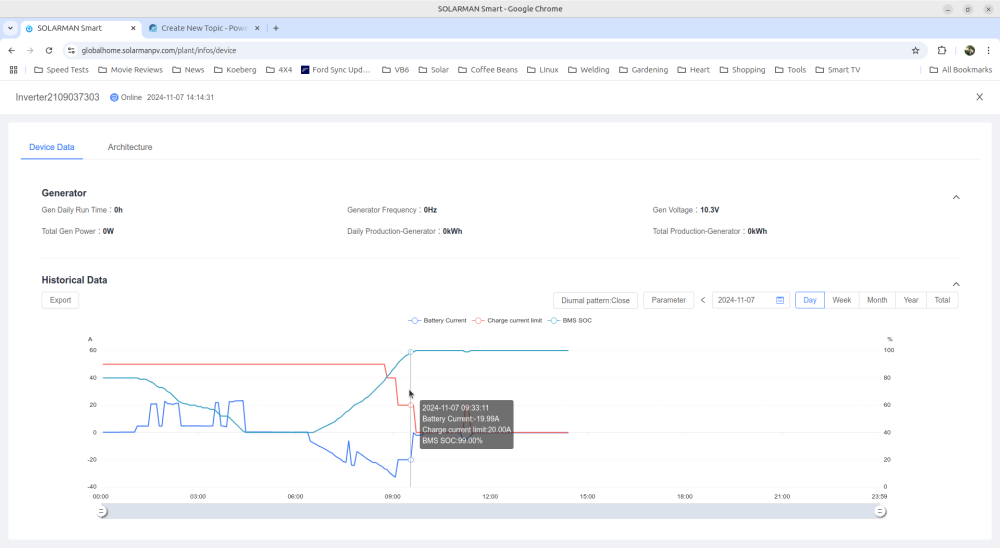
I created this topic here as it got no response when I joined the forum. I have a 5.1 kW Deye hybrid inverter and a 5 kW.hr Dyness battery. I have 6.3 kW solar panels on my roof. About 2 months ago I started reverse feeding my excess solar back to the grid. All well and good. I have a question about F20Tz_Dc_OverCurr_Fault that I get once a day (some days, there is no fault but most days there is). My battery has a 50A Max Charge and 50A Max Discharge limit. However, I have discovered that the battery charge current limit (red line) changes as the battery nears fully charged. The battery charge current limit line below steps down as the battery nears fully charged. What happens each day is that the charging current gets very close to this limit and there is an overstepping of this limit. Today, the trip occurred at 09h35. The screenshot shows 09h33 where the current limit is 20A and the battery current is 19.99A. I am at a loss to explain this but I get a trip most days around about this time of the day and it always happens within an hour or two of the this part of the day. In the initial part of the day, my battery is set to charge to 40%, after being used down to 40% during the night (well point pumps for garden). Are there any suggestions as to how to avoid this. As far as I can see, there are no settings on the inverter that can be tweaked.
-
Hi to all, This is my first post although I have had a 5.1 kW Deye hybrid inverter and a 5 kW.hr Dyness battery for about 3 years. After my first year I added 6.3 kW solar panels on my roof. About 2 months ago I started reverse feeding my excess solar back to the grid. All well and good. I have a question about F20Tz_Dc_OverCurr_Fault that I get once a day. My battery has a 50A Max Charge and 50A Max Discharge limit. However, I have discovered that the battery charge current limit (red line) changes as the battery nears fully charged. The battery charge current limit line below steps down as the battery nears fully charged. What happens each day is that the charging current gets very close to this limit and there is an overstepping of this limit. Today, the trip occurred at 09h35. The screenshot shows 09h33 where the current limit is 20A and the battery current is 19.99A. I am at a loss to explain this but I get a trip most days around about this time of the day and it always happens within an hour or two of the this part of the day. Are there any suggestions as to how to avoid this. As far as I can see, there are no settings on the inverter that can be tweaked.

