


Felix Merz
Members
-
Joined
-
Last visited
Everything posted by Felix Merz
-
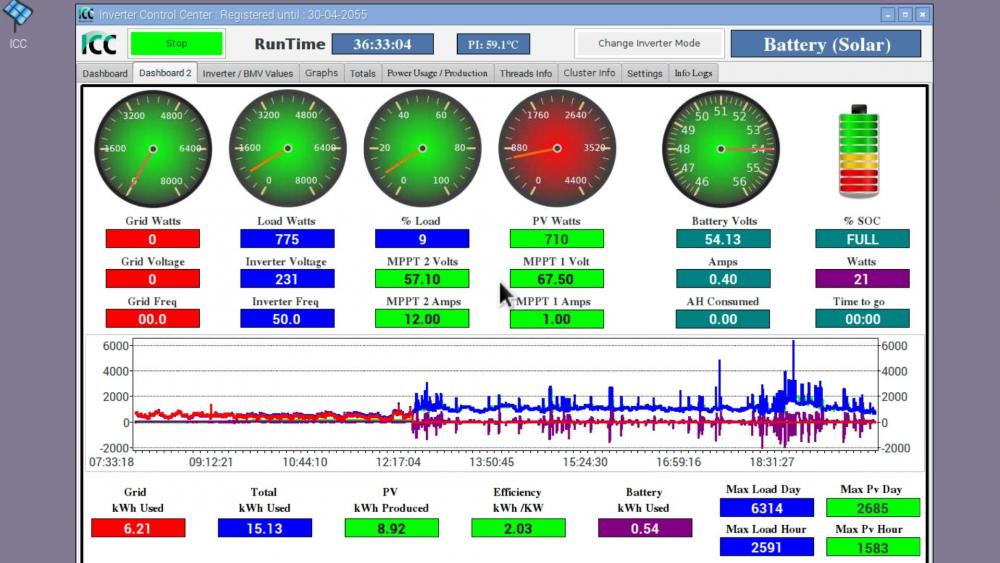
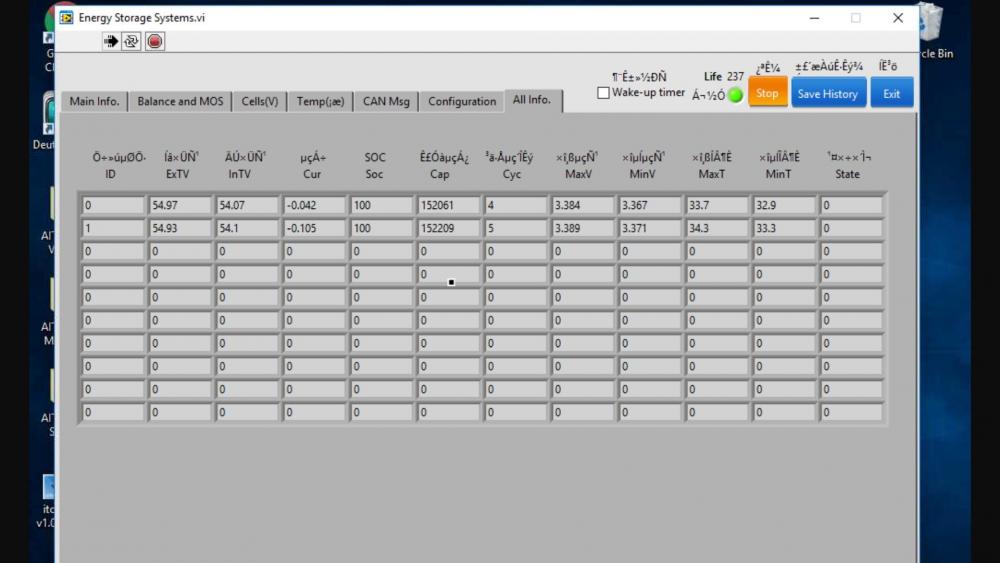
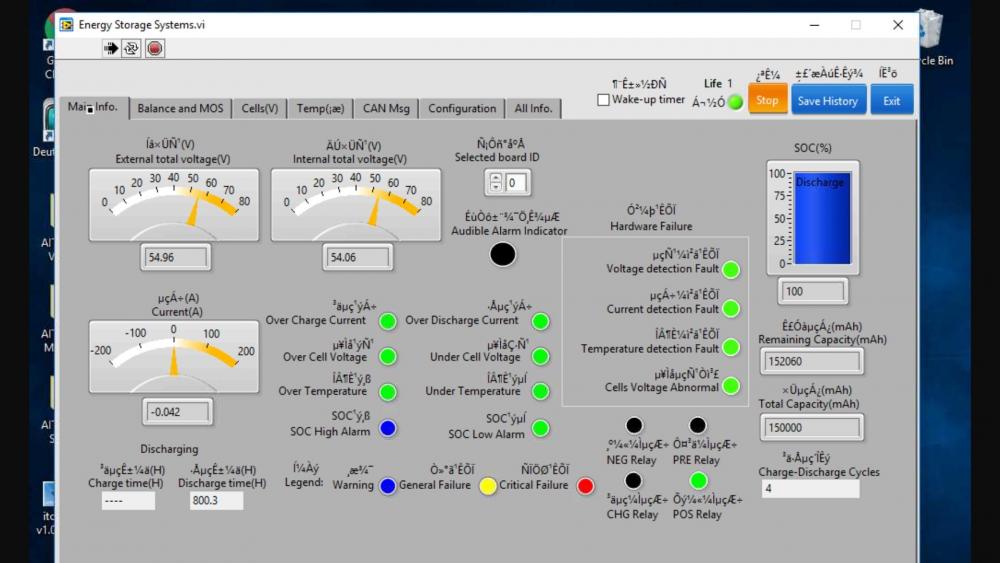
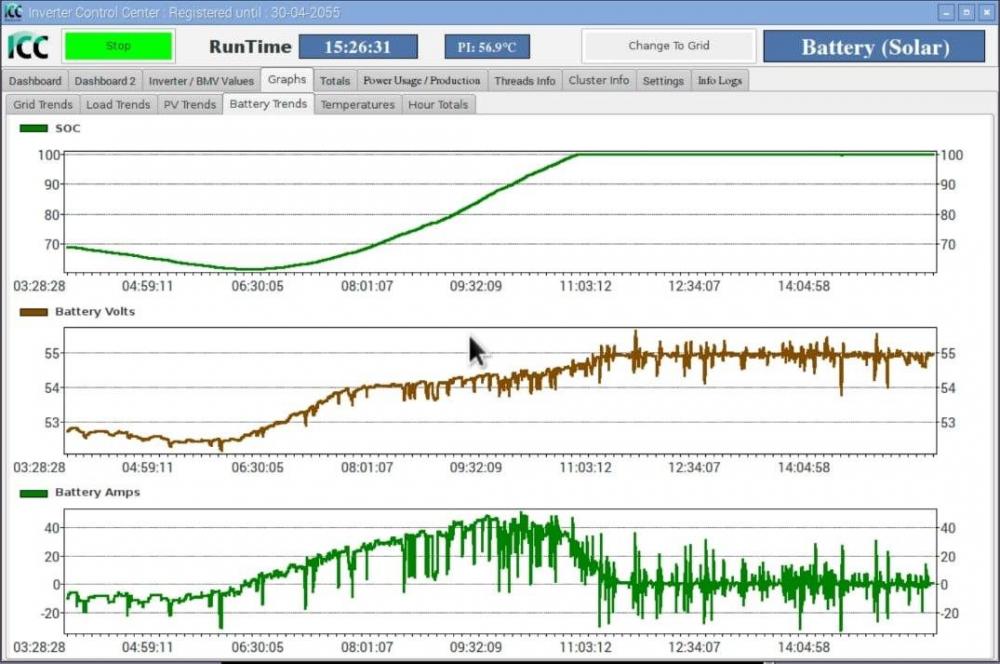
Hey, I think I just answered a few of you questions in the other reply. No special inverter settings needed. Just... Bulk charge voltage: 56V Float: 55V Cut-off: 48V LiFePo4 don't need absorption. Just set bulk and float voltage. BMS cares about the rest. I do have a BMV-702 installed. It's connected to the batteries and ICC. Like this I have all important info in ICC, like SOC, Ah consumed, time left, etc. If I want to check more details about my battery packs, I have to lock at the BMS. Attached 3 screenshots: 1. ICC Dashboard 2. YiY BMS Overview 3. YIY BMS Details Hope this helps... Cheers, Felix
-
Hi Mazs, Yes, I ordered 2 packs 48V 150Ah in March directly from Yiyen, China. Excellent support with shipping,.paperwork and stuff. 3 weeks later I received them and installed them straight away. Since then they have been working perfectly, without any issue. The internal BMS seems to do a good job. Just... the BMS monitoring software only works on windows. And you have to order the CANUSB Adapter seperatly to monitor the batteries. So, I connected the two batteries via CANUSB to a Intel Computer Stick with Windows, and so I can monitor the batteries via VNC from anywhere. After sales support, i.e. technical questions, monitoring, etc. is very good. Till now I have 50 cycles on the batteries and they work perfectly. I am happy! Cheers, Felix
-
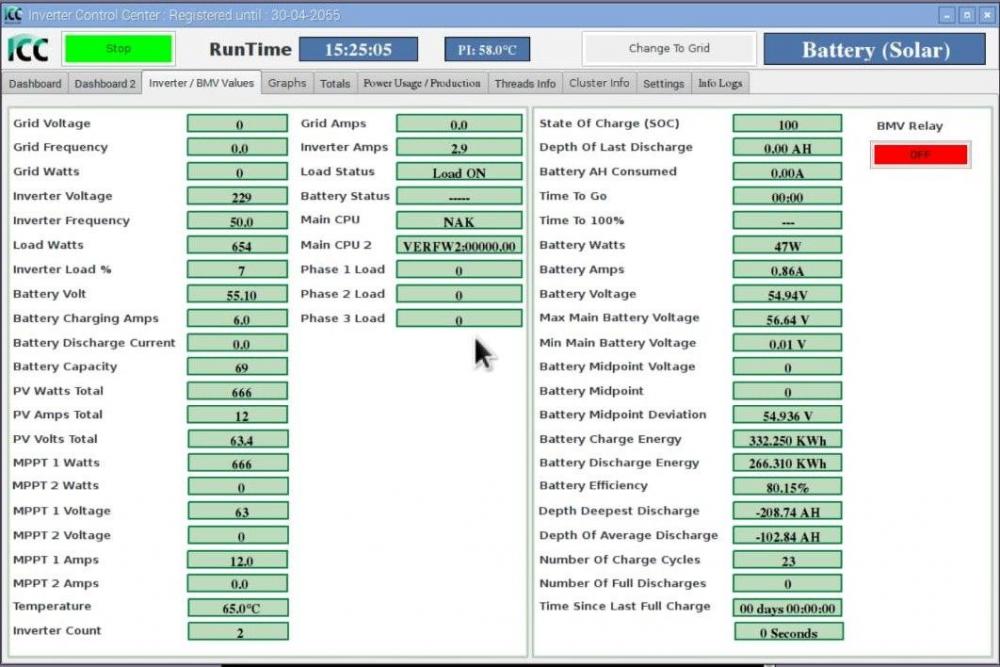
Hi Plonkster, Thank you very much for your quick and detailed answer. For the energy issue... I did update my BMV settings after changing to LiFePo4. Current settings are: Peukert-Exponent: 1.05 Charge Efficiency: 99% Maybe I should lower the Charge Efficiency to 95%, to get BMV AH and SOC closer to the BMS values ...!? Other question: Is the "Charge Efficiency" related to the "Battery Efficiency" which I can see in the ICC -> BMV-Values? I guess, ICC is calculating the Battery Efficiency by Battery Discharge Energy / Battery Charge Energy. In my case the Efficiency is always around 80%. Is this not too low for LiFePo4? See screenshot... Actually... with my current settings, ICC gives me quite good and probably accurate SOC readings. But it's optimistic compared to BMS values, i.e. When BMV SOC is around 50%, BMS SOC is around 40%... See screenshot... Thanks for any comments Felix
-
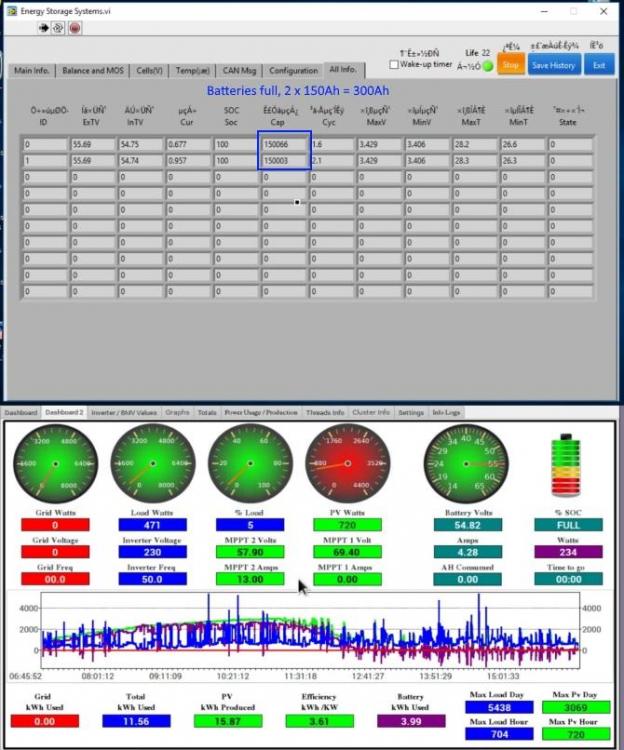
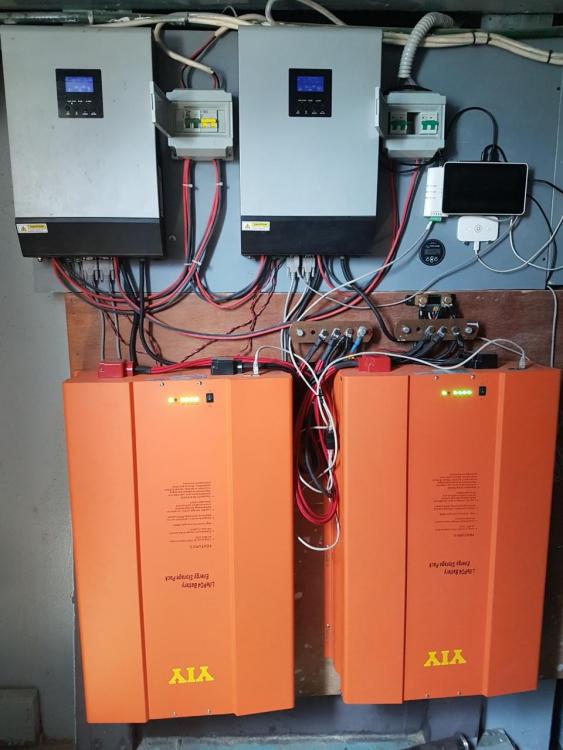
Hi there, I have a bit of a problem with understanding measured Amps in/out from my batteries. A coupIe of weeks ago I replaced my GEL batteries with some new LiFePo4 packs in my Off-Grid PV System. My setup: 2 x Axpert MKS 5KVA parallel 16 x TrinaSolar 275W (4.4KW) 2 x YIY LiFePo4 battery pack 51.2V/150AH (15KWH) Victron BMV-702 ICC on Raspberry 3 The new LiFePo4 packs work just great so far, but I am a bit confused when comparing data from the BMV-702 with data from the LiFePo4 BMS... There is quite a difference in measured Amps going in/out to/from my batteries between the BMV and the internal BMS. Accordingly, other info like AH consumed and SOC are also different. See attached screenshots of ICC and BMS in different situations... My connections and wiring should be ok. The two battery packs ar connected to a -/+ busbar. The BMV-702 is connected via original shunt to the - busbar and via original USB cable to the Pi3. See attached picture... Anyone have an idea what could be the reason for these big differences in measured current? Thanks for any help or advice Felix


-
No other feedbacks or opinions? Comparing datasheets and specs I tend to go for the YIY ESS. 3 x 5.2Kwh for 5000 USD Sounds like a quality product. Should perfectly work with my existing 16 x TrinaSolar Panels 275w and 2 x Voltronic Inverters MKS 5KVA Would highly appreciate more opinions! Thanks a lot YIY - 5.2KWH.pdf
-
And I just got the datasheet and specs for the YIY ESS... 3 x 48V(51,2v)100ah parallel = approx. 15kwh for 5000$ + shipping around 500$ + custom clearance... Sounds not bad. Would love to have your opinion. Thanks Battery pack 5.2KWH YIY.pdf
-
Dear Community, I would like to have your opinion... I currently run an 48v off-grid system on a boat with: 16 x TrinaSolar panels 275w 2 x Voltronic inverters MKS 5kva (parallel) 12 x Newmax Gel batteries 150ah My batteries might reach end of life soon and I'm considering to replace them with LiFePo4. I live in Egypt and I couldn't find any proper LiFePo4 packs here locally. That's why I might order directly from China. There is lots of Chinese companies offering all kinds of LiFePo4 battery packs. I contacted a few and already got some interesting offers, but I'm not sure about quality issues and if I shall take the risk. They all sound quite promissing and the prices are not bad. For example: 48v100ah from EV Lithium for 1500$ http://www.evlithium.com/LiFePO4-Battery/606.html 48v100ah from Meritsun for 1380$ https://www.meritsunpower.com/telecom-solar-energy-storage-lithium-battery-system Or 48v300ah from Yiyen for 5000$ https://www.yiyen.com/product/battery-energy-storage-system-ess Anyone of you has experience with LiFePo4's of that kind from China? I'm pretty sure they could work well with my Voltronic inverters. But I'm wondering if they deliver what they promise... I know that many users of this forum swear by PylonTech or BlueNova. No doubts, they must be great. But quite expensive and also not easy to get to Egypt. Any advice is highly appreciated Felix
-
Hi Coulomb, Sorry, I was a bit busy the last days... You mentioned my inverter setting. Actually my solar installer just recommended me to leave all inverter settings on default - except 05 AGM 28 PAL (because I have 2 inverters in parallel mode) But now, after I investigating a bit in why my batteries lost their capacity I checked the charging settings, which are default: 02 60A (Max. charging current) 11 30A (Max. utility charging current) 26 56.4V (Bulk charging voltage) 27 54.0V (Float charging voltage) 29 42.0V (Low DC cut-off voltage) But since I have Gel batteries and I read that these batteries can be a bit sensitive against over-/undercharging, I am wondering now if there could be a problem. The data sheet for my batteries says: Recommended charging (@ 25°C) - Cycle use: 2.40-2.45V/Cell (+-5.5mV/°C/Cell) / 57.0A max. - Float use: 2.20-2.24V/Cell (°-3.3mV/°C/Cell) Does that mean that my settings should rather be like this: 05 USE 26 57.6V-58.8V (2.40 x 6 x 4 = 57.6 / 2.45 x 6 x 4 = 58.8) 27 52.8V-53.8V (2.20 x 6 x 4 = 52.8 / 2.24 x 6 x 4 = 53.76) Could that make a difference for performance and life-time of my batteries? Thanks for any comments or recommendations
-
That is also my suspicion. And that is what I'm currently discussing with my solar dealer. After the situation on Dec. 10. which I described above, I checked the voltage of all the batteries individually and found one with a low voltage 10.7V, while all the others had 12.8V. I took that battery out from the system and operate the system with only two strings since then. In the meanwhile I tried to charge that battery seperately with a proper smart charger. But even after 10 hours on the smart charger, that battery still only have a voltage of 11.1V. Could that mean that that battery has a broken cell? Can a battery with a broken cell ruin a whole battery bank?
-
Thanks @plonkster , that is also my opinion. Yes, I always tried to treat my batteries well...
-
Well, Dec. 10. was quite a special day, because that day there was accidently running a 2000W water heater, which was normally never active when were off-grid. On normal days, when using 15-25kWh in 24 hours, the panels could cover that loads. Yes, you are absolutely right, nominal power of my panels is 4400W and they provide a maximum of 3kW at noon-time. The panels are flat mounted on the roof of the sun deck. So, of course not max. efficiency! But still, we have a lot of sun here in Egypt - pretty much every single day... 😉 On a sunny summer day my panels can produce 25kWh. And also, on normal days my batteries always reached absorb voltage from PV easiely... Ok, there were a very few days, when this was not the case. But in general, I feel that the sizing of my system is not too bad. Another point I would like to ask: As mentioned in my first post, I have a coffee machine (Nespresso 1300W), and a water kettle (2000W). Nespresso machine has been used around 15-25 times per day for 1-2 minutes. Water kettle has been used 3-4 times per day for 2-3 minutes to make hot water. Now, my solar dealer/installer here in Egypte just tried to explained me, that "heating devices like coffee machine, kettle, water heater etc. are very dangerous for batteries and defect them fastly!" He says that this the reason why I had one battery whit a voltage drop, and that my batteries are nearly end of life! Is that through, that a coffee machine or a water kettle can severly damage my batteries, so that they give up after 9 months? Is a coffee machine - running for 2-3 minutes on 1300W, worse than air compressor - running for 2-3 minutes on 1500W? For me, watt is watt, amp is amp. And of course, heating devices are never economic and not good to run from batteries. But can they destroy the batteries? Thanks for any enlightenment...
-
Sorry... here the same post again. But with images accessible Thanks guys for your feedbacks. Highly appreciated. Actually I gave you just a brief idea about my problem. Here some more details... Already for a while I could notice and see from the monitoring data, that the capcacity of my batteries are slowly decreasing. Means, that when running off-grid and no panel power, the battery Voltage and SOC going down faster than in the beginning, although not taking too much power from the batteries. That's the situation I could notice for a while already... Then a couple of weeks ago - on Dec.10 - after going off-grid around 8am we might have stressed the batteries a bit during the morning by accidentally running a 2000W electric water heater, and then in the afternoon around 4pm, after sunset, still using some ~3000w for a short while suddenly the battery had a huge voltage / SOC drop like never before. That was just before the boat came back to the marina and went on-grid again! After that day the boat was operating daily for a couple of days and everything seemed to be normal because during day trips we are using mainly solar power and not using the batteries. But the next time when the boat stay outside overnight (off-grid) the battery didn't keep the voltage anymore and SOC/voltage dropped low within one hour without using much power... The battery didn't recover from this bevaviour anymore. Since then they charge toooo fast and discharge toooo fast... Below some reports from the ICC-Monitor (historical data in emoncms) Battery SOC / Voltage - 10.Dec.2018 Battery Amps / Watts - 10.Dec.2018 Load Watts / PV Watts - 10.Dec.2018 Here a diagram of battery SOC vs Voltage for the past months: Is this information helpful for you? Thanks for your support Felix
-
Thanks Javi, I thougt about this also. Yes, in summer it can get quite hot in Egypt. But not extremly hot... Well, on non windy days it can get to 40°C sometimes in July/August. The batteries and inverters are installed in the engine room of my boat. But we are not moving much with the boat and so the engine room doesn't get really hot. An air conditioned box for the batteries... hmmm... possible. But still, could warm/hot temperatures kill new batteries within 9 months?
-
After the situation I just described above - mid December 2018 - I checked all batteries and found one with a voltage drop. The 1. battery on the positive side of the middle string had only 10.7V instead of 12.8 like all the others. So, I took that one out, replaced it with one from the 3.string and ran the system with only 2.string (8 batteries). But still the same behaviour, i.e. the batteries seem to charge tooo fast and discharge tooo fast.
-
Thanks guys for your feedbacks. Highly appreciated. Actually I gave you just a brief idea about my problem. Here some more details... Already for a while I could notice and see from the monitoring data, that the capcacity of my batteries are slowly decreasing. Means, that when running off-grid and no panel power, the battery Voltage and SOC going down faster than in the beginning, although not taking too much power from the batteries. That's the situation I could notice for a while already... Then a couple of weeks ago - on Dec.10 - after going off-grid around 8am we might have stressed the batteries a bit during the morning by accidentally running a 2000W electric water heater, and then in the afternoon around 4pm, after sunset, still using some ~3000w for a short while suddenly the battery had a huge voltage / SOC drop like never before. That was just before the boat came back to the marina and went on-grid again! After that day the boat was operating daily for a couple of days and everything seemed to be normal because during day trips we are using mainly solar power and not using the batteries. But the next time when the boat stay outside overnight (off-grid) the battery didn't keep the voltage anymore and SOC/voltage dropped low within one hour without using much power... The battery didn't recover from this bevaviour anymore. Since then they charge toooo fast and discharge toooo fast... Below some reports from the ICC-Monitor (historical data in emoncms) Battery SOC / Voltage - 10.Dec.2018 Battery Amps / Watts - 10.Dec.2018 Load Watts / PV Watts - 10.Dec.2018 Here a diagram of battery SOC vs Voltage for the past months: Is this information helpful for you? Thanks for your support Felix
-
Hello community, My name is Felix and I live in Egypt. I'm new in this forum and I would like to ask you guys for your opinion. I'm running an off-grid pv system on my kitesurfing boat. Installation in April 2018. It was performing quite well for a few months, then after 5-6 months I noticed that my batteries slowly started decreasing it's capactity and finally after 9 months my batteries only provide less than 20% of their expected capacity! My setup: 48V system 16 x 275W TrinaSolar panels 12 x 12V, 150ah/C20 Newmax Deep Cycle Gel batteries - SG1500H 2 x Axpert MKS 5kva (parallel) ... ICC 2.3.0 on Pi3 for monitoring My daily average load is 15-25kwh (10-15kwh during day-time, 5-10kwh during night-time). - Water pumps: 1 x 1hp fresh water, 1 x 1hp bilge pump, 1 x 0.5hp salt water pump for toilets, 1 x 1.5hp waste water pump - Air Compressor: 1.5hp for inflating kite - Fridge/Freezer: 2 x big, 2 x small - Water kettle: 2kw - Coffee machine: 1.3kw - Sound system: 50-60w - Some ventilators: 50-60w - 20-40 LEDs during the night - 3-7w - And some computer- and phone-chargers... Talking to my solar provider/installer... he tries to explain me, that I damaged my batteries by using the water kettle and the coffee machine! Or that I finished the cycles of my batteries. Both I can't and I don't want to believe. According to the data sheet, the cycle life characteristics of my batteries are 800 cycles at 80% DOD,1500 cycles at 50% DOD or 3000+ cycles at 20% DOD. During the last 9 months (270 days) I maximum discharged my batteries as follows: 20 x 20% DOD 100 x 50% DOD 150 x 80% DOD Of course, during a normal day, the total load is sometimes higher that the input from the panels, because I have some electric motors for pumps. But this always happens only for a very short time - seconds to minutes... But during a normal day, my battery SOC never drops below 95%. If from any interest, all historical monitoring data from ICC are available on https://www.centurionsolar.co.za/emoncms/ usr: Tornado pwd tsci2018 Anyone have an idea, why my batteries lost their capacity way too early? Any help is highly appreciated. Thanks, Felix


