Wlotzkas
Members
-
Joined
-
Last visited
-
Hi, I use the Aux output as follows, and it works well. My criteria is that I want to heat up all my geysers once my batteries are full and there are excess solar, effectively use them as storage. All 3 my geysers are wired to my essential grid (everything in my house are wired to essential grid), each with a CBI smart switch. Below the smart switches, I have a common contactor (each geyser on a NO contact) that prevent my geysers from getting power even if the smart switches switches on. I then have the contactor coil supplied either from my Aux out, or another CBI that I can control remotely. Aux out set to switch on when battery is at 98%, off when at 95%. Then the first (most important) geyser has a timer switching on at say 09:00. Even when this happens, the geyser still don't get power since the contactor is still off. Only when the battery is full and Aux out energize, will this geyser get power. I then wrote scenes on the CBI app to switch on successive geysers when power goes below a set value (geyser is warm), so all geysers get power, one after the other. If there are clouds, I can force the contactor on with the "Master" CBI to heat up anyway. Works well, except that sometime when solar is not great, the battery will charge and once the geyser switches on, it draws down the battery to switch off at 95%. The CBI then sees this as a warm geyser, and toggle to the next geyser, and so on. But when the sun shines it works great. It will be great if the solar setting on Aux output was an "or" and not "and" to battery state, since it sometime takes a long time to get the battery full, leaving less time to get the geysers warm in the day. Groete.
-
Dear All, Just an update on my idea above. Although looking good on paper, once I built the panel, it did not work. For 2 reasons: First, the switching of the contactor (C1) is too slow, so during the switch it causes the two phases to short, tripping my breakers. This can be resolved by adding timers, but it also complicates the system. Secondly, the Energy Control units take about 2 seconds to switch once it detects a current. The result is that during the 2 seconds, all the geysers are on, resulting in overload trip. So I changed the system completely to get the same result, but programming scenarios on the CBI smart switches: I installed a contactor that connects each geyser to its smart switch separately (using 4X NO contacts). The contactor is energized by either: -A relay closing when the Aux output on the inverter energizes (battery between 95% and 100%). -A 24h timer closes forcing the geysers to be on. With the settings of my timer and smart switches as follows: -24h timer energizes the contactor from 05:00 to 07:00, and 16:00 to 19:00 Main Bedroom Geyser Smart switch: -05:00 On (we shower in the morning) -07:00 Off -15:55 Off (Make sure it is off before the kids geyser switch on) -17:05 On -18:30 Off Kids Geyser: -10:10 On (to be on when the contactor energizes once the battery is full) -16:00 On -17:00 Off Then I created 2X scenes on the smart switches, to enable the two geysers to toggle on once the other is hot during the day when the only way the geysers can be on is if the battery is full and the Aux out energized: Scene 1: -10:03 - 16:00: every day -If Kids Geyser Amps goes less than 5A, then switch on main bedroom geyser, and switch off Kids Geyser. Scene 2: -10:00 - 16:00 every day -If Main bedroom Geyser Amps goes less than 5A, then switch on kids geyser, and switch off main bedroom Geyser. This is working well, and the geysers toggle between each other when the one is hot. This only happens during the day (10:00-16:00), and they only use electricity when the battery is full (Aux out on). So my inverter first fills up the battery, then heats up each geyser, one after the other. I will add the electrical diagram later, it still needs to be made neat! Groete!
-
Thanks, that is interesting. I have limited supply, but on three phases, so I need to switch my geyser loads with a contactor between my essential load, and another phase. I can't put my geysers upstream of the inverter on the same phase. Using the aux out to switch the changeover switch automates the changeover if there is sunshine, otherwise the battery will never get to a full stage (it does not grid charge). I will look into the Home assistant option to control the CBI smart switches, thanks for that idea. I am in the business of hydro power generation, my oldest turbine is a 1925 model, so I like hard wire solutions where possible :-). I understand it better. Groete,
-
I have three phase supply from Eskom, my neutral is earthed. My inverter Neutral and my Eskom Neutral is the same, both earthed. Is that not good? The ECU units will keep on cycling between geysers as they switch on and of (thermostat). It is not a one a day limit. The ECU purely check if one geyser draws current, the next won't be able to. My plan is to have two geysers in series (the water flow) at each bathroom to ensure there is ample water for evening and next morning use, eliminating the need to heat water early mornings. Thanks for your valuable reply!
-
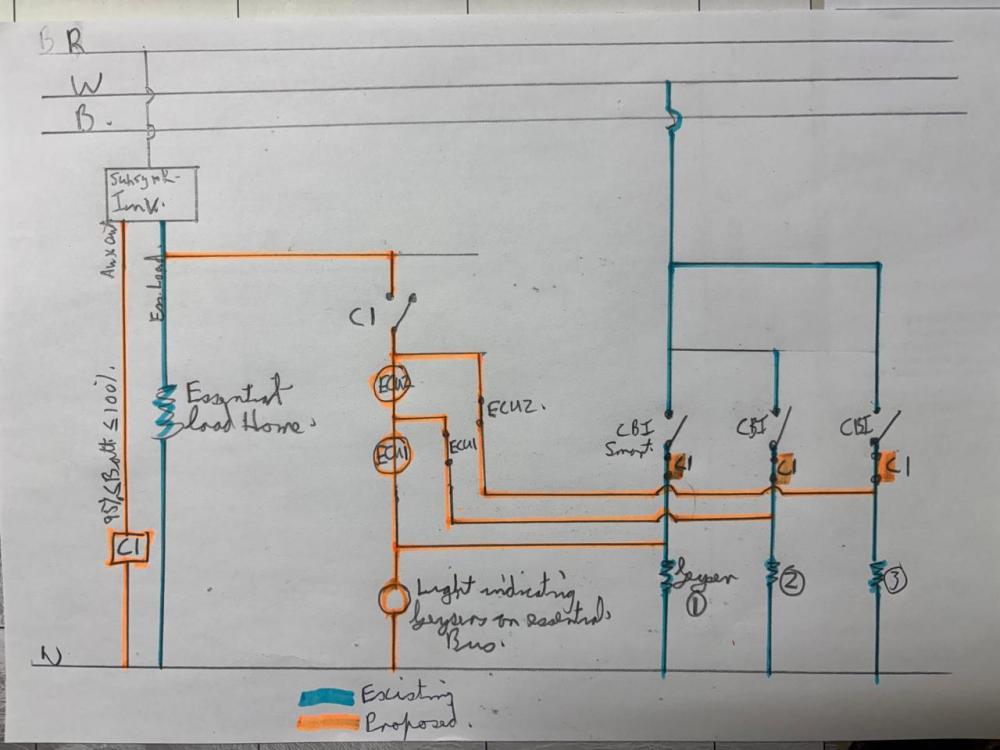
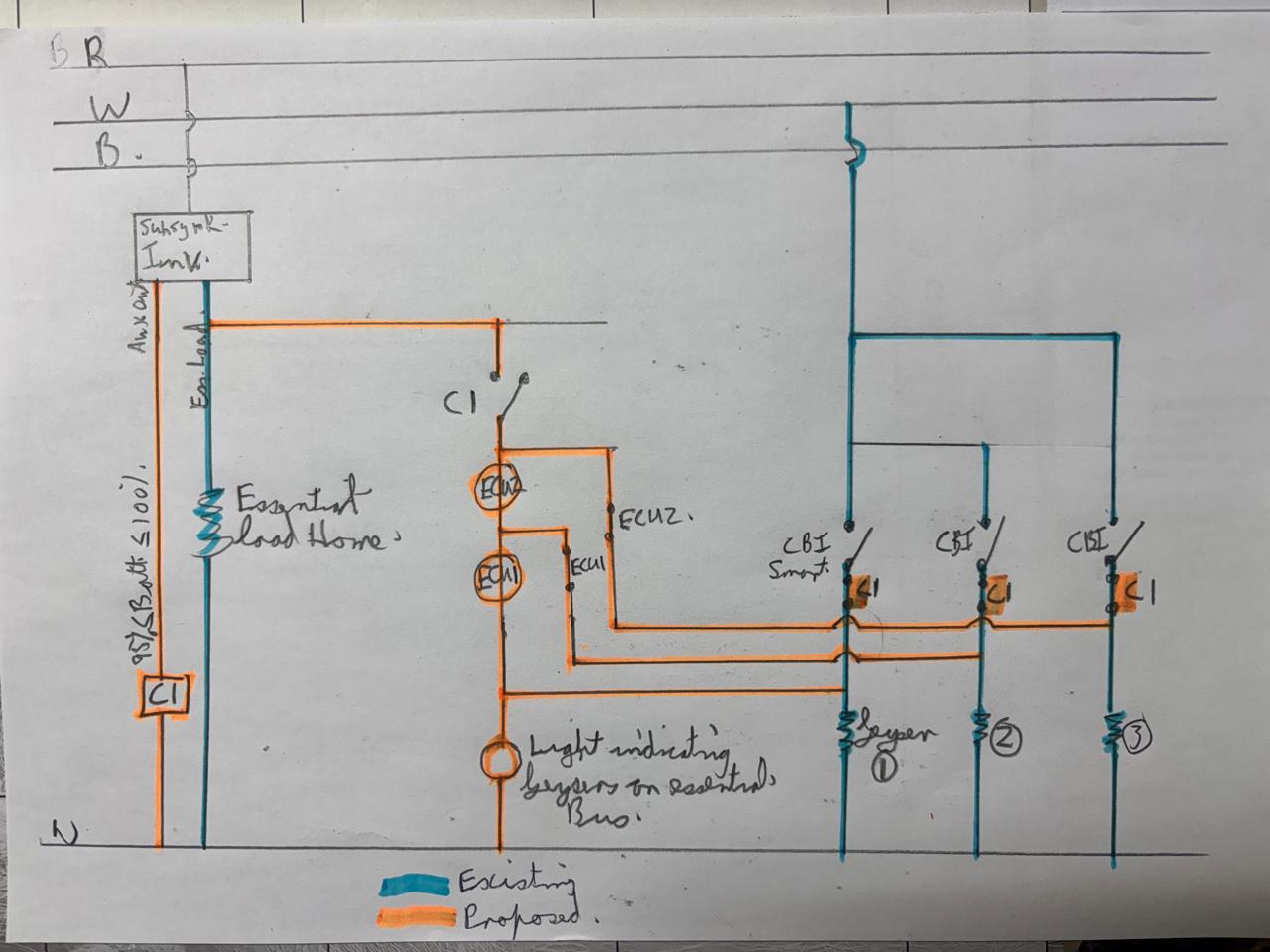
Dear All, I can't seem to find a discussion where the Aux output is used to "cleverly" switch loads from Non-essential to to essential bus. My idea is to switch my geysers over to the essential bus, but only if my battery is say between 90% and 100%. (The battery will only get that much charge if the sun shines) In addition, I am planning to switch my 3X geysers on in sequence, i.e the first go on, when hot (and thermostat switch off) the next geyser switch on, and so forth. This ensures that I can have all my geysers hot by the end of the day, never drawing more than 3kW at a time to the geysers since only one is on at any time. This idea also do not take away the function that I can actually switch all my geysers on simultaneously (using my existing smart switches) at night and early mornings on the non essential bus (white phase) should I wish to do so (lots of people in the house, no sunshine, etc.). Doing it like this uses the geysers as energy storage after the battery is fully charged by the sun. Attached is a diagram I want to implement (Blue is existing), orange is to be added. ECU=Energy control unit. This monitors current, and switch if the current exceeds 6A. So the 2X ECU will ensure only one geyser draw current at a time while on the essential bus. C1 is basically a contactor (changeover switch) switching from essential to non essential load, and also isolating the geyser circuits from each other while overriding the smart switches (that currently only switch geysers on early evening and early morning). Please let me know what you think, and if there is a better or simpler solution. One condition is that I don't want to lose my current functions on the geysers, and I also don't want the system to require manual input by looking at the app all the time and switching loads. I also don't want the geysers to heat up during the day if the sun don't shine, so just managing it by timers won't work. I look forward hearing from you. Thanks in advance.