


Janna
Members
-
Joined
-
Last visited
Everything posted by Janna
-
Coulomb: You are getting way to technical for me. What I meant was, can I expect the Pylontech to trip on voltage unbalance or limit output as if only one set of long cables are connected or perhaps not behave as normal when handling load as far as SOC is concerned?
-
Thanks Coulomb: Do you foresee any Pylontech control related issue with two sets of long cables hooked to the 4 x US3000B stack?
-
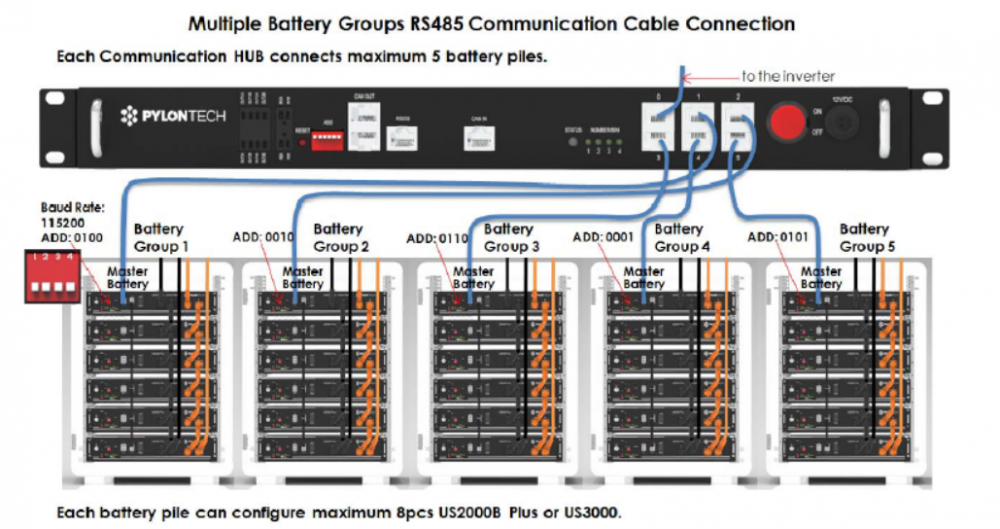
Thanks for your prompt response Coulomb. My real concern is the ampacity of the 25sqmm battery cables and battery terminal connectors. From my understanding, the Pylontech terminals have built-in temperature sensing and on-board output current control, seemingly configured to avoid overloading of the cable and terminal connectors. I'm yet to find literature on how that actually works. I recorded a peak steady state load of around 7kW once over the past month, hence very comfortable that I'll be within the ratings of both my inverter and battery capacity. I intend to set par 02 (max charge current) on each of my two inverters at 50A, thus the maximum steady state current on the battery cables is expected to be below 208A under worst loading condition. Aberdare's 25sqmm Power Panel Flex Cable is continuously rated 104A and I'd expect the 25sqmm Pylontech cables and terminal connectors to be similarly rated. Using larger cable size would only resolve cable capacity but the terminal connector ampacity remain what it is. I therefor thought of using two sets of 25sqmm long battery cables connected to the open pos & neg terminals of both the master battery and the bottom battery to form a parallel feed from the battery bank into the common busbars which in turn feed the two inverters, each via its own 100Amp DC fuses. In theory that would give me 200A battery ouput current (as limited by fuse rating) without straining the cables or connector terminals. Looking at the image published by Youda on 22 April 2019, it definitely appears if each stack are connected by two sets of long battery cables. Do you have any experience with such configuration or do you have any concerns to make it work?
-
Hi: Hope you can assist. I have 2 x 5kVA King Inverters setup for single phase parallel operation and 4 x parallel connected US3000B batteries (totaling 14.4kWh) . I want to maximize on demand and energy without overloading the long battery cables, hence I'm planning to connect the four parallel connected batteries via two sets of long 25sqmm battery cables to a single common set of busbars (as per picture attached). Both inverters will then be fed from the common busbars via 100A fuses. Any suggestions or concerns on the proposed configuration would be appreciated.
