Thurston
Members
-
Joined
-
Last visited
-
Thanks for sharing your setup @stefan44 ! We are on a farm in the KZN midlands and also 100% off-grid so it really matters that we get the best out of the system. It is quite remarkable that your batteries are within 0.01V of each other despite never being balanced, so you must be doing something right! 🤓 Sadly, I have noticed that the DCRebel Gen2 batteries seem to be fading after only 4 years of service. Directly after installing, the voltage would drop by 0.2V when a load ran on the inverter (eg: borehole pump at 1.6kW). Nowadays, the voltage drops by 0.8V. Also, the battery voltage would be around 52.2V in the morning before they started charging again, whereas recently they are around 51.0. It doesn't really seem to change much when I fiddle with the charger settings. Question: is there any value in allowing these batteries to go into absorb?
-
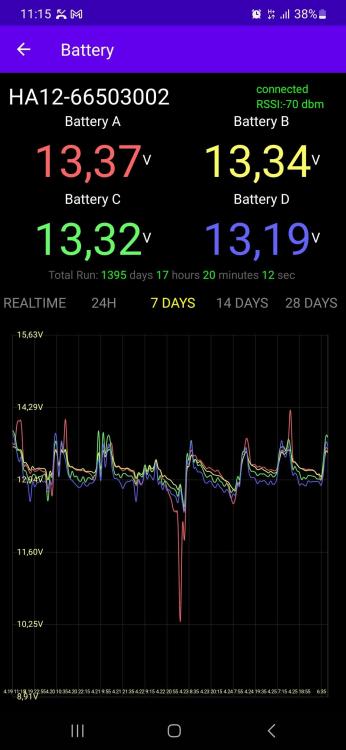
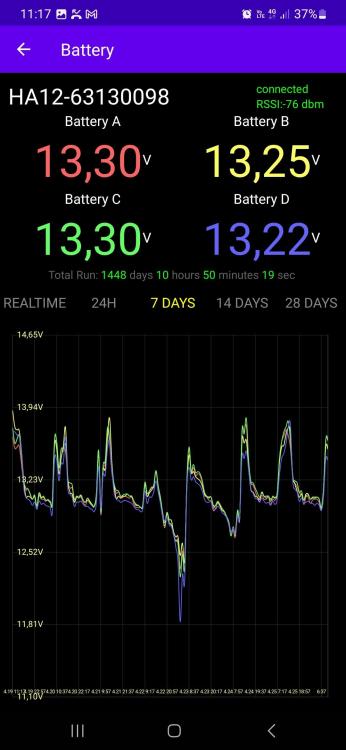
We have these same batteries in 4s2p configuration. The data sheet claims these should be charged to 56.8V but we have never been able to push them that far - the voltage would suddenly shoot up and the inverter would shut down. I assume that one (or more) of the BMS's stopped accepting charge to protect the battery causing the other batteries to get flooded with charge, leading to the voltage spike. I'm not sure if the BMS/batteries have been damaged by these spikes during the initial setup. To avoid this, the MPPT's (2 x Outback FlexMax 60) have been configured to charge rather conservatively (Bulk 55.4V, float 54.8V). And since the MPPT's don't read the same voltage from the battery packs (one reads slightly higher), we've also configured them in a master/slave setup where the MPPT that reads a higher voltage will charge to the bulk setting then go straight into float, while the other continues to charge (at less amps overall) to the bulk setting, allowing the battery balancers (provided with the batteries) to better manage any variances. Well, that's the theory anyway. If anyone has a better way of managing these batteries, I'd love to hear from you! PS: We also had to send one of the batteries back to the manufacturer for testing (at our expense and inconvenience). The battery was replaced but that battery pack (3002) has never been stable (before or since) despite many attempts at balancing. This is the other pack (0098) for comparison:
-
Thurston joined the community
-
Hey Keith, interesting posts - you have made good progress and I'm sure you're enjoying your energy independence! My lead acid batteries are failing, I'm considering the "LCB" li-ion batteries being promoted on sites like Solar Wholesaler, Solar-Boks, Solar Energy Zone etc. The price makes them very attractive (R15k for 6kWh). The spec sheet refers to them as "LiT48120-BT" which appear to be the same (or similar) to the ones you have installed. Your system has been running a few years now, have you experienced any failures with these batteries? Would you recommend them to a friend? Cheers Lance