SolarNoobish
Members
-
Joined
-
Last visited
Everything posted by SolarNoobish
-
Hi guys ! Hope you're doin'well. And hope you will light the bulb in my mind ! I have already 10 panel, 3500W, 1 string, installed. The panels are oriented SE ( i am in Europe). The VoH stated on them it's 33.3 Volts, the Open Circuit Voltage it's 40.7 V. Current 10.51A. Linked to a 5.5KW hybrid inverter ( a clone, no name). Single MMPT. There is also a Pylontech usc2000 ( 2.4KW / 48V). Everything works ok. Inverter says max open circuit acceptable = 500 V. MPPT interval between 120 to 450 V. The Problem / Question I would like to increase power production, i mean to mount more panels. I cannot find exactly SAME type of panels i got, what i found das a little bit different voltage., like : Open Circuit Voltage(V) 40.9 V Short Circuit Current(I) 10.89 A Maximum Power Voltage(V) 33.8V Maximum Power Current(I) 10.37 A I would need more 6 panels, but i am not sure about wiring. There is a single MPPT. I need to do 2 strings, in parallel. BUT...BUT....BUT... Is there a good idea to keep as it is the actual string, and to put in parallel the new one, since there will be a difference in Voltage between strings ? 1. In other words, can one have 2 strings with different voltages ( and panel types) ? 2. I can think about 2 strings x 8 panels each. But, this means the "new " string would have 6 (new) panels + 2 different panels ( old). And Voltage differs at panel level. Is this a good idea ? I've read somewhere that 5-10% difference in voltage it's acceptable. What do you think ? Except a new inverter vith dual MPPT, which would be best choice...
-
Hi again ! @Scorp007@Beat @Coulomb Friends, after 1 month, being more wise, looks like i got acquainted with the little Chinese Pylon2000, we made peace. She's sleeping nicely , she's floating, waiting the power-grid to fail and through that to do the job. I had a power-failure and the inverter switches instantly , it was a beautiful ideal test-situation on a sunny day, so the source was PV's + Pylon. I took advantage on the situation, in the idea to create for couple minutes the worst case scenario - and flush water, started microwave, forced geyser and water pump to work ( by leaving warm water flowing). There were something around 4.3 Kw on stake. And it worked ! Pylon survived these harsh conditions and at the end she was at 58% !!! PV's had produced something around 3.2 Kw and pylon successfully completed the rest. The entire test took around 2 minutes - i mean the big consumers. After that the house had something about 350W - a joke, PV's were dealing with . So, with a little help from Sun, it was okay. Once the stress ended, pylon was charging itself from solar panels. Not bad at all. I am still discovering the wonders of technology, don't know if i mentioned till now, i didn't believe in solar energy before starting this adventure, i was 90% certain it's a hoax, a joke, something appropriate for lighting a 50W bulb, but not a house. Meanwhile i have found and buy a more efficient water-pump, she claims she need only 370W to do the job. The actual one takes 1.2 Kw. These days the pump will be replaced, in order to have low power consumer in case of grid-failure and ensure a little bit more life to pylon. It is kind of weird the way the solar tech changes one's mindset - look at me, i started to thing "green" , low power consumption, power-economy. @Beat I need at least 3 bar. Because between pump and house i have also a softening water tank - don't know name in English, basically extracts the Ca, Fe & stuff from it - and this station requires at least 3 bar on input water. I have what we call hard-water, full of Calcium, it is killing wash-machine and stuff if no treatment. That's why i said i need 3-4 bar.
-
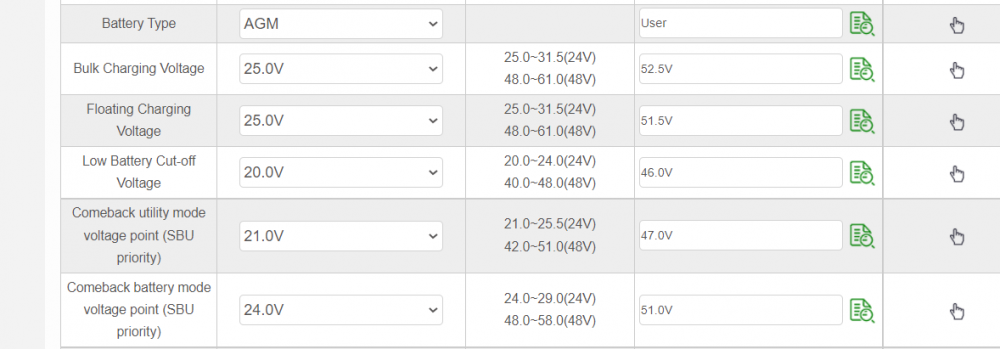
You all have right. That pump it's too much, for one pylon. There is only one pylon because , despite the fact i have a big pump, i don t have the big money for 2nd pylon. I'll try to find a way to reduce the power - changing the pump. It is working through pressure detection , i mean no expansion, it's a little piece we call it "pressostat", which actually measures the pressure of water up-side ( house) and when it drops (flush, open tap) , he opens/starts the pump. I am not sure if i can find a pump with little power able to push from 25 meter and to ensure me 4-5 bar. I'll make some enquiry, maybe i'll find something. Would be best solution. Regarding the need of cycling - it looked also for me a little stupid idea to f... all time the battery. Was not my opinion that. I set the batt as USER , it is not AGM. Probably you saw the left-side of interface - these are NOT the actual inverter values, are kind-of-menus. Right side are the working values. Clearly, geyser will be eliminated from configuration. Secondly, i start enquiries about a more "polite" and having low-power rating water-pump. Thank You Guys, for spending time with an idiot.
-
You' re right, @Scorp007 For sure i need to change the AC circuits, eliminating geyser from them - i mean from back-up part through battery. As you pointed out - in case of emergncy / blackout, ino one needs to take shower. It will remain only water pump as the big consumer, but at night, no one will use it, except flushing water - this takes 1 minute of load or less. True, i am scarred because the current drawn - 35A it's too much, but i don't have a solution yet. A less power-pump cannot push water , it's a zug-zwang, a loose-loose situation. But... one of the goals to do what i trying to do it's exactly this - case no grid, i need water pump working. Last night all house was on battery - geyser off. There was little loads - 2-300 watts when the refrigerator goes on, in rest 100-150 w. At morning, the pylon shows 2 green led on SOC. So - in normal and low loads she can manage it successfully. I am trying to USE the battery because i've read that she goes out when no cycling for 3 days. Kind of block, pain in the b... They say that no usage means less life, they like to be charged/discharged at least once per day.
-
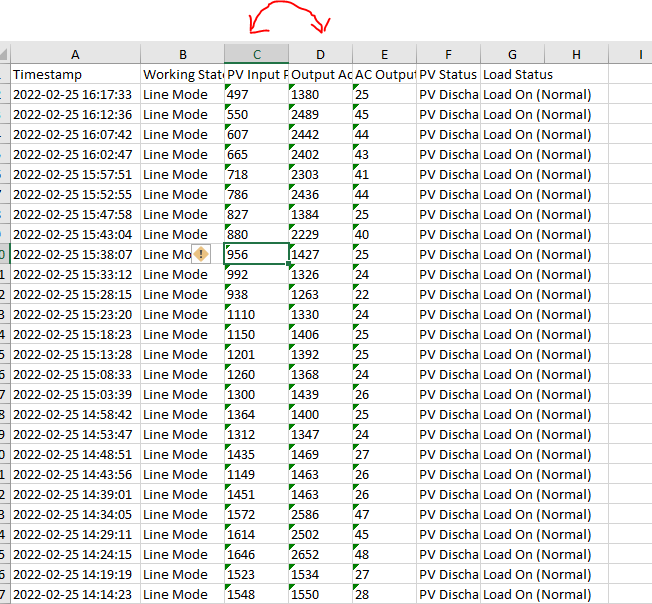
Thank you @Scorp007, @Beat My inverter it's a piece of junk, i am aware of. I discovered, after hours of playing with and going from loop to loop, that it pretends to control voltage in 0.1V steps, in reality it is working with math round... only INTEGERS. Sounds crazy but experiments are talking. Of course, there is no such reference in "manual". Therefore i am trying to find the best way to set the junk in order to avoid looping and stuff. Looping was triggering EXACTLY because of this issue - real he's working with integers, even you put in it decimal values. Ok, i got it, lesson learned. Till i'll got money to buy a real inverter i have to survive with the junk. There is a gain , this way i have to learn more, to understand more. I made settings after settings, looks like i found a combination which does not go looping. I checked manually, on inverter's screen what happens, voltage , bla-bla-bla. I have these settings now : With these, the gap between go-to-grid and go on batt it's large enough, no looping. I tested, playing with loads - usual loads, no geyser. I cut-off power on geyser. But water pump it's mandatory... These are readings from the inverter's screen. The "peaks" 1.4Kw = testing what's happening on flush water ( he he he...i need to do that even on black-outs...) and rest are usual consumers. What it's a kind of weird for me is that when a big load ends, the voltage reported by inverter raises. Hm. Meanwhile, the battery lights are displaying the same SOC - 5 green lights shining, no matter what the web-interface of inverter says... Do you think that these values i use in settings can harm pylontech ? From experience i mean... To me they are looking in the limits. I am a little bit worried by the 35Amps drawn by water-pump... Pylon says MAX 50A... I think it's ok for couple minutes... Struggling to understand what am i doing here, i really don't get it, how the inverter / web interface calculates the capacity of battery... He is giving some figures... i don't believe them, since the pylon shines on 5 lights... Clearly the invertor uses inside some algorithm, NOT for litium, so, he makes some wrong calculation and displays these figures. My hope is that BMS it's on duty. These are Data from inverter-web. Ok, this is correct, same values i've read directly. Now comes the madness. Well, well, well... what do you now ! My battery grows it's capacity from air, from nothing, without charging ! I am cool, huh ? same proof of my perpetuum mobile, free energy fro data-sheet : I am putting these here just in case someone like me will encounter same issues. Bottom line - i don't believe nothing from what inverter says, excepting Voltage. This is the big "advantage" using cheap inverters, no communication, they allow to charge batt from nothing...



-
I am new in this world. Just installed one pylon 2.4 kw/50A , on a no-name inverter - actually he calls himself as MPS-V PLUS 5.5KW. Got 10 panels 350W. Evrything made in ...china. The inverter has no comm port (CAN,RS458), so the pylon cannot communicate. I hope that BMS it's on duty. I made the voltage settings ( back to utility, back to battery, bulk charging, low dc cutoff, float ). Then i was killing the grid power. (the inverter is hybrid). The primary source was SOL. It was dark outside, so no sun, meaning inverter was functioning in "bypass mode". The test succeeded - inverter switches on battery instantly, when i killed the power. I re-connected grid power, I switched inverter on SBU as primary, instead SOL. Looks okay also. But not for long ! As i saw also here, the problem occurred when the big consumer ( boiler, water-heater, geyser) started. He draws like crazy from battery. He needs 1.6 kw. Way too much for my little pylon. The battery voltage drops instantly. The inverter goes in alert mode, displaying 4 = voltage too low on battery. He switched back to grid. In seconds, he changes again to battery - i presume the voltage on it has raised at point back to battery. But, having the big consumer, he falls again instantly in alert - low voltage. It was an infinite loop, he goes back and forth from grid to battery. Kind of idiotic behavior - i mean i would expect it to be more clever. Meanwhile, pylon seems happy and - all greens lights , SOC near to max. Another stupid thing - how to display all green and same time low voltage ? Clearly, there is no way to deal with a load bigger than pylon it's able to. Piper / Coulomb warned me about, but at that time i was more idiot than today to understand. The inverter option "switch on grid on overload" is useless. Because event was set, the idiot keeps the loop, despite the overload. I managed situation by raising the voltage for come-back-battery, and exit from that loop. So - at least my no-name inverter , in such case, was going in an infinite loop. Maybe inverters which are communicating with pylon don't do that. I am still trying to guess the combination in such manner to avoid the loop, and have the inverter to act logic - IF load it's too much for battery, go back on grid, and STAY there, don't switch back-forth every second. Ok, i am aware that the geyser wants too much from pylon. It would be nice if i could find a way to deal with through settings. If not.. my plan to stay on SBU at night falls down. Because of the geyser. Hm. Okay, i have a stupid solution... barbarian but looks workable. I could kill the power for geyser at night. With a timer outlet - case closed - he will sleep. No power from sun-set till dawn to geyser. This is less expensive than another pylon, to increase capacity. What i would like to have...but it seems impossible - at least with my inverter - would be the ability to change AUTOMATICALLY, on a time-schedule, the "primary source". it would be nice if i could program SOLAR from dawn to sun-set (i.e. 7 a.m to 7 p.m) and SBU for night. My inverter does not look like to be able for that. Neither to let me have a combination alike SOL+SBU. Theoretically, what i want it's what does inverter on SBU. But - what do you know... as i said above, i got a beautiful endless loop.
-
@Coulomb and @Piper I did it ! Thanks to your advices, i finally connected it. Looks like it's working - at least the charging . She was near to empty, 21% ( voltage 48.2.) I am waiting her to get full and start discharging testing - i mean i'll cut-off the utility and see how it works and find the point of go-back -to-utility. Now i set it at 47V. It's too low, i mean i think this will go till empty battery. Maybe i'll go little bit higher, 47.5-48. I got a new toy ! Here it's winter, cloud and easy snow - so no PV input, only 2-300w. Perfect day for testing it. I set the limits in area you advised me. I set the charger current low than 25A - my inverter has 20A and next 30A. So - i go for the lowest, just for safety - cannot be bad, willl take more time to charge and limits power , but i am testing, this is first day. A big-big-big, a giant THANK YOU for all your time spent with me and for valuable info you gave me. You can't imagine how helpful you were. I don't know how to thank you...
-
You' re right, it sounds logic what you said... 1200 W would be max what i can get from pylon. But... what the fu...k is doing the hybrid inverter ? This is his job - on my understanding. Taking / switching power from utility IF the source ( no matter source = PV's or batteries) hasn't enough. IF i am on battery, and the request i have it's 3000 W, for example, i would expect the inverter to be clever enough and manage situation ,without killing battery. Ok, i take whatever i can from battery ( these f...g 1200w), i am stopping draining battery when it's voltage reaches lowest value ( from settings, i.e.. 46.5 V as Coulomb suggested) and i switch back to utility. Same model as now, when it works without battery, only panels and utility. He's doing perfectly the switch whenever solar power isn't enough to cover consumption. I presume same behavior with pylon. But i am not sure. This is why i look answers from people with experience, like you. The only problem is that i PRESUME a behavior of inverter in case consumption it's bigger than bloody 1200w, hoping he will switch back to utility instead killing pylon. And all my stupid posts here are generated by the fact that i need to set this desired behavior only from some idiotic voltages... If i do something wrong, i have all chances to kill pylon, to say good bye to 1000 Euros....
-
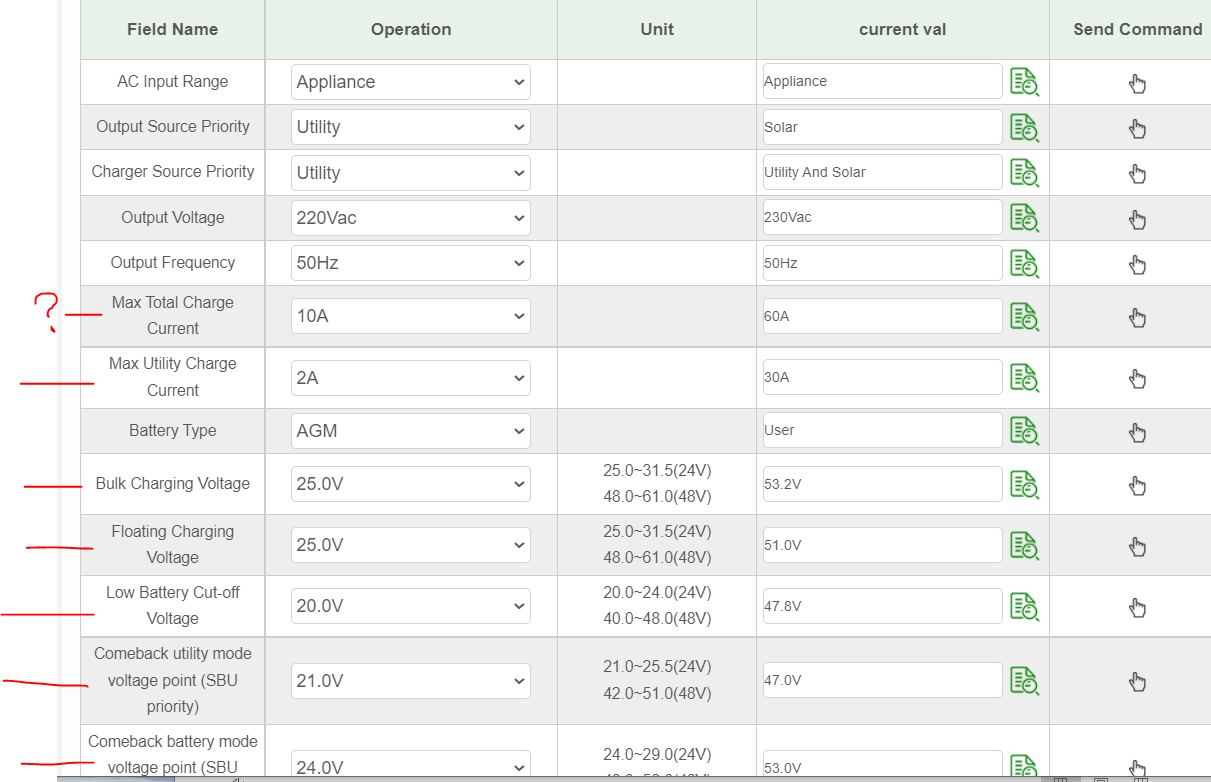
Thank All both of you for spending time with my stupid questions. It's very valuable to find someone who answers to your questions, even you put idiotic questions. All my appreciation and respect for you. @Coulomb Thx, yeah, i have these in menu. Looks like the no-name clone i got it's a copy pretty close to original. @PiperThe idea is to cover the house consumption after sun set, in reasonable limits. I mean limited / low consumption. But, in the event - for example - that power drain reach let's say 3 kw, clearly the battery cannot face it. Here, in that case, i would expect the settings from inverter to act as i imagine they do. Take power from grid when the battery goes as little as 30% - should be the message. This is what i expect from those settings. . Okay, i can set 25A charging current. Correct. I will NEVER use the full power ( AC) the inverter can give ( 5.5KW ). Usually, i have "peaks" of 3 - 3.5 KW for short periods, minutes ( boiler- water heating, , water-pump ( 1 kw , couple minutes). I already limited the inverter output ( on AC side = limited consumption) at 20A. So - i cannot use never more than 20A in household, the fuse will jump, the show will stop. I did that because the inverter dealer says that it' good to NOT keep him at 5 KW - he can deal till 6kw on peaks, but it's unhealthy to have it all time at max power. The 5.5 kw inverter was over-dimensioned, in reality i play somewhere between 2-3 kw. So - my max consumption on AC can be 20A * 220V [ I am in Europe ] = 4400 W. I limit the charging current for battery at 25A. Ok, 20A as Piper suggests. Pylon states he got 2.4 KW @ 50A . I made a survey on after-sunset consumption. For example these are WATTs. (TV-set, lights, refrigerator, usual stuff.) That's the kind of consumption i think the pylon can manage without problems. Problem may occur in this situation. Water-pump on, boiler on. As you see, 15 minutes approx. with high power i.e. 1.3 Kw. Let it be 1.5 KW. I presume that, pylon can supply that power , for that limited time. Theoretically she can give 2.4 KW in 1 hour. What i am not sure and try to understand and do it correctly by settings, it's exactly this kind of thing. Will know pylon to deliver those requests, and when she gets less than 30% to stop and inverter goes back to utility ? This is what i have in mind to do by setting it. This happens after sun-set. The other moment could occur during day-light. When, i got some PV production, let's say not enough to cover consumption. Now, without pylon, i take difference from utility. But what will be if i wire the pylon ? If i set on inverter priority SBU ? And a picture with my inverter web-interface. Max Charge current refers to battery - i presume... The values are just for fun, pylon it's NOT wired yet, she's sleeping in her box while i try to establish the settings. Sorry... looks like the Chinese are dealing with English as well i am... Nothing clear and obvious , looks like one needs rocket-science to do these settings.



-
Hi guys, Completely noob here. After reading twice some posts about pylontech, i am more idiot and lost than was initially. You know how it goes - what you don't know doesn't exists... The problem. I installed a solar system with a hybrid inverter. It's a...clone...no-name, looks like EASun, but isn't. He is 5.5 kw, i have already 10 panels (350w each). I am on-grid also, in a sense, i mean the inverter takes from utility what is needed in case solar is too low. I made an investment in a Pylontech US2000 and from 3 days i am starring at it, and reading forums. I would like to have it long time, she's "precious" for me, had eaten a lot of money. The issue comes from the weird piece of j..k no-name inverter. NO CAN port. NO RS485. NO PYL definition - he knows only Flooded or AGM batt. That means i have to go for USER - type. And here comes the problem. Some things are totally out-of-my-understanding, and i would like not to do some stupid settings and say bye-bye to battery too early. Please don't blame me too much - i am NOT a native English speaker, therefore my understanding could be affected by language barrier also. Look please what my dear NO NAME inverter expects from me in order to set the battery : 1.Bulk Charging Voltage - I put this 53.2 V as pylon says in docs. 2.Floating Charging Voltage - Here I've read some topics, didn't understood too much, too many opinions, i would go for WHAT ??? 52 V ? maybe 52.5 ? One mystery here. 3.Low Battery Cut-off Voltage - in my understanding this should define the battery Voltage where inverter stops using it, stops taking power from it. As i saw, the LI batts are having a quasi-linear voltage till to final stages, voltage drops when near to empty. I would like to NOT reach battery empty ( ok, i know BMS will do his job), but more - i would like to use battery till she goes to 30%-40% let'say. Not bellow 30%. HOW can i do that with this parameter, the only one i have available ? What voltage has pylon when it's 30% full ? I must give a Voltage... I am lost here. I would go for 47.5 V - i mean when the batt has 47.5, disconnect, leave-it alone. 4. Comeback utility mode voltage point (SBU priority) - Well, well well. Sound nice, don't you think so ? but again... he wants Voltage ! What voltage should i say ? In my understanding, this parameter should instruct the inverter "ok, DO NOT USE power from battery when she got THIS voltage, take it from utility ! " Means that i should give here a value ... the one i want for example when battery it's 30%. Here... i am lost. Probably by testing, to find the voltage for 30% for example. Something around 51. No idea. 5. Comeback battery mode voltage point (SBU priority) Hm. In my poor English, i understand here "When battery has THIS voltage, disconnect utility, USE BATTERY". Can anyone give me some advice ? I feel lost and i don't want to do something idiotic....