


RabidBunny
Members
-
Joined
-
Last visited
-
-
@Scorp007 ... yes, but compare theirs with their Welding Cables, and you'll notice a sizeable difference, that's why I'm leaning towards Welding Cables rather than Battery Cables ...
-
-
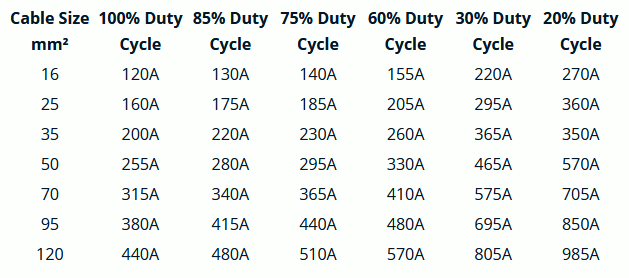
I'm with you on this one, even those guys specs say Battery Cable 35mm² can handle 220A at 100% duty cycle; hence the confusion as I'm trying to avoid installing 95mm² cable at the price of half the system, where 35mm² proper Welding Cable (as per the above) will suffice (even for sanity sake 50mm² being half the price of 95mm²).
-
-
That's my gut feeling as well ... Original post did refer to SABS ... 😀 Most Welding Cables run 400V+ easily ... many of them rated for 1000V (max 2000V)
-
Yes, that's what I'm trying to confirm, thanks! You clearly outlined it nicely in this quoted section: What baffles me though, is that if you phone (almost any supplier), asking for the amperage rating for 35mm² Battery Cables, I can guarantee you almost every single one of them will tell you something different and at the end of the day, no-one is any wiser as to how can some say 147A, some say 162A some say 240A (high current rating - expensive as hell from the UK), then they all start "googling" because even they aren't even sure anymore - and before you know it - you can run half of Eskom on a 35mm² Battery Cable ... 😆 Why on the AC side of things is this more common and straight forward, ie. ask them for 2.5mm GP Wire and almost all of them will tell you the exact same. I understand with Battery / Welding Cable comes complexities like number of strands, insulation type, etc. but if I search for 35mm² Battery Cable, almost every supplier (some even selling the same cables are way out of bounds from any kind of "normality"). I'm trying to get to the bottom, not just of what is right (according to SANS), but also what is safe, ie. not trying to skimp on cable or such ~ but even a 25% over-spec leaving room for "additional" safety.
-
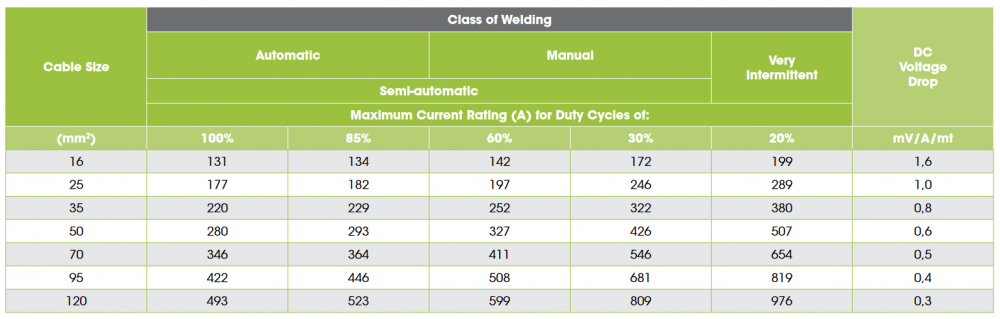
The Battery Cable amperage ratings provided, is from the actual manufacturers' website (for the exact cables in question). The Welding Cable amperage ratings provided is also from the actual manufacturers' website, they attached alongside it the relevant approvals and certification from SABS, etc. If you consider the 75% de-rating factor then it means in order to "safely" charge / discharge at 190A, (for these cables based on the above charts/ratings), then one would need the following: Battery Cables @ 120mm² ~ Sunsynk recommends 50mm² and Deye recommends 35mm² (for 190A charge / discharge); however, to be honest I've never even seen an installation ("domestic") using this size cabling ... 50mm² or 70mm² sure Welding Cables @ 50mm² ~ for 190A charge / discharge ... 50mm² seems reasonable However many manufacturers have a degree of protection integrated, ie. from 5% upwards some even as high as 15%
-
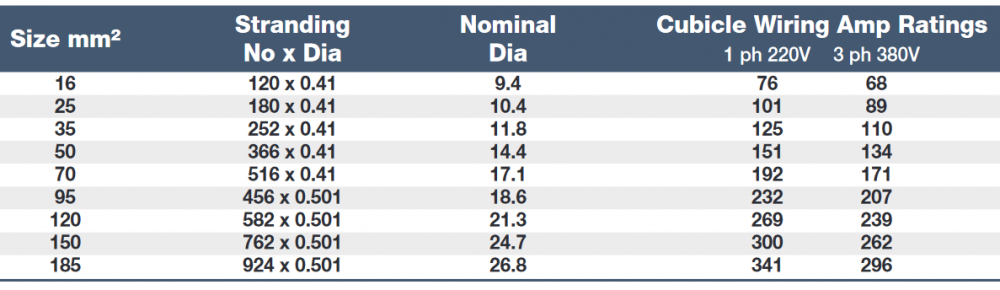
After quite a few days of research I've been doing on the topic in question, people all over suggest that Welding Cable can be used instead of Battery Cable for Solar systems; however, people tend to prefer Battery Cable as they believe it's cheaper than Welding Cable. I however found with searching through many online stores that Welding Cable tends to be slightly cheaper (obviously depending on where you buy), but in general the pricing seems slightly better (based on the same size mm² vs mm² comparisons). What I find interesting is the following comparisons ... Battery Cables: Averages around 60V Fewer copper strands Low to moderate flexibility Not flame resistant Welding Cables: Easily exceeds 400V+ More copper strands Greater flexibility Flame resistant The chart below is based on approved SABS 1574 standards and ratings: However what can't seem to escape me is, the fact that for Welding Cable you'll use a way smaller size cable to do the same job when compared to Battery Cable, ie. 16mm² Welding Cable compares to 35mm² Battery Cable (technically between 25mm² and 35mm²). My question is, why do you need 35mm² for 125A ~ 140A charge / discharge using Battery Cables when 16mm² Welding Cable can suffice? * even if you choose to play it safe and rather obtain 25mm² Welding Cable you will still be way aboveboard when compared to Battery Cable (purely based on the amperage) Is this purely a matter of personal preference or choice, or are there any sinister items I am overlooking: ie. degrading factors on Welding Cable with tin lugs vs Battery Cable or oxidation at greater heat or such? Surely if there are no ill effects of using Welding Cable, then by assumption based on the above the following can safely be used? 16mm² Welding Cable for a max continuous 100A charge / discharge 35mm² Welding Cable for a max continuous 190A charge / discharge Looking forward to the replies ... 🙂
-
I tend to agree with @Mad Mike on the water heating. I reduced my bill by close to 45% at first just by having gas installed for the hobs and having EV tube conversion performed on the geyser. ^ these two combined should be within your budget and you'd still have spare change. ... the benefit of the above is that even during load-shedding you'd still have hot water for showering and you can still make a hot cup of joe.
-
-
The strings mostly run around the 300V (sunny days)
-
The voltages does not have to be 100% the same for the MPPT's (I think there is a margin of tolerance). I won't say 50V difference between them would be OK (you'll most likely get a unbalanced error/warning); but between 5 and 15 volts I'm pretty sure it would be OK? Today was very bad weather and they ran around the 249V / 250V peak (each of the 4 x MPPT's, taking into account that they are "paralleled" - voltages roughly stay the same for the 2 x strings, but the amps double) ... on a good sunny day they push up to around the 300V mark. I've added a few more panels since my original post, I started out with 24 x 410W panels and added another 12 x 410W panels (during summer), and then recently last week added another 12 x 415W panels. I'm currently running 8 x Strings of 6 each (36 @ 410W 6S2P, 12 @ 415W 6S2P), I can still add 2 x panels per string and still be within the safe zone with regards to the 500V limits as I still have enough roof space 😀 Panels are facing 18 degrees North-East at a 8 to 10 degree tilt (I don't really have shading problems, even though I do have a lot of big trees, they are mostly far away not to cast shadows) ... (optimal tilt in summer is about 23 degrees and in winter around 53 degrees), but when I had 14.76kWp during summer I generated 15.5kWp on most of the sunny days.
-
I tend to agree, if you adjust too much you will lose out in the other months ... rather just add the odd two or four panels to compensate. I've had awesome results this summer that passed where I actually surpassed my PV array max capacity, I had 14.76kWp ... and generated around 15.5kW on most sunny days continuously. I've since added a few more (as demand grew), and now have 19.76kWp ... (having generated just over 16kW peak yesterday - during winter). My panels are all facing 18 degrees North-East, around a 8 degree tilt, so I'm thoroughly impressed by the panels, as my optimal tilt for winter is suppose to be 53 degrees and summer 23 degrees ...
-
Which sections are you interested the AC or DC side, or all? Sorry have been very busy lately and haven't frequented the forums much.
-
"The oven should never get battery power" ~ not all are equal, ie. not everyone has the same goals, some users are completely off-grid. I took the plunge and shoved the middle finger up Es(d)om's nether-regions (around a year ago) ... I have since not spent 1c on electricity generation (regardless of cloudy, non-cloudy, etc.). There are quite a few people on the forum who also runs their entire house from inverters, solar and batteries. I sometimes peak around 6kW in the evenings, if your bank is large enough then the 2kW you draw for the oven is a breeze (as the load is shared amongst your bank).
-
"It's days like this that can turn one into a nagging power nazi, constantly moaning at family members for making toast and using the microwave." ~ this was hilariously funny, yet true at the same time! There should be a meme for this, "Let the Winter Games begin."
-
Take of the "Activate Battery", that is only used when you add new batteries to the bank, and allow load balancing until they all equalize. I don't like doing this using the inverter, and rather ensure all are fully charged, even the new one being added, then I know their balancing is roughly 100% within a few decimals of voltage. If you have two batteries assuming 100ah each, you could bump up the 100AH to 200AH, and set the charge to 50% of the bank capacity and discharge can go up to 75% (this depends on your battery types, etc.), consult your manuals for the respective configuration. However the CAN communications (if you inverter is connected to the battery bank), should take care of these for you.
-
Remember that the "MPPT Range" for the Deye 8kW Inverter I provided (125V ~ 425V), is not the limit it is the recommended range where your MPPT tracker will produce the best possible results ... (since you have the 8kW unit, you also should have 2 x MPPT's, where each can take 2 x Strings, ie. you can have 4 x Strings connected to your Inverter). Since you are in Centurion, note that for your area your optimal azimuth is around 53 degrees during winter, and around 23 degrees in summer. So regardless if your panels are facing 0 degrees north, you will also lose some efficiency if your azimuth is not correctly adjusted, begs the question who gets onto the roof to adjust the azimuth every 2 to 3 months ... ? (that's a little insane). Take into account that the general average I've seen on the forums from much reading and asking is that people tend to lose about 30% efficiency during winter, which seems to be common in the Southern Hemisphere (even results from Australia, etc.). If you need 100% optimal all-year-round, you will most likely need to install a sun-tracker system, which will cost more than your entire system, battery banks, panels, inverters all included, rather than just adding one or two odd panels to compensate for the loss.


