WallK
Members
-
Joined
-
Last visited
Everything posted by WallK
-
My MPPSolar does the same thing It does it on every firmware I've tried Both with SUB mode and with APL range (my problem is the higher threshold tho, my grid is basically unusable now with 260-270V all the time)
-
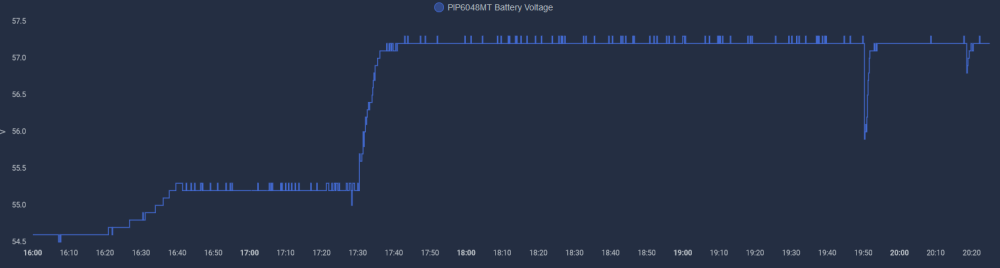
I've finally tested with grid (and solar) charging at the same time and it never overshot the float voltage EDIT: Sorry, I wasn't patient enough After some time it got past it and sticked at 57.2V while batteries balanced
-
100% is the maximum rated capacity of the cell If you don't go to the upper voltage -- you would not get out all the capacity I don't trust you after the parallel current fiasco 🙂 I won't touch the BMS settings for the simple reason of warranty And anyway, it never goes there, even if 3.6 is too much and the quote below is wrong There's no such setting in the firmware I actually don't for a long time now
-
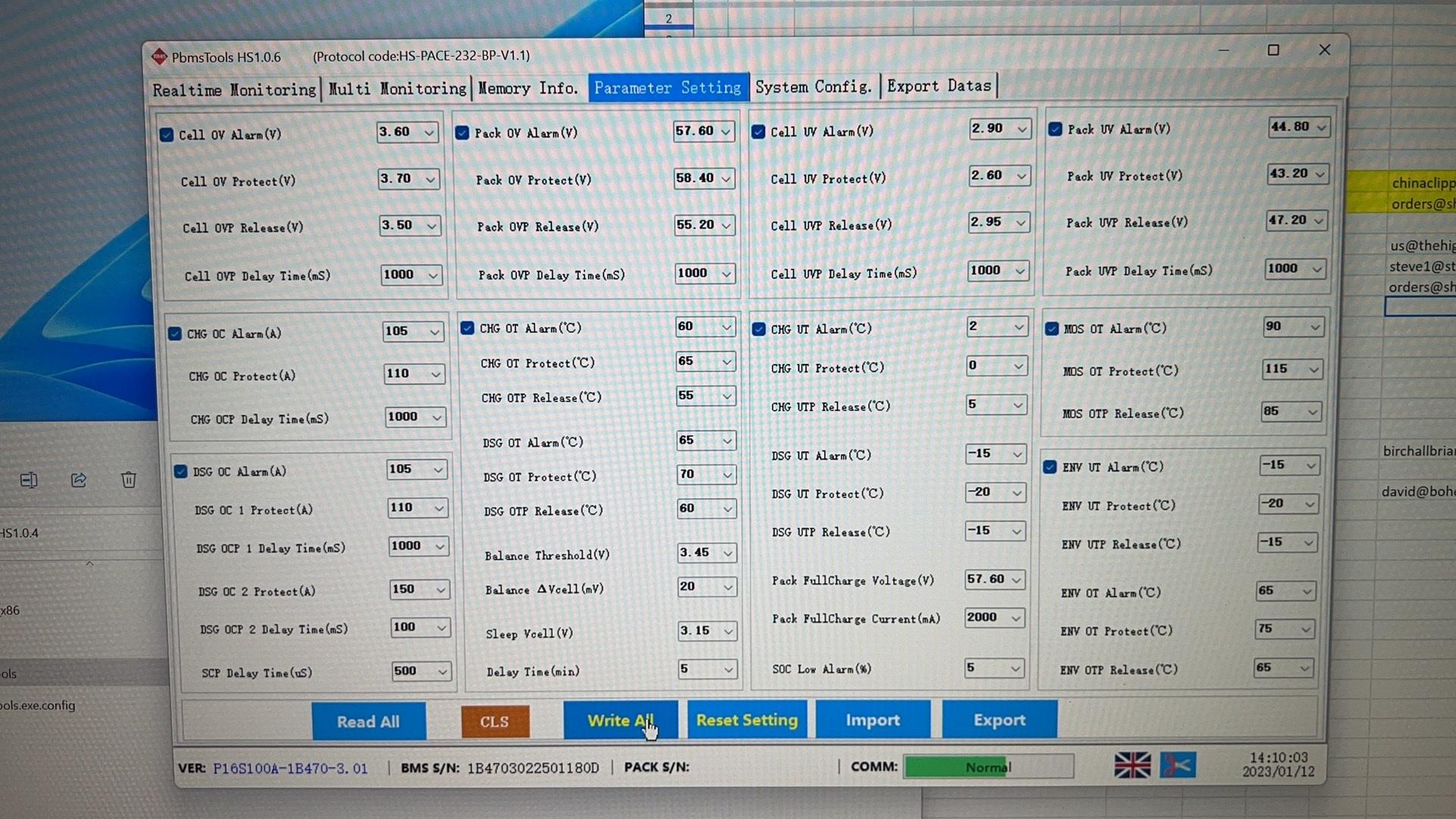
I have found the default (recommended?) settings of SOK 16S LFP if you're curious This is actually the usual (or close to it) BMS config for Pace BMS based batteries, I have found several very similar setting by image search But also some with 3.5 OV and 3.65 OVP Not sure, but as said before -- I don't see a reason for it to affect inverter stopping at 55.2V

-
It should! As far as I've read it's balancing by using input current, not by discharging the highest cells (or something along the lines) With the idea behind it being all the cells will become fully charged thus really balanced, not just equal voltage I'm not sure about the specifics, but the disconnected battery with BMS doesn't balance, at least perceptibly The highest cells just passively lose charge a bit faster. But this is an anecdote, I haven't left them for any substantial amount of time I will check when I have good grid power if it goes over the float But mine stops at 100% or close to it, it doesn't stop THAT early...
-
This is exactly how balancing works It goes into OV and then charges the cells that are under this How else do you plan to actively top balance cells? Your link recommend not charging to 100%, but most sources say it's fine or even recommended And I'm not talking about seller here, I'm talking about battery designers here, Current Connected Just to reiterate -- this only happens on solar charging, grid charging is fine for some reason...
-
Sorry, what? If I put 30A into system of two parallel batteries they each will take a part of it depending on their resistance They will take fractions of available current, so that <full current> = <bat1 current> + <bat2 current> So in my case of almost identical batteries one will take half and the other will have remaining half Literally <available current> / <number of batteries> I don't have JK BMS and theirs charger settings will not allow the battery to ever balance I will not change the BMS settings from designer's recommended (that we discussed with them) for the fear of losing a pretty long warranty Also, those charging numbers are what BMS requests when connected over CAN or I've tried other settings and it's getting stuck at whatever is set as float
-
30A max for two 100A batteries in parallel is low enough I think (15A per battery) It is literally the spec And it happens only on solar charging I don't think so, voltronic said it was a bug and provided me with 60.66 firmware built to fix it
-
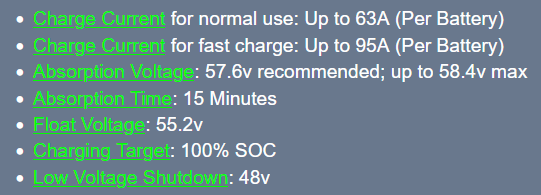
My bulk is set to 57.6V, and 55.2 is exactly what is set as float voltage My battery never goes even close to the CV for some reason It did before on grid and even overshoot that voltage for a bit My batteries are SOK LiFePO, BMS goes into OV at some voltage and starts balancing Never happens on solar for some reason Also, going to this firmware from 60.66 to 60.96 patched reintroduced the bug when inverter is using ~2A (~400W) from grid to charge the battery even is Only Solar Charging is selected
-
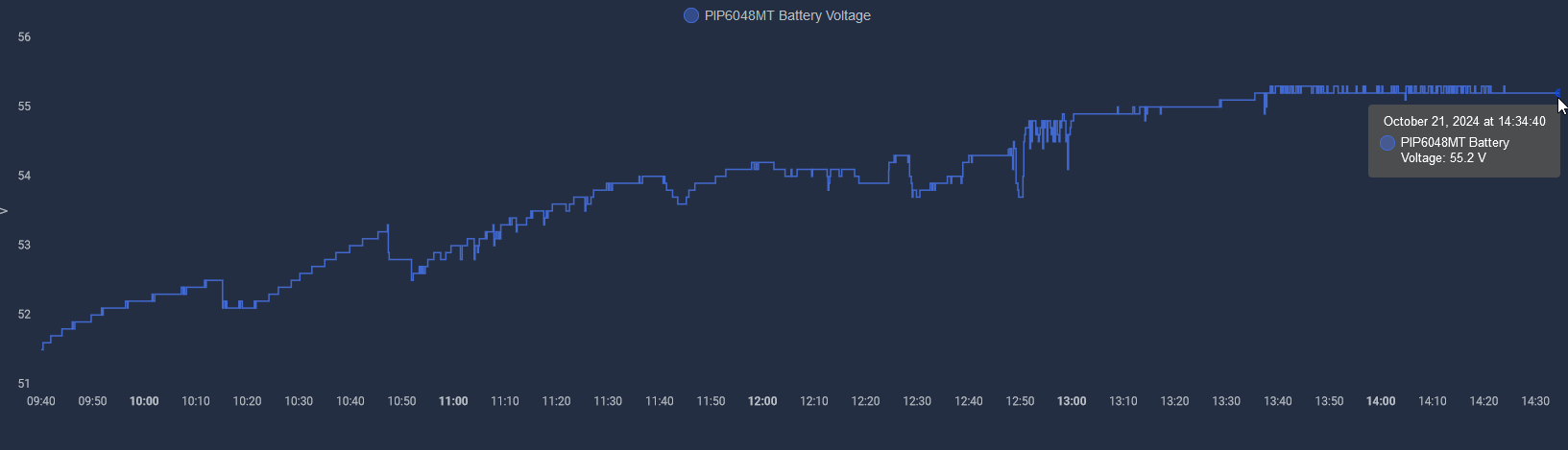
I've flashed this firmware with the hopes to see my batteries finally balanced But it just stops charging at float voltage still (please check attached image) This happens on solar-only charging, with grid it goes to float (at least it did on other firmwares, can't check right now) I have still plenty of solar available at the last point Was I mistaken and the fix is not for this? Thanks!

-
My BMS requires higher voltage to drop into OV protect mode and start balancing With Voltronic solar charging behavior -- it's actually is charged to 55.2 like yours are 🙂 Thanks for the information, really appreciate it!
-
I very much hope so, I don't think we had full day without couple of hours of power yet. But it depends on rockets and stuff falling on electrical grid hardware, so no guarantees whatsoever That's not lead acid, that's LiFePO with BMS attached. Actually, two of them parallel I use around 8-15 KWh a day, but I still have a lot of solar energy available. This is why the grid consumption is pretty low. It will surely change during colder winter times Some sever PSUs are current limited, not just protected, some are not. And not everyone specifies. There are Aliexpress "chargers" that are basically server PSU with some PCB with a pot that should limit current to whatever I want. They look kinda dodgy, to be honest, but cheap as chips. Batteries can eat up 200A without complaining (theoretically, I can provide only 100A from the inverter), I can't afford this big of a PSU and it will be just scary Plan is to get ~50A ~60V current limited PSU or add a current limiting capability to one without so it doesn't turn off or die the second I attach it to batteries
-
In the last month I've used only 32KWh of grid power, I hope to keep it very low Basically, for the winter the idea is -- when solar will not be available and long blackouts planned -- charge the batteries from grid and use the grid through the charger/PSU double conversion So it won't be running ever for 24h straight Should be fine, right? If I really don't have time (for example only 2h of grid will be available, like it was in the 2022-23 winter) -- I could raise it closer to bulk, but make sure it's not sitting there for a long time
-
I'm not sure I understood, so let's try an example My battery is set to 57.6V bulk and 55.2v float (in never stays in bulk, I really need to try your recently released patch) So I would put the external charger to 57.5V, is this what you're saying? I was thinking about putting it very low, like 54V or so, so it never fully charges the batteries with the hopes that solar will pick up the last part when available This is considering I'm looking at constant current PSU as a cheaper option, not a real multistage charger
-
Oh, that's a great advice, thank you! Any recommendations on separate chargers? 🙂 Also, voltage under the invertor's bulk or float? I'm not sure what the logic here should be
-
My laptop touchpad stops working when I'm near the inverter when it's charging batteries 🙂 Double conversion meaning they don't do true bypass to the output when in grid mode? I would love to avoid sending this voltage to my other poor devices too I basically live on battery right now for the purposes of clean output voltage King 1 doesn't have high PV voltage input, so I'm limited to the second one only (I'm confused at the specs, as Twin model has the frequency sync parameter, so I guess it has true bypass at one of the outputs?) Maybe there's an option to use external charger in addition to my inverter and disconnect grid input to it? Not sure how much chargers cost, but theoretically should be cheaper than an AiO Will it be fine charging from two sources at the same time? Or is it a very bad idea? Thanks!
-
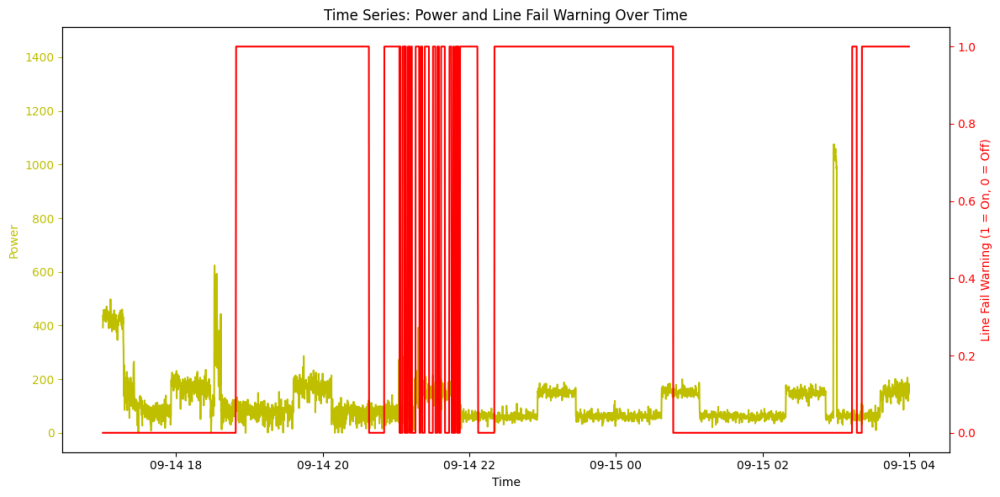
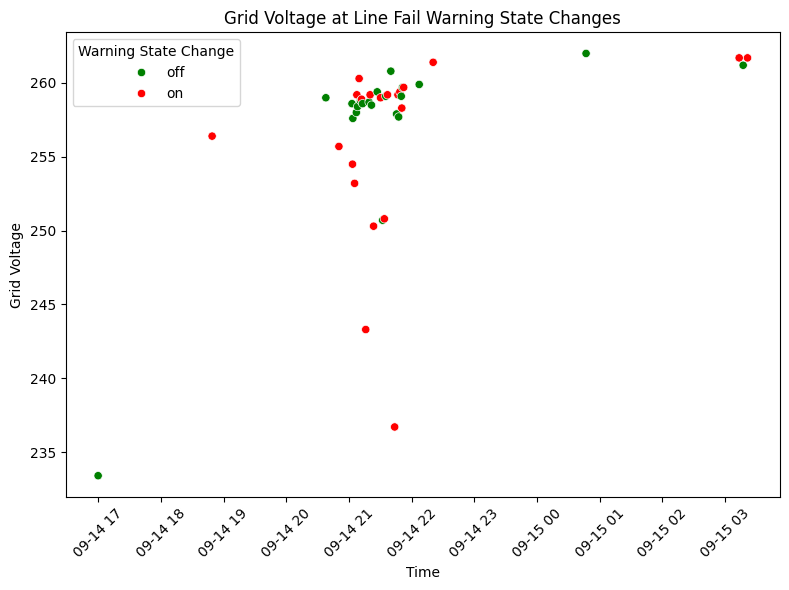
Frequency is 49.9-50.1, seems stable Can't see correlation here Grid is not very good, as you can see With a pretty high resistance, considering voltage drop under power You could be onto something with the voltage rate of change, it seems to change state on the downpeaks But how can I prevent this? Even pretty fast voltage stabilizer (or whatever it's called) won't catch those... Here's a clearer graph with markers when the grid fail warning changes state


-
Hello! My PIP6048MT goes into Line Fail Warning mode (usually at night) and starts using battery even if grid is present I thought 265V is a bit too much for it, but analyzing data doesn't show a clear correlation between voltage and this fail state Here are some screenshots from HA, some diagrams I've made and I've attached raw data export I can attach the analysis I've done if you want Do you have ideas what could be causing this? I'm really stumped and the winter is really close now... Thanks! power_line_fail.csv line_fail_history.csv


-
That's my hope, it's not very over spec for the tracker not to be able to clip Also, I just don't have anywhere to put all the energy when sun is shining high, this oversizing is more for winter I think our power situation will be even worse then Yeah, that's a shame... But I don't plan to parallel the inverters (I would love to, but alas), only the panels
-
MPPSolar PIP6048MT (Axpert VM III Twin) Panel specs (all the panels are the same): Peak Power Watts-PMAX (Wp) 565 Maximum Power Voltage-VMPP (V) 38.3 Maximum Power Current-IMPP (A) 14.76 Open Circuit Voltage-VOC (V) 45.6 Short Circuit Current-ISC (A) 15.81 I think I'm cutting it pretty close to the tracker's limits 🙂
-
Paraphrasing a reply I've got on another forum: Shaded panels will create high enough voltage to prevent backfeeding from irradiated panels without any additional hardware So it's fine 🙂
-
Great, thank you! If you want to use esphome -- I use this project: https://github.com/syssi/esphome-pipsolar I've done a fix for dual output inverters (longer QPIGS) and it's live in pip8048 branch
-
Hello! I have 9 panels on my roof that fit my inverter perfectly I could have a change to buy 9 identical panels in the near future and I'm thinking about installing them under the existing ones in 9s2p configuration (I mean, two 9s strings connected to the same mppt tracker in parallel) But my existing installation gets a long shadow from smoke stacks for the whole morning, severely capping my early production Second string should be not affected by it, or affected for much less time So, considering that second string could theoretically start producing much earlier -- do I need any additional hardware between parallel strings? Maybe some diodes? Or will it not be affected by shadowed top string at all? Thank you!
-
That's weird, coz I have 44-55 range in 25.06 already @Coulomb will you try to apply your mppt fixes to the new firmware or is it finally fine as it is? I'm ok with even older firmware capabilities, but I really want the "premature float" bug fixed 🙂
-
Mine doesn't do this as far as I can see, right? I guess I jump through that set voltage too fast to notice It worked out somewhere in the range My invertor specifies 350V nominal and my panels are rated for 345Vmpp, in real world my tracker wobbles around 330-360 I've heard some advice that you should get a little higher than nominal max power voltage, but in my calculations Voc became a problem before I could get to the nominal MPPT tracker voltage with Vmp With these specific panels it all worked out almost perfectly!