


andrevh
Members
-
Joined
-
Last visited
Everything posted by andrevh
-
To add to the topic, based on the Victron Superpack whose spec is above they say: Do in that case be sure that your chosen replacement fits your criteria by checking the datasheet and be aware the SuperPacks can be connected in parallel, but not in series. Hence in that case you would consider the other Victron lithium products named above. Mine were sold as a serial application (2 batteries) -- Not victron but another Schubart brand
-
Hi This is now my third swap of Lithium Ion 12V x 2. After charging them lastnight and made sure it is balanced, I started the dischange through Inverter process. It went well for 3 hours but at a combine voltage of 26.9V while discharging it shutdown, same as described on third post where while connected in series with load, the 1 show negative, but disconnected, the one was at 12.6V and the other at 13.8 or around there. 1) Contacting the supplier they said I need to do this process a few times before these batteries would become stable??? 2) I should not use a balancer (Victron balancer , using .7A) to balance them, it is self balancing??? Two serial connected packs???? Is above 2 points valid for using Lithium Ions in basically UPS applications. (I doubt it, but maybe I have something to learn here) The load on the batteries is about 170Watt and it is 1500W batteries.
-
Meaning minus, was while connected in serie, the one battery still gave 13.nn V but the other gave -4V that increased tp -.07 etc. When I disconnected everything and measured again it was 12.6 and the correct battery 13.xV
-
Thanks, got it. To find an existing topic across 256+ topics not always do-able especially when topic names are not properly descriptive. I will keep on exchanging batteries till I get a working battery set or will go back to heavy lead acids eventually.
-
I have added a battery balancer and am testing discharge. I got a high voltage on upper battery after an hour and the Voltages were 13.65V and 13.12V A minute after tht the system shutdown and the battery voltage were minus on the lower and 13.82V on the other. The same happened the first time without a balancer and I swapped the batteries.
-
https://www.victronenergy.com/upload/documents/Datasheet-12,8V-Lithium-SuperPack-EN.pdf This answers my question
-
Hi I got a Schubart inverter 24V and 2 1500W LiFE batteries with a Schubart sticker on. The settings the store gave is 29V Bulk, 28V float and 24V discharge cutoff. I am using 200Watt in office and yesterday the batteries did supply the ncessary for first loadshedding but not the second 2 hours later the afternoon. I have to work with what I have now. What would the recommend best performance settings be. On a spec I coul get: http://www.sustainable.co.za/media/pdf/FreedomWon/freedom_won_lithium_battery_spec_sheet_fw-12-100.pdf it specifies charge moe 14.6 V (12V) at 0.2C and then 14.6 at 0.02C which would assume 29.2 which is also the maximum bulk charge of inverter. The cutoff is specified as 8V which should make the 20V cutoff of inverter safe? Thus would 29V or even 29.1V float be safe to use and 29.2V Bulk?
-
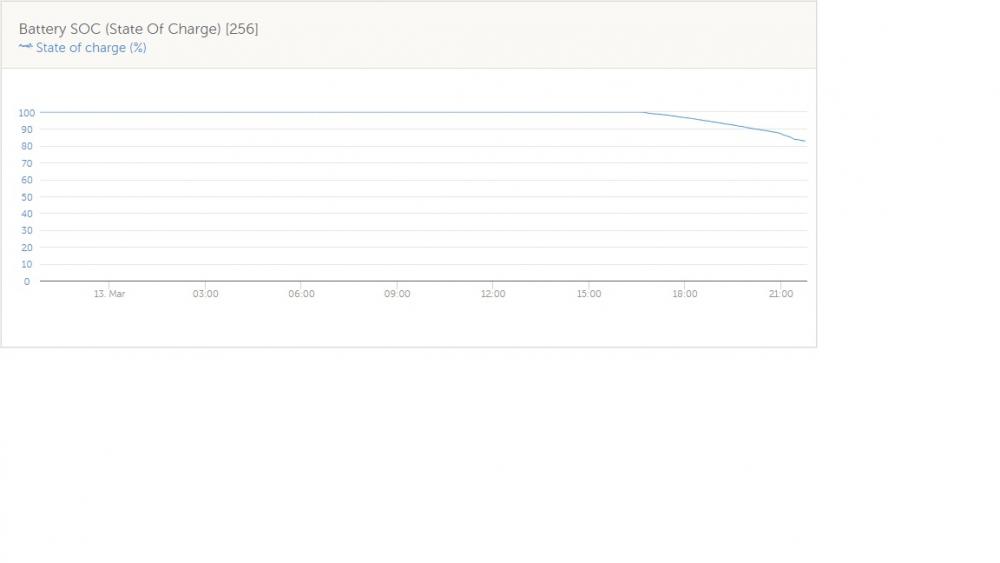
Hi Just some feedback on the system after I had all banks on battery balancers and some recycling of batteries. So all batteries are still the same that produced the above curves. The current current curves seems better.


-
My ESS is now fully implemented. Assuming it is allowed to return energy to the grid, what would be the most cost effective; to keep batteries charged or to use 20% of the battery as well? Regulations require a contactor; is that not the sam as a 2 pole AC switch on the AC input line? Sent from my iPhone using Tapatalk
-
From the same battery big bank, I tested another battery the same way. The first round I got 52 minutes out of it and after discharging it slowly (with 2 car headlamps) with again a last monetary fall to below 8V (hard to check the last part, but will build a low voltage cutoff switch at 9.5V) and recharging it to full capacity, I got 2 hours 45 minutes out off it. The difference between the discharge of this and previous (where I only got a 1h 30 min after recycling) discharges, is that I only used the"dimms", so slower discharge. I think I will redo it, but with a cutoff switch doing the monitoring. http://www.instructables.com/id/9v-battery-status-indicator-circuit/ (Using 1K below green Led instead of 330R works. (I have tested it. Previous circuit doe not work.)
-
I am testing a Omni Powe 12V 260Ah battery. C100 = 260AH and C10=200AH On a inverter using avg 375W for an hour an 25 minutes before the inverter cut of on 11V. What is the condition of the battery and how long should it last?
-
I am testing a Omni Powe 12V 260Ah battery. C100 = 260AH and C10=200AH On a inverter using avg 375W for an hour an 25 minutes before the inverter cut of on 11V. What is the condition of the battery and how long should it last?
-
It seems there are two batteries that cannot keep the voltage. Interesting that it is always the middle batteries (4 per bank) (in my case) that gives the problem. I do have three banks on 1 balancer and the recovering bank on the other. Will still connect all. The disadvantage of the balancer is that all parallel cells are being pulled down, Without it, only one cell would have gone low. The one bad battery, when tested on its own inverter using 350-400Watt, it lasted 13 minutes and after discharging it to below 10 Volt(unfortunately it had a sudden drop from 9.8 to 7.5 and you cannot watch it being discharged all the time) ) and then a full 40Amp (3 stage) charge, it lasted for 70 minutes at +-400 watt. Now busy with another discharge cycle.
-
The battery amp/voltage curve and SOC curve does not indicate the same here. The battery voltage seems to fall suddenly. Can it be a memory effect? Maybe I need to do a recycle on all batteries,ie discharging each individual to 9.5 Volt and then charge them at 40 Amp each for 3 times? Those 3 that had the low voltage issue did go from 10 minutes to an hour usage after the procedure.


-
I need to update the firmware of the multi to proceed, but yes ESS makes especially that you can adjust it not to use all the battery as with the relay setting and Hub-1 when main available. At the moment I am running Hub-1. Battery condition: Battery monitor reads 88% Battery voltage = 49.2 and Amps being withdrawn = 30.7 Amps. Is this the correct voltage or should it be higher. ( 4 x 4 x 12 V) - 260 AH total = 1040 AH battery bank.
-
Thanks for all the feedback. I need to upgrade my CGX Controller, just got a SD card to do it. Just to confirm, you did mention earlier, the SOLAR Control must go directly to the CGX again , the same way I used it with the relay setup and not through VE Bus to CAN interface?
-
Is there a cabling diagram for ESS somewhere as there is for Hub-1
-
I have gone through options feedback and do not feedback. The options here are the only available. Yes, I will do the ESS option, but will need to do more reading on it and what they say you do need an anti islanding device can delay its implementation here.


-
That's why I think the battery balancer would have solved the issue. Ok, they are not completely dead, just a bit less what I expected. Obviously the 4 10V batteries took the overall voltage down by 2V getting to a battery low alarm faster. But those 4 are now on a separate bank, again part of the system after the reviving of them
-
8. Comparison to Hub Assistants 8.1 Hub-1 Assistant -> ESS Assistant Policies Hub-1 policies that are deprecated in favor of ESS: Policy 1: Connected to mains, feedback: use ESS and enable solar charger feed-in. Policy 2: Keep batteries charged: Use ESS, select the “Keep batteries charged” mode. And enable “Feed-in excess solarcharger power” Policy 4: Prevent feeding energy to the grid: two options, one use ESS and do not enable Solarcharger excess feed-in and it will be always be connected to the grid. Or, use the Virtual Switch with ignore AC-Input. Policy 5: Connected to mains, no feedback: Use ESS, select the “Keep batteries charged” mode. Above leaves us one policy where the Hub-1 Assistant can do things that ESS cannot. Policy 3: Disconnect from the mains when possible: Keep Hub-1 Assistant or, often a simpler and therefor better solution, use the Virtual Switch with Ignore AC-Input. This is why I will use Hub-1 until grid feedback is official sorted out. But then the original 2 questions: 1) Using Hub 1 battery low cut-off switch back to mains setting.I assume by now it is the standard Inverter tab DC Input low shutdown. 2) Without any external anti Islanding device, except for the UK Region code inside the inverter, would it be technically (ignoring regulations) safe to use.
-
This then is the part that I missed, but was under the impression that the Peukert exponent took care of that.
-
I took all four out and recycled them individually on a 12 V charger and run them down on a separate inverter just powering my study room. (+-400W) On each the first use took 10 minutes till the (seperate) inverter shut down but after 3 cycles I got an hour out of them. I presume they are fine again.
-
I think the problem might be, because the battery might be in absorption phase for the amount of time required, but because I am using almost everything from the Solar array, the remaining amps going into the battery is the .4 Amps that triggers the sync????
-
Unfortunately, I have 16 Omni Power 260Ah OmniPower Fully-Sealed Deep Cycle AGM+Gel VRLA Maintenance Free Solar Batteries. I just want to get out off them what is left for as long as possible. That's why the feedback to grid can also help to recover some cost. I do have a mechanical meter but no other external equipment.
-
Thank you for feedback. I used the simpler setup for a year. What I had wrong is the auto syncing of the BMV. Although I waited till 57V and 20 min and .4 Amps, I think it synced to soon I had it to only use 20% of the battery, having 80% left inside battery. The resync caused the batteries to discharge more every time. (My assumptions, others say batteries just don't last that long. Mine is a year old and went through the 40 degrees heat wave we had.) Second problem I had, (could not afford it at the time) was battery balancers. I do have it now. I have 4 banks with 4 batteries. On each bank one of the batteries went to 10.n V while the others were at 12.n V, therefor the change in setup. So, now state of charge is meaningless because the Voltage goes to low at 80%. (My assumption) The ESS setup (did not know about it, till now) does not give the option not to feedback to the grid.That's why I want to use Hub-1, but without any devices if using the British grid is technically safe, that is an option I do have all the required hardware for Hub1. CGX Monitor BMV Monitor, 18 CIS panels and 70 Amp charge controller and VE Bus to CAN cable The firmware on it was to old but I got it updated to be able to use Hub 1.


