pintopf
Members
-
Joined
-
Last visited
Everything posted by pintopf
-
I think, a noise-free version doesnt exist,because a minimal air convection must exist. In my VMIII Twin - 400W works with DSP Firmware Version 60.95 and Display 25.12. In this 60.95 version are the fans are controlled by temperature and under less output power the fans produce less noise. I think, this version is a good compromise between cooling and noise.
-
Thank you for the new version 68.13 ! Yesterday i put this version in my VM III twin 4k and its work fine, but i think, that the internal measurements of the inverter are in this version very optimistic. I have an offset on the battery charging output of +4A, that means, if no current flows, the axpert shows me 4A. Also the internal measurement of the solarpanel-current are above 150-200V Voltage more than twice as high as in reality. Under this voltage, the display shows the correct value. Badly, it looks like that the internal MPPT uses this wrong values, and the output power is less than it can be. Also, the statistics in dessmonitor shows much to high values. In december we have short, dark days in germany, so that every watt counts ;-) My next step was to reinstall the version 60.95 , but by this action my computer gives up and die without any sign of life. I think, that any yovervoltage from the RS232-port from the inverter bricks my computer. The lucki thing was, that i can bring him back to life, with the help of chatgpt. I bougt an galvanic isolated USB->RS232 interface and installed today the older version 60.95. I testet also the version 60.87, but in this version are the fans very loud. Greetings, Peter
-
My inverter sends energy back to the grid, if the batterys are full charged or the charging current is over the maximum. ( if "Solar Feed To Grid" is enabled.) Interestingly i don't see it at the inverter-display or the app. I see it only at my shelly.
-
See the attachement. The graph shows an 1 hour intervall. Firmware: 60.95

-
Here is it : \x51\x50\x49\x47\x53\xB7\xA9\x0D
-
I attached the file. This file is from this thread, date june,13. My node-red program sends cyclic the "QPIGS" command to the inverter, and the answer contains also the heat sink temperature. If the fans run faster under load, the temperature drops, and start to rising under heavy load but reaches never 50°C. I don't log the temperature but i will tomorrow use 2000 W for some time out of my batterys to show you the graph from the node red -UI. VM TWIN_Ver60.95.7z
-
I read in this thread, that with the firmware 60.76 the fans are much more silent, thats way i testet it today. The version 60.95 was replaced by 60.76 an i measured the noise under no load condition, with 230V output switched on. Heatsink temperature was in both cases 35°C at 18°C ambient temperature. My measurements in 1m distance from the inverter: FW: 60.76 44dB FW: 60.95 44dB I heard also no difference.


-
This is the reason, why i bought the 4000W Version, it consumes "only" 45-50W in standby. My solution for the batterys was an another ESP (ESP8266) to read out the status of the batterys. I found the project at github: click! It produces also MQTT-Messages and creates a simple web-interface. For the solarpanel i found no switch for the 400V without great losses. The chinese DC-relais are often fakes (AC-Relais labeled as DC-relais) and the solid-states eats too much energy for my case. In this bad wheather i use the VMIII only to charge my batterys (if its not so gray as today ;-). If my battery has enough energy, i discharge them with a Hoymiles HM600 Inverter in the normal grid. His efficency was between 90-95% and it is fanless. I control the HM600 over my third ESP in my cellar, this project i also found at the internet. My house automatisation ("Homematic" from ELV) control all this devices via MQTT via Node-Red. I agree with you, that this solution is only for your own use, it is not a good idea to install it on your father. You have to design the relais to the maximum current, which is possible from your batteries, this are 120A, this relais are big an have noticeable energy-consumption. Otherwise ist the risk, to burning your house down too high. Ther are some risks in the use of solar-inverters: The high DV- Voltage at the solar-input and the high current at the battery in/output. Don`t underestimate that. Here is a small video, which shows this effect at only 60 V, demonstrated in an opened AC circuit-breaker. Sorry, it is in german, byt the interesting part need no words and is shown from minute 2:45. Video!
-
Hopefully you use a ATS for high DC voltage for your solarpanels, otherwise ist very risky to switch high DC voltages, long sparks occur. I live in Berlin/Germany and have the same problem like you, on some days my inverter produces less energy then he put into the battery. My goal was to save the energy, consumed at nigt by the inverter. (40-50W for my 4000W model) My solution was a small circuit with an ESP32 controller, wich communicates with the inverter via RS232. This ESP32 communicated via WiFi (MQTT protocol) with my house-automatisation. The main program on the house-automatisation is in "node red" programmed. There i programmed the round power button to be (virtually*) pressed 30 minutes before sunrise. After sunrise, i switch the button off, this saves around 20W. * I tapped the connecting cable between the display and the device in order to connect an optocoupler in parallel with the switch, which is triggered by the ESP
-
I testet it at my 4kW VMIII and the result is: 55W with depressed button and 65W with pressed button. My mode was "SBU" I switch an measure the grid with an "shelly 1 PM" Why do you not use a automatic power transfer switch to solve your problem? I think, that this mode (without battery) is not optimal for the inverter. I use this switch: (see photo)
-
If your inverter starts at the first attempt in the morning? Without grid and power-button "off", my inverter often destroy the EEPROM Data at the interupted boot attempts, as i showed yesterday Not the same, but with the older display-firmware my battery lost sometimes (1 - 2 times per day?) the conection to the inverter, the battery symbol at the display stop blinking, and the warning shows. After i installed the new firmware, this never happens again. (or it happens, if i'm not in front of the inverter?)
-
I had similiar problems in communication between my inverter and the pylontech-batteries. The display firmware update to version 25.12 fixed it.
-
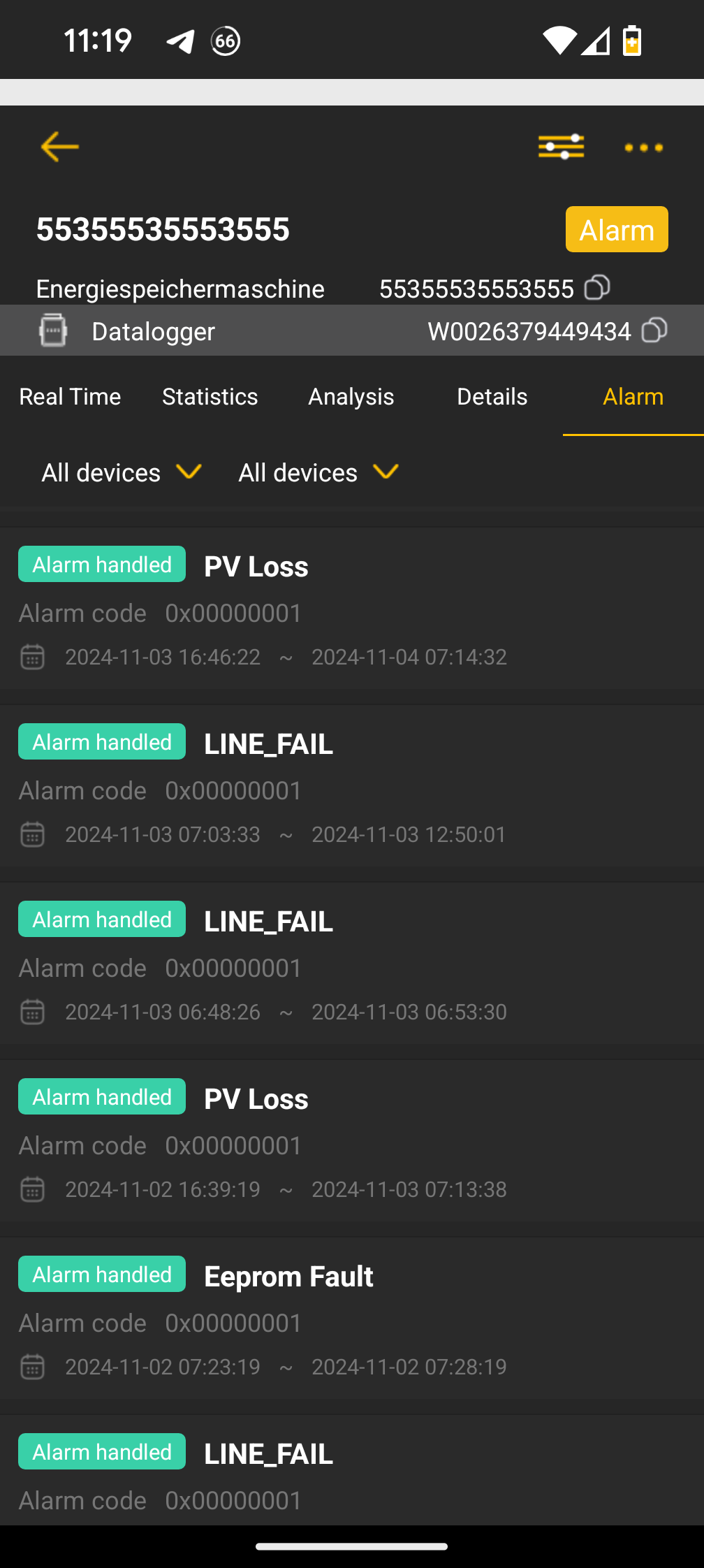
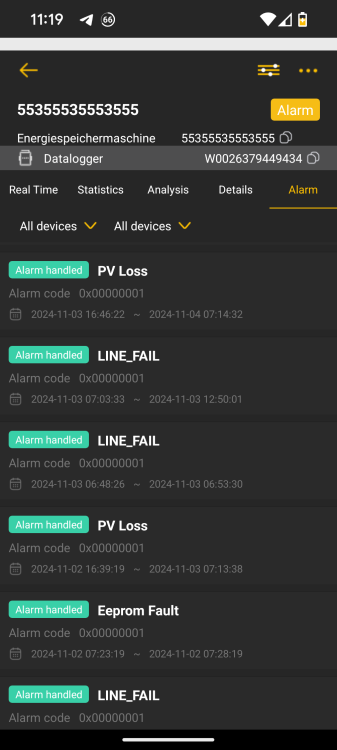
Hi @ monsam, i had a similiar problem with my VMIII Twin / 4kW last year, in my case lost the inverter his serial number. The problem was, that in the morning, with 230V off and Inverter off (round button not pressed), when the sun begin to shine, the solarpanels create not enough energy for complete startup the inverter, so many attempts were made, until he starts. Every attempt causes an interrupt in the start-up procedure, and sometimes the EEPROM becames corrupt. You will see it in Watchpower, Energy-Mate or Dessmonitor under "Alarm"
-
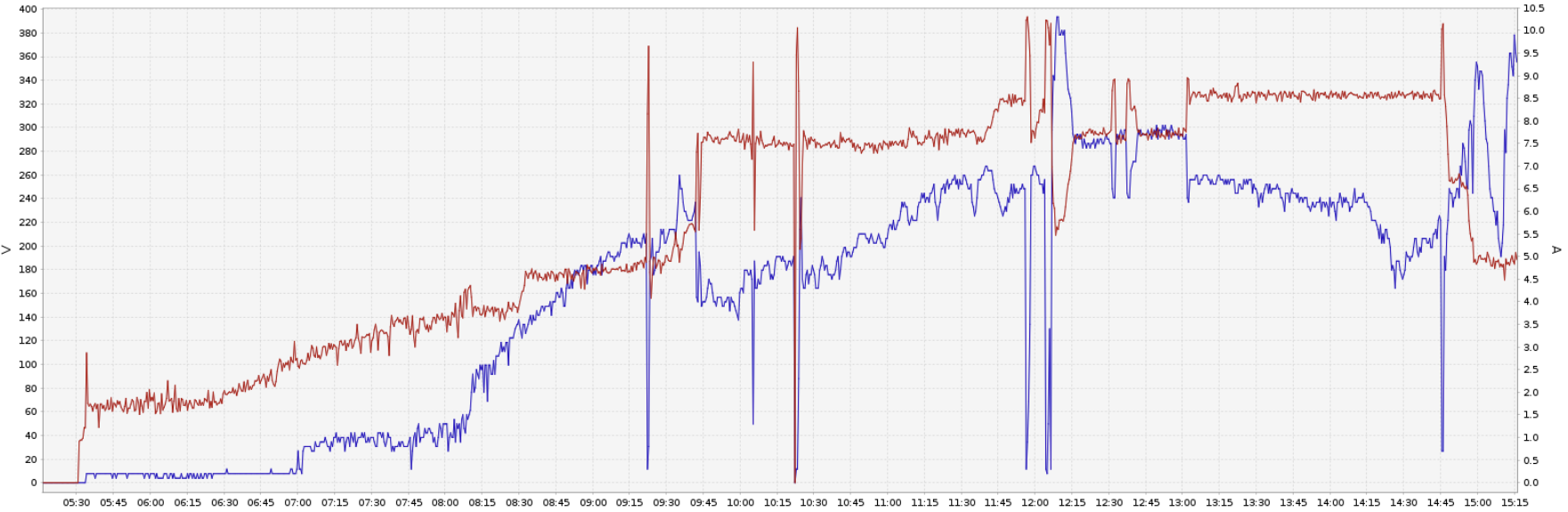
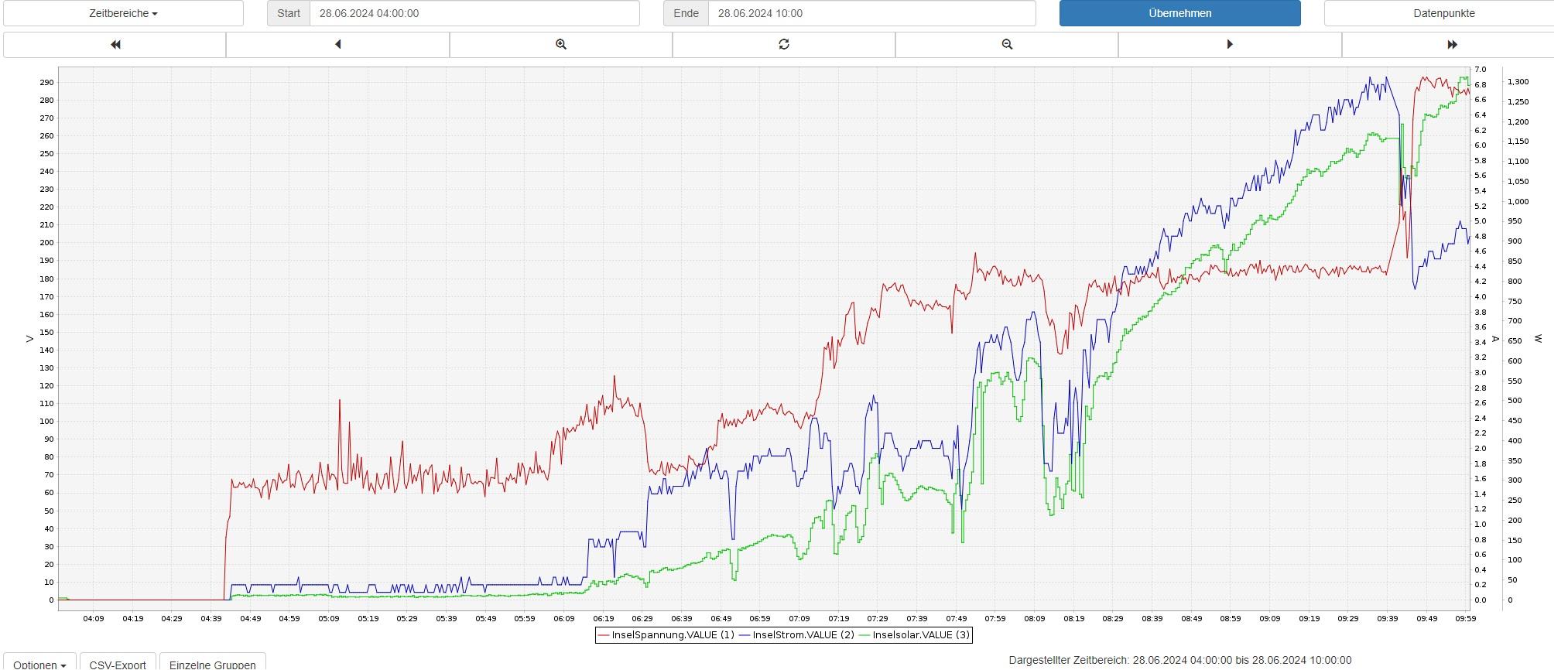
Is here anybody with an "stuck at 60V" problem with 60.95 software? Since i installed this firmware, mine MPPT works fine. I attached a plot from today until now, a cloudless day: ( red: solar voltage ; blue solar current)

-
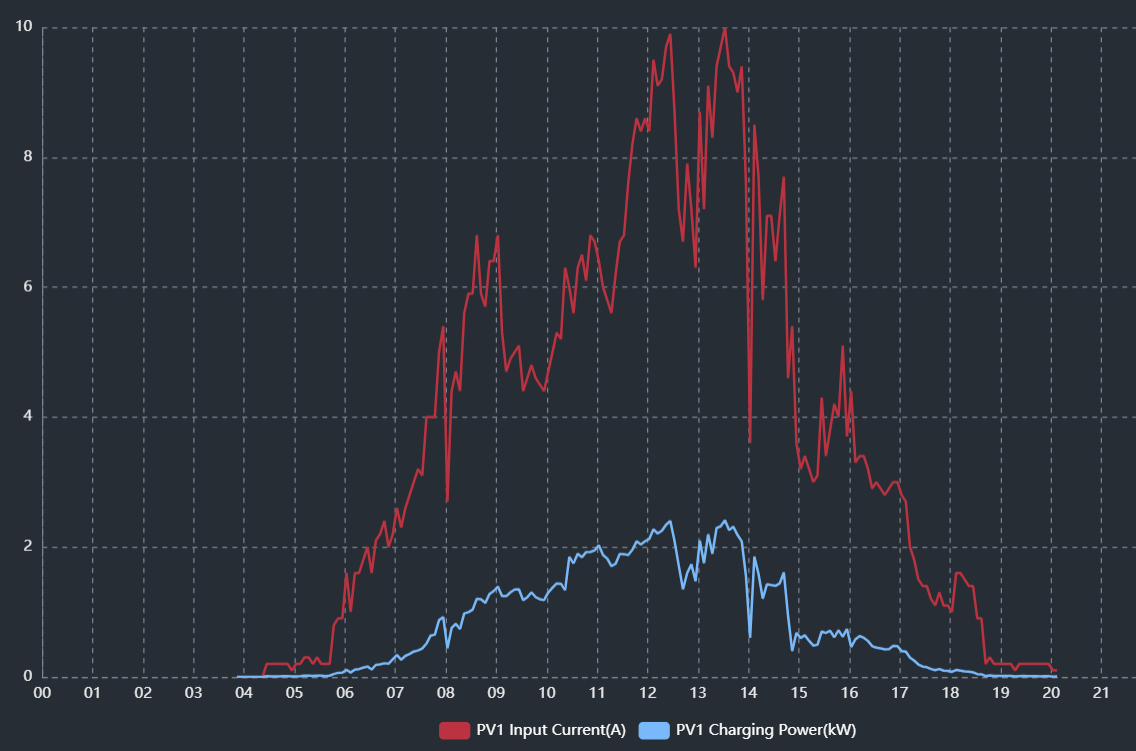
I see, that my inverters MPPT starts if PV-input current reaches 0,2A . (FW 60.95) With panels in parallel, this current is reached earlyer. At the beginning of this year, i testet a lot of connections between my panels and my inverter. I found also out, that 2s 3p was a good solution, but it was a lot of cables in my garden and the current was very high, about 25-30A at around 100V. After this tests i experimented with TIGO "TS4-A-O" Modul-optimizer (Link ), and they worked nearly perfect in my system. This optimizers reduces the output voltages from the modules and keep the current constant in the system, so thad shadowed modules produces less power which added to the string-power, instead of reducing the overall performance through the little current they produce. So, the max current is 9A, and the maximum voltage 350V. Then was only the problem with "Stuck at 60V" with the older firmware, but this has @Coulomb solved. After i installed the 60.95 firmware, the noise of the fans decreased and the MPPT works fine, without any patches. Thankfully i used pylontech batteries, so that the discussed battery-problems are not mine. The picture shows a average day.

-
I use a solution with an ESP32 microcontroller, which is connected to the serial interface of the display via a MAX232 converter. The ESP cyclically sends a "QPIGS" request to the inverter and provides the result via the MQTT protocol via W-LAN. (Example: String QPIGS = "\x51\x50\x49\x47\x53\xB7\xA9\x0D"; //hard coded string with CRC) The ESP32 also receives commands via MQTT, appends the CRC16 checksum and sends the result back into the network. The ESP32 is controlled via my home automation, using NodeRed.
-
This bug means, that the inverter´s MPPT is stuck at his starting voltage at the begin of a new day, where the brightnes is increasing, until the current of the solar input reaches 200(400?) mA at 60V. The calculation of the output power results in a value that is too low to start the tracking. If you have some Solarpanels in serial, you reach this current relativ late, you can´t use the first Energy of the day. If you have i.e. 350V panel voltage, are this 70 W (at 200mA) If the MPPT starting voltage higher, the inverter calculates a higher power and the tracking starts earlyer. In this thread @Coulomb presents his patched firmware, which sets the starting voltage from the MPP-Tracker to other voltages.
-
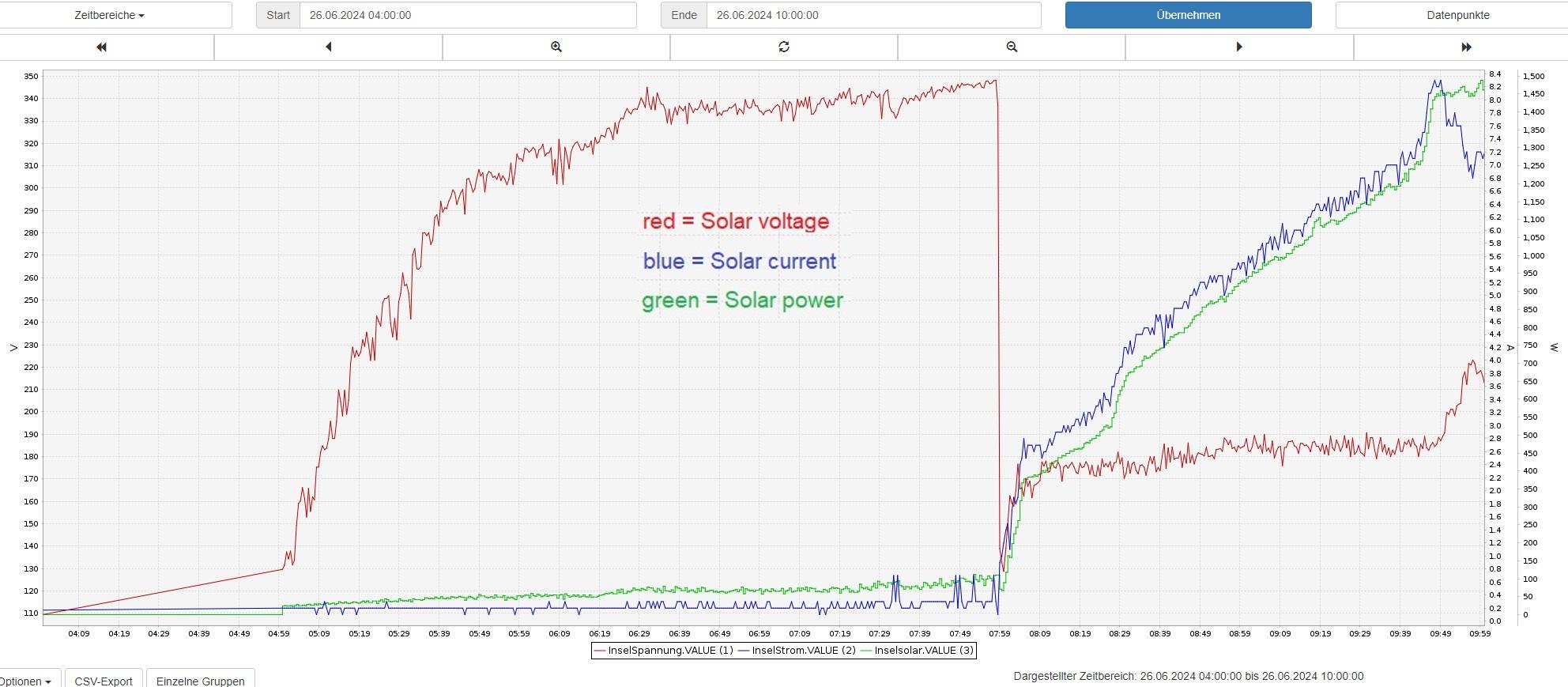
I'm attaching two charts to this message. Both show the start of the solar system in the morning. Picture 1 ist with the older modified firmware 160.06 from @Coulomb Picture 2 shows the same situation with the newer firmware 60.95 Before 8:00 the system is in charge mode (charging only), then the 230V output switches on. In the first case, the MPPT restarts at 8:00, where the output is switched on, and finds a good working point In the second case, the MPP tracking starts on its own.


-
Is there a change log for the firmware versions? Are there Improvements? I control my inverter with an ESP32, which get the data from the VMIII over serial connection and build up a communication via WiFi (MQTT-Protocol) to my home-automatisation with NodeRed. Since I don't miss any functions, I conquered my curiosity and didn't install any new firmware yet. 😉
-
I also tested this version (60.95) and it runs nearly perfectly. My DisplayFW is : 25.05 Much quieter fans at low loads and the heatsink temperature has never been above 45°C. At higher loads (>1500W) the temperature drops again because the fan(s) then run faster. The inverter hangs in my basement at around 19°C. Another positive thing about the software version is the fact that the MPP-Tracker no longer gets stuck at low voltage. So far I've had to use a version modified by @Coulomb so that the voltage doesn't get stuck below 100V. Thank you for this Software-Version. Edit:typo


-
Hi, some weeks earlier i postet my problems with the lost serial-number of my VMIII-4000, but after some weeks of normal operation, no "error 90" occurs. 🙂 But since last sunday, my inverter creates a "(warning) 70" message on his display and he switches off the 230V output and charges only my pylontechs. In the android-app or the windows "watchpower" - program no error or warning is displayed. In my handbook to the inverter is warning or error 70 not discribed. In this thread here i found the description of this warning, but this tells me nothing. My 3 Pylontech's are charged between 50% and 80% and untlil sunday my inverter works fine. If i switch from "pylontech" to User, the inverter works normal and switches the 230V output off. I hoped, that an update to the Firmware Version 56.11, als descibed an linked in this thread (thank you @Coulomb), solved this problen, but it isn't so. The Firmware 56.11 works fine, but the warning still appears. Has anybody an idea, what my problem is and how can i solve it? Thank you, Peter


-
Now i have realized this feature with an optocoupler between the contacts 7 & 8 in the connection inverter <--> display, which emulated the on/off switch. My ESP32 controls now also the optocoupler via MQTT, so i not longer need reprogramming the battery shut off level everytime i want to switch the DC-AC converter off, to save power. I measured 1,6 A (25V) battery current at no load . If the inverter in standby ( the switch (optocoupler) released), the current is near 0A. Unfortunaly, i dont have a complete list of commands for this inverter, have anybody in this forum such a list? In the status flags (QFLAG) and in my app exist a point called "enable/disable power saving", but i can't set this bit. Is it functionally in newer firmware-versions? I'm still waiting too an answer because of my serial number problem from "Solarpower 24". 50% of the 60 days are over.
-
In the linked thred, on february 8, user @lucass descibes the same problem, which my axpert has, as the EEPROM deletes. But i can't read in this thread, that this issue was solved with the new firmware. My inverter is under warranty, an new firmware with unknown features is to risky for me. i loadet the firmware down from the link, if i need it later. I solved this problem for me with an "shelly 1PM" remote switch, so i switch the grid for my inverter 1 hour before sunrise on, he awakes, ten minutes after (enugh time to connect the pylontech's) my node-red programm switches the battery on (set the shut-off capacity to 10%), an after 1 hour i swiched the shelly automatically off. If i don't switch the battery on, with grid connected, the inverter sucks 2,5 A from the battery for nothing. When enough solarpower is generated, i can swich the battery off, is neccesary ( shut-off capacity to 90%), an the inverter works fine in "charging mode".
-
Many thanks for your effort. I'll wait and see what my seller says. If the errormessage only shows in the display, it is no problem for me. Would it be worthwhile for me to import the new firmware? Could you please give me a source for this? I have another question: Is it possible to implement in the software the powersave (shut off the DC-AC converter) command you mentioned in another thread for another Voltronic inverter? Or is my hardware to cheap? Greetings, Peter
-
In this moment, after 3 attempts, i received a answer from solarpower24, they answered me, that they where waiting for a response from voltronic. Is it much work for you, to modify the firmware? 18 out of 60 days are already passed, and with your firmware i have a solution for my serial-number problems if voltronic sends no answer to solarpower24. Greetings, Peter here is the answer: