TheMafiaMan - NotMuffinMan
Members
-
Joined
-
Last visited
Everything posted by TheMafiaMan - NotMuffinMan
-
Hey Bobster, I hope you don't mind the question - I know from reading another thread you've had many dealings with the whole COJ SSEG process - what are your thoughts and in so much the info you can share with regards to implications, costs you might be aware of and therefore paperwork involved in not having any electrical supply at all? I'm on Prepaid. I've been told, provided info, bits and pieces of nonsense side chatter and various 'scenarios' ranging from they'll pickup that I'm not using and or buying any credits and send the City Power Gestapo to see you've not done something illegal (which I've not so then what?), to "its not allowed"; to you have to have a connection to your house as part of the municipal bylaws (I've never actually seen that exact wording) to it costs +-R2100 fill in a form at city power offices and they will remove the meter and deregister it from your erf/stand number; to you cannot sell your house along with many many others. If I'm self sufficient there is no law that I'm aware of that says I have to buy power from the incumbent government SOE or any IPP. Your thoughts? In my scenario by the end of this month, through a transfer switch, which currently interrupts my incoming city power and switches to my diesel generator, I will for all intents no longer be connected to City Power at all when I move my transfer switch to Generator only. I will be my own "utility" island if I may call it that. I wont be back feeding both from it physically being impossible i.e. no physical connection to the grid and I'm not interested in getting cents on the rand, for my capital expense to feed back into the grid. So my system will pose no hazard upstream to utility workers or my neighbours. I've slowly built out my system since 2022 first with Inverter and storage and the generator I already had. I now have a fair sized array of 8kw with I hope, all the best of the scenarios, like no shading, facing perfectly north, on a 30degree slope etc. Its having some final work done. An 8kw inverter; 12kw+ of storage and onsite the generator room with a 6.5kva diesel generator and enough diesel to run for 1-2 weeks and indefinitely if I had to. (1.3ltr per/h for 5kw or +- 80% generator load), This will replace for me my City power feed by choice. I can hear the keyboard warriors raging, typing furiously that electricity is cheaper than diesel - but is it really? 😑 - it serves my end goal - that's all that matters. I will use Solar during the day, storage to take me through the night and if needed on a poor generation day(s) top up the batteries or cross support the load with the generator only if needed, maybe 1-2hrs in a day, a few days a month - the last step will be automating the generator coming online and going offline based on time of day, load demands vs peak solar output vs current load as well as percentage of storage left before heading into sunset - the goal being to finish as close to or at 100% SOC- my December hobby project. I share others sentiment that all they are doing with all the nonsense they're dreaming up is making the financial case for me to add another battery maybe some solar in my case thereby saving me more diesel and service costs on my generator - the way I see it - there is no scenario for me and I refer to only me, where I need 'services' in this case power any longer, soon enough, if I have my way I wont need water either - they know this day is coming hard and fast - those that can sort themselves out - and those that cannot, well they can't afford to pay the ever increasing costs - its a lose lose situation for them - I pay large taxes, in the form of company, personal, food, rates and fuel levies taxes to name just the most common ones - sorry I benefit from none of them - I'm older and very much too jaded now later in my albeit mid-life to adopt the "its for the greater good of all my countryman" argument or perspective anymore. I'm not 100% sure about your school of thought about if you sell, then the purchaser might factor in a new connection etc. I don't suggest you're wrong, but I'd suggest another school of thought in that regard - that there is the right kind of house for the right kind of buyer - I know I can find a buyer that wants the freedom from utilities to a large extent, and the guarantee of their own clean water supply - that's a whole other interesting discussion. As always your thoughts and anyone else's perspective is always welcome.
-
It is sounding a bit like a the parallel setup is not functioning properly can you possible post a picutre of the screen of your two inverters on the section which shows master/slave settings? one inverter would be setup as master and one as slave. Do you have one battery connected to each inverter or both going to one inverter? The switching you're descripting does it sound like a solenoid type switching on the battery end or is it on the inverter(s) side? Sorry for so many questions - the more info the better someone can help - i might not be able to but at least we would have more info to try figure it out if its only a settings issue ...
-
Hey Christo - Remenisent of my CFE batteries cycling between 90-100%, then 95-100% after a firmware update then pinned at 100% after yet more updates - i'd look to get an official explanination from the manufacturer/importer and maybe your installer can help shed some light as well...maybe check that the parallel connection is working as expected - i'm assuming you have no errors stored? - also you don't mention if you have solar installled or not?
-
On the 8 August 2023 @ 11:00 am, my CFE debacle came to an eventual end - the saga if anyone has interest or wants to see the history HERE I would love to be able to say that the many many hours of trouble shooting - help, comments and questions from numerous forum members like @HendrikBigChief for analysing endless graphs and reports - much appriecated your advice and willingness to hear me out and offer solutions to look at, @Zak @I84RiS and others i'm sorry if i forget to mention you, not least being banned/kicked out from a CFE whatsapp group (what a misreable lot) resulted in the problem batteries being sorted out - rather the situation with the CFE batteries got so bad that no load over 2000watt could be run in BMS only mode (which i'm sticking to my guns on is how the batteries are supposed to be run) without getting F56 errors F26 errors the list was endless - CFE where unhelpful eventually flashing the 2 batteries at least two more times and then proclaiming that it was the inverters firmware that was the issue - we (SolarAdvice and I) relented and got DEYE to push an unneeded but never the less non-problematic firmware update to my 8kw inverter for only the exact same things to continue happening. (just a note we did try to run the batteries in AGM but we couldn't get more than 30min reliably in AGM / manual settings without both batteries tripping out even when idle and not under load) I had to travel for work and its been more that a month but it had already been agreed with SoalrAdvice that we had exhausted all options - they really have been no nonsense about exchanging them - the delay was more from my side to exhaust all options and mostly my patience. But its the batteries and thier bad BMS. The contenders where Solar MDs 14.3kw(single battery) or two DEYE 6.14kw batteries and given Budget and my existing diesel gensets conversion to automation and final sound proofing of the generating room, just a few weeks from being completed, the DEYE where deemed the best compromise as the 8.1kw solar array still to be commisioned together with the Genset and automated system in place as well as low household base load means we'd be fine off grid. There is space being made for a posiible 3rd DEYE Battery towards December but right now the Genset project needs to be completed and Solar Commisioned before Feb 2024 to claim the rebate. Almost one week in and with Loadshedding back to 5-6hrs for us i'm happy to report so far that the DEYE batteries have performed flawlessly (fingers crossed of course) - even though we've only grown usable capacity buy 2kw or +-18-20% we're seeing different consumption/efficiency/conversion numbers running all the same loads as before and conversion/efficiency wise we're seeing an actual net gain of almost 25-30% from the batteries. I cannot say why right now and I only have 6-7 days data vs 255days data from the CFE's but something is different (time will tell if this a indeed a gain of sorts and i'll be monitoring it) - off the top of my head the only notable change is battery temps. the inverter battery settings have remained unchnaged and we're running in BMS mode with the inverter showing 00 & deye next to it under lithium - the CFE's always opperated between 27-35°C even at idle in a 21°C space - and loads even reaching 39-40°C - but the DEYE units are sitting @19-21°C under load, maybe there is a better thermal layout inside or better passive cooling but even now with them being on load for 2.5hrs during loadshedding and then charging @40A back to 100%, tempreture is 21°C and its notably warmer outside today. Time will tell is guess. I'd just want to again mention that SolarAdvice where champs in getting this all sorted from the re-order, allocation, booking a team to do the swap/install and keeping me in the loop the awesome two guys (cannot remember their names) that did the swap out and wall mounted them for me without makign a mess, breaking anything and just being really pleasant to chat to - this business is doing this right and all my interactions with them over the last 7+ months has been consistently excellent - they're patient and I know I can be difficult - but there was no need to be as they where just really professional about dealing with all of this - highly recommend them. I'll post an update in about a months time and again am happy to answer any questions and hopefully keep up and contribute info to the forum - theMafiaman - out.
-
PS the BESS app shows all 16 of my cells in each pack to be at 3.32V most of the time As of right now the master battery is 16 cells @3.32v my slave battery has 13 cells @ 3.32v and 3 @ 3.33v - even when I've had the weird drops and such the cells are all according to the app fine and within normal range - and I've never had the actual pack go into a full on fault mode other than once for a low voltage level 3 fault when they where completely drained and we had no power for 12+hrs Anyway I hope you fair better
-
Welcome @New As you can see I've not had a great experience - your SOC cycling between 90-100 suggests 2 firmware version earlier than mine now after 2 updates - mine did that originally - purchased in Nov 2022 you can see in the post how to determine which batch and version battery you have but if you bought it in the last 3-6 months its the v3 most likely - mine is too. My advice - don't update the firmware if you're not having any issues - I hope unlike me time doesn't paint a different picture - if you can get below a 20% SOC then you're already better off than I am, whenever my batteries hit 40% SOC they'd drop to 7/5/1% in 2-3 minutes. Maybe as a caution, C rating doesn't stack as people think it does - I've seen multiple installers, resellers etc. say that 2 x 0.5C batteries gives you 1C. That is not correct. Assuming you have 1, 4 or 8 of the same battery rated at 0.5C your storage capacity is doubled, quadrupled etc. but in essence if you want to realise that stored energy as efficiently as possible then you would need to use it at 0.5C or even possibly 0.25C Basic rule" C rate doesn't stack in Series In parallel connection the C rating is wrongly attributed to stacking the load because you're "1/2 ing" the current between for example 2 batteries - think of it this way the faster you discharge them "Higher C rating" the less electricity you get out over time. At it's simplest Its the electric car example - lets use a TESLA - freekin quick but if you thrash it in 01-100 launches and max performance pulls what happens - batteries overheat and your range i.e. usable storage disappears and becomes much less. fast = more power, more power = higher C rates 2C, 4C 8C etc. I used to in a previous life fly large commercial load-bearing drones - we'd have large LIPO packs that you could pull/discharge at 25-40C for about 2-3min in specialty situations and then they'd unceremoniously die or you could fly reasonably at 8C and get 10-12min If you where unlucky your drone would plummet out the sky or if you where a good pilot you'd monitor voltage and current like a naughty kid in a park and landed it just before it was about to expire - I was one of those pilots that was careful and I have only ever lost one drone - I "infamously" drowned a very large, very expensive drone 10yrs ago that had a faulty BMS and I ignored the V and C rates for 5-10 seconds - it landed itself in a large dam - police divers had to come fish it out. Needless to say my "employers" where not happy with me - however telemetry data proved I wasn't reckless and that the BMS went "offline" about 15seconds before the drone became "unstable" - the lesson applies though. 200AH batteries discharged at 2C will not nett you 200AH worth of energy. CFEs own data is misleading - an older manual states 5000w/3000w nominal i.e. 0.6C, the sticker on the side says 100ah or 1C and newer docs mention neither other than 1C charge and discharge - they cannot seem to decide which one - I would have to advise based on my experience that you treat them as 0.5C for charging and discharging. My beef with them is CFE sell there batteries as 1C charge and discharge product - It cannot in my case reliably do 1C between the 2x 5.12kWh batteries and in Lithium mode the batteries die in 17min or less - now whether the SOC is wrongly calculated, comms are faulty or my batteries are not charging fully or discharging, I don't know, but we cannot spend the type of money we do on these to tinker - If I wanted to do that I'd build my own battery packs. My advice after 7+months - there is no need unless a once-in-a-blue-moon emergency to charge your batteries at 1C - 100AH, i'd recommend not acceding 0.5C or 50A and I found 40A is a nice middle ground leaving your inverter some headroom to run other loads when charging - again ideal on a 8kw invert but I'd drop that to 20-25A on a 5kw inverter.
-
HI @HendrikBigChief tried this morning as a last ditch effort to put the system into V mode as you suggested - it would seem since the latest firmware update I cannot do this any longer as the batteries once booted up, inverter restarted and connected back to the batteries - immediately trip into a fault mode when the inverter initiates the connection - so SOL. Thanks - I know you where try to resolve my problems and at least see what the batteries where doing but as noted I'm returning them - the question now remains what to get and if my supplier can supply something they don't normally stock - will have to see SolarMDs 14.3kWh battery seems to at least according to their spec sheet have the most honest representation of what/how the battery will perform - and if I can make some modifications to my loads and not exceed 4kwh loads at any one time then I can follow their recommended 13kWh useable storage @0.3C or +-3.9Kw load I'll post back here what happens next...thanks.
-
lazy typo's on my part sorry yes I know its kWh...engineering OCD is welcome Update: now you triggered my OCD - updated posts to kWh for this thread as much as possible - thanks for contributing to my insomnia
-
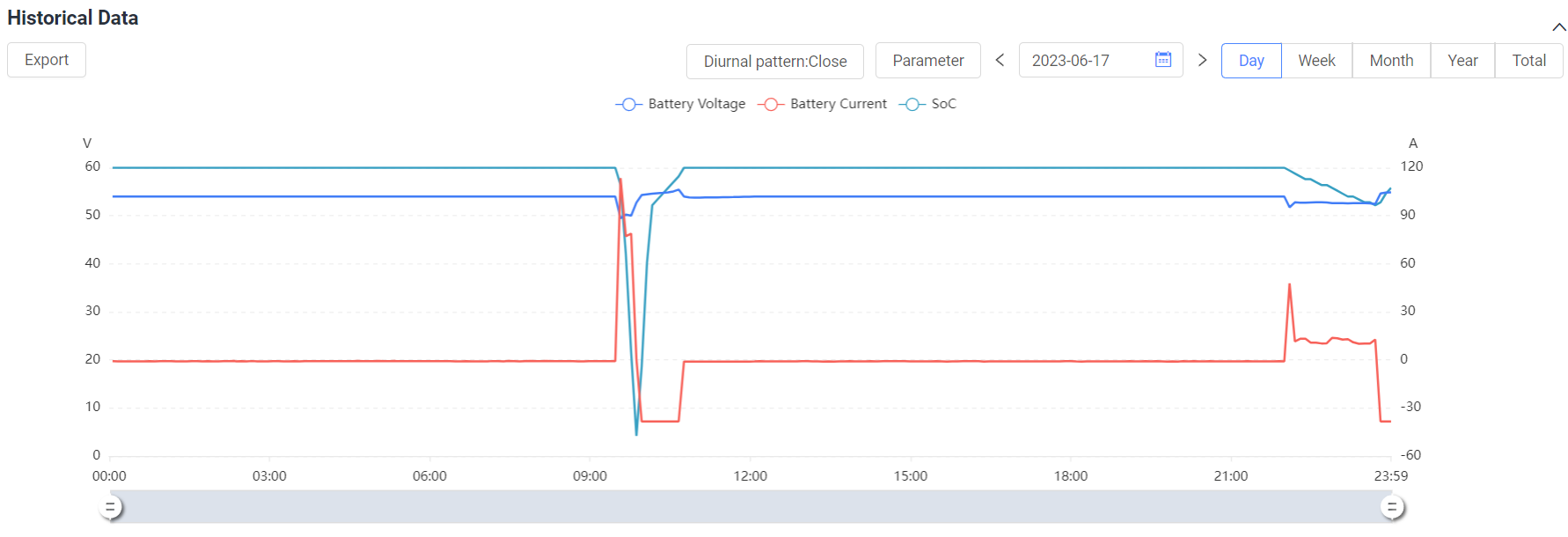
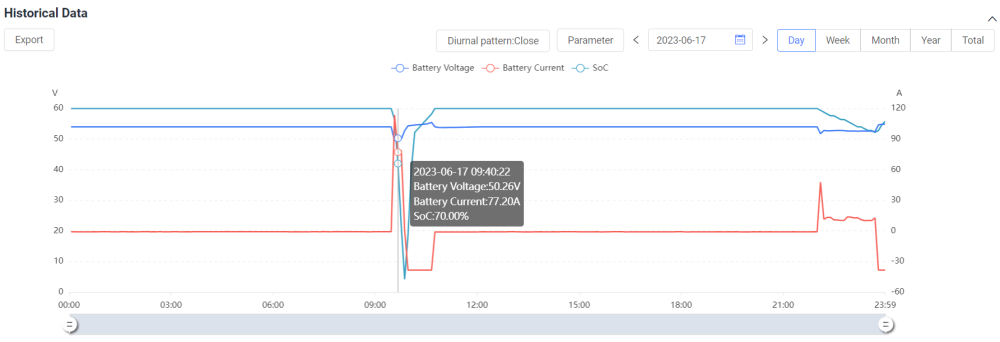
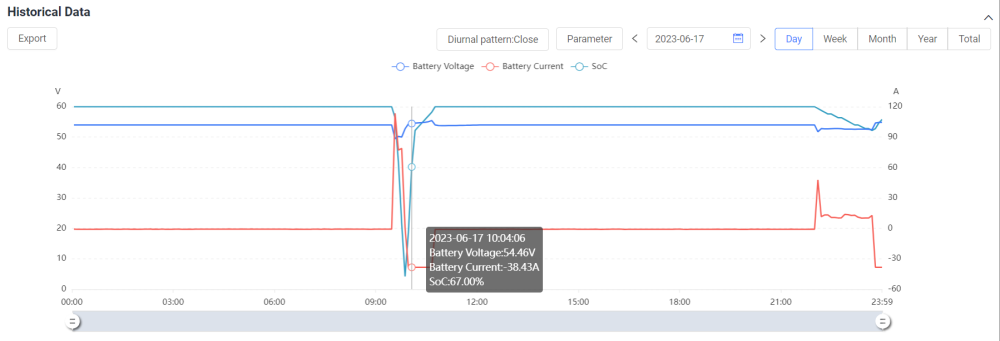
Hi @HendrikBigChief here is hopefully what you need/asked for Whole 24hr for the day in question Battery voltage is 53.99-54.00 from 00h00 to 09:28:29 when I start the run down - rundown below At 7% Eksom feed is restored - next images are charging @40amps Finally from 22h00 to 23h59 is a loadshedding slot with my usual base load of 480-630watt TV, fridge, routers, fiber and a few devices in standby etc. that base load comes into play most days from about 20h30 and will reduce to about 340-480watt from 1am to 6.30am The latest firmware update (13/06/2023) from CFE eliminated the SOC cycling, prior to that the update the did changed SOC to cycle between 100-95% & before that it was 100-90% when the system was originally commissioned. Here is the 13/06/2023 data (last firmware update) you can see the batteries drop out at 12h48 this is when the firmware was updated the batteries where powered on/off twice. At 16h06 you can see the same catastrophic issue appear again after reaching 100% "SOC" at 13:55:53 until 16h06 when load shedding starts and at 18h01 an active load kicks in, @18:07 its hits 46% and @18h13 10% just as Eskom power is restored and at 21h13 100% SOC is achieved @ 53.49v The below is from Solarman, a steady SOC @ 100% for 6+hrs - it would appear that in data going back to commissioning date, float voltage has always been 53.88-5399 and now 54v after the latest update - charge voltages have always been maintained up to this last update at 56.1v I believe for LFP charging in parallel the parameter is normally 56-56.8v






-
Sure - I’m going to collect the data for you and I’ll post it up with what you suggested
-
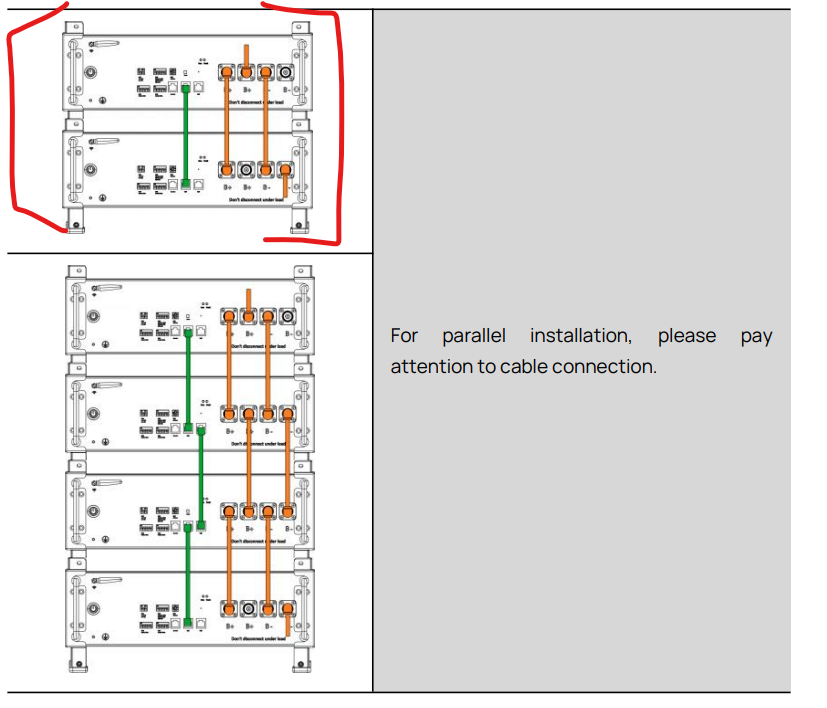
Thanks @Tinbum the cable lengths are identical so it should then be as per fig 2 - very confusing the manuals vary and add or remove info for the same version battery 3-4 months apart
-
Thanks @HendrikBigChief I'm running in storage only no solar currently. Agreed. You keep referring to SOC (I beg to differ on the correct calculation thereof but anyway)- I'm referring to the actual usable Kw I'm getting out of the batteries in BMS or Voltage mode being 6kw at best for 10.24kWh of storage (the center of my gripe to begin with) 60% of my installed capacity after 7 months of frankly light use? - not acceptable! I've calculated multiple times with loads I know to be correct and constant and can monitor via other means and not just the battery app, inverter logging or DEYE Cloud/Solarman so that I can verify the data. I've experimented with this before "time of day usage" I have no solar so not really relevant - I can confirm that this has been tried before as a possible problem solving approach and made no difference - for example allow the batteries to go to 60% with solar but while being Grid tied do a final run up to 100% late to make sure you're topped up properly (I understand the rational )- my intention and detailed below is to be 100% of grid I will not be grid tied at all - but in a Storage solution only as i'm currently setup I don't have the luxury of entering say stage6 with 60% left at any time of the day, especially when the power doesn't come back on in some instances for another 1-3hrs I never said I was doing that as my normal operation - I suggested at the beginning of my thread people should got back and read my first post and the original one I referred to because it seems you've not done that other than insist multiple times now that BMS are bad and that I run my system in Voltage mode and thank you later. I won't be running in V mode - I did that previously only to confirm the data and for trouble shooting 2 weeks ago during the firmware updates to corelate data I had collected. Hmm...why would any manufacturer have a BMS that specifically is going to shorten the life of battery(s) that they have to warranty for 10yrs if that is going to as you're suggesting almost definitely lead to them failing prematurely? Why have a BMS at all then? See where I'm going with all this? There are numerous applications, devices and systems that have existed long before LiFePO4/LFP & prismatic cells and the like and those BMS systems have all worked correctly in my experiences - I have lithium battery based systems 10+ yrs old that still work to within 80-90% of spec... This all paints a very bad picture of batteries in SA at the moment and confirms my suspicions all along and as you've mentioned and rightly so that none are really suitable for the multiple loadshedding events we have - They are vastly exacerbated in a Storage only setup like mine. That a real issue for me and the type of Money myself and others are forking out. I've outlined previously but will touch on again the energy production route I'll be following: 8.1kw solar array (Still to be commissioned) - in ideal conditions, no clouds, no panel shading, ambient of between 25-35c etc. etc. I can comfortably produce 25-30units each day - an array this size can peak at 45+ units a day - I use a 4.8 hour factor to calculate possible peak and exclude the trailing in and out power that would be created from 7am-9am and 3pm-5pm which on a good day could account for another 8-12 units (over the conservative 25units) in my specific array - easily getting me over my worse case 20-25 units a day I need - so I've erred on the most conservative side possible. My battery storage is only meant to supplement poor production numbers between 9am and 4pm and at night 10pm onwards where my base load never exceeds 700w I have embedded diesel generation - 6.5kw and fuel for weeks Using my program logic which I've implemented before, I can run the Genset between 8am and 8pm at night that steps in to: Supplement load if the weather is kak, or if storage is below 40% or solar generation is below a threshold I set or all of them combined I can top up storage (batteries) if it is below 60% @4pm in winter and 5-6pm in summer (I can vary this window up to 8pm at night reasonably) In all these scenarios I'd most likely keep to my 40amp charge rate (which I've used) and well enough below the 0.5c recommended on most batteries if you want to actually take care of them. We'll agree to disagree on you not believing in running a BMS - as I've stated for me this is simply non negotiable and for LFP poses a significant system risk - insurance companies would have a field day with 60%+ of the installations and so called "professional" ones I've seen. The BMS is the heart of or the ticking time bomb in an LFP pack and it must 100% work - I'm non-negotiable on it. If I have to go through 10/20/30+ battery brands to find one that actually works according to spec - so be it - I'll burn diesel when they don't - simple. The manufactures data on all of these batteries (and I've studied 10 of dozens of them by now) are disingenuous at best to flat-out lies, hidden in small print where some bother to disclose it with others simply stating numbers that go against the laws of physics / science and in this case chemistry. I'll pick on SolarMDs 14.3kWh pack (which I am considering) the real number in their specs which is the only one worth reading is 13kWh usable at 0.3C - that's a measly 3.9kWh load (for me) and I'm pretty sure that if I ran that pack at 3.9kw that I would not get 3h33min of runtime - SolarMD i'm up for testing. Just like my CFE packs which can at best deliver 3kWh out of 5kWh @ supposedly 1C - they like to obfuscate the numbers and bullshit on their labels but these 5.12kWhw batteries can only deliver 0.5C semi-reliably which means you need to keep load at below 2.4kw to get anywhere near getting 3.5-4kWh of use out of a 5.12kWh pack - Naturally I've tested this and @ 1.7kWh load the battery discharge curve is fairly linear to about 30% then tappers more seriously as the packs voltage drops to 50-49v - I don't know about you but I didn't pay R55k to have 1.7kw on tap and their technical spec says I shouldn't have to accept that dreary performance either. More so i'f i'm going to expand to 20kWh or possibly look at 2x 12/15kWh packs I've seen numerous sites, heard advice given by resellers, installers and electricians alike (all self confessed "experts") that have for example said that 2 (or more) x 0.5c batteries means you now have a 1C system or 2C system (4 packs) etc.- this is categorically false - you have a larger storage pool but you're still governed buy the 0.5C rating. Bottom line - for the average consumer out there this discussion and many others like it wouldn't even vaguely resonate with them or allow them to know what to follow - or do - so they do what most consumers do - follow the guidelines in the specs or rather the specs the installer regurgitates off of the manufactures data. I'm calling out that specific data, in most cases, grossly misleading and at the very least contradictory.
-
@JAK I was of the same opinion but I’ve been staring at this nonsense over the last week for so long I wanted to see if I was missing something - thanks.
-
Also my reason to be apprehensive about doing this is that when you run them via the inverter in voltage monitoring mode the BESS app (which is mostly rubbish) cannot communicate with the battery at all (until you go back to BMS mode) and provide any battery details, no individual cell voltages, SOC, AMPS in or out - I actually think in this case the BMS is "asleep"...
-
@JAK do you agree though that the two manuals contradict one another in terms of parallel connection diagrams? Or am I just being paranoid?
-
Thanks Jak, yes I know it doesn't "disable" the BMS but it does bypass the BMS "rules" for the Pack to a certain extent and I'm just not going to do it because that alone proves the BMS is faulty or badly calibrated which means I cannot rely on it to do its primary job correctly
-
Thanks @JAK
-
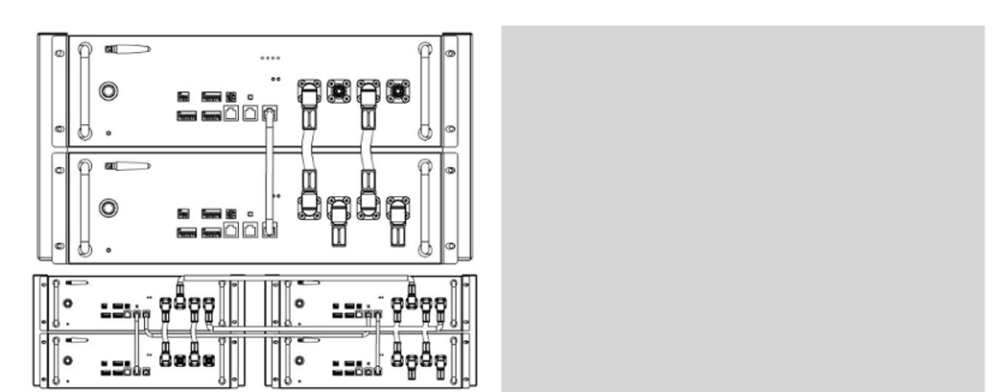
So this is my last ditch effort at trying to work with CFE before I throw the towel in completely on these batteries... My printed manual and some of the online versions I found show the parallel connection of 2 and 4 of the batteries as per Fig1 Fig1 This afternoon while digging and digging and digging some more to get some last ditch info I stumbled across another CFEnergy site and downloaded a manual dated 20230321 and found this diagram for parallel connection which looks like this Fig2 - the main difference being that the positive of the first battery and the negative of the last battery are what go to the invert - as apposed to the positive and negative on one battery going to the inverter and the two being bridged in the same way. Fig2 Anyone who has these CFE-5100s batteries 2 or more @JAK, can you please confirm what is the correct connection method or if it makes no difference? Mine are currently connected as per fig 1 but this might now be incorrect...though I have no errors or faults so maybe its nothing - I've also confirmed after watching a very long training video conducted here is SA with CFE that: A) The white units which have serial numbers starting with 1416x are from 2022 - so that's good its not an old battery from 2021 - and mine are 14168xxxx which denotes batch 8 from around Aug/Sep and its is definitely a v3 of the 5100s and has the newest version of their BMS - apparently v1 and v2 where different. B ) in the video an installer or reseller mentions or part answers a question about the cables as per what I'm asking above and its even more unclear whether FIG2 is for series connections as he sort of confirms then back tracks on with some mumble about that not being correct...or that you wouldn't get 200ah and only 100ah blah blah- frankly I really don't care - he confirms how clueless most installers are and that they use us as guineapigs. FFS!!! which of any of this is actually correct or valid and can someone take a picture of there CFE units so I can compare - please. Thank you in advance.
-
@HendrikBigChief Thank you for your very detailed info very much appreciate. For some further clarity from my side - I'm not running the inverter based on SOC but rather BMS Battery Mode - CFE and I've checked with some other battery providers will not honor a warranty on an LFP battery run in Voltage Managed mode - Its universally accepted especially in the EU market that you should not run specifically LFP batteries without a BMS - Especially in the manner you've described where 2 or more are involved and there is for obvious reasons no comm connection between the 2 batteries. To be clear I have already run as part of testing and fault finding both batteries individually in Voltage Managed mode to get to the bottom of my issues and the fact remains that on a 2.5-3kw load these batteries assuming for any efficiency/conversion losses and even generous ones, should be able to run a 2.5kw constant load for 110minutes - I've allowed in the calculation a 10% DoD - in the tests I ran even at 2kw, I could not get more than 55min of runtime - at which point the CFE's low voltage solenoid can be heard triggering a contactor disconnect and then go into a low voltage fault mode or roughly 4-5% charge left at 48.7v - already above your 47v suggested Shutdown value. I used your exact numbers except for shutdown at 48v and low batt trigger at 48.7v but my batteries are clearly foobaared as I cannot even get them to 48.6v. I'm not going to give CFE ammunition to possibly wrangle out of my warranty as I know they store values for BMS bypass - it's not worth me risking the best part of R52k and its clearly not they way most LFP if not all should be run - again you're more than welcome to disagree with me, but my family and properties safety is much more important. I have this all documented for the supplier and they agree that CFE have basically proven they cannot fix it - I'm not going to keep accepting firmware updates that are progressively and clearly becoming more and more unreliable. I'm not going to run 10-20kWh of LFP batteries in non-BMS mode - sorry I consider that unsafe - you're more than welcome again to not agree with me - but I've dealt with a large Lithium based fire before and since this is my personal residence I'm not willing to risk the worst case scenario The BMS must do its job and I will seek out a battery manufactured that has a proven reliable one - even if that takes some time - I do have a diesel Genset all wired into the property so I'm not completely SOL for alternative power. Unless you have a further updated manual for the CFE5100s I've 2-3 different versions spanning 2022, and they do not provide those numbers as you're rightly so expected to run them with the BMS Again - appreciate your detailed input and help - but I'll be RMA'ing these batteries and hopefully replacing them with something that works correctly - in BMS mode
-
@Tinbum while I don't disagree or necessarily agree - the over arching issue(s) I have are: The sheer amount of hoop jumping people are to going through to get warranty support and not just on PylonTech products SegenSolar are building up a reputation for being unhelpful and and in some instances quite condescending - And to be fair and balanced to them other suppliers alike tend to treat everyone like idiots - with the kind of money being spent - giving you the time of day and listening to your clients problems and not dismissing them at the first opportunity they can find is a minimum requirement in my experience - at the very least Most (and yes that is a poor generalization I concede) inverters when running in BMS battery mode (DEYE is my reference in this case) strictly follow the BMS instructions/data being fed to them - while an argument can be made for how long the inverter takes to respond - my personal experience and sample of one I concede, is 20ms or less - but where do you draw the line? Go and look online at the many in this case Pylontech - and sorry I'm singling them out but they are the focus of peoples ire here - that after 3-5 yrs are swelling as an example or many users anecdotal evidence that if they peruse the logs, report seeing a voltage spike at least at some time especially during the commissioning state - that Pylontech would characterise as out of spec and therefore the "no warranty for you" attitude. - Do we then assume (and as I now have said numerous times I hate assuming) that most inverters are rubbish at reacting to comms signals ? Sorry I don't buy that. Yes you are correct that there are threads of BMS repairs reflecting that the BMS did its job but there are also many instances of the BMS clearly not doing its Job and "official" replies from Pylontech containing words like Passive BMS etc. - It does if you stand back from it all smack just a little of arse covering - and yes that is my opinion - so people are completely welcome to agree or disagree with that. I've stated in other posts that Pylontech are generally seen as a good stable/safe choice, but I've also stated that I think think their tech is a bit long in the tooth now and like all things we need to see progress in the battery space at a much quicker rate - look what Sunsynk and DEYE are doing battery wise in the HV space with really sophisticated monitoring and multiple layers of programmatic safety systems in the batteries and management hubs. I don't support chasing inverter, battery and solar tech down to the cheapest dollar or Rand amount in our case, that almost always bites you in the end, but I'd like to believe - naively maybe - that most people are investing money they've had saved many times for other maybe more important things, or borrow where they possible shouldn't but there is a fevered rush to basically provide our own power because our government has failed us. In many instances it's everyman for himself and opportunistic action from suppliers, importers and manufactures who use warranties like their own personal magic wand deciding on your fate at their behest - needs to be brought to light and stamped out if we're to have a robust alternative energy industry where every second to third person is being ripped off. In that instance - I'd level the same ire at a DEYE, Victron, Canadian Solar, Pylontech, LG Chem etc. etc. My 5 cents worth.
-
I know for a fact my CFE 5.12kw units are 16s as I can see and monitor the voltage for each cell in the pack with their separate BMS App - there seems to be 2 different 5kw Sunsynk packs a 5.12kw which is 16s and a 5.32kw which I cannot find the cell count on - They do both look quite different the 5.12kw unit is a rackmount type black unit (maybe an older model??) the 5.32kw is a wall mount white unit with a status bar on the front - assuming which I hate doing I would imagine the later is also a 16s else it might be a stacked wafer style? The data sheet for it doesn't specify this - I'll see what I can find and post it here for you.
-
100% agree the mounting flexibility means nothing if the BMS/BAT is unreliable just unfortunate for me as i have dedicated space and will not be able to expand over time as i wanted to - this morning I did another test to qualm my paranoia with my two batteries and well this image shows it best 100%-7% on a 5.27kw constant load in 25min then back from 7% to 100% with a 40amp charge in 55min...flaky as all hell - and I'm running my DEYE in BMS Battery mode. As you can see the latest update I got from CFE now pins the batteries at 100% - I think after 1hr or possibly some other defined factor I'm not privy too, it does stop taking a charge and then discharges at about 30-40watt - not sure what the nominal discharge rate would be sitting idle. I'll know on Monday if the Sunsynk batteries are from DEYE and if the inverter warranty extension applies - I think it won't but best to check my facts...even if it doesn't I might consider spending the extra to get the higher capacity but I'd prefer slightly smaller capacity and multiple batteries for redundancy if there was a failure of a pack etc. I'll let you know what i find out.

-
Hey Ted There are third party BMS solutions that can be had like the JK JBB and Victron have the Victron Lynx Smart BMS 500 which they say is only for Victron Lithium Smart batteries but I have seen one used on other batteries will try find the Youtube video - its a bit odd - then there is options from LBSA but it seems they might be closing out on selling them - they have/had a 100A 15/16s 48v LiFePO4 Smart BMS with a display you could possibly use on the Sunsynk once the warranty was up and say the BMS failed but where a warranty implies that the BMS and Cells are warrantied separately under various conditions, its safe to assume (and I hate assuming) that they will only part warranty the half that isn't faulty if they replace/repair the faulty part as Sunsynk themselves - i.e. an agent sanctioned repair. My understanding of that is that you would have 1 yrs coverage on the part that has been replaced/repaired. Let me know if I'm better understanding your question - though again, given you have a DEYE inverted and the price you where quoted I'd still recommend going for the DEYE battery unless you have some interesting info you can share? - DEYE are Sunsynks Manufacturer. As for the Pylontech Batteries, yes I've read this test report before but if you haven't visited this evolving thread I'd go read most of it - not looking good for Pylontech here in SA, even just at face value - I don't agree with their testing methodology completely with the accelerated testing to equate to 5/10years use - Li chemistry will almost always perform poorly in forced heavy and environmental lab sims and its not inline with the more 'considered' moderate load model that takes unfortunately much longer to run and is more representative of how they will be used by and large in the field. If I was a for example a mobile network (cellular) operator or heavy industry potential user then their data is of more interest. There are specialist HV systems mostly out of the UK, Germany and the Nordic regions which are very specialised and mostly custom built - non the less its a very interesting read
-
Wow Wow - Pylontech commenting that the BMS is "passive"? really. I rest my case / hat / cape what ever you prefer - as someone noted we're into the first 5yr window of battery/inverter warranties and the alarming overtone is that warranties seem to not be worth the paper they're printed on and of course the importers and dealer are dare I say it as unscrupulous as always - any excuse to not honor a warranty. I personally just on the comments thus far wont look at Pylontech - there is an alarming read between the lines situation brewing - the battery swelling issue is not new and has been happening for years with various 2000 and 3000 series models probably more than most people know/admit/report The bottom line is this - international standards which lets be honest seem to mean little in SA dictate that LiFePO4 and other/simlar Li-chemistry are required to have a BMS, Battery Management System, a mandatory component for LiFePO4 batteries. LiFePO4 or all lithium battery cells are sensitive to over-voltage, under-voltage, and over-current. If a LiFePO4 battery is kept under one of the above conditions for a long time, it can easily cause capacity degradation, battery damage, or even the risk of fire. There was an EU/EE statement I read once that was much like the above and added ..."should invoke (I love that word) a hard disconnect from the inverter to circumvent the damage and or fire and or exhausting of chemical gases or other unsatisfactory expulsions at all costs" I've butchered it a bit most likely, but I know some manufactures actually employ a solenoid/engergised disconnect that physically breaks the incoming charge or out going load if an inverter doesn't respond in xx millisecond of a fault being registered. If Pylontech want to assert that they have a Passive BMS then I think they should be "passive aggressively" banned from selling their product here unless they can demonstrate that their BMS does what its actually supposed to do - protect the internal cells and pack as a whole from what they are claiming is the cause of the issue(s) experienced by users. Out of interest and this isn't a "plug" for DEYE inverters, but one of the options is a STOP on BMS error which I've seen many an installer disable because its considered a "nuisance" but what it does is when there is a BMS error it can disconnect from the battery and isolate the inverter and loads and battery(s) from each other - as far as I'm concerned it should be a password protected option that cannot be unchecked and only in very special circumstances with an installers ID. I have mine on and with my "badly misbehaving" CFE batteries it does exactly that in mere milliseconds. Then again I think half the batteries out there in SA would never work if that was a requirement because BMS issues seem to be a large problem from scouring this forum and we need to ask ourselves - what scarp is being dumped on our shores that wouldn't pass as safe in other countries?
-
Hey there have to agree that redundancy is much more important than less cables - cables can be tidied up - as noted for redundancy, swap out or expansion, all are valuable to consider - the only time one larger battery becomes a consideration is when there is an unavoidable space consideration and one large battery is your only option, but then buy big and well known which equals very expensive - think LG Chem.