


soulfreeze
Members
-
Joined
-
Last visited
-
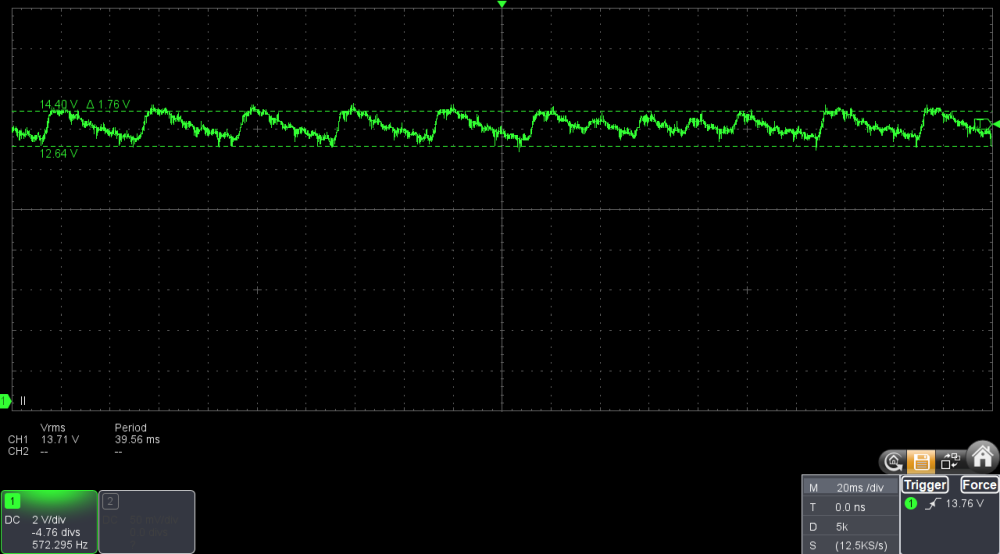
Really insightful and clever design. thanks for the explanation. So i went troubleshooting the idle AC charging consumption (50w when battery is basically full), as i suspect that it may be abnormal, I have a usb multimeter and measured the ripple current, isnt this abit high at a delta of 1.5v for a 12v system? also switched on the unit with no battery, the waveform that rises up is the measurement at the DC terminal during startup, it looks to me like the ripple increases with voltage increase. does this mean anything and could it explain the high consumption during the float phase of charging. Or is this all normal?

 Hi all, recently got a faulty Mastervolt Combimaster, which i have found quite similar in architecture to the inverters discussed here, And thanks to the posts I have managed to get it repaired by replacing burnt out High Voltage Capacitors, IGBTs, Gate drivers and their associated zeners. Inverter appears to work fine, however some concern with it getting quite warm when charging in 'float' mode, i assume that is when the battery is full and the unit is trickle charging. I have a few questions to ask, first of all is whether this is normal behavior, The unit draws around 50W from the mains while in that float charging state with zero load, and gets quite warm, which is suspicious since when its inverting on a larger load of 200-300w it stays cool. Is this a typical consumption for float charging LiFePo batteries (I have 2 12v 300AH batteries). I would have assumed the float charging rate would be pretty low, with occasional jumps to keep the battery level, not a constant 50W I am suspecting that there might be some inefficiency thats happening? maybe an inefficient charging stage, or something amiss with some circuitry that is only in oparation during AC in mode (Power supply for the logic maybe?) Im not expecting a straight forward answer to this, other than some of the obvious (float consumption , warming), so i would appreaciate very much if someone could point me an explanation on how these inverters work , I think i have a grasp of the inverting mode of operations, However the charging one is where i would love some insight, i read somewhere that the AC side IGBTs act as the input rectifier using the body diode of the IGBTs? is this true? i would have assumed they would be actively switched? also does this result in lower efficiency? Also how does the buck converter section work during charging mode?I have a MasterVolt Combimaster inverter charger which i recently repaired (blown IGBTs / Gate drivers). I have it wired as a backup / UPS with a pair of lithium ion batteries, it operates as expected, however there is this weird and suspicious behavior as it gets very warm while sitting there connected to mains fully charged in standby mode. Is this expected behavior? Even when operational, and inverting mode with a small load (<500w) it seems way cooler. My understanding is that when mains grid is powered and the battery is full, the inverter should only be operating in charging mode and only occasionally trickle charging which should be negligible in terms of power consumption. at least not enough to make it significantly warm. I have a suspicion that i overlooked something during repair, anyone who has intimate knowledge of inverter operation have any insight? I understand that the High Voltage IGBTs operate as a full bridge rectifier when in charging mode, could they be generating more heat in that state? Or could it be an issue with the high voltage rail buck converter having efficiency issues? Or is this all normal operation (kindly note that the fans are off during the whole 'float' charging state so i imagine the heat would accumulate, but with the thermal mass of the unit, i find it suspicious that there would be that much load during standby charging). Or is this normal behavior and am i worrying for nothing? Anyone with any insights would be of great value, What are other inverter brands idle 'float charging' temps /consumption like?

