


PierreJ
Members
-
Joined
-
Last visited
Everything posted by PierreJ
-
Thanks! Both the SmartSolar and Multiplus run quite hot under full load - which is pretty much from 10am up to about 3pm every day. I worry about longevity of the electronics. I am considering removing 3.2kWp of the panels from the SmartSolar and connecting them to an AC-coupled Fronius Primo, which will also reduce the load on the Multiplus during the day. It's an additional R25k+ outlay though, which is hard to jump over. I have 5 PylonTech batteries so I needed to use two pairs of their cables. I couldn't find a 4 pole disconnect, so I decided to use 2 x three pole disconnects which will also allow me to add a third pair of battery cables in future if I add more batteries. There are 125A fuses in there to protect the cables in case something catastrophic goes wrong (like a short between + and -). The PylonTechs do have on/off switches so a separate disconnect is perhaps not critical, but I feel more comfortable having a physical disconnect that I can pull to immediately isolate the batteries from the rest of the system.
-
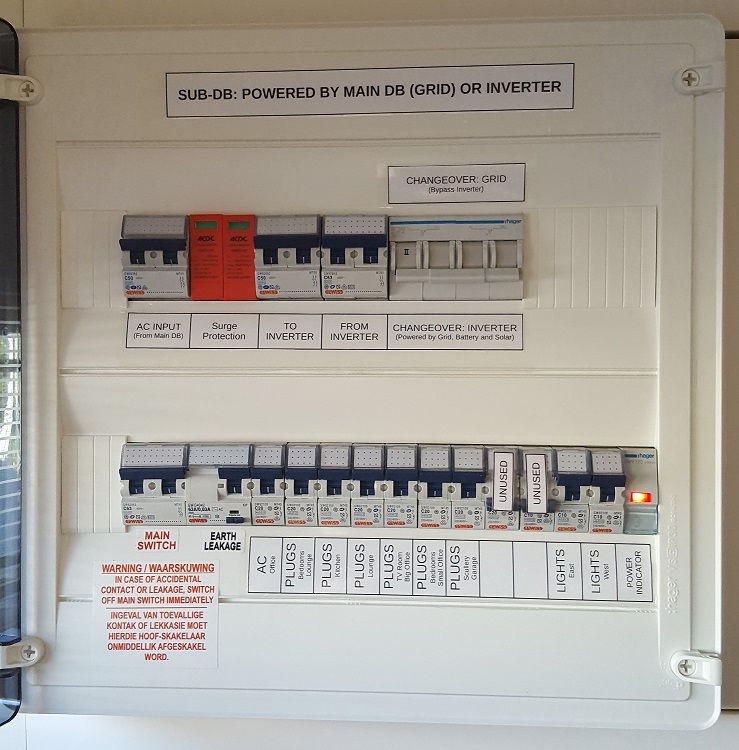
Got the sign-off from CoCT about a month ago, so my DIY solar project is finally done and dusted. Thanks to everyone on the forum that provided advice - I probably would have stuffed it up if it wasn't for you. The whole project took about three months of evenings and weekends to finish, and was a welcome distraction from the current state of the world. 4 strings of 4 Canadian Solar 400Wp poly panels in series, facing NNE. Another string of 4 Canadian Solar 400Wp panels in series, facing WNW. All five strings are paralleled together for a combined 8kWp. This is my main DB. CoCT installed a new split prepaid meter. According to the technician that installed it it has built-in reverse power blocking. I have tested it to see what it does when I try to feed in power in to the grid, and it charges me in both directions. That is perfectly fine in my opinion - much preferable to it tripping when there is momentary feed-in. Grid power is measured by an ET112. There is a breaker that connects the main DB to the solar installation in the scullery: Top-left is the AC DB. Top-right is the DC combiner box. Bottom left is the Multiplus II 5kVA inverter, and bottom middle the SmartSolar 250/100 MPPT. The SmartSolar was initially running a bit hot for my liking, so I mounted it on a 6mm thick aluminium plate which brought down peak temperatures from 82C to 65C. Bottom-right is the Victron Cerbo. The battery cabinet on the floor contains 5 PylonTech US2000 batteries for a total nominal capacity of 12kWh. I've set it to 80% DoD: Close-up of the DC buses. Close-up of the AC DB, with and without cover. Close-up of the DC combiner box, with and without cover. The geyser and oven, as well as the swimming pool DB are connected to the main DB, so those are unpowered when there is loadshedding. The AC DB in the scullery is connected to the output of the Multiplus, so all the essential loads stay powered when grid power goes down.




-
Just an update on this: Turns out it was a problematic cell in one of the batteries. Once the battery was exchanged the warnings went away and haven't come back. Thank you @Youda and @plonkster. Oddly the firmware of the newer battery is almost a year older than the older batteries, even though the new battery was manufactured in May 2020 and the older batteries in November 2019. They seem to be working together just fine though. For anyone considering buying Pylontech batteries, but worried about warranty and support issues: My experience has been very positive. I dealt directly with Pylontech and the process of swapping out the faulty battery for a new one was quick and painless.
-
Not yet. I'm going to give it a few more days, and if I'm still getting high voltage warnings after that I'm going to make up the cable and dig deeper. Thanks for making it available. Should I be worried about these high voltage warnings, or is it safe to ignore them? Presumably the BMS will shut the battery down before the cells get damaged, right?
-
I thought so too, but after a couple of cycles down to the region of 60% and back up to 100% it started throwing the warnings again. Perhaps a recurring cell imbalance? I've been coaxing it for more than a week now, so if it was only an initial imbalance it should have been sorted by now. Judging by the rate at which the voltage drops from 52V when discharging, and the rate at which the voltage rises above 52V when charging it's very clear that the Pylontechs store a minuscule amount of energy above that range. Presumably that means that even the tiniest of imbalances will manifest in a disproportionately large voltage differential between the cells when the battery is charged to 52V+. It's a pity the Pylontechs don't report the individual cell states over the CAN bus. It would have been very insightful to be able to see the individual cell voltages, and whether it is always the same battery cell that is causing the warnings. If it's a dud battery I could have it replaced under warranty. Is it a misguided lead acid backward compatibility thing perhaps? What you're saying certainly makes a lot more sense. I've been looking at the charge current limit that the Pylontechs report to the Cerbo, and it seems ridiculously high even when already highly charged. It's not giving itself any time to do any kind of balancing when it is approaching a fully charged state. Thanks for the feedback.
-
Referencing a very old post here, but in the Venus OS 2.60 beta the Pylontech charge voltage was raised to 52.4V (we've discussed this privately), and a new feature was added to allow the limiting of the grid export. Using the latter with a low export limit (e.g. 100W) causes the charge voltage to rise to 52.8V, and sometimes briefly 52.9V. I'm regularly seeing "high voltage" alarms from the BMS at 52.8V. If I disable feed-in or allow the Multi to feed in the full excess then the voltage drops back to 52.4V and everything is fine. Perhaps 52.8V is pushing the envelope a bit, or I could just have dud batteries... I did mention this on the Victron beta feedback forum, but since this is your department I figured I'd prod you here as well 🙂.
-
I'm busy looking at SANS 10142-1: 2017, but I can't find this requirement anywhere. Do you perhaps recall under which section it is stated? Looking at my main DB I see multiple violations of this, and it has passed two CoCs that I know of. Is this a SANS 10142 requirement?
-
I haven't actually. I have ordered 6mm^2 cable online (which is massive overkill for the 10A it will be carrying), but I've never held it in my hands. Perhaps once I see it I'll be reassured. I'm leaning towards not using conduit at all now. I'm slightly worried about rodents gnawing through the cables, but if I look around in my ceiling I see plenty of tasty AC cables that have been there for at least a decade that haven't been touched. Thanks for the advice.
-
The exact wording in section 6.2.6 is: "Positive and negative cables shall be run alongside each other, to prevent the formation of induction loops;" If I put the two metal conduits next to each other, touching, will that pass muster? It just seems safest to me to put a physical barrier between the +ve and -ve cables.
-
I've read through the draft document, and the rules seem kind of strange: In section 5.3.5.2 it states "Where conduit is used for DC cables, it shall be metal conduit." Then in section 6.2.6 it states "Where a system features longer DC cables (e.g. >50m), consideration shall be given to the use of screened / armoured cables, or to installing the cable in earthed, metal conduit / trunking." And again in section 6.2.8 there is the wording "Where a system features DC cables longer than 50m, the cables shall be installed in earthed metal conduit or using armoured cable." So what I understand from this is that PVC conduit is never allowed. If you put the cables in conduit it has to be metal, and above 50m runs using such conduit is mandatory. Why the hate of PVC? Surely in runs under 50m PVC is better than nothing?
-
Thanks. That seems a bit draconian, given that 220V AC in PVC is apparently just fine. My plan is to run two separate conduits, one with + cables and a separate one for the - cables for my four strings. All the + and - cables will be shorted together in the combiner box anyway (after the fuses/isolators), so this should be quite safe. There will be 4 strings, so 4 cables in each conduit, 10A @ 200V DC. My application has been approved by CoCT, but I haven't actually started installing - the lockdown has put a stop to that. The big question on my mind now is that if this draft standard becomes final while I'm busy installing, would I have to comply with it? PVC conduit is so much easier to work with (and cheaper).
-
Are you sure this is a regulation in South Africa? I spoke to my solar installer and according to him PVC conduit is acceptable inside the roofspace.
-
I've noticed this on the specifications page for the Fronius Primo: Fronius Primo 5.0-1, Fronius Primo 6.0-1 and Fronius Primo 8.2-1 are not fully compliant with VDE AR N 4105. I'm not familiar with the German standards, but perhaps that's also why it also does not have NRS0970-2017 certification?
-
Well, that just threw a spanner in the works. It makes perfect sense of course, but I was foolishly assuming the CoCT wouldn't look that far. I've already paid the deposit on the Multiplus and SmartSolar, and I was about to pay the deposit on the Fronius. Thanks for the warning - you've saved me some money. If we both survive this virus thing and we cross paths in the future, remind me to buy you a beer :).
-
Surely that is only an issue if it is connected directly to the grid? In my case the Primo is on the output of the Multiplus, so CoCT should approve my application right? The Multiplus will limit the current to 15A and also prevent feed-in, so as far as I can see all their major concerns are covered.
-
If you're able to shift your heavy loads to the sunshine hours (like I am) it would be slightly more efficient to have one Multiplus together with a Fronius AC coupled inverter on the output of the Multiplus. The total capital outlay would be about the same, but there's one less DC - DC conversion. I submitted my application to CoCT last week and I'm now waiting for approval. I went for a 5kVA Multiplus, SmartSolar battery charger on 8 x 400W panels, and a Fronius Primo on another set of 8 x 400W panels. During daytime the Fronius will carry most of the load while the SmartSolar charges the batteries. During the evening the Multiplus will carry the loads from the batteries.
-
If the 3kVA multiplus trips while transferring 32A then the transformer on the street corner would see a 32A load change. If one inverter trips it would just be noise, but if all the inverters in the neighbourhood trip in unison (which is not inconceivable) it could be a significant event. I'm not defending it, just stating what I believe the rationale behind it is. According to an e-mail exchange I had with CoCT the same limit applies to a UPS system - you may not draw more than 15A to charge batteries: "Any inverter used as a UPS must adhere to SANS 62040 for UPS systems. Also note: That the maximum battery charger power drawn from the utility (kVA) shall not exceed the Maximum Total Generation Capacity limit as listed in the City of Cape Town's 'Requirements for small scale embedded generation in the City of Cape Town's 'Requirements for small scale embedded generation, Table 1')"
-
CoCT looks at the maximum current at the point of connection between the grid and the inverter, so even if you have a 3kW Multiplus you would still have to limit the AC transfer to 15A. I strongly suspect that this interpretation is contrary to how they interpreted their own regulations previously, but this is the way things currently stand. There is no restriction on the amount of power you may generate for the loads connected to the inverter output, as long as you stay under the current limit between the grid and the inverter.
-
I doubt anyone would ever visit you again, unless the transformer on the street corner blew up and they're hunting for the cause. If the option to override the current limit via a GX device is disabled, then you would need the (expensive) VE.Bus to USB cable in order to change the current limit. So your installer could make it hard for you to change the limit if he/she was so inclined.
-
I'm hoping that the wi-fi range of the Cerbo is better than the Venus. I'm not going to buy the screen, but it's nice to have the option of adding it later. (Apparently you can plug in any HDMI display and mouse - the ports are not proprietary.) If the Cerbo was more expensive I would have considered a Venus, but they're pretty much in the same price range. It's clear to me that the Cerbo is intended to replace both the CCGX and Venus, so it's also a case of not wanting to buy something that will be obsolete soon. I've gotten several quotes on various lithium batteries, including FreedomWon. It's hard to look past the price. I have not been able to find anything that comes close to the Pylontechs in kWh/Rand terms. I'm also fearful of buying one big monolithic battery in case something goes wrong with it. I'm not going to blindly assume that the battery manufacturers are going to be around to honour their 10 year warranties, but at least with the Pylontechs if one goes bad I can toss it out and still have a working system.
-
I got several quotes and ExSolar was actually on the lower end of the scale, particularly on the Victron hardware. Perhaps others in the region are taking advantage of the situation and coining it. Hardware prices have certainly shot up in the last couple of weeks, more than the weaker exchange rate can explain away. Seeing that I'm getting the hardware from them, perhaps it would be best if they handle the panel install as well. Then at least there can't be any blame ping-pong between the hardware supplier and installer in the event that something doesn't work. By the looks of things my build will only come to fruition in several months' time: I'm at the back of the queue for a Victron Cerbo, and I still haven't been able to source Pylontech batteries. It's disappointing, but at least it gives me plenty of time to iron out all the kinks in the design.
-
Thanks for all the good advice. After scrolling through all the images of burnt out solar panels I am now thoroughly scared of DC wiring, and I'm wondering whether I shouldn't perhaps get someone with more experience in these matters install the panels for me. Does anyone have first-hand experience with an installer in the Somerset West area that they can recommend?
-
Thanks for the info. I think what I'm going to do is buy a couple of MC4 connectors and use that to connect 6mm^2 PV wire to the panels and then route the PV wire straight into the DC combiner box in the garage. I'll put fuses and disconnectors in the DC combiner box. How do you normally bring the PV wires through a tile roof? There has to be a better way than flexible conduit and lots of silicone, right?
-
So I'm busy planning the wiring between the solar panels on the roof and the inverter in the garage. I was busy researching which DC isolator to put on the roof when I came across several horror stories of DC isolators failing and even causing fires. Apparently it is a legal requirement in Australia to have a DC isolator on the roof, but the regulation is set to be reviewed due to their presence achieving the opposite of the intended goal which was increased safety. Are DC isolators required on the roof in South Africa, and do installers typically install them? I scanned through the draft SANS 10142-1-2 regulations and didn't see such a requirement spelled out (but it may be implied perhaps). Having read all the horror stories of PV fires, I'm also wondering what I should do to protect the cables on the roof and how to bring them through the roof tiles. Is there a guide somewhere that explains best practice in this regard? I'm planning 4 strings of 4 panels, thus 10A@200V will be travelling down each of the four wire pairs to the garage where they'll meet in a DC combiner box. Thanks!
-
Fortunately the wiring distance between the two DBs is only about 10m, so at roughly R30/m for 16mm^2 wire I'm looking at about R1500 (2 x 10m live, 2 x 10m neutral and 1 x 10m earth), which I can live with. My main DB is also Samite, so I would have to use those adapter clips for DIN equipment which looks bad. Furthermore I would like to have the option of switching the entire main DB between being an essential and non-essential load. I had our energy usage monitored over a month and we rarely go over 4kW (about 1 hour per week), so I might get away with hooking up the entire house to the essential loads output of the Multiplus. The Multiplus can sustain 4kW from battery and/or solar, and when there's Eskom power I can draw an additional 15A from the grid on top of that. When the grid is down and the sun isn't shining we would have to manage the loads. In any event, are there any regulatory issues with routing power from the main DB to elsewhere and then back in the way that I am planning? Do I need power indicator lights? Would it complicate matters if I perhaps split loads in the main DB between Eskom and the Inverter output? In case things don't work out I might want to move the geyser directly to Eskom power (but then I'll also have to add an energy meter of course). I just don't have any space in the DB and on top of that some of the loads in the main DB are essential and others not. It being Samite is just the cherry on top.


