daniemare
Members
-
Joined
-
Last visited
Everything posted by daniemare
-
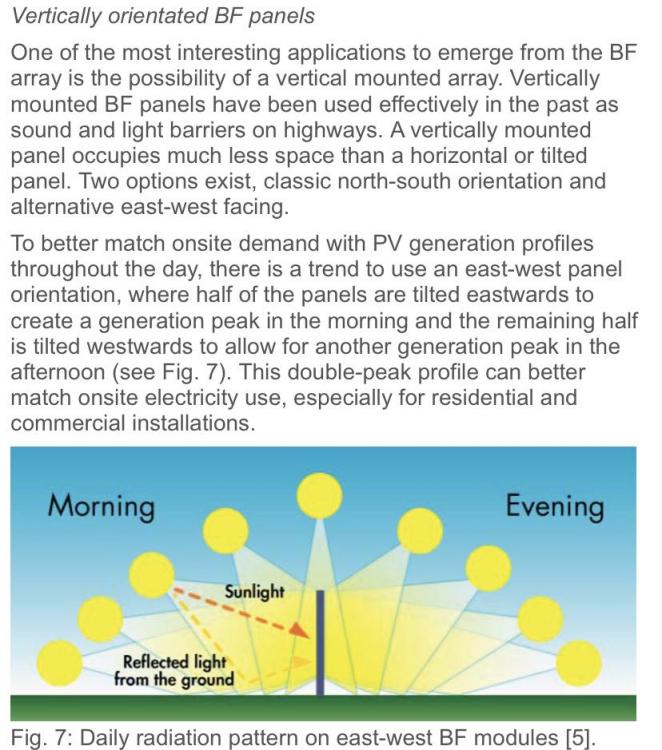
Hi All, As I continue my solar research, I came across the bifacial panel option and I want to sound board my thinking. Traditionally convention dictates a north facing install. Now, as I am installing a Goodwe ES with 2 MPPTs, I was thinking: - Install 1 string of 4 panels (350-400W) north facing on the roof (traditional racking) - Install 1 string of 4 panels facing West. This will help optimising production during my peak usage (Western Cape and late sunny evenings) BUT - seeing that this will be on a flat roof section, which will then require a tilting racking system I am wondering whether Bifacial panels will not be a great option here as I should then get very good production during the morning when it hit the back of the panel? (for discussion assume no shading issues) Secondary question Can one do 2 west and 2 east on the same string and MPPT? (See snippet from article attached) Secondary question Assuming a VMP of 50V, what wire thickness do I need for a string of 4 and 15m cable length. Online calculators give me different answers of 4 and 6 mm2.
-
Hi All On this topic, how does one distinguish between a hybrid inverter and a grid tied inverter. Hybdrid - Like Victron Multiplus and Goodwe ES that can blend power sources like PV and Grid whilst providing backup Grid Tied - To my understanding these have both Grid and PV inputs but can’t blend, like most Axperts. Reason I am asking is that when I read spec sheets I see for both types specs like AC in, MPPTs, ups transfer times, Battery In BUT struggle to understand what technical aspect makes this differentiation. The price off course is an indication
-
Thanks Piet. Which specific Goodwe inverter model will that be. And how is Anti-Islanding then achieved if the solar panels can feed the grid side if my backup/side is not utilising everything? Will the EZMeter do that? Can you share a link to that. Thanks
-
I saw the Goodwe, and the Imeon, but I do not understand how the non-UPS load connects to the Inverter (like the AC2 Out of the Multi). So even though I read that (for example) a 3kW inverter supports 3kW when the grid is off, it can do up to (for example) 6kW when the grid is available tby means off pass through, I struggle to understand how this works if there is not 2 outputs? I will probably, just want to make sure I do not miss a trick buying the same thing for maybe 30-50% cheaper. 😉
-
Hi all As I educate myself of the world of solar and backup power, I am trying to understand the different inverter brands. Functionally I have settled on the Victron Multiplus II. For 3 basic reasons 1 - I understand the AC1 out (UPS/Backup Load) and AC2 out concept. Logically it just make sense to me how solar plus grid powers both when available and solar and battery powers UPS only when grid is not. 2 - On Cape Town’s list 3 - Wealth of knowledge from various community forums and ESS system that looks very logical and well supported. Now my question, what other Inverters (plus model) does exactly, or almost exactly, the same as the Multi? And what are the key differences when considering point 1 above. Thanks guys Danie
-
I saw the 2 x requirement. What will the problem be setting up with 1 at first? I want to use the battery only for critical UPS loads during load shedding
-
I am, I deduct the equivalent of a 1200v victron inverter charger and 1 Pylon 2.4 battery and basic installation as my “convenience” cost before seeing of the rest gives me payback. (And this basic setup can even be cheaper with different Inverter and Lead Acid Battery) Still struggle
-
I also in category 3 as you. And I do think the above holds true. But what I do hate is when someone quote me 1) Kick $50 2) Knowing where to kick $50 Same price, but it just feels like a rip off. I would rather see 1) Equipment quoted at competitive pricing 2) Installation cost (with markup off course) 3) Support cost with T&C of support. Then you know what you have paid for and what you can expect
-
Exactly what you said. Either bond interest rate if you borrow or investment return if you have the cash. But for ease of calculation, I also do high level assumption that the electricity increase washes the opportunity cost. I guess I was only so surprised that marketing wise, savings and ROI is toted all the time, yet it is not there.
-
Good point. Is that worth a 35% markup, debatable, but the concept makes sense. Of course this then goes with selecting a reputable installer that will come back.
-
I use 588 kWh or just under 20 a day (R1075 per month) I even deducted the 1 2.4kWh battery and basic inverter charger from the prices quoted (as I see this as my basic load shedding luxury charge) and I still don’t get to a decent 5-7 year payback. I might not know allot about solar (yet), but I can run numbers, and all the examples I see never take into account opportunity costs. But I have no problem to be corrected.
-
Western Cape. I mailed you
-
Herein lies my problem. If they do it on the equipment lines, how inflated is the service lines which I cannot check or quantify myself. Yes, I am getting more than a few quotes, but it becomes impossible to compare apples with apples as installers do not lump their generic lines the same. And my address normally see service providers add another 25% But, I have basically concluded that there is no payback for a solar install at my level of self consumption, unless I can do every bit myself which I cannot really (like wiring into the DB) So basic UPS it is for loadshedding
-
Well, although I agree on a markup for working capital, the self same quotes I got was very specific about the deposit I have to pay upfront. So no, there is financing of stock by the installer
-
Hi All, As I am getting quotes from various installers, I have noticed that the installers typically charge between 20%-35% more for the itemised equipment compared to websites like Livestainable, The Power Store etc. Typically for the Inverter (Victron), MPPT (Victron), Battery and Solar Panels. Why is this? Would Installers not would have preferential prices with the distributors/wholesalers, and should at least match (or slightly higher) the online guys. 1 - is the installer double dipping (i.e. mark up on equipment and installation fee) OR 2 - are the online guys doing parralel importing (grey products). As I am new in this industry, I am trying to figure out what will my risks be regarding warranty and after sales support buying direct vs using the installer to source the equipment. Thanks All Danie
-
Have a heat pump. Very happy with that. In the western cape, with kids using water in the evening, and the adults in the morning, I cannot be happier or recommend it more. I actually use about 550kWh per month, but buy up to the limit of the 3rd tier of Stellenbosch’s tiered pricing. The accumulated energy is then used in Jan and Feb for the aircons at night, essentially using the prepaid system as a battery.
-
Thanks PJ. But I am still unclear about the wiring and installation costs. The inverter and battery part is easy enough to get pricing, but the rest is unclear and what is the advantages of the UP 2500 over the US2000/3000 in this UPS application? I do not mind the low selling price, I do care about the fixed fee which I currently do not pay on prepaid, so for my calcs it is incremental
-
FIT is a joke. At R250 odd meter reading, which is 25% of my consumption bill, its as if they do not want you to feed in. Thanks Johan. Starting to realise that. Just funny how every solar website touts savings as this big motivation factor.
-
So, an installer works with a said number of supplier, month in and month out. They probably know each other by name. You on the other hand do not know the installer from a bar of soap. Yes you might have connected based on a referral, and have met each other for the consult, but that is it. So, his regular business partner do not trust him enough to give him trade terms and a credit limit, why should you by giving him a deposit. I could never understand this. It’s a pet peeve of mine. But the I also know you can’t “poep teen donderweer” so I accept to pay for goods upfront, but I pay that supplier and thus at least secure my goods.
-
Base UPS system Victron 12/1200/10 R11000 Omnipower 240Ah R7000 Install and other 25% assumption (hence my question) Total R22,500 Solar System Victron Multiplus II 3000 GX R20,000 MPPT Bluesolar 150/30 R4,500 Pylontech US2000 R15,000 Solar Panels (6x300W) R12,000 Install and other 25% assumption (hence my question) R65,000 Difference R42,500 The Calc I use 588kWh per month of which I assume 14 is during sunlight hours per day (averaged over year - Stellenbosch) Now if I self consume 60% of that or +-250kWh at my marginal municipal tariff of R1.90 for that bracket I save R475 per month of electricity costs If I use my bond rate of 9% as my cost of capital, and I assume an Eskom increase of 12% per year I work out a return adjusted payback period of 8 years. Now I do not even think my solar option of R65k is realistic any more the more quotes I get. So the payback is starting to look even worse. Maybe I was just unrealistic about what these things cost. But thanks for the input
-
Hi. I am trying to understand what a basic Pure Sine Wave based UPS system will cost. (Inverter plus battery) I can conveniently source prices of inverters and batteries online, but the wiring and installation requirements and costs are not that easily understood by a noob like me without getting formal quotes. Requirements: - Wired into DB board - Specific circuits already identified which do no exceed 1500W when all is turned on at the same time. No items have high inrush current when turned on - Required time 2 hours - Recharge time 4 hours So What: I am actually considering a solar grid tied system. But I just cannot justify the expense from a payback point of view. So my thinking is, as I am comfortable to invest in a basic UPS, I will deduct the above and see where my ROI ends up. If it does not make sense, I revert to the basic UPS option Thanks for the input Danie
-
Hi All. New here, so I thought I will first say hi and give some background as to what I will be using this forum for. Like many, the load shedding has taken it’s toll, and with the new Eskom chief finally indicating that load shedding will become more permanent, the incentive is now there for me to invest in some convenience. My needs are simple 1 - provide up to 4 hours or 2x2 hours of load shedding of my critical (read convenience) load 2 - if budget and payback allow, add some solar generation for self consumption and battery recharge during the day I am not looking to go off grid, sell back or supply my full peak power requirement. So far my research (including this forum) has taught me allot, which I also enjoy, so I am excited about this journey, all be it small when compared to some of the installs here. I have settled on a Multiplus II 3kVa GX unit and Pylon 2.4 battery. Next to understand is - What to consider and how to determine the amount of panels and MPPT charger size - What are all the other bibs and bobs needed for an install (i.e. wires, combiner boxes, compliance etc) - How to choose a reputable installer that doesn’t see my address and try and sell me a mini Medupi. Thanks in advance for all the help or cross references to where things have already been discussed Danie Stellenbosch