


1ougat
Members
-
Joined
-
Last visited
Everything posted by 1ougat
-
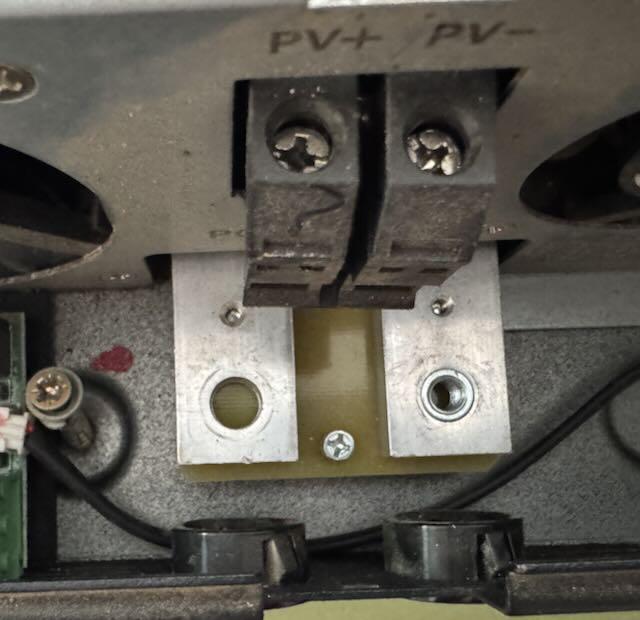
Well contemplated various inserts to fix the tread - 1. Drill and tap , 2 . Rivnut , 3. Helic coil , 4. Bolt and nut , 5. Replace with the existing part from the broken inverter and then got the actual solution that is a easy fix . 1. With the hole that is there this could work but you will end up with probably a M10 - so could work but got a better solution. 2. Rivnut is not the ideal application for this as it would need modification to the hole to fit an it is more suited for applications in thin plate . Also as this is a current carrying comonent it is best to use a insert with full contact with the metal . 3. Helicoil - could work as a M8 could fit (probably ) 4. The bolt and nut needs acces from the rear - so could work but is a pain - so early discard. 5. The part is soldered to the main bord - so total disassembly required and the need a heating /soldering station to work - so discarded. The actual solution came from my visit to Apple Tools in the Strand - The M8 Helicoil kit was sold out and by asking the shop assitant got the neat solution for fairly cheap = R8 - Its a self cutting insert for the M6 bolt originally used . It uses a M10 x1.5 tap tread on the outside that you just turn into the hole - I started with the insert and used a tap to do the final fit - trim the extra lenth on the insert and - Job done . So if you have this problem this is the solution . Photos shown the solution before final fitting - first cut the thread and remove to trim the ears to fit without protrusion at the back .
.jpeg.490731b2e9e18926f1577271a38c2b89.jpeg)
.jpeg.bbff08c36d3c7ac52b4d03d2f4824a55.jpeg)
.jpeg.20c8a1df2755df53403593f7bf295f92.jpeg)
-
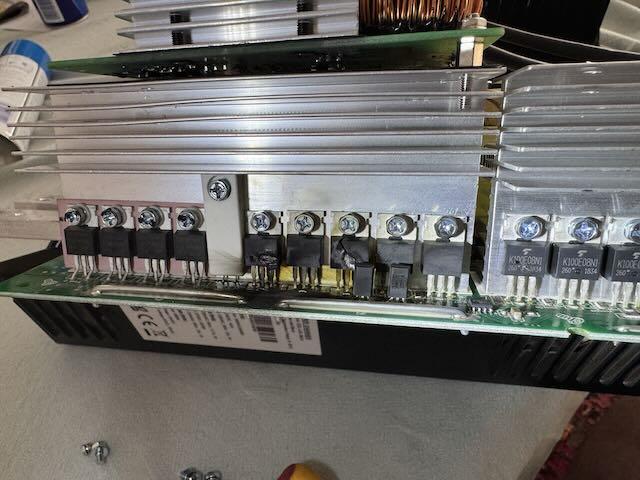
Was call-out to a customer on Monday regarding a Mecer 3kv 24v inverter not working - found the batteries totally flat (lithium Blue Nova 1.4k) - so took home and charged them = when I put them back it seems like some short on the battery terminals , as screaming inverter and som magic smoke appeared. Luckily the customer had a second hand replacement but with one single annoying issue - so here my questions : 1. Photo One - TK100E08N1 Mosfets - seems to be the issue - is this beyond economical repair ? It is a 2018 3kw inverter ? i could do this a s a winter evening project - but based on my current project list ( number of cars , electronic repair's , lego builds, Pocher builds , drinking wiskey and talking shit , my wifes list for me etc.) I have worked out that I have probably more projects to do in the time I have left on this earth so this will probably come up when I turn 90 . So if someone dont have anything to do then maybe they can have it - comment please . 2. This leads to question 2 (Photo 2)- the replacement inverter . Exactly the same one that should be a 5 minute swop out - but with the anoying missing insert on the one battery terminal . While stripping the broken one thought of swopping from the old inverter , that have a perfect set . Swop out actually requires major surgery and probably messing to that extend with such an inverter could actually mess it up . So I could tap the aly and put in a bigger bolt or put in an insert - access is a bit limited . Any suggestions ?
-
What panels do you use /reccomend with the higher rating available ? 455W used to be the limit with the 11A rating - Now the 500W JA Solar has a 13.04 A and Isc of 13.93A - is this acceptable ?
-
Yes has a 17A+17A Isc rating - so what does that actually means in relation to the 13A+13A

-
Hi The current limit on 5kw Sunsynk MPPT used to be 13A - generally limit the panel sizes to about 460W . The latest versions have both the 13A and a 17 A limit on it . What exactly does that means ?
-
On the 3Phase meter can you still see the individual phase details or is it combined in one reading/ graph?
-
I have been using the Efegy meters for a number of years as a way to first survey a site as to the load usage etc. It was quite a good tool for that purpose and very cost effective . The original ones I bought directly from England and then the Ellies branded versions appeared locally and I used those very successfully . Then Ellies discontinued the importation . I have used them on individual phases and on 3 phase systems . They are now unobtainable - what alternatives are available ? This is specific for the use of temporary measuring the load at a site . regards
-
Thanks - went into the app and it was fairly easy to reconnect the wifi - seems that the Solar
-
Hi This relates to the new Sunsynk WIFI dongle , not the SOlarman app. Had the app working but the user changed their wifi router name and password - so the app is not working anymore - Is there a way to update the app with the new password without a total new install? I dont want to loose the history build up . Regards
-
Hi The following senario : 1. 1x Axpert 3kw 24 V inverter that provide the essential load with 2 x Lead Acid batteries. 2. Installed a Kodak 3kW Grid tie inverter with panels to provide relief on the energy usage from the Munic. Very cost effective and works well and has been operating for over 3 years . Now the issues : 1.The batteries needs to be replaced and could be replaced with Lithium batteries. 2. The 8- 10 hours of loadshedding you lose out on the PV generation because of the inherent switch off of the grid-tie inverter whenever the supply is off. Options : 1. Replace the batteries and take two panels directly to the Axpert ( think it can handle about 800W) 2. Run the gridtie after the Axpert so that it is always on - anyone that has done that and can comment on that ? 3. Replace the two inverters with Hybrid inverter - Any smalller Hybrids that run from 24V that anyone can reccomend? The customer is a pensioner and the aim is to be as cost effective as possible . Any suggestions/ Comments
-
Except if you could feed into the grid ..... Energy must be consumed when it is produced - if you cannot move load to the daytime when the sun is shining you will lose that generation. So move the washing mashine , tumble drier all to the day - If you have a AC you can use that in the afternoon to heat /cool your house . Form my customer base - the only people that have a sinewave PV curve are those that feed into the network or have an undersized panel for the load.
-
My experience with the Axpert 3kW 24 V inverters set up as UPS's is the following : I have found that the lead acid typically last about 2.5 years before people notice that it cant run the full 2 hours of load shedding . Another case we have over sized the installation with 160Ah x2 and that because it dont see the deep discharges has been lasting well . The obvious answer is Lithium but it is considerably more expensive but is the best return for your money . I have been using the Blue Nova 24 V mini and also the Blue Nova Mobile Power Series (MPS) 12V 1.4 batteries with the Axpert 24V and had good results - It can charge quicker . Just check the individual batteries every 6 Months and then charge them individually to balance . The new option is that Blue Nova now has launched a 24V Version of their Mobile Power Series (MPS)- Effectively a 1.4k in a 24 V setup - so no need to balance charge these anymore.
-
The misunderstandings of safety earthing ,bonding and earthing for lightning is scary. Lightning earthing is also part science and black art 🙂 1.The lightning incused spikes are a high frequency Voltage spike that travel on the conductors ( Neutral , Live , Earth - it does not care ) towards your precious inverter - and it will also do so on your DC wires . At a reflection point on the line it will reflect and effectively double up and can spark over at such a point . It is why you see arcing horns sometimes on overhead lines and the good munics will install surge arrestors on the incoming lines at the supply transformer. In the high voltage case you also will then have the 50hz power going to ground at such a breakdown point and effectively creating a short circuit that the upstream breakers must clear . That can cause damage as the time could be long before the breaker operates .(Long is also relative as this would be a few cycles for the breaker to operate vs the lightning induced spike timeline. Suffice to say you want all your equipment to rise together on this voltage so that the differencial between the equipment don't exceed the equipment rating . So add as many earths as you can, connect them together and add surge arrestors on your incoming feeds . And buy insurance. Some connections I have seen would not have helped in a lightning strike but at least would satisfy the insurance guy that you had an earth as required . 2.Bonding is there that you are not the earth conductor that closes the loop in case there is a live wire touching exposed metal . 3. Safety earthing is there to ensure that your earth leakage works properly in case of any current (more than 25mA)returning on the earth wire. Earthing is a very interesting subject and can be confusing to people . Hope this helps
-
I had the case in the Strand that the grid tie inverter I used would not connect as the line voltage was above 250V - think it was around 253V . Had to report it to COC and they send out their electricians to come and measure the incoming voltage at the pole . Then they got the Line electrician to tap down the transformer. That solved the problem and the inverter has been running happily since - think the code checking build into the inverters are pretty decent.
-
Well - I went ahead and did it 🙂 Agree with the sentiments expressed - current is current so the current rating is more important in this case . The insulation is supperior to the normal PVC so good on this front and the multistranded nature of the DC cable is to cater for more movement so ok on that front also . The colours is also ok - So that was also my assesment . Thanks everyone .
-
So here is an interesting question - like to hear some of the views on this . I need to connect my car charger permanently - it is rated to be run from a 16 A plug (3kw). It typically run overnight to charge the car and I find that the plug heats up. I want to install it on a dedicated circuit via a "welding plug " - 32 A rated plug to connect the charger . This will be connected on a dedicated circuit - eg like a stove connection . Will be using 4 mm house wire . So here is the question : I had an installation a while back where I made up a solar 4mm pair with a earth wire and after running the bundle to the inverter I cut the extra part off . So now I have a live , neutral and earth bundle that will exactly fit as the supply for the charger . So can I run AC over a Solar cable ? My take on this : You usually see the comments from the other side - don't run house wire as a dc clable - lower voltage rating , PVC vs XPLC etc . and I agree, but this is now the other way and normally I would just use gp wire but waist not want not ? Effectively a solar cable is a superior cable - current wise it is fine , it is fire rated , it is high voltage rated etc. The only difference is that it is stranded vs 4mm2 GP wire has 7 strands , it is more expensive, but I have this made up piece that I will not use on a site and a there currently is also a shortage for gp wire - so would you use it ?
-
Dont actually know - but that is the ultimate back up - low solar , battery flat -only option - so sizing and use and learning how to live with what you have is important . My recommendation was 6kw PV, 5.2 kW inverter and at least 8kWh battery installed at 35+degrees. You need to optimise for the winter months .
-
Seems that the King has a low voltage mppt - any reccomendations for high voltage versions?
-
Retirement home in a Eco development - no Eskom / Munic power supply - Only solar and generators . Gas stove and gas geyser . There is a R100 000 provision in the house build for Solar .
-
Reliability wise - both are a transformer less design - and usually these will not make it is if the designs are not good to deal with the inherent issues related to trfr less designs . The other option that would make sense is the Microcare offgrid inverters - but then you then have seperate MPPT's etc. - still also a good inverter with a transformer based design .
-
The only other design related issue is the lower voltage limit on the MPPT's of the Axperts - but I think there are some that have a 450V in stead of the 150V limit?
-
P1000 - I have installed a number of the Mecer branded Axperts and only had one case where I had to take the inverter for testing and it then turned out that the battery was the problem - You have any other experience ? Must say that the battery supplier said it was the inverter that caused the issue - but in the end that was also false - just a overstated ability of a lead acid to work in a cycled environment . Seven years ago a lot of statements was made by people that this is chinese crap and Victron is the only option but 7 years later they are still operating and I am not aware of an enmass failure of that design - yes it is not an Hibrid and a Hibrid is now my choice for a normal house install with a eskom/munic supply because mostly you can still use your solar panels during loadshedding , you can cycle your batteries in a intelegent fasion , you have a good app etc. But I must say that most of the original Axperts is probably still operating if it was installed with adequate protection . Or am I on some other planet?
-
Hi I was asked to review quotes for a friend for an off-grid install . It is a true off-grid - no munic or eskom power . Both of the quotes propose a Sunsynk inverter . Now just to state it up front I like the Sunsynk and is my go-to in case of normal installations . But in this case I would propose an Axpert or Clone as an adequate inverter . It will be cheaper , you can still power it from a generator , and you could use the saving to get extra panels or bigger battery . The true hibrid features will be waisted in this case . Am I missing something ? What alternatives could also work ?
-
Hi all Thanks for the replies , my take from this : Support ,mounting etc. probably similar . Only real difference is the chemical make up and then we into the NMC vs LFP debate . I can understand the case for the higher density for the use case of Electric Cars( I have a i3) and Cell Phones . You will find that in those cases also each cell is monitored and you have sophisticated BMS management in place . In the case of storage batteries you can reuse NMC as a storage battery as a second life option but for home installations where you are sometime compromised as to where you have to install batteries ( no dedicated battery room etc) I would opt for the inherent safer chemistry of LFP . I was involved in the review of a Battery Fire in Nelspruit - It was installed in a dedicated battery inverter utility room and substantial damage to the room and the garage was done - if that was in the house it could have been deadly as the wires that burned cut the power to the safety door and the people was locked in( and yes that they only found out with the fire ). I will provide the feedback to the customer and she can make the call . Thanks
-
Thanks Excellent point
