biometrics
Members
-
Joined
-
Last visited
Everything posted by biometrics
-
I see this in the spec sheet: "Supports peak shaving control in both "self-use" and "generator" mode"
-
The generator is nominal 1,800W so I'll set the maximum charge to 1,500W which for the 50V battery is 30A. I'm getting a professional electrician that have experience with this type of installation, so a CoC will require a breaker I am sure. Thanks for the feedback everyone.
-
I've been told the Solis inverter actually has a dedicated generator port. So that is obviously the best approach. I'll just limit it to say 30A (1,500W) and it will take 3-4 hours to charge.
-
Thanks to @HennieL , @Pho3niX90 and others in the following thread I got the charge rate of my inverter battery sorted. I have a follow up question due to the recent storms. https://powerforum.co.za/topic/33856-slow-charging-sunsynk-5kwh-battery-at-only-180w/page/2/#comment-227998 With the recent storms the grid was out for many days and there was basically no sun (I don’t have panels yet but in any case there was no sun so it would not have helped). My battery only lasted a day so we were without power for a few days. I decided to a get 2,000W inverter generator to top up the battery and supply some power to the house during such conditions. I have a Solis 5kW hybrid inverter and 5kWh Sunsynk lithium battery. An electrician will install a change over switch so when the grid is down I can connect the generator safely to the AC supply. I have a few questions: If the battery is partially charged and we’re on generator, when I boil a kettle will the inverter blend battery and generator power to supply the load? Kettle can draw more than the inverter generator. What settings should I change in the Solis app. The most obvious is the max battery charge rate. Currently it is set to the nominal 50A (max is 100A). If the battery is 50V and I want to charge at 500W then I need to set it to 10A, correct? That leaves 1,500W spare for the house, correct? Will the inverter automatically know what the generator can output? The inverter generator: https://www.takealot.com/steco-sg-2050i-steco-inverter-generator-2000w/PLID94464184
-
Yay, it’s working! Thank you @Pho3niX90 and everyone that commented. Much appreciated. A bit sad that Solis SA support said it’s a battery issue and they can’t help. Will get solar panels this year and will then set it to use down to 40% SOC overnight. Don’t want to go lower in case of outages or lack of sun.

-
Thanks very much. Will feedback with the next power failure (don't hold your breath).
-
Currently no solar panels so yes it's for backup.

-
Like so?
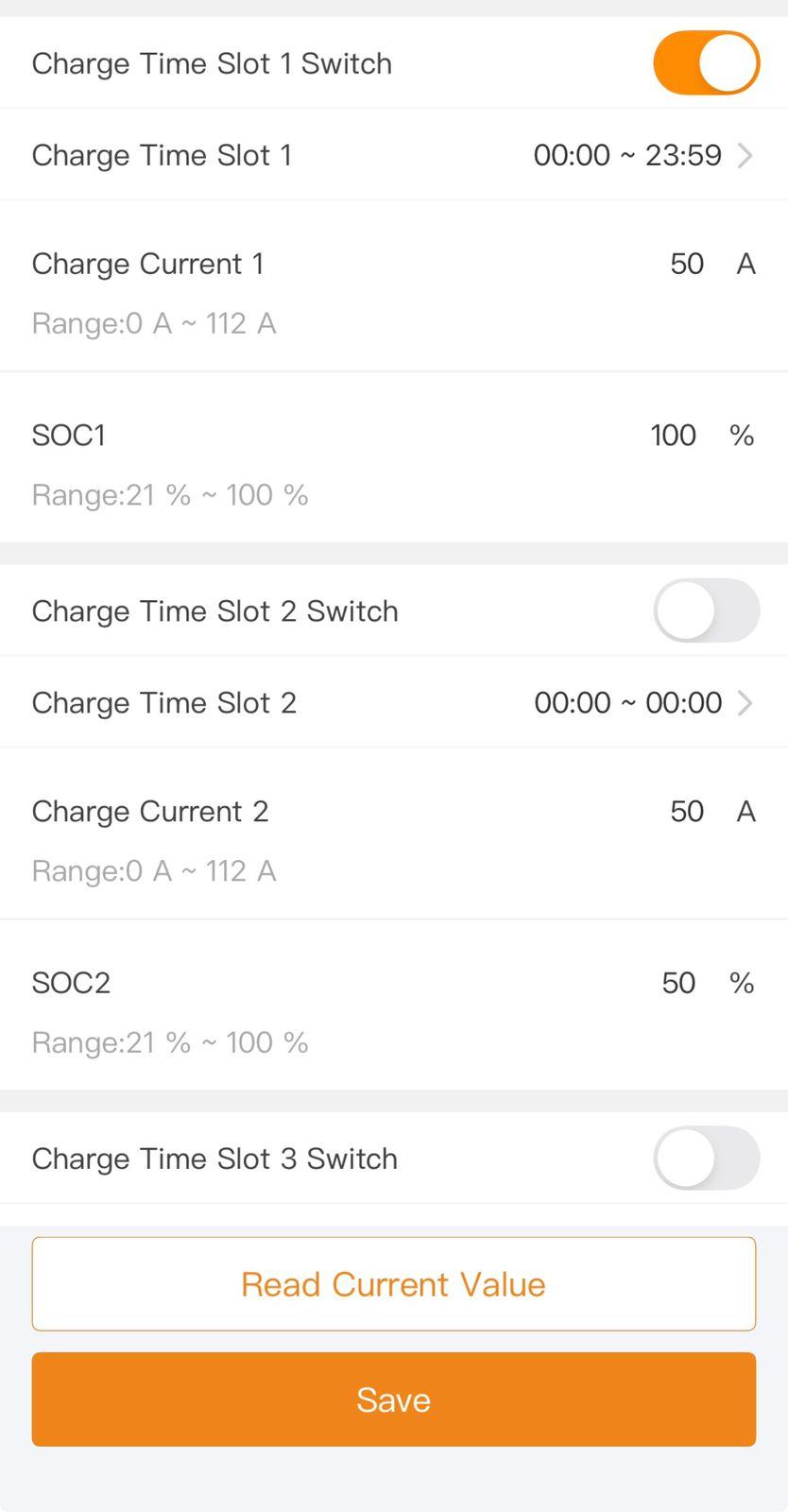
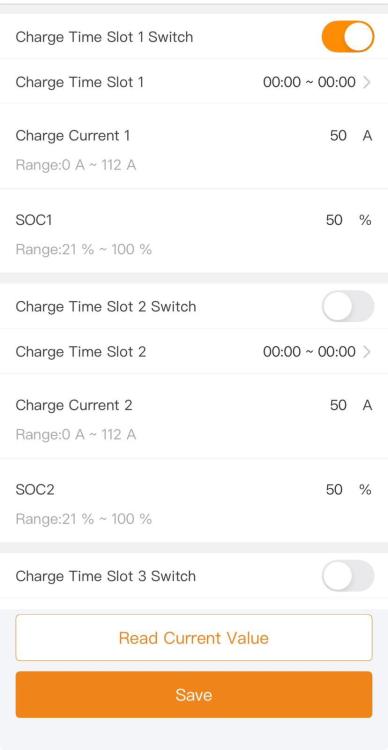
 I don't have solar panels but I found this option: Inverter/Inverter Control/Storage Mode/Charge&Discharge Slot and I enabled Slot 1. Let's see if this makes a difference. If this it then it's a pretty well hidden option!
 I selected Lithium LV as instructed by Solis.Check my photo from three hours ago, 64% SOC and charging at 180W.Turned off the battery which stopped power to the house. Had to switch from inverter supply to Eskom supply to get power back. Waited a bit and turned the battery on. After a while the inverter saw it and I could go back from Eskom supply to inverter supply. It's decided to do a top up, still only 180W:
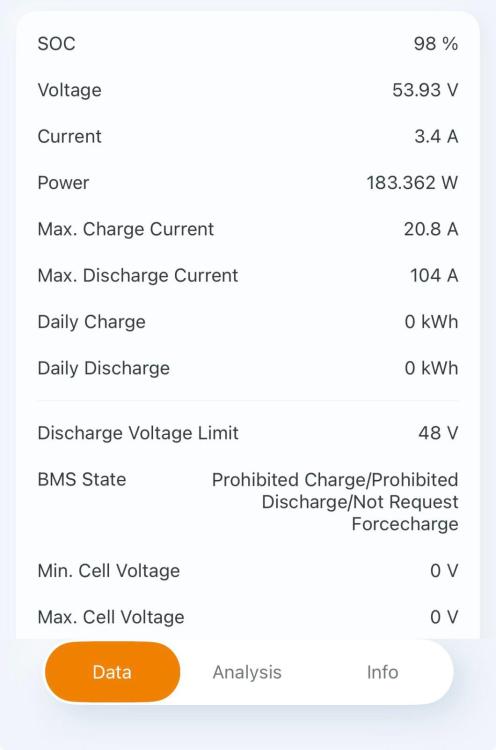 I have been in contact with them, they updated the firmware but it didn't make a difference. I have asked now if they can remotely check it. This is what it charged at recently:
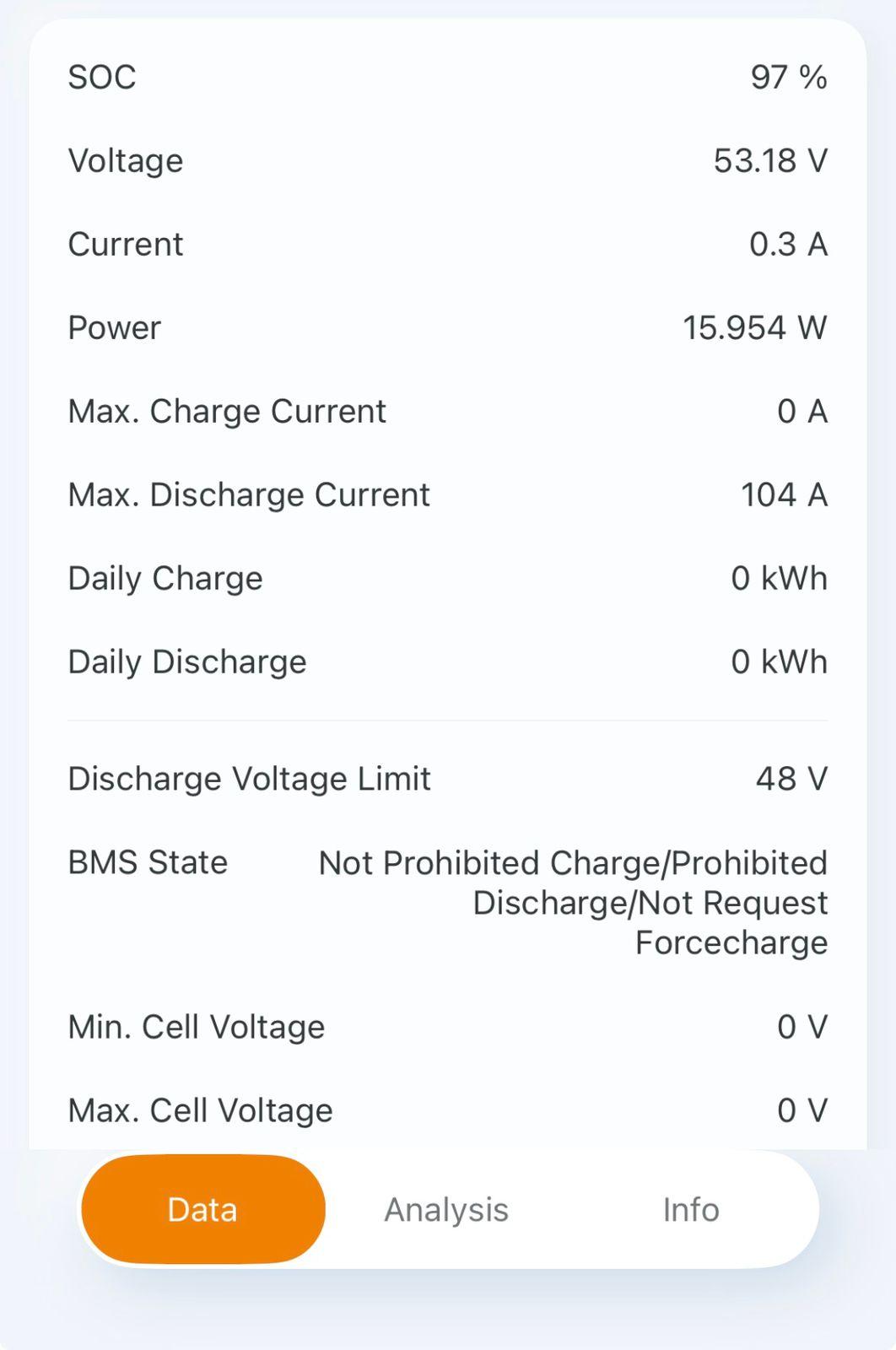
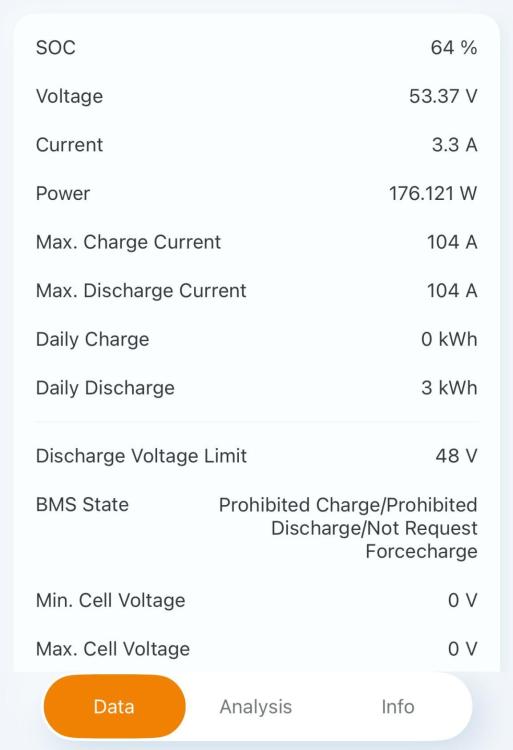 Battery Settings Maximum Discharge is set to 100A, but the battery reports 0A. See above. I don't currently have solar panels, so I charge from the grid.Battery Settings (note I have set max discharge to 100A as per the Sunynk spec): Battery Stats (note max discharge is 0A): What else can I show you?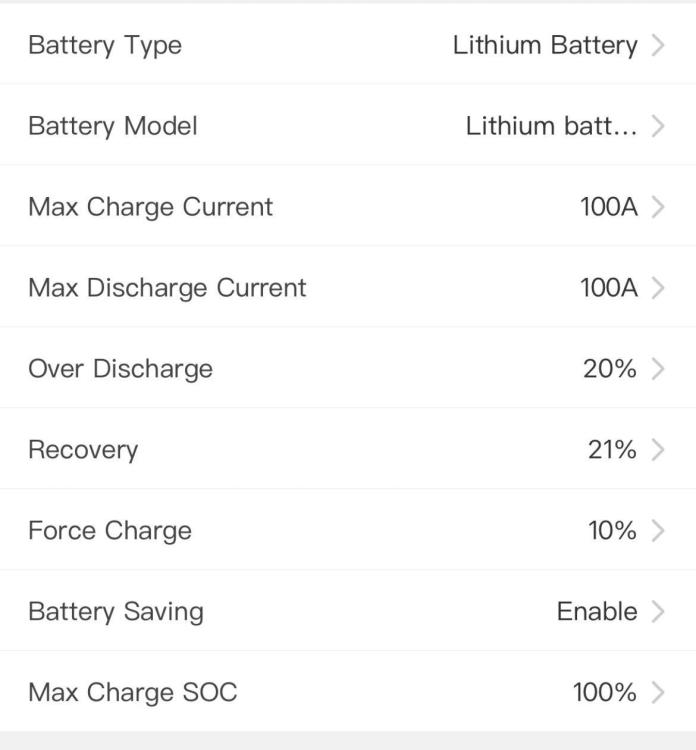
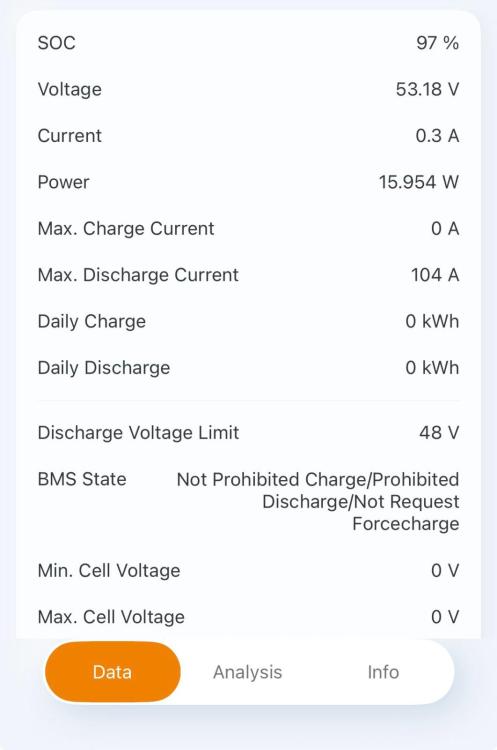 Has this problem occurred since the system was installed (when was that?), or is it a more recent problem? This inverter was installed about six months ago and since then we went without power twice, once down to nearly 20% SOC and the other time about 40% SOC. Both times it charged slowly and took nearly a day to complete. What made you state "Edit: seems it’s not a great idea running it in this mode."? Presumably you tried that, but something must have happened that changed your mind - Care to elaborate? I asked ChatGPT "What is the consequence if i set my inverter battery settings to manual non BMS mode." and the resulting response made me feel uncertain to try this out. I'd rather explore other possibilities before doing this. =========================================================================== =========================================================================== =========================================================================== 🔧 What changes in non-BMS modeThe inverter stops receiving real-time data from the battery (state of charge, temperature, cell voltages, etc.) It relies entirely on fixed voltage settings you manually configure No automatic protection coordination between battery and inverter ⚠️ Main consequences1. Loss of accurate battery monitoringState of charge (SOC) becomes estimated, often inaccurate Can suddenly drop from e.g. 40% → 0% because voltage-based estimation is crude (especially for lithium) 2. Risk of overcharging or underchargingWith BMS: charging stops exactly when needed Without BMS: inverter just follows voltage thresholds 👉 If set incorrectly: Overcharge → battery damage, swelling, reduced lifespan Over-discharge → permanent capacity loss or shutdown 3. Protection becomes one-sidedMost lithium batteries still have an internal BMS, but: It acts as a last-resort cutoff, not a controller Sudden cutoffs can: Trip your inverter Cause system resets or errors 4. Reduced battery lifespanEven if it “works,” incorrect voltages or currents can: Stress cells Increase heat Shorten lifespan significantly 5. No temperature awarenessBMS normally prevents charging in unsafe temps Manual mode ignores this → risky in very hot or cold conditions 🧠 When is manual mode actually OK?Manual / non-BMS mode can work if: You have lead-acid batteries (they don’t use BMS communication) OR lithium batteries without communication ports AND you correctly set: Bulk/absorb voltage Float voltage Low cutoff voltage Charge current limits 🚨 When you should NOT use itAvoid manual mode if: Your lithium battery supports BMS communication (CAN/RS485) You’re unsure of the correct voltage settings You want maximum lifespan and safety 👍 Bottom lineIt won’t immediately break things, but: You lose smart protection and accuracy The system becomes dependent on correct manual setup Mistakes can damage the battery or cause shutdowns =========================================================================== =========================================================================== =========================================================================== This implies that the charging was done at night ("after a day...") Is this assumption correct? If so, there would not be sufficient solar power available to charge the battery, and it would need to be charged with grid power. Is there not a setting on the inverter to select/enable charging from the grid? I don't currently have solar panels, only the battery and inverter.If it is indeed a cable issue, does it make sense that it charges slowly like this? I mean, is this the typical safety mode?Ah ha, worth a try before I replace cables. Edit: seems it’s not a great idea running it in this mode.Both set to 100A. If the data cable is faulty or incorrectly plugged in, is this typical behaviour?I have a Solis 5kW inverter (model S6-EH1P5K-L-PRO) and a Sunsynk 5kWh battery (model SUN-BATT-5.32 with serial number starting with SSLR so a rebranded Eenovance). After a day without the grid with the battery on the low end it will charge to full at only 180W and that can take a full day. That's less than 4A whereas the battery spec says maximum charge is 100A Surely this is not normal? Any idea how I can fix this?Appears to be set to 112A:
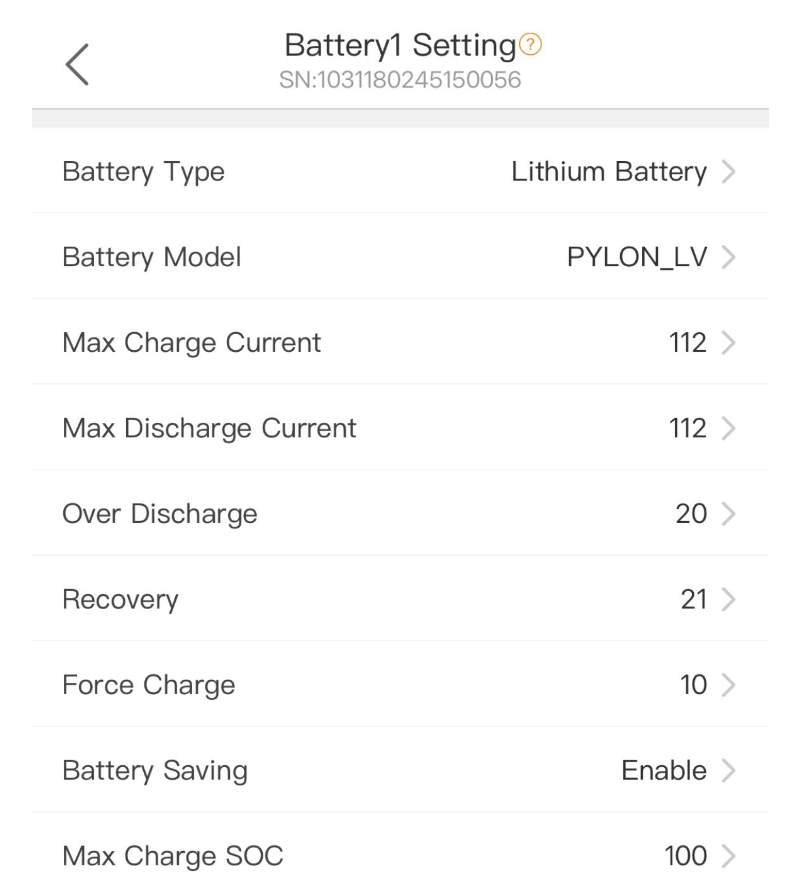
 I could only share the first screenshot with chatgpt as I’m not a subscriber and it suggested this: Thanks for sharing the screenshot. From your Solis menu, I can see that “Pylon_LV” is currently selected, but your SUN‑BATT‑5.32 (EENOVANCE/Sunsynk) battery isn’t listed directly. For your battery, the best option to use is: ➡ Dyness LV Here’s why: Dyness LV uses the same CAN-based lithium protocol as Sunsynk/EENOVANCE units. It is widely used as the closest compatible setting when a battery isn’t listed. Choosing it allows the inverter to read the battery’s real charge/discharge limits, so grid charging will no longer be stuck at ~170 W.I have a 5kW Solis inverter, model S6-EH1P5K-L-PRO. It is paired with a 5kWh Sunsynk battery, model SUN-BATT-5.32. The serial number starts with SSLR which apparently means it is a rebranded Eenovance. I only have the inverter and battery currently, no solar panels. Recently our power was out for a full day and the battery discharged to nearly 20% SOC. When the power came back it only charged at 170W and took nearly a day to recharge. From googling it seems my installer did not select the correct battery (or more likely didn’t at all) and the inverter is charging at the minimum, a safety mode of sorts. Please help select the right battery and its settings. Currently it is set to PYLON_LV. Chatgpt suggested I choose this: Choose “Lithium – User Defined” if Sunsynk/EENOVANCE isn’t listed. With these settings: Parameter Value Nominal voltage 51.2 V Battery capacity 5.32 kWh (≈104 Ah) Max charge current 50–60 A (or your battery spec) Max discharge current Match battery spec Charge cutoff voltage ~57.6 V (or per battery spec) Discharge cutoff ~42 V (per battery spec) These are the options in the Solis app: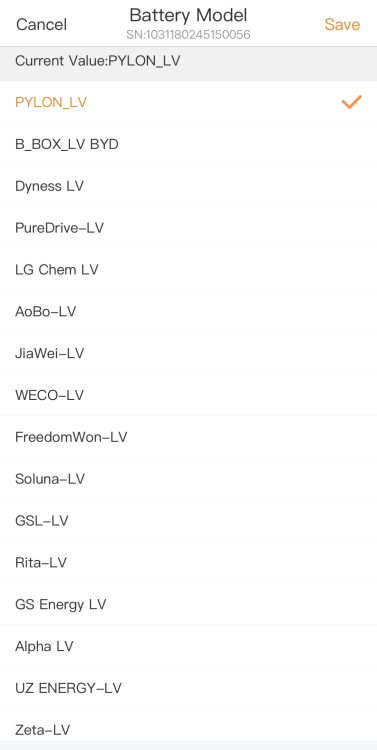
 Thanks, that will help deal with this dodgy company I have the misfortune of dealing with. Got issued CoC...