
Freakazoid
Members
-
Joined
-
Last visited
Everything posted by Freakazoid
-
Hi Clinton @C solar I like what you've done with your maximum theoretical production curve. What's the total area under the "combined production" curve (total theoretical daily production) for such a system? I think the ideal setup (with 16 panels) would be an East string (5 panels), a North string (6 panels) and a West string (5 panels) with the East & West panels paralleled on the one MPPT and the North string on the other MPPT (basically what you proposed in your theoretical calc). I actually think that this setup would produce a greater daily yield (in a typical home) than a system with all panels facing North. An East, North & West string split will tend to "flatten" but "widen" your daily production curve as you start producing earlier in the morning (East string) and produce until later in the afternoon (West string). The peak production around midday (predominantly North string) would be compromised but in my experience, we won't use the full production capacity during midday of an all north facing setup. Typically, our house would only use a maximum of around 6kW at any moment so a system that can deliver 8kW would be wasted capacity. I would rather have a system with a maximum production capacity of 6kW but with the "extra" 2kW capacity available for use in the late afternoon (when we are cooking or bathing the kids). This means we start drawing power off our batteries later in the afternoon. On my system, during the summer months, my maximum daily consumption is much less than in winter which means that I probably only use between 40% and 50% (estimate) of my system's full installed production capacity. On most summer days, my geyser is warm and my batteries (15kWh) are full at around 10:00!! The benefit of being "overspec'd" on production capacity during summer is that we tend to have many cloudy or rainy days so with the extra capacity we always manage to fill up the batteries and warm up the geyser. You might only have 3 or 4 hours of sunshine on some days but with your production capacity spread over 3 directions it doesn't matter when you get some sunshine. This has become a really interesting discussion! Regards, Rudolph
-
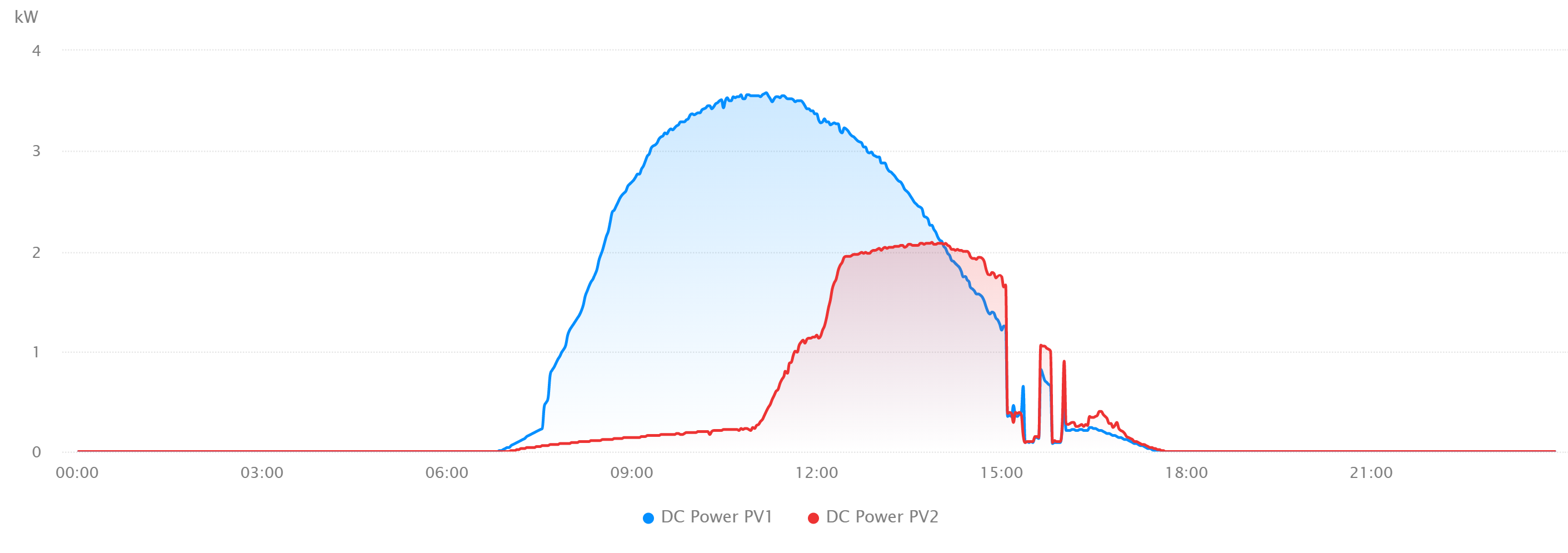
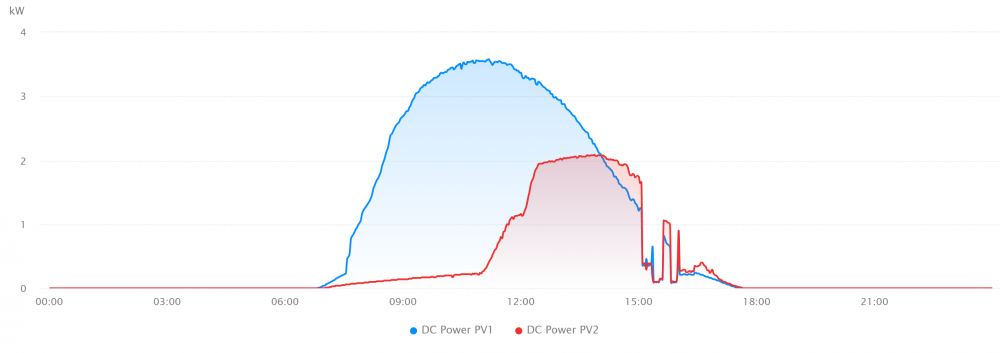
Hi @C solar Please have a look at the two attached graphs of my PV1 and PV2 production. You will see the first graph was from 2022-04-05, even though the production curve is jagged, you can clearly see the general trend for the max possible production. The blue curve is for my N & E string and red is for the W string (which sees shadow until around 11:00) The second graph is from yesterday (2022-07-26). You can clearly see that it was a cloudless day, PV2 was also performing relatively well but only performing well from around 12:00. On 2022-04-05 PV1 produced a total of 22.66 kWh but was only performing at around 70% of it's total capacity (estimated). On the same day PV2 produced 9.94 kWh On 2022-07-26, PV1 produced a total of 20.54 kWh (estimated at 95% of maximum capacity) while PV 2 produced 7.91 kWh (estimated 70% of maximum capacity) Regarding your question on whether it would make sense to parallel two strings. I think it definitely does make sense, especially if you have shadows on one of your strings at any stage during the day. I don't think I would get nearly the same daily production if I opted to put a 1 x 8 panel string on each MPPT vs 2 x 5 panels on MMT1 and 1 x 6 panels on MPPT 2. Let me know what you think Regards,

-
Hi @C solar Thanks for your feedback regarding how the parallel strings on an MPPT should be equivalent. My panels are all the same and the two strings paralleled on MPPT1 both consist of 5 panels each. My paralleled strings are however facing different directions (N & E) but as far as I can tell this doesn't seem to be holding me back. I am struggling a bit with production in winter as 2 of my west facing panels (part of the 6 panel string connected to MPPT2) see shadow until around 12:30. There is unfortunately nothing I can do about this, I have a trickey roof. This means that during a "perfect" production day the 2 x 5 panels on MPPT 1 produce approximately 75% of my daily production. My worst production period was early June where I am only able to produce around 26kWh per day even on clear days with my system running as best it can. Current production is a bit better and if my system were to run at full capacity (my usual daily consumption is only around 28kWh) I would probably get around 32kWh per day (my 2 problem panels are seeing sun sooner in the day than what they were 6 weeks ago). That's an impressive system that you've got, shows you what a difference well orientated panels make! If your load (batteries, home consumption) has sufficient need to pull maximum production capacity from your panels you'll probably be able to produce around 55 kWh with your system on a clear summer day! Regards, Rudolph
-
Hi @Shain As I understand it, the Smart Load will always first pull power from the PV (when available), then the batteries and then, when the batteries reach their minimum set SOC, the grid. I don't think it is possible for it to skip the batteries and pull straight from the grid. You should, however, be able to get a workable solution by playing around with your smart load settings and minimum battery SOC value (the point at which your inverter pulls power from the grid). I hope this helps. Regards
-
Hi @Margaret To answer your question, to see the Battery info I think your plant's "System Type" needs to be set to "Storage System" as shown in the screenshot below. You can change this setting in the Smart App by selecting the three horizontal dots at the top right corner of your screen when you are looking at the "Real Time" data of your plant. Under the three dots menu you'll see an option for "Plant Info" and then just look under the "System Info" section for the "System Type" setting. I hope this helps...

-
Hi @Tariq If you need to "Kickstart" your AUX port by switching on the kettle then it means that your Smart Load (AUX) power setting is set too high... The inverter can't determine the maximum PV power available, it looks at what you're currently producing (which is partially determined by what load your drawing). I set my value quite low, around 200W. I then know that my Geyser can then still switch on until approximately 30 minutes before sunset... @Brickman, yes, my AUX port switches On at 95%SOC. I found that in the last 5% SOC there is actually very little usable power in my batteries... Also, my BMS seems to slow down the charging rate to top up those last few percent so there isn't much sense in waiting for the SOC to reach the full 100% before my Geyser kicks in, 95% is "full enough" (if that makes sense)
-
Hi @Brickman Yes, I have the Deye 8kW and also run my Geyser off the Smart Load (AUX) port. Works like a charm and exactly how you explained it! With my setup, the PV will supply my load first, charge the batteries second and then, once the batteries are pretty much charged up (95%SOC), switch on the geyser. It is basically fit and forget and one always has the option to manually switch on the geyser using the "On grid always on" option! This is also a handy future of you want to manually switch on the geyser if you're not at home (using the Solarman Smart app with your account enabled for remote management). In my opinion, the AUX port is the perfect option to run a geyser off.
-
Hi All I sent Deye Technical support an email last week asking why the inverter is clipping the current at 20A and not the stated 22A as indicated on the technical datasheet. They came back to me stating that the inverter clips the current at 20A as a safety feature as too much current is not good... (as shown below) Not a very technical answer and it also doesn't answer my question as to why the clipping happens at 20A and not the stated 22A... But it confirms that it is current clipping that I am seeing in my PV data. Anyway, guess I'll just have to live with it...

-
Hi All I think this is a relatively easy question and I'm sure it has been asked before I just can't seem to figure it our for myself. I have a Deye 8kW hybrid inverter. Under the System Work Mode (SWM) menu I am only able to set my battery SOC to 35%, no lower. I want to set this value down to 25% but there must be another setting somewhere that is stopping me from doing this. The inverter is set give a low battery warning at 35%,shut down at 20% and restart at 50% Could anybody please tell me what else I need to set to be able to bring my SWM battery SOC down to 25%. Thanks in advance!
-
According to the Deye datasheet and label on the inverter, the max PV input current is 22A per MPPT but as per my original post, it seems as if my inverter is clipping at 20A. I'm not sure if anybody else with a 8kW Deye has seen currents higher than this??
-
Thanks @Sc00bs, I checked the sticker on the side om my 8kW Deye and it clearly states 22A+22A for the "PV input current". @Scubadude, my inverter has been constantly connected to our WiFi for more than a month and I don't think it has ever done a firmware update... My device software details are as follows HMI : Ver c34c MAIN1: Ver 3881 MAIN2: Ver 717 How does it compare to yours? What is the latest version?
-
Thanks @Kalahari Meerkat Yes, I agree with you that it is unlikely that the north and east facing panels will be running at peak production at the same time and we're very unlikely to see a total of 26A on my PV1 string... This was my reasoning when putting these two strings together. Losing capacity due to clipping should be negligible... However, I don't think it is unreasonable to expect a current in the region of 20A to 22A on PV1. It does however look like my system is clipping the current at 20A and not 22A as indicated in the datasheet.
-
Hi Guys This is becoming a really interesting discussion... You are right, at this time of day, it is mainly the batteries being charged (max set to around 5kW for charging). It might be that it is the MPPT busy doing its job but the fact that the curve is perfectly flat and always flattens out at 19.89A just seems like too much of a coincidence?? Since I've had my system I have not see the PV1 DC current exceed this value... @Kalahari Meerkat, I'm not sure that I understand your comment regarding that the fact that the north-facing panels only produce most of their power later in the day and that that may the the real problem... Would you mind explaining what you mean? Thanks for all your comments.
-
Hi Guys Thanks for all the comments. I will have a look at the sticker on the side of the inverter later today but I do remember that is lists 22A + 22A. Here are the graphs of the DC Current, DC Voltage and DC Power. I doubt whether it was a WiFi issue as there is data available in the "flat" section of the DC Current graph and there is a variation in the other parameters around this time. The curve is just to consistent for it not to be due to the current being clipped... What's the process for updating the firmware on a 8kW Deye?? Regards,


-
Hi @YellowTapemeasure Please see the attached datasheet, I have the JAM72S30-540/MR panels. Voc is listed as 49.6V What are you trying to work out? Regards, JAM72S30_525-550_MR_Global_EN_20200904A.pdf
-
Hi @YellowTapemeasure Sorry, I forgot to mention my PV arrangement. On the one MPPT, PV1, I have two strings of 5 panels each (East and North facing respectively). Then on the second MPPT, PV2, I have a single string of 6 panels (facing West). All 16 panels are JA 540W so I have total installed capacity of 8.64kW. As per the datasheet, each string of panels can deliver around 13 Amps. This means that, on PV1 with the 2 strings in parallel, the panels can deliver up to 26 Amps which the inverter would then cap at 22 Amps? Do you agree? Regards, Freakazoid
-
Hi All I have an Deye 8kW hybrid inverter that was installed in December. On one of the MPPTs I have two PV strings paralleled. Now, according to the inverter datasheet, the current will be clipped at 22 Amps, what I am seeing in my data is that the current is being clipped at 20 Amps. Has anybody else seen this happening? I suspect my inverter might need a firmware update or what else could be causing the issue? Any advice would be appreciated. Regards, Freakazoid

-
Thanks @Gerrie, yes, I understand that while the Smartoad (AUX port) is active, the system will dip into the batteries for short periods of time when the PV can't supply the entire load. I am happy with this, I just don't want the geyser to run off batteries only for 45 minutes... @Scubadude, yes, I can imagine that having an oven run on the AUX port won't work well as you need to run the oven "on demand" where as a geyser I just need to heat up sometime between 8:00 and 15:00 so that I have enough hot water for the evening and next morning. This is supposedly how the AUX port is intended to be used. The AUX port can be forced to be permanently on (if grid is available) by selecting the "On Grid Always On" options but this then allows the load connected to AUX port to drain the battery to your SOC values specified in the "Time of Use" or general battery settings, it ignores the AUX Off battery SOC value as well as the PV power values. The nice thing is, unlike the non-essential loads on the Grid port, the AUX load can be set up to work when there is no power on the grid side (i.e loadshedding). @phidzYes, your use-case is exactly what I noticed on my system too... The AUX Load doesn't "know" what power the PV can provide and therefore the PV power value you set for the AUX port first needs to be drawn by something else on your system before the AUX Load will switch on... This is my issue as this is not how the manual explains it and not really how I want to use it... As @Tariqsays, doesn't look like Deye or Sunsync can give us an official answer as how to use it. In fact, Keith from Sunsync explains in one of his videos that the PV power value specified on the AUX setting page is the maximum power that the AUX port should supply which is definately NOT correct. Seems like he himself doesn't really understand the workings of it... @CraigB, sorry to randomly tag you in this post but I assume that it was you who posted a similar question in the Sunsync forum a while back? Can you perhaps give us some feedback on your experience with the AUX port or any additional info you have managed to find? I know you wrote a short document discussing 2 different use cases for the AUX port which is very helpful!
-
Hi All I am new to the forum and this is officially my first post. 🙂 This week I had my PV system installed which includes an 8kW Deye hybrid inverter, 16 x 540W JA panels plus 3 x 5.1 kW Shoto batteries. I did quite a lot of research on the Internet (including a ton of reading on this forum) regarding the inverter. One of the features that really attracted me to the Deye (and I suppose the Sunsync as well) is the ability to run my geyser off the AUX port known as the "Smart Load" feature. From what I have read, the AUX port/smart load would allow me to manage the operation of my geyser with a bit more intelegence when compared to simply connecting it to the GRID connection on the inverter (non-essential side, after the CT coil) From all the info I have read on the web (including this post on the Sunsync forum https://www.sunsynk.org/forum/techical-support/using-the-aux-output-on-8kw-hybrid), I understood the operation of the AUX port as follows: There are three settings that drive the AUX port, the battery SOC where the AUX load should become active, the battery SOC where the AUX load should be turned off and the minimum required PV power available at which the AUX load should be turned on... So basically I can set it up like this If more than 3500W is available on my PV (I have a 3kW geyser) and my battery has a SOC greater than 95%, then turn on my geyser und run it until either the PV power drops below the set 3500W or my battery SOC drops below 80%. However, after playing around with these settings on my Deye today, it seems as if the flowing is actually how these settings work. When my battery SOC is greater than the set value (i.e. 95%) and my inverter IS ALREADY DRAWING 3500W OR MORE FROM PV, then only will it turn on the Smart load (AUX port). This then means that when my geyser on the AUX port is turned on, the total load on the inverter often exceeds what is available on PV and I have to dip into my batteries to run the geyser (something I want to try and avoid). Today I tested this as follows. I knew that there was in excess of 4kW available on PV even though my inverter was only having to to supply our base load of around 300W. With the battery at a SOC of more than the set 95%, the AUX load would only turn on after I reduced the PV power "switch on" value to below the value that the was currently drawn by my inverter, not the power that is potentially available on PV... Can anybody elaborate on this, is this how the feature is supposed to work, is there a wrong setting on my inverter setup or am I missing something? I would prefer if the system works the way I had originally understood it... Only turn on my geyser if available PV can supply more power than what my geyser draws. Thank you in advance! Regards,