


incagarcilaso
Members
-
Joined
-
Last visited
Everything posted by incagarcilaso
-
In this case it's the other way round. On the higher voltage cell's positive the reading is 3.5 A and on the lower voltage cell's positive the reading is 2.5 A. But I thought this might have something to do with the fact that the balancer is juggling more cells, not just these two, so it distributes the amps among all pairs?
-
Conundrum: direction of current on battery balancers. In an attempt to check that all is working correctly and the balancers are passing the current in the right direction between high and low cells I have taken some measurements, but I am a little confused as to the real flow of current. As always the "conventional" and "real" models for direction of current are confusing. Normally you just pick one and as long as you are consistent with whatever you do based on that, it should work. But after doing this, I'm still not sure. I have a multimeter that tells you the direction of current, giving negative and positive readings accordingly. Based on this I have put together the diagram below of a test I have done on two pairs of batteries with very different voltages, connected to a single HA02. I hope everthing is clear on it. The blue arrows show the direction of current based on my readings and the multimeter's indications of direction of current (I understand this to be "real" direction, although the manual doesn't state this). From this, is the behaviour correct? Is the balancer passing the current from the higher to the lower voltage cells? I can't work it out. It shows that the current is flowing out of the high voltage cell along the positive wire and into the high voltage cell on the negative wire. It shows that the current is flowing into the positive connection on the low voltage cells and out of the negative connection on these. Is this correct?

-
I was really lucky to pick these up - right place, right time. Most companies that use these have to follow strict policies on the age of these back-up banks, which is usually between 12 and 18 months. This should mean that there are a lot of nearly-new banks out there up for grabs every year, but they are not easy to find.
-
Very nice idea. The trollies would have to be braked - if these start moving they don't stop for anything, not even a brick wall.
-
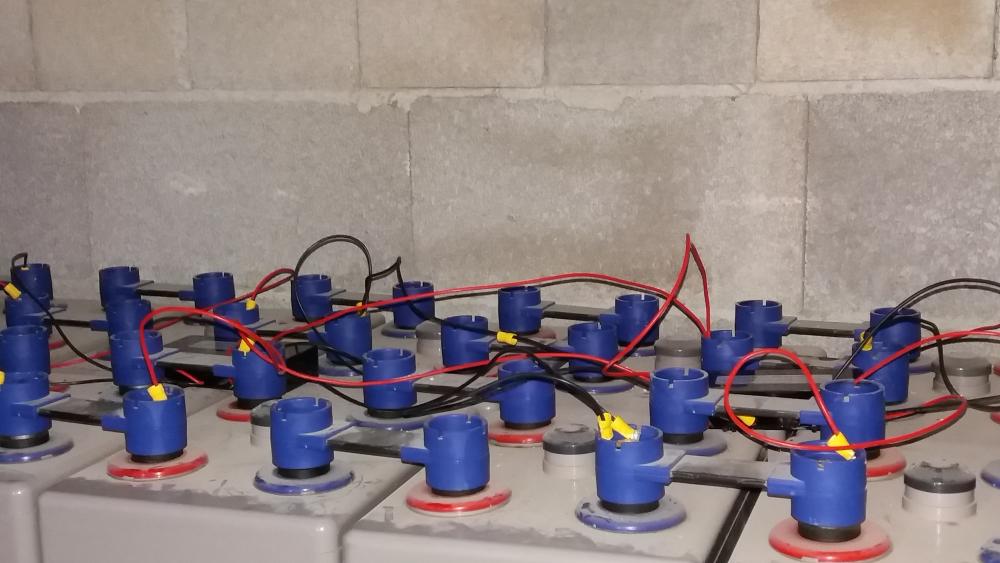
Just so you can see what we are talking about - here they are, with the 4 HA02s connected. Gives you an idea of how difficult it is to shift these things around at over 100kg a piece and the way they are tied in together (two copper plate sheet connections on each). It's impossible to keep the balancer wires any tidier because of the way they have to reach each cell in each cluster.

-
:-)
-
Yes, I'll try in this order: Balancers Conventional charge on discrete sets of problem cells as @Don suggests but without moving anything Replace the very high voltage cells because it seems that these are faulty as @Chris explains. If 1-3 don't work give up, throw the towel in, pay a slightly larger electric bill and have more free time to watch some cricket!
-
Yes, I get the cricket analogy. Noted @Don, so if it becomes absolutely necessary I may be able to get some used cells to replace faulty ones from the same source as these, since they have to replace theirs every 12 months for brand new ones.
-
Does it ever! And they are in a cramped space (low headroom) with one row behind the other, against a wall.
-
At around 220ah they are at 90% SOC - yes I'm lucky. I bought these second hand. They were 12 months old and came from a telecoms installation where they were in float for most of the time (emergency back up, which rarely kicked in). They have to change them every 12 months. They came with history, provenance and a 2-year guarantee but cost just 30% of the new price - otherwise I would never have been able to justify the cost.
-
You may be right, 90kg was what I remembered but they could well be 115kg - back breaking in both cases.
-
I have four balancers on the whole bank. Luck would have it that two balancers on these two very low voltage cells - just a fluke. I was measuring amps in the HA02 connection wires yesterday and I was surprised to see the values fairly low - around 1 or 1.5 amps in most cases. I was expecting higher readings. However, on the wiring conneceted to these very low voltage cells the readings were at 2.5A. This probably means that the HA02s are doing more with these particular cells, right? At any rate, I was expecting to see amps closer to the max values of 10A for the HA02s.
-
Certainly sounds like it should work - good idea. I think for curiousity's sake I would do that right now if it weren't for the weight of each cell (90kg) and the solid couplings tieing them all in together. If the balancers aren't able to do much over the next few weeks I'll look at doing this. I'm feeling optimistic about the HA02s - I think they just need some time.
-
Yes, it comes from El Inca Garcilaso de la Vega - not many people have heard of him. I'm beginning to understand this now - that it is an advantage to have the individual 2V cells. I am now taking daily voltage readings and will post a sample here to see what story it may suggest to anyone. At the moment they are all over the place with about 6 in total with very obvious extremely high and extremely low voltages. I will be patient and see what magic the HA02s can work over the next few weeks. If the challenge is too much for them I may need to look at changing the weak cells as @The Terrible Triplett suggests (although I'm not sure if the "weak" ones are the high or low voltage ones). Having said that, I'm not sure how easy it is to slot in new idividual cells in a bank like this because of the voltage differences and the age differences - it could lead to the same problems occurring again.
-
That's an idea. Not sure if any one else has tried this? It certainly may bring them back more in line with the rest and then the slower HA02s can continue to bring them into line. I'm not sure exactly how this works - I suppose it depends on exactly whey they are so low. It may be that after doing this and returning them to the bank they still struggle to reach the same levels as the rest of the cells in the bank?
-
I see what you are saying but this is more about discharge percentages and full charge frequency than balancing. I agree with you that occasional deep discharges do no harm (although this depends on the battery technology type to some extent) and can even be beneficial in some cases. The problem with batteries being out of balance (especially of the 2V type where you have 24 elements) is that some in fact never ever fully charge even though you think your bank has fully charged. When you talk about having a full charge at least once a week, you may see that the "bank" gets to 100% but if the individual cells are out of balance then what is actually happening is that some are over charging (all the time) and some never fully charge (stay at effectively 80%). When this happens they are not going to last very long. In my case, I have 2 cells that are way out of balance from the rest and when the bank shows 100% charged and floating at 54V, these two are only charged at 2.07V (75%) rather than at 2.25V so they never fully charge and others are at 2.62V to compensate, which means they are way overcharged and floating far too high all day every day. This also means that as soon as the bank has to assume any load it falls straight down to 48.5V from 54V floating because of those poor cells and so they provide you with less power for less time. The bank readings only really give you a part of the story - the individual cell voltages will affect the life of the batteries as well as the amount of power they can give you each day when in discharge. I think balancing is crucial.
-
Yes. The deviation is at 3.8% under high charge and in late absorb, so it is quite bad. I am hoping to get it to under 1%. I'm El Capricho on PVOutput.org. I donate and so have extended data but haven't been able to work out how to configure that. Currently none of the BMV voltages data gets uploaded to pvoutput.org, but if you could point me in the general direction of how to do that I'll happily configure it.
-
OK, so with thanks to @Chris Hobson for all his help via Skype the other day, I now think these are wired up correctly. Before making the changes the boxes were getting very hot - I now know why. Now they are not even warm. It seems obvious now that it was totally wrong to have the polarity reversed on some of the connections to the HA02 on some pairs. The complicating factor was that I was working in pairs of cells (because the minimum nominal working voltage for the HA02s is 3.6V), which gave me positives and negatives on both sides of each pair. Unfortunately, 6 days connected incorrectly means that the reverse has happened and the batteries are now even more out of balance - the low voltages are now lower and the high ones higher. On the positive side this would seem to suggest that these HA02s work and have an impact in a short period. The first day of charging correctly today seems to show that they are doing what they should, although they may need some time to bring the imbalance under the 1% mark (currently running at 3.8% mid-point deviation). I have been measuring amp values in the HA02 connection wires today and the most I seem to see is 2.6 A in some while a lot are just around the 1A mark. This seems low but maybe with time this will change. In principal these could have up to 10A flowing through them. @Mark's comment about jumping across the bank with the connection on single HA02s is interesting. I also wondered if this was a good idea. Now I am learning a little more about these HA02s I feel that it may not be an issue to have cells 1-4 and 21-24 hooked up to one box. Another small disadvantage with these HA02s is they don't have any indicators on them at all - not even a single little LED to show when they wind into action out of passive mode. Let's see how it all progresses. One thing is clear - the bank now has to be better than just leaving it out of balance with the mid-point deviation growing steadily. That would have meant an early demise for the bank.
-
That about sums it up. Far, far too much lost in translation, coupled with far too many wires - if it looks confusing on paper it's much worse here with all of them in front of you, tracing which is which. The battery connections also have a protective tall plastic cylindrical housing around all the M8s, making it very difficult to connect the lugs to them - can't believe I've got to redo it - at least it's only 16 of the 32 connections. Will report on progress.
-
Oh, OK. I thought it might be that. What have I done wrong?
-
It makes no sense. I've checked and double checked the cell pairs. I'm attaching a diagram of exactly how the positives and negatives are connected in each case for each of the HA02s. Do you see any issue there? I have made the diagram exactly as the wires are connected. As you can see these cells have 4 connection points on each cell and I have made the diagram to represent exactly the way I connected them. One of the odd things for me to grasp is how the overlapping can work with what is essentially half a cell. For example, I overlapped on cells 4 and 21 but both of those are only "half" of the groupings attached to the other HA02 (21-22 and 3-4). I'm awaiting arrival of an ammeter because the one I have cannot measure DC current. This will help a lot as I will then be able to see what current is flowing to and from the HA02s and in which direction. I'm totally stumped as to what could be happening.

-
Aaagh! Help. I've had these wired up since Tuesday now and the situation is worse, yes worse! The higher-charged cells now have an even higher charge and the lower-charged cells have an even lower charge. My deviation is running at 4.5%. What could be wrong? I'm going to get a diagram of exactly how I have it all wired up and will post here. Any initial ideas how/why this could happen? It's as if the balancers were passing the compensating current the wrong way.
-
So, I have finally managed to fit the HA02s, following your last schema for overlapping the four boxes. I had calculated a couple of hours but it turned into 4 hours and I have serious back ache! All seems to be fine and I have already noticed a slight improvement in the bulk charge stage - the mid-point variation takes longer to happen and you can almost see these boxes trying to pass more of the voltage to the lower voltage cells with the BMV readings. In the end, I still have a 3.4% mid-point variation in this last absorption stage but I know these may take several weeks to bring that to within a more acceptable range. Here's hoping so. One thing I have noticed that is slightly worrying is that one of the boxes in particular gets very hot. The others are just warm but one is actually quite hot to touch. Has anybody had a similar experience with these? I don't suppose it is a fire hazard. Can't smell any burning plastic at the moment.
-
Yes, must be difficult for @Manie for testing all the types of hardware - he is managing to do it though. As you say, totals are correct so I think it's just fine tuning and from what I see in the screenshots the new version has ironed these out - it looks great.
-
Thanks @Cybertza, that clarifies things, especially knowing that the output in the terminal is not an important error. The only thing is I wasn't aware of having created or modified a start-up file to run ICC in this way on the pi. As far as i remember I just loaded and ran the Jessie/ICC image that I downloaded. What is the location and name of this file in Debian, so that I can take a look at it and modify it?


