


IanO
Members
-
Joined
-
Last visited
Everything posted by IanO
-
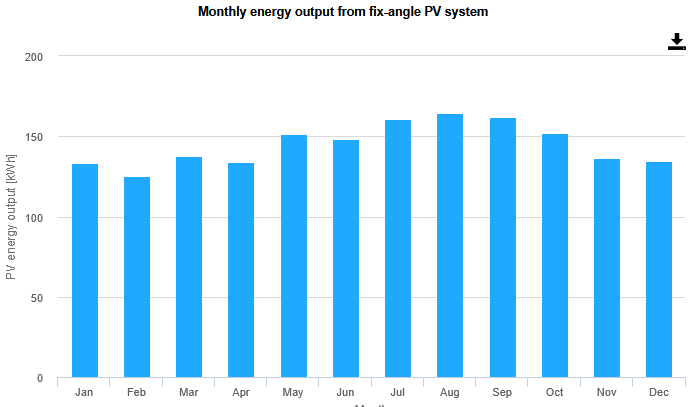
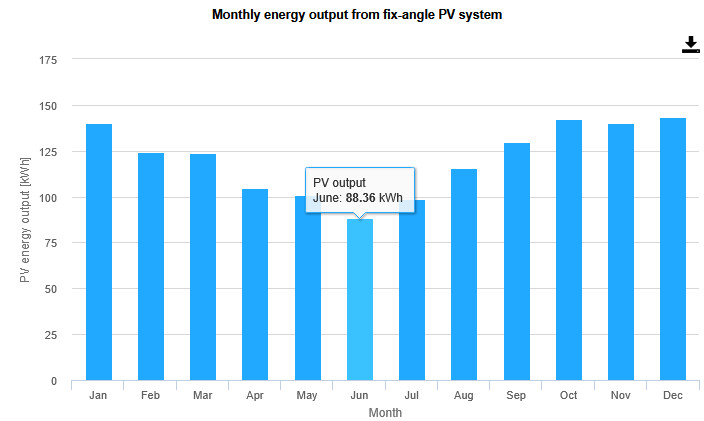
Two things to note: 1. The cloud edge effect can potentially increase the power produced by the panels by up to 25% so I would not move so close to the MPPT maximum voltage which might let the MPPT smoke out. This is produced by boosting the irradiance when clouds around a clear sun act like a reflector. This effect occurs most likely under cold, bright windy weather. 2. Depending upon your latitude, a west facing array at a nominal 30 degrees slope would cause a significant drop in energy during the winter months. For example, on the South African highveld, the potential harvested energy of an array facing due north would look like this, per kW of installed panels. A west facing array would give you something like this due to the winter midday sun being lower in the horizon and at right angles to the panels The combined effect of the two arrays would be to flatten the curve but still a dip from April to July
-
I have a situation where I require extra panels. The North roof is full and only have an East-west roof. The thought is the use the first MPPT for the north-facing roof and the second MPPT for the east roof. The Sunsynk would continue to use the BMS to the battery. The Victron MPPT would connected to the west roof and feed the batteries direct. If this is viable, how would I set up the Victron values? I would probably use the Cerbo S for remote admin. I would appreciate only solid technical advice together with evidence and values, Please don't muddy the water and reply with opinions.
-
Victron is not better than Sunsynk. We install both and Victron has more separate components and more to go wrong. Having said that, Victron is extremely reliable and better suited for corrosive environments such as coastal installations as well as boats and RVs
-
Thank you for that clarification
-
I was referring to the MPPT which is DC coupled at 50V as in the hybrid inverter such as Sunsynk and Deye. The same with Victron system.
-
My first observation is that the MPPT is actually a DC-DC converter with a 50V output, with an algorithm to adjust the input current to extract the maximum power from the panels. I have also been wrestling with ignorance. The MPPT is designed to only draw the maximum power it is designed for and throttle back once the battery SOC reaches the specified level. Just keep the Voc below the spec taking into account the possibility of extremely cold weather which would cause a rise in Voc. I take the point that sudden changes in solar voltage could cause a problem, but the device should be spec'd to take changes. The spec that puzzled me for a while was the inclusion of Isc. If the MPPT controls the current, so what is the reason for including it? Here is the answer. If the MPPT input polarity is reversed, the MPPT creates a short circuit to protect itself. However if the Isc available exceeds the design, the input circuitry will overheat and destroy the device. The moral of the story is, don't swap the DC cables of a multi-string array.
-
As far as I understand, tick "Selling first" and "Solar export" on the Sunsynk app If you do export, register and follow the authorities requirements, in which case a new meter is required. Be aware that some meters handle exported power as if it is being imported and you get charged as if you are using it. Other meters do not like exporting and trip out I am not sure of this, but I heard that the very old rotating disc meters can run backwards on export.
-
Did anyone attend the Segen presentation on Hubble batteries? Anyway, the item that fascinated me was on earthing and bonding given at the end of the presentations given by a learned man whose name I cannot remember at present. He was pointing out that earthing and bonding were not the same thing. Bonding is where each item it connected together so that no potential can exist between components, This is important to prevent human harm as well a electrical damage to electronic equipment. Then there is earthing. This should be done at only one point in a system. He gave examples how cows have been electrocuted at a distance from distance from the lightning strike. The strike creates a spreading pool of potential as it dissipates into the ground. There is a difference in potential created between the legs which electrocutes them. If we put multiple earths in the ground a nearby lightning strike will do the same thing. It will create potential differences between the earth rods causing damaging currents to flow between components . The point he then made was that we bond the equipment only to the incoming utility earth. South Africa has violent electrical storms on the highveld and I remember and years back Escom built a new national control centre. While the structure was securely earthed, all electrical equipment was bonded to an earth "mecca". More strikes occur to nearby objects than directly to panels. If there is a direct strike, everything is fried anyway. Rather protect using appropriate lightning conductors direct to ground.
-
We had the identical problem. Sunsynk and Freedom Won 5 kVAh battery. The battery had been commissioned about 2 months before. I happened once then became more frequent over the days. The difference was that the SoC recovered very quickly each time. Segen passed us on to Freedom Won who tried to access the battery over the internet but were unable to get in. It appeared to be a problem with internal cell balance so they requested we return the battery to them. After a few weeks they gave us a replacement battery free of charge and no problems since. It might not be relevant, while checking through the system we did find that the BMS cable had not been inserted fully. After inserting the cable the problem continued. From what we now know about Battery management systems, this could have been a contributing factor.

