


BertKu
Members
-
Joined
-
Last visited
Everything posted by BertKu
-
Hi Bony999 All lightning arresters have a mounting device where they are fit in. Ask your supplier in my case Electrcomp to email you the details of the device you have selected. i.e. I am going for 100KA TDK Epcos ceramic arrestor, if they can import them in small volumes. Bert
-
Sorry Bony 999, I went down and am only now able to reply. 1) First at all keep your earth pin into the ground, provided it is less the 10 Ohm Otherwise you have to add spikes or relocate them, 2) I took thick copper plumbing pipe and hammer them flat, so that it could withstand high currents and drilled 2 holes and mount them with SS 316 bolts and nuts and a few panels with yellow copper bolts and nuts all together.. so that all the panel frames are one!!. a The 100Ka lightning arrestor is mounted between the one end of all the panels and the one on the other end. . Between the 2 lightning arrestors other ends , I have a 8 mm copper welding cable wire mounted to my earth spikes I have. That is all , Should the lightning find my installation attractive, which is not possible, because I dont think so/ But should I have an hit or a close by hit with high voltage field, it will collapse to earth and the surge is rerouted to earth. Bert
-
That is one reason why I don't like panel frames to be earthed directly and not via lightning arrestors to earth. There is a risk that due to movement by wind the solar negative may touch one day the panel frame. For 50 years I am used that a surge protector is a lightning protector without a MOV, varistor in serial. Very confusing for people who mix a lightning proctor with a SPD. Bert
-
I forgot to mention. They are manufcturered by TDK and sold in RSA by Electro......... Surge Arresters for L-N and N-PE Applications TDK has developed a new line of EPCOS surge arresters that are designed especially for AC power line applications based on the IEC lightning protection zone concept. The new arresters meet the requirements for class I, II, and III protection with current capabilities of up to 100 kA for L-N as well as N-PE applications. Regards Bert
-
Thank you all, who replied to my question, really appreciated.
-
Hi Bonny999 and GMAC Yes I found the right solution. 2 of those parallel will solve the problem at a 2 corners with the solar panels frames proper connected to a 10mm thick (80 mm2) copper welding wire via 4 lightning arrestors parallel each to 3 earthing pins in the ground. Surge protection devices Power supply units Green energy installations, such as photovoltaic and wind energy Potential bonding in telecommunications, railway and pipeline installations Features I imp up to 100 kA In up to 100 kA UL 1449 approved Withstand capability acc. to IEC 61643-11 Customer-specific terminals RoHS-compatible I will approach the committee and ask for approval to place lightning arrestors to be placed between solar panels frame and earth. BertKu
-
I am also a little bit confused. I approach the insurance people and they stated, that I do not need a COC if the inverter is not connected to the wall and the DB board, and is lose standing. But I have solar panels 6 off them, and they are connected. What rules should be applicable to my installation.? I like to thank you for your information about the cabling etc. I have an engineering certificate about the weight etc of the panels. What should I apply further for my installation. I am aware of the consequences of, if I earth the panels and am looking for a solution that surges and strikes created by a lightning strike can be properly exposed of without that I attract lightning strikes. Anybody has an opinion? thanks if you do have. BertKu
-
Hi Bony999 One cannot use a lightning arrestor over items, like 230VAC application or when the arrestor will damage something when the voltage is dropped to 10 Volt,like in a mains circuit with transformer. Only if the short circuit takes place , that than no equipment is damaged. example: input over an areal, on top of a tower etc, building, boat, routing the lightning to earth. The strike is in bursts normally and as soon it hits the arrestor, within 10 nanosecond, the arrestor shortens to 10 Volt (Siemens most types) and if the current is in bursts, the arrestor recovers at a rise time of 75 Volt/us, thus that is my gamble, that arrestors placed parallel would all conduct practically at the same time. But, it should be the same make and the same model and current ratings. I am gambling that the heat dissipation, if the first one collapses, is not enough to damage the first one, but that the current starts spreading over the multiple arrestors. Hi Bony999 I had a wifi interuption and started all over again, here are both replies One can only use a gassarrestor in an application that the shortening does not damage the application Mounting over the 230 Volt AC is a no go. The working of a lightning arrestor (Siemens small types) the lightning strike drops to 10 Volt over the arrestor and this is within 10 Nanoseconds, Thus the voltage of the strike drops to 10 Volt provided it is within the current rating. The arrestor is conducted . As soon the electrons are discharged the arrestor is opening up at +/-75Volt/uS and then the next burst discharge. When the 75Volt/uS is not reached, the arrestors absorb the next current burst straight away and that means that a second parallel arrestor most likely does not shortens and the first arrestors blows to pieces. The problem is Bony999, I can only tell you if it works, when I get a lightning strike and that should not be happening as the frames are not directly connected to earth but via a series of parallel connected lightning arrestors. I am lower than all the surrounding buildings and lightning goes via the best earth route. A piece of metal on a roof does not attract lightning. Only if it is connected somehow as the best earth route. Bertku
-
That is interesting. I googled and they stated that you can place lightning arrestors parallel having a similar characteristics I assume that they must come out of the same production batch, but they should be practical the same. I am going to try it with 20 or 30 x 10 or 20 Kilo Ampere lightning restorers parallel BertKu
-
Hi Bony999 The dual lightning arrestors were special designed "floating wires" applications like telephone, 2 floating wires, whereby the both outside connections are for the floating wires and the middle part to earth. Should a lightning strike travel over the wires, the surge may not arrive at the same time to the lightning arrestor, thereby both lines are protected. You could see it as two lightning arrestors packed in one casing. Asking what my friend Google thinks, about placing lightning arrestors parallel, there are some who thinks it could be beneficial to have lots of arrestors parallel. I am concerned about that statement, because of the high current, that the first arrestor conducting will explode and then the next will explode etc. Well only a proper test will give an answer. To answer your idea of having a small cap one , i.e. thus the frames are not connected to earth, thus the lightning will not be attractive to go that route and probably skip your house, but the gap should in my view not be more than 1 mm. But the problem is, you are not according to the law. But if it hits your solar panels frames, the lightning may flow through glass impurities and flows into the wiring to your inverter. Also not a good idea. You see a lightning arrestor is conducting when a strike hits the frames and immediately within nano seconds flows to the 3 spiked very low earth resistance. I don't like lightning, I had a strike on my tennis court, the energy in the surrounding area was enormous. Bert
-
Hi Bony999,k fat 10 to 12 On your question , how I should do the mounting. I would run a copper thick fat 10 to 12 mm2 copper welding cable run along the various panels. Then connect at various places of the series of solar panels the lightning arrestors to the fat thick copper cable running to the earthing 3 ground pins. Bear in mind, lightning arrestors parallel close next to each other is a no go, I think. Otherwise i could have placed 20 x 10 KA lightning arrestors parallel. But they will probably pop like a popcorn machine. I wish that the Siemens factory would still be in exsistance in Berlin, I could have asked them to do an experiment for me, to place 10 arrestors parralel and shoot 50 KAmpere at it. Will they all pop, or will there a be a sequence of tripping and the 50 KAmpere is rerouted to earth. Bert P.S. Maybe CSIR may be able to do such a test. (lightning arrestor- small resistance)+ (lightning arrestor- small resistace ) etc with 10 z 10 KAmpere lightning arrestors all in a string. What would happen and will it be a good solution for 50 KA - 100 KA. BertI am pleased that some people realize what the real problem is. Tell him, to thank him for using his practical experience, not those few engineers who have an incredible theoretical knowledge , but lack the practical side of it. He is right, for 20 years my electronic gate motor survived lightning by not having it earthed. Sadly i put an earth to it, after modifying the electronics and it blew all my Mosfets and even all transistors. It took only a month and now I had to rebuild the electronics again. BertI am pleased that some people realize what the real problem is. Tell him, to thank him for using his practical experience, not those few engineers who have an incredible theoretical knowledge , but lack the practical side of it. He is right, for 20 years my electronic gate motor survived lightning by not having it earthed. Sadly i put an earth to it, after modifying the electronics and it blew all my Mosfets and even all transistors. It took only a month and now I had to rebuild the electronics again. BertThank you Bonny, my apology, My wife had a hip replacement and that took me also down. Had to give her 100 % attention. That is interesting stuff you found for me. I hope to get something, which can handle higher currents and faster in time. The Siemens was up to 50 Ka and 10 nano second reaction time + max breakdown voltage was approx 10 Volt for duration of the strike. That one would have been ideal, The problem is. If the lightning strikes , let say 6 panels at the other end, the resistance of the frames to the earth might be 0,05 Ohm, but at 50.000 Ampere is means 2500 Volt still, thus i like to have arrestors on more than one frame with a fat copper bar to the central earth. But that is a dream, not easily to materialize. BertCan You still remember the solar cars competition from I think, Johannesburg to Cape Town., the Dutch had some solarcells of a German origin, which gave also energy when it was overcast due to some substrate, which also converted infra particles + normal photons . They were nicely waiving at the cars standing along the road due to a heavy overcastng. They won in I think Australia as well as in South Africa. That should answer your question. BertKuI need a gas discharge lightning arrestor because the speed of such discharge arrestor is in nano seconds and the conducting to earth is about 10 nS that suits me, special for a lightning strike which are continuous bursts of high currents and it recovers as soon the voltage has dropped below 10 volt .Sadly the one arrestor I still had , I dropped and the glass broke and the Berlin factory does not exists anymore. There are 50 to 60 kA arrestors on the market, but they are made for 235 Volt and i like to have it down to 10 Volt and 10 nano Second otherwise it is not legal. The idea is , the lightning does not find it attractive as the earth resistance somewhere else is better to discharge the lightning current, but should i be so unlucky still to get a high surge from a lightning strike close by , i am safe with my installation. I hate to invite lightning onto my house, by having the best earthed solar panels in the area.
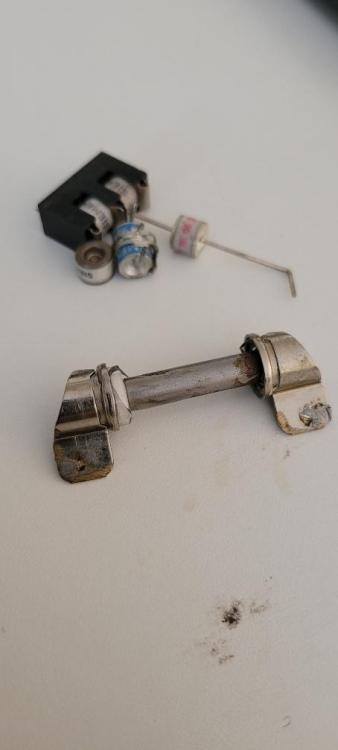 The law is very simple, a solarpanel frame has to be earthed. I am personnaly totally against earthing a solar panel frame, except if it has a suitable 50 - 100KA lightning surge arrestor between earth and panel frame.. . However lightning will dispose of it energy by finding the best earth. That is not allways the shortest route. If your panel frame is the best earthed metal in the area, you are a sitting duck. If I look at all the high rise buidings in Johannesburrg, the frames of the alluminum windows are not earthed and I have not heard or experienced in the near 25 years I was dealing with Siemens lightning arresters and varistors and insurance issues, that a building was hit via the metal window frames, when the frame was not earthed. What is your opinion. Sadly the Siemens surge arrestor factory in Berlin who made the 50 KA lighning arrestors does no longer exist anymore. Who can help me with a company who sells high current and fast lightning surge arrestors of 50 KA - 100 KA in small quantities the maximum current we had measured in JHB was 50 KA , but there are allways exceptions, like 300.000 Ampere measured in Japan. Thanks if you know who sells them. BertKu.This represent approx 0,0085 Ohm per 10 meter of 10 mm copper and that at 60.000 Ampere lightning strike (measured in Joburg a number of times) gives you a potential of 500 Volt. I can live with that. But there will be connection resistances and that is very difficult to measure.sorry my mistake not 10 mm2 but 10 mm thick copper cable like welding cable . 10 mm z 10 mm x 0,785 = 78,5 mm2I fully agree, I have been speaking to 4 electricians and I am very concerned, that many people will have problems with their endurance, should it be hit by lightning. I personally am busy t put a separate spike into the ground as deep as possible 2 feet away from the building wall, with a 10 mm2 copper cable in a protection pipe going up to my roof and then at 45 degrees to the top of the solar panel frame, then with a spike to be higher (+/- 80 cm) than the top of the solar panels, ( IF I have the money I will gold plated, but sadly I don't have the money for that.. and then with a small, thin wire or lightning arrester from panel frame to spike on top of the solar panels, to ensure it is also earthed. What do you think about this way I am going to do it? Bert .Yes, it is one of the most difficult subjects and the CSIR some 40 years ago did some incredible nice research conclusions. Somebody mentioned, can he use 5 mm2 cable. Let say he is good and get a resistance of 0,1 Ohm. With a lightning strike of 60.000 Ampere, you looking at still 0,1 x 60000 = 6000 Volt on your panel. Not ideal. Thus if you earth it, the thickest copper cable you can afford. The CSIR figured out that the best way in protecting thatched roof house is by two or 3 very high poles with excellent earthing, which created a neutral 45 degrees field, and with the thatched house in the neutral zone, no fires were recorded. One thing is for sure, one should try to create a Faraday cage around his electronics. . I love to put some very high poles around my house, but how long will it take before a neighbor is complaining at the municipality and I have to take it down? For me the best is that my neighbors have better lightning protection than me, then I will only have to worry about surges. One has to obey with the law, but how good were the people who propose the rules? if I was on a farm, i would put some good high lightning poles up and have the solar panels in the neutral field BertA very long time ago, when I was involved with selling millions of lightning arrestors and varistors and were involved in helping with insurance claims and arguments for customers, I came to a different conclusion. Lighting is 95 % from cloud to earth and while the earth potential is the greatest the lightning is "slowly" searching for the best voltage potential and is not just one line of the shortest distance between your solar panel and the lightning striking cloud. We came to the conclusion that if there is a better route for the lightning to go to earth, around your solar panels and other very good earth connection, it will go there. Thus a lightning pole close by, could be a better solution for a badly earthed solar panel system than the best earthing in the area, you definitely will attract your lightning strike. With the 50.000 to 60.000 Ampere flowing close to your electronics it will be fried potatoes. have a look around your house, is there a better point for the lightning to dispose of the charge or are you the best conduction earth. I personally will earth my solar panels very badly, but ensure that there is a much better route close by for the lightning strike to go to earth. There is a pole close to my hose much higher than my roof and that I make a good earth. Or as an alternative I have a 200 KV plus potential low current pointer above the panels and protect my panels in that way. Only over the sea there are lightning strike from the sea to the clouds . I will take my chance a have a bad earth and protect my electronics. Bert By the way the lightning just passed our house at the coast.I had a little accident. i have a 5 kw inverter with 140 Ah batteries setup, for only to be used to 2 KVa i.e. 229 Volt Ac / 10 Ampere maximum. ( it worked for 2 months fantastically) . However I manual switch the main-switch off and then have a second switch by the inverter to switch over to feed my house. I did this, as I am not allowed to manipulate the main-switch board) Till I was so clever to exceed my max cable current from 10 Ampere to ??? a washing machine and dishwasher at the same time. The 220 Volt wall plug packed up and I replace that., but the inverter no longer has the red LED showing that the inverter sees the 220 Volt. What are my options?


