


cvschalk
Members
-
Joined
-
Last visited
Everything posted by cvschalk
-
I've got a Geyserwala and its integrated with Home Assistant. Works great. But I'm struggling to use the API (for non-HASS features). Has anyone had success to log into the API with cURL commands? I tried with my token and password, according to Manual: curl -X POST "http://192.168.1.xxx/api/session" -H "Authorization: Bearer xxxxxxxx-xxxx-xxxx-xxxx-xxxxxxxxxxxx" -H "Content-Type: application/json" -d '{"username":"admin","password":"xxxxxxx"}' but I get return: {"success":false,"code":401,"message":"Bad username or password"} I've confirmed the UN and PW, by visiting the local WebGUI in my browser
-
@JustinSchoeman @AndreFvdM I've decoded the 1 wire signal. Its not UART based. Its essentially just duty cycle encoded (short 400us pulse = 0, 800-1400us pulse = 1). 32bits transmitted at a time. LSB first. Temperature packets are 0x1800ZZ00, where ZZ = (temperature in degrees + 15). Another packet has two bits to indicate heater element state.
-
@rfl unfortunately this is an issue specific to the Sunsynk and Deye MPPTs. They dont actually do Maximum Power Point Tracking at all, but rather Local Power Point Tracking. I've been trying to motivate them to fix this issue in FW, so that the bypass diodes are used as intended. All of their competitors (Vitec, Sungrow, SolarX, SAM, Fronius, Sofar Solar, SKE/ Huawei Luna, etc.) have special algorithms to handle partial shading - mostly by performing a periodic (eg. every 30min) global Voltage scan to find the maximum power point. I can just imagine how many millions of kWhs goes missing every year because of this issue. And the most shocking part is that most installers seem to think this is "normal shading behavior".
-
@Scorp007 Ah I see. So the drop is only for a short period of time and only for <20% loss? This will fits with my understanding of full cell panels. BTW, on full cell panels the cell-columns are wired 2:2:2 between the three diodes. So if you know which columns blocked, you will know how many bypass diodes activate (1 or 2 of the three)
-
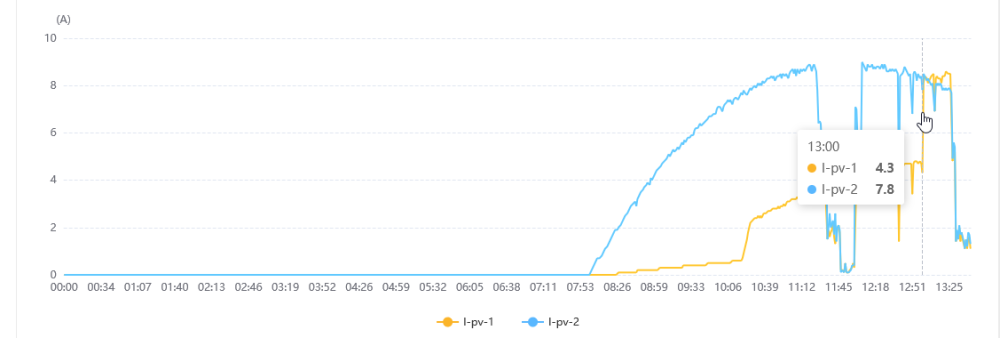
@Scorp007 I see you also have half cell. What inverter do you have? Imagine that you could have have more than 2kW production without this shading! (complete the graph to the left) here are some simple formulas to calculate shading. Assuming that panels are mounted in portrait orientation, so vertical shading is the blocking of the long edge cell and horizontal shading is the blocking of the short edge cells. Full cell PV panels: horizontal shading = loss of full panel for each shaded panel. Rest of unshaded string at 100% production (so 12.5% loss for a 1/8 panel string, 25% for 2/8, etc) vertical shading = 33% loss of full panel, per 1/3 of the panel shaded. Rest of unshaded string at 100% production (so only 4% loss per 1/3 of panel shaded) The above is true for both old and modern MPPTs Half cell PV panels: horizontal shading = same as above for modern MPPTs, but 50% loss of the full string for old MPPTs (because the bypass diodes never activate) vertical shading = same as above for full cell. Both for old and new MPPTs You might wonder what the use of halfcell panels are then if they cause so much trouble? If you have a modern MPPT, they actually perform very well if you have partial vertical and horizontal shading (a couple of cells shaded anywhere on the panel). Then you can end up in the zone between 33-100% loss on a single panel, which can be very advantageous if you have a tree/chimney/antenna throwing shading multiple panels on a string (eg if you have horizontal edge shading on your full string, you loose you whole string for full cell, but only 50% for half cell). But for this you need a MPPT with a half cell algorithm.
-
@Scorp007 thank you for the feedback. For traditional panels, shading in full sun is actually quite easy to quantify and handle, since the shaded cell current potential goes to very close to zero. Then as soon as the MPPT starts to load the current, the bypass diode of the panel activates and that third of the panel is shorted out (each panel has 3 bypass diodes, allowing a third of the panel to be deactivated/bypassed if shaded). The end result is that you still end up producing 2/3 of the power of that panel and if your String is 9 panels long, then you will still produce 96% of the power of the string (26/27 "thirds"). What makes things a little more complex to understand and to manage by the MPPT, is that half-cell panels are wired like two smaller full-cell panels in parallel. You still have 3 bypass diodes, but the panel is broken into 6 sections. These sections are wired in parallel, two at a time, each pair sharing the bypass diode. So, given this configuration, if the panel now experience partial shading during full sun, the MPPT has two ways to handle this shading: it pushes the current of the string into the zone of expected current (assuming full sun) and thus forcing the bypass diodes in the affected area to activate. This will result in 96% production for a limited partially shaded string. It only pushes the current a little bit. The bypass diode of the panel remains inactivated, because the parallel complement of the shaded cells are still producing current - so current is flowing! But since its only half the current, the whole string are now forced to only produce half their current potential. This results in exactly 50% production. The problem with old school MPPTs are that they start to increase the current slowly. Then they reach point 2 above. Since this is a local power peak, their algorithm "gets stuck" here. It does not know about and never reaches the second power peak, which is almost double the size! The modern half-cell-compatible MPPTs knows that they need to sweep the full current range to identify where the true maximum peak is (the 96% one, not the 50% one). I would have fully expected Sunsynk to be compatible with halfcell panels - given this is the newer technology panels and what everyone is installing. But it seems they might not currently be. I can only imagine how much wasted energy this produces every day because of partial shading on halfcell panels.
-
I'm having issues with my Sunsynk 8kW inverter and 550W Halfcell solar panels when partially shaded. The Sunsynk MPPT algorithm does not seem to handle half-cell shading well (with their multiple power peaks). When the top half of only one of my 550W panels are shaded (out of a string of 8 panels), I reach only half of the expected current. If the MPPT was clever, it would have pushed the current to activate the bypass diode on the shaded panel and achieve the full production current. As soon as the shading clears, the current jumps to double the value immediately: The nett result is pretty much 60% of the production I should achieve, for half the day - all only because half of one panel is shaded.... Does anyone know for a fact if the Sunsynk FW supports the periodic "current scanning" for half-cell panel peak detection?
-
Has anyone successfully integrated Home Assistant with a Sunsynk inverter over the local network by directly connecting to the inverter dongle? No looking for the Modbus (RS485) connection or getting the slow update data from the Sunsynk cloud. My inverted has the "new" e-linter Sunsynk Wifi Dongle (not the Solarman Dongle)


