


JustinSchoeman
Members
-
Joined
-
Last visited
-
-
Contact the supplier. If it is a supplier worth doing business with, they will give you the information.
-
Generally not, but RTFM. The installation manual will tell you what type of upstream protection is required - this is the only source of truth for product specific information.
-
-
-
Just gotta love those product specs: 🤣

-
-
Never seen that. My EV starts tapering off at 85% - but this corresponds with reaching the target charge voltage, and entering CV phase (where current tapers of natually). Most lithium chemistries hit this point at around 85%. None of the BMSs I have used have tapered off current for any other reason, but I suppose it is possible (although I have also not found any cell manufacturer who recommends anything but straight CC-CV charge profiles).
-
I just automate mine through Node-Red. If load gets too high, I instruct the charger to reduce the current. Not all chargers are smart enough for automation. But all do at least have jumpers to set maximum current, so if you really are limited by the infrastructure, you can reduce the charge current (power) to a suitable level, at the expense of charge speed.
-
The charger rating is actually in Amps. A '7kW' charger is actually a 32A charger, and will draw 32A continuously in operation.
-
Also - one thing I wish I had done at the time was to run the fixed wire to a 32A industrial socket, and fit a 32A plug to the charger. This way the charger can be moved if required (without affecting CoC), and you have an industrial outlet handy, if you ever need one. Not sure how good an idea this would be, but I thought it would be nice when I rented an industrial mulcher...
-
I can't see any need for municipal permission. Installer did not mention anything when they installed mine. Only requirement is for an updated CoC, and the only catch to the installation, is that some wallboxes require an external Type B RCD (check the manual), which can be quite expensive.
-
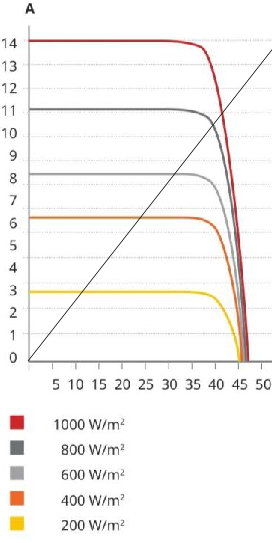
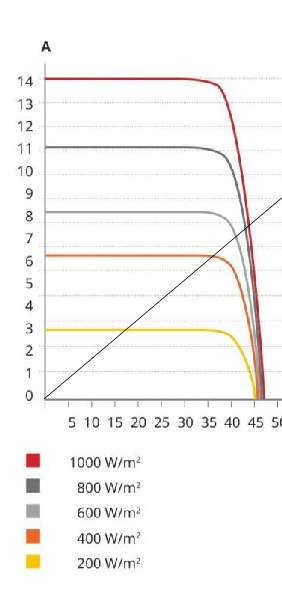
This curve also shows the main disadvantage of not using a MPPT. If we add the characteristic curve of a resistor (V - I * R) (black line), then the operating point is where the two lines cross: So, as irradiance goes down, both current and voltage drop, and you lose power to the load at a squared rate, while available power from the panels only goes down linearly. So you lose a lot of available power at anything less than optimal conditions. (Power = V * I, and the maximum power the panel can produce for a given irradiance is just after the point where the current starts dropping.) Things are even worse with a PTC element - as it heats up, its resistance increases and you get something like: And you lose a massive amount of available power under good irradiance (although it does become more efficient at lower light conditions). So it does work without a MPPT, but you don't utilize the available energy from the panel very well.
-
-
-
-
As far as I can tell, no Felicity documents provide any information on surge capacity, so they do not guarantee anything beyond the rated power (unlike the Voltronic products). The 'surge capacity' of LF inverters is often misunderstood. The output transformer provides excellent filtering and buffering capabilities - but the energy storage potential is still less than 1/2 of a phase cycle. So 10ms or so. This makes absolutely no difference to motor/compressor start-ups which require a second or more of surge power. This sort of longer term surge is provided by the drive electronics, and the manufacturer sets the limits on what the drive electronics will supply. Surprisingly, HF inverters have substantial advantages in this regard. HV bus capacitors are cheaper, lighter and smaller than a LF transformer, and generally store a LOT more energy. Also, the high frequency switching also allows for very rapid increase of power delivery to the DC bus, when required. So modern HF inverters often end up with better short duration surge capabilities than LF inverters.
-
Just remember that most 4 core armoured cable you find will be rated at 600V. You are probably going to pay through your teeth for cable rated at 1000V.
-
-
Not quite. The INVERTER controls the charging. The BMS tells the inverter what it wants, and the inverter does what the BMS tells it. The only direct action the BMS has is a failsafe option to disconnect the battery if the inverter tries to do something outside of what the battery can handle.
-
-
1) 3) Fusing curent of 4mm² wire is 280A, which I assume is well above the maximum fuse rating required. I am not 100% sure why they have this rating, but I suspect it is for reverse current protection of the bypass diodes. 4) You average surge is a MASSIVE amount of power. I have seen copper wires vapourised by a near by lightning strike. There is no way that tiny little box is going to absorb that amount of power. It will vapourise within milli-seconds and let the remaining surge toast all your hardware. Instead, they are designed to short circuit the surge to ground, which produces a massive overload current through the protection device. This opens the protection device, cutting the load off from the source of the surge. Please read the datasheet of the SPD you intend to install to learn about the minimum installation requirements.
-
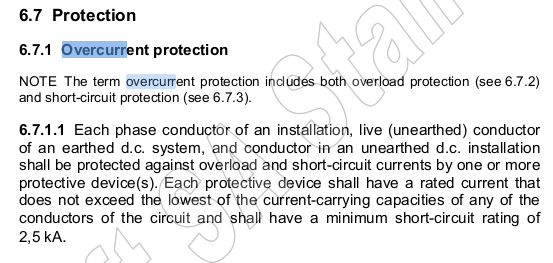
1) The regs require cable protection, irrespective of the source capabilities, so there is a legal requirement for over current protection. 2) With parallel strings, a short circuit in any string means the parallel current of ALL strings can flow through that string. So with parallel connections, you definitely want fuses/breakers. 3) Many solar panel manufacturers specify a required fuse. Failure to use that fuse means no warranty or insurance coverage. 4) A SPD can NOT work without a fuse/breaker - its job is to trip the fuse/breaker on a surge, not to absorb the entire surge itself. 5) When protecting parallel strings, remember that current can flow from one string to another. You MUST either use fuses or non-polarised breakers. Polarised (or AC) breakers will be a significant fire risk.
-
Both are DC? But that is also (usually) illegal, as all insulation must be rated at the highest voltage in a wireway, and battery cable is often only rated at 100V...


