


Kalahari Meerkat
Members
-
Joined
-
Last visited
-
-
Yes, you can probably set this up as the Grid feeding the Victron, problem is, do you have it connected to the batteries as well? and who charges the batteries, the Solis or the Victron, the Victron would obviously have to go on the UPS side of the Solis and if this is the case, would the Solis be happy to have another generator (the Victron) sitting at its output end? If the Solis is not battery connected, but only grid and UPS to the Victron end, not sure this would actually work, as soon as the grid disappears, I'm guessing so would the Solis, so no more solar power... So, go on, get a SMA or Fronius and cut the cord, then everything should work out as expected :-) else, ditch the Victron and invest in Solis or do what I did, ditching the grid and getting MPPTs, I could have gotten AC coupled MPPTs, like Fronius or SMA, but didn't consider this an option, after all, if the inverters were to go down, the batteries would still get charged by the MPPTs here... whilst sorting out the inverters... since not telling the inverters about the batteries by way of CANbus messages, the inverters have never gone down, the MPPTs charge based on Voltage, at 55.2V I consider my 16S batteries full 3.450V per cell and that all works as expected. The inverters, of course, can not charge the batteries, since there is no grid, so no need to let them/Cerbo know too much about the batteries anyway, other than, consider the batteries empty at 48V (they aren't but have never reached that level yet).
-
-
AC coupling is always a possible problem, if you can not export, since you are grid connected, you can not tell the AC coupled device (Fronius, SMA, microinverter) to slow down production, since your batteries are full and your consumption is being more than covered, since the frequency is determined by the grid. The DC->AC AC-> DC conversion is, I think fairly low cost, not like a pumped hydro storage, I think its even better than a LiFePO4 battery's round trip efficiency, so AC coupled, great option, possibly, if you are off grid, or, if you can export, else DC coupled solar is probably best.
-
-
yes, that is a problem, also, note the Victron Factor 1.0 rule I went for the DC MPPT side, also, since we are totally off grid, I suppose an AC MPPT would also have done here, but certainly we have enough for now (need to actually install a few more panels, but the MPPT capacity is there)
-
-
-
a rocket mass heater has a exhaust/chimney out of the house, normally, so that takes care of the exhaust gases, since most local houses are not built to prevent air exchange from the outside and burning the wood, would consume oxygen which get expelled via the exhaust, fresh air from outside would be drawn in via the various holes and possible vents... the amount of wood that these consume vs the heat produced is unbeatable...
-
Rocket stove mass heater...
-
what is the rating of your battery? 1C, 0.5C aka C/2, if it is rated at 100A (C/2), then the cable supplied would probably be ok, I think, also, is the suppled cable insulated with a silicon jacket? again, if so, its current carrying rating would be higher than a PVC jacketed cable.
-
@ash785 also what is the state of charge for the batteries, are they limiting the power production, possibly? what is the daily consumption on your end approximately and are you connected to the grid? If you are then some inverter settings may prefer grid power to solar, maybe, so looking at that is also a good idea.
-
sounds very low, are these 450W or 480W Panels? and are they all the same? how are they connected? 23 panels in 1 string sounds problematic... where are you georgraphically and how much cloud cover have you had? I have 4S2P 280W panels times two and 4S1P 560W panels, so 3 X 2240Wp, we have had a fair amount of cloud cover of late, totally cloudy right now and 2.8degC outdoors around sunrise earlier today. I'll attach a power production screenshot from the 1st of June until now and the worst day, so far, the 22nd of June we produced 7.96kWh for the day, which is really low, but eithert side of that, the 21st we had 14.01kWh and the 23d, no clouds whatsoever, I'm guessing, we had 30.98kWh for the day...
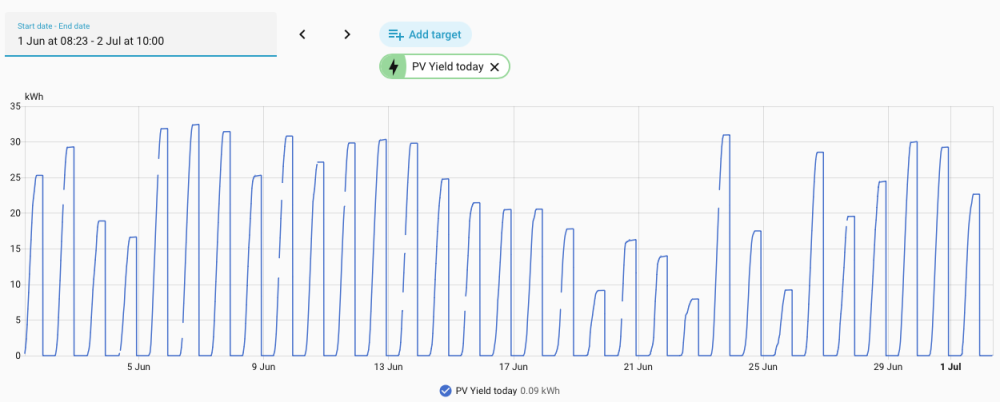
-
Hi @AlanPS67 , no experience with this lot, but I'd imagine you should be able to set things up, to mainly run off battery+solar when the tariff is high and then, run off the grid when the sun doesn't shine, depending on the SoC of the battery and even charge the batteries, when the tariff is low and the batteries need som charge returned to them...
-
 Yellow Measure reacted to a post in a topic:
Adding 2 panels to a 6.6kWp E/W split on a 5kW Sunsynk for winter — safe and worth it?
Yellow Measure reacted to a post in a topic:
Adding 2 panels to a 6.6kWp E/W split on a 5kW Sunsynk for winter — safe and worth it?
-
it should make a difference, how noticeable, is tough to predict, if there is no partial shading on either of the strings, when they should be producing energy, it should be worthwhile, I'd say the inverter should throttle the power back to what it is able to consume/charge the batteries the more important one is the strings Voc, which should be ok, I think, just a hair under 50Voc per panel * 7 = 350Voc per string, which, I believe, the Sunsynk would be ok with, maybe double check this, I don't have a Sunsynk here anymore...
-
Ideally you would want to take temperature readings in the manifold and compare them to the temperature in the HWC (hot water cylinder), if the manifold temperature, is more than, say 4 degrees Celcius higher, then you'd want to run the pump, if its is 4 degC or less, you probably shouldn't...
-
I seriously doubt that these were LFP. NMC type Lithium Ion, sure... As for the 1st video in this thread, I saw lots of 18650 cells in the video, who has a LiFePO4 battery made up of 18650 Cells? Will Prowse has a video addressing the LiFePO4 issue and it is supposedly a serious health hazard if the LiFePO4's should vent, however, the amount of failures of the LiFePO4 cells. or rather the lack of failures, indicates to me at least, that you should be aware of the possible hazard, but don't panic, if you have treated your cells well, did not drop them, did not over charge or discharge them, then the likelyhood of things hitting the fan is so low, that you should not over-sensationalise the very few failures that do occur, rather investigate why, if possible, the failure occurred, the 1st video in this thread, the battery with loads of 18650 cells, how was this put together by the manufacturer? If they have loads of parallel cells, which they presumably had, was each cell fused individually? etc. I think for us homebrewers, 304 or 314Ah cells in 16S format with a decent BMS, we probably should be aware, but don't have to be unrealistically concerned about gassing, as long as we treat our batteries well. I don't come near the 3.6V mark, heck I charge up to 55.2V (/16=3.450V per cell) and the lowest I've seen to far is 51.33V (/16=3.208V per cell), with maximum cell delta of 0.034V aka 34mV on my worst 304Ah battery in the last 33 days, the rest of them 15mV, 13mV and 12mV. Based on this, I believe that my cells won't vent and will carry on operating for many years into the future. As it is, my batteries/inverters/MPPTs are all in the garage which is very well ventilated, chances of hydrogen or other gas accumulating is pretty much non-existant. If you have LiFePO4 batteries, obviously they probably should not be in your house, but the NMC type Lithium Ion batteries are the ones, I would be a lot more worried about.
-
-
Quite right, sorry, didn't pay enough attention, read Deye, when it actually said Dyness... I can't say for certain, but I'm pretty sure one of the protocols supported by the Sunsynk should match with Dyness. again. someone who actually knows the Dyness batteries should be able to confirm... personally, @JTK, I recommend homebrewing batteries, more cost effective and you actually have a better idea what makes up your battery....
-
-
Yes it has two separate MPPTs Yes, within limits of the MPPT, can't remember, but possibly around 20A Isc and 400Voc, check the manual/specifications for that inverter. Maybe, but I'd check the Voc or the existing 7 and make 100% certain there is room for expansion, but personally, I wouldn't mess with the existing string, I assume it works and you already have nearly 4kWp solar on that MPPT, fill up the other one rather. Yes, same or more current, but I'd suggest you leave the string as it is, rather... should be fine as long as the Isc and Voc values of the string fall withing the MPPTs specifications... I would think not, same manufacturer, just Sunsynk is a different label/Deye rebranded and sold under the Sunsynk name. But others may know more, as it is, I doubt that Sunsynk or Deye actually manufacture batteries, so yet again some other manufacurers items being rebranded...
-
Discussed here. And manufacturer test info here.


