Moffat
Members
-
Joined
-
Last visited
-
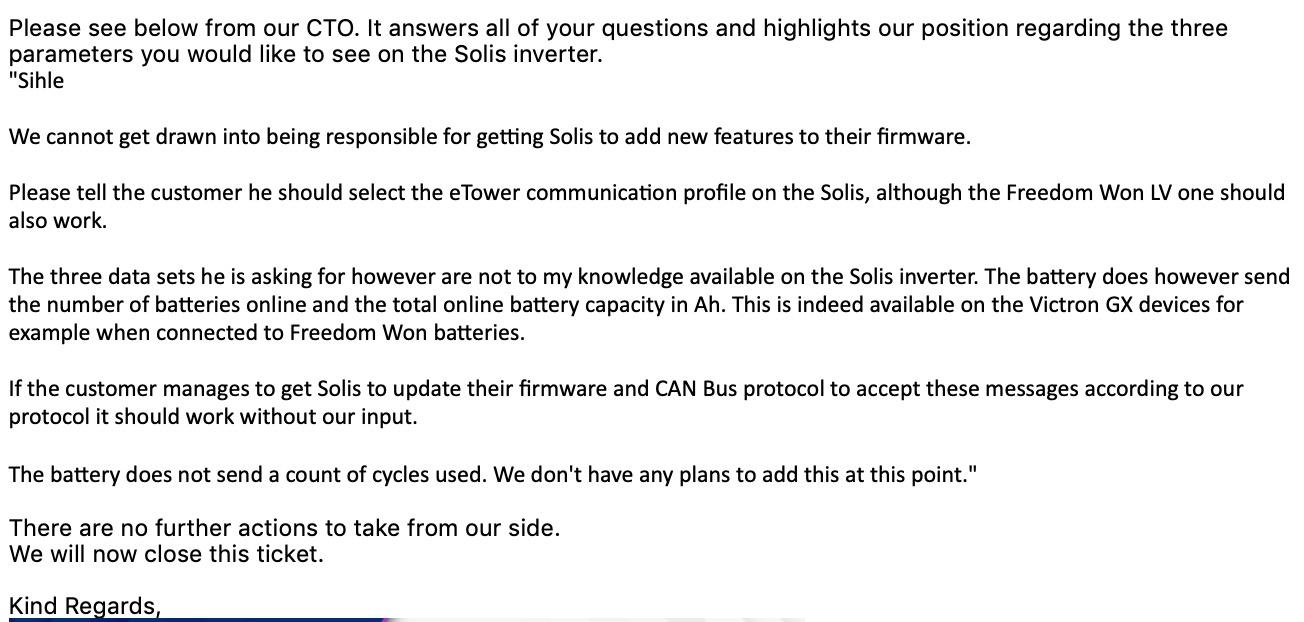
Succinctly put @Steve87 now the next battle is getting to have information displayed on Solis Inverter in respect of: Correct number of Cycles Number of parallel connections Battery Packs (number of single module core strings); and Number of Battery Modules in Series Already FW has indicated that this is a Solis issue via email which I have shared with Solis and hoping to get a way forward and resolution. My knowledge (limited as it is) indicates that this would be a BMU/BMS issue which the two of them ideally should work together to do a firmware which would give a resolution, unless the eTower PACE BMS is not physically able to do this, but I guess I have to wait and see.

-
-
-
-
@Steve87 I'm in the same boat with you in terms of having to remove the battery and cart it off back to manufacturer, moreso as I'm not in South Africa. The cross-border logistics and time become not only tedious but also very expensive both in time and transportation. FW does have a local distributor but because I bought the battery directly from FW through the PowerForumStore they were not wiling to assist (rightfully or wrongly so), that's another story. Fortunately, to be fair to FW when they had a tech coming to their distributor he took the time and sorted my issue within half a day, which I was very grateful for and also on warranty. So I've not entirely lost faith in FW and do recommend their timeous attendance, on the whole, of their tech support team and professionalism.
-
@Steve87 for the sake of the local markets on the African continent and in particular South Africa, I certainly hope and pray FW and all others in various sectors pull up their socks. Just off the top of my head it made me think of the demise of Nokia and Blackberry vs how Apple came and decimated the market landscape in the mobile sector. We unfortunately then become beholden to external suppliers and this effectively means no jobs for our local people and markets save for scraps.
-
-
Looking forward to the continuation of this story with bated breath... especially as I also go through my own issue with FW but more specifically in relation to an eTower BMU.
-
-
Out of interest definitely would be keen to explore and try your products. Just a couple of questions though: Would you ever consider or are you in the Southern African region (Zimbabwe, Zambia, Mozambique, Botswana)? How well do your products perform in areas where Internet network connectivity is erratic and not the best, in terms of data collection and aggregation?

-
-
Many thanks for the response, I have since sent an email to Solis at 18:27hrs (16 July 2026), ticket ID# 984064
-
-
-
@Yellow Measure As I've indicated Solis team service representatives gave me a commitment, last comms was in January 2026, they have been silent since then. I have not received feedback from Solis since then. Trying to engage them on a public forum is in the hope that I get traction and a response. If at the end of all this, the whole issue lies squarely with FreedomWon not playing ball, would it be unfair for me to have expected a response from them indicating what has transpired, initially privately? Secondly, I have not said Solis nor FreedomWon products are bad, AT ALL, in fact am very happy with the products I have from both, it's the issue of a dropped ball in relation to only a specific issue, which I am now getting clarity on this forum that this is a FreedomWon BMS not sending the information to the Solis app/web portal. I have no reservations, at all in apologizing to Solis. If you had engaged them and their representative commits to getting the issue resolved in partnership with the other party and then it's not done, what is the recourse? In my humble opinion, the recourse is to say, "listen we have engaged the other party and they are not playing ball or you have old hardware that is not able to get what you would require" or whatever the final story is and then the matter rests. AGAIN and for the record, would I purchase products from both vendors? ABSOLUTELY and without reservation and am intending to do so again.
-
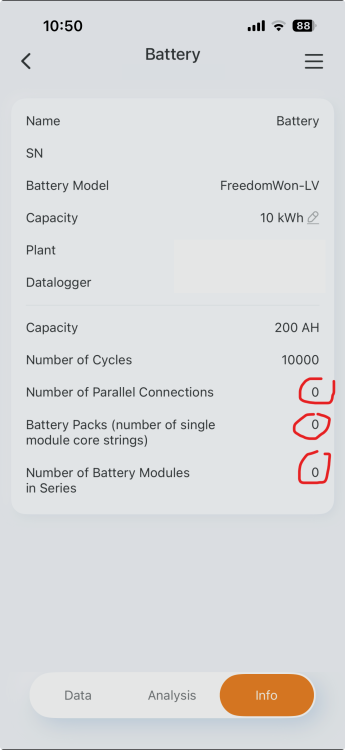
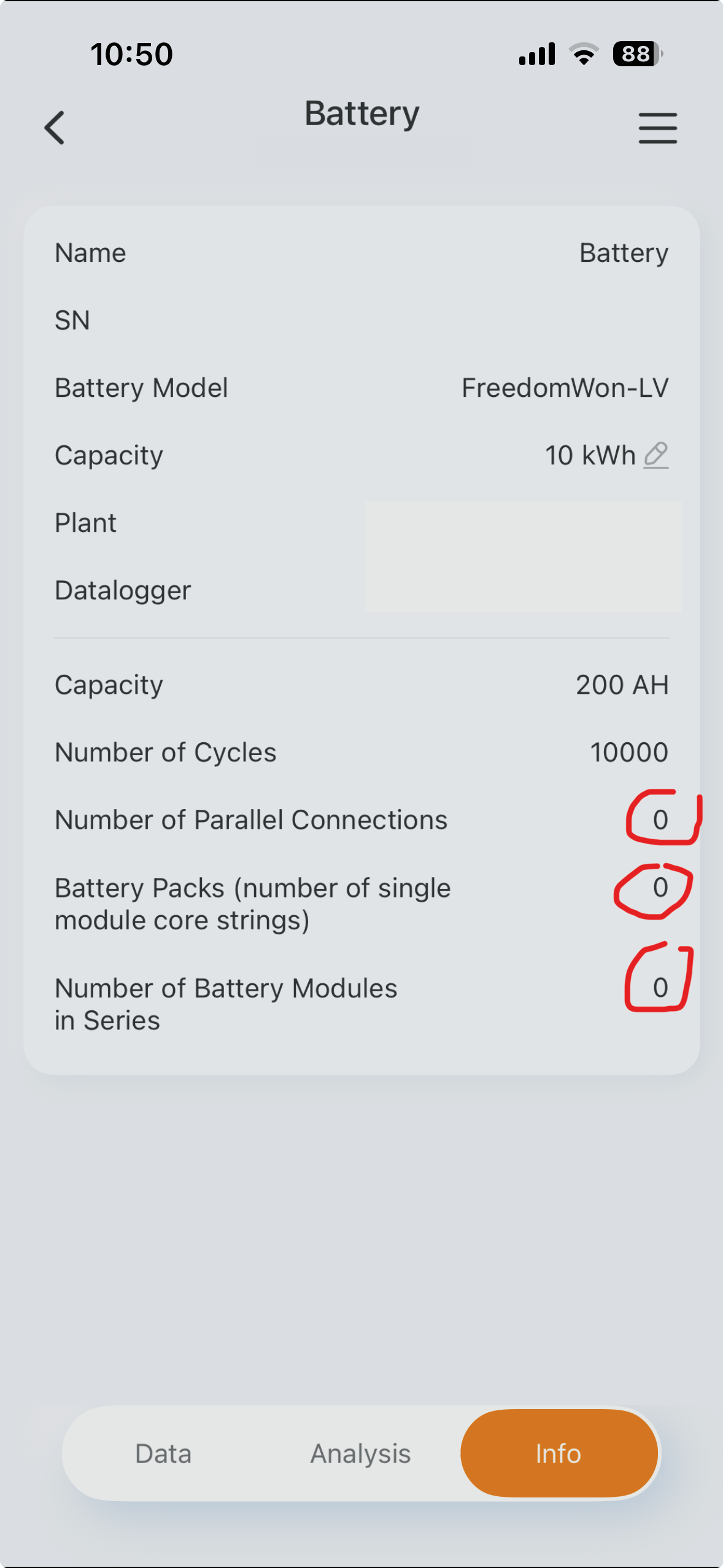
I also spoke to Solis guys who promised to work with FreedomWon to get a resolution, so both parties’ support staff gave commitments and promises. My problem I guess on my part was that the comms were via WhatsApp calls but I have names from both parties who made these commitments.Would be keen on also getting to find out regarding this issue. For me my loads are generally sorted in respect of the battery but my 200w panels are beginning to reach end of life and I used to have 12, now I have lost 1-panel and the others look like they will likely fail soon, so before I can afford new panels would be keen to see how I can get a generator to work as a charger for the batteries and carrying the loads through the Solis.@Yellow Measure too true, but what would anyone do who is an ordinary customer when faced with a manufacturer or manufacturers who are the makers of the product?🤔@HennieL I personally did research for my inverter and battery over the course of almost 3-years solid and was really partial and drawn towards the Sunsynk until the reports of inverter issues taking over 6-weeks or longer began to resurface. Granted the huge levels of sales and lack of commensurate growth of their after-sales and support side, may clearly have been the problem, but if one is going to take over 6-weeks plus without a backup option, moreso in the times when loadshedding was at its peak becomes problematic for me and am sure for anyone. On the battery side, I've had an issue with my first purchase via the @Powerforum Store which was no fault of theirs and they were absolutely supportive in linking me up to FreedomWon, who in turn were equally supportive. My only gripe was that their local distributor would not assist me, at all, since I had made a direct purchase. Eventually the battery was fixed, on warranty but being outside of South Africa posed a huge challenge. I also further purchased a second FreedomWon battery and up to date, no issues for both Solis and FreedomWon save for the BMS information issue. Would I recommend both brands, absolutely, but clearly they can do better in respect of missing or incorrect information.Yes @Yellow Measure I logged the issue and they said they would get in touch with Solis R&D to work on this. This issue is still outstanding. Last comms I did on the matter was in January 2026 with team at Solis Zimbabwe support and it's always a back and forth blame game till eventually I got frustrated and tired.@Powerforum Store you are very correct in the information you have shared and I engaged FreedomWon customer care and technicians in this regard and they advised that the whole process of updating the BMS information and it's display would require collaboration between FreedomWon and @Solis Inverters SA . I continually engaged FreedomWon over many months and they in turn blamed Solis team for not their unavailability, now whether that is true or not, I have never been able to verify it hence raising it here that this issue has been outstanding since last year October (2025) when I first raised it including official tickets with FreedomWon, which they kept insisting on closing and eventually went quiet. Previously I was not even able to get the basic information such as: Total Battery capacity (Ah) for more than one module - this was fixed Total Battery capacity (kWh) - I requested if this could be received on the Solis inverter automatically - this is still done manually So the question is whether @Solis Inverters SA got any joy from FreedomWon or not and clearly since this outstanding, it means someone somewhere dropped the ball or thought my request was not important. What FreedomWon sent me was a RS232 cable so I can get information directly off each battery module and information for diagnostic purposes and I even recommended that since that cable is difficult to buy maybe it be sold together with their battery modules. Their distributor was not willing to assist me, in the first instance, as I had bought the battery directly from the @Powerforum Store. My battery had a loom issue and fortunately FreedomWon had a technician travelling to train the distribution personnel and in Zimbabwe and during that time he was able to then resolve my battery issue under warranty, so am very grateful to them for that. I not had any issues with the FreedomWon batteries reliability, to be fair, but I always want to be aware of issues before they escalate or deteriorate, hence having granular information is important, at least to me. Battery sellers and installers (some but not all) are normally interested only in the initial sale and after service is asking for the moon, clearly. So that's my backstory to raising the issue here.Many thanks for the tag @HennieL. Number of cycles keeps going up and down as well. Today it's 10,000 on another day it had come down so clearly there's an issue with accurate comms and or capture of data either by inverter or being sent by the battery FreedomWon eTowers. I've also attached screen shot with circles in RED of area that have no info. I've also closed off personal info so that any update is done, not just for me but for ALL comms between FreedomWon eTower batteries and Solis S6 pro hybrid inverters and I know, not everyone is interested in granular information as much as I am, but it's important to have it.