Qtin
Members
-
Joined
-
Last visited
-
-
Hi guys Apologies for the only hopping back on the forum now. And thanks @GreenFields @Moffat @LumexClipsal for your advice and inputs thus far. I ended up opting for the 8kw Solis inverter (more within my budget). I got it for a really good price and last bit of stock at Rubicon in PE, and just thought if I need anything bigger later on, I can always just sell the inverter and upgrade. Also went for the Dyness 14.3kwh battery and 12 x 585W Trina Duomax N bi-facial solar panels, which should be delivered today.[ Calculators show that I should easily be able to generate more than 25kwh a day - even at my roof's NW (8 panels) and SE(4 panels) direction] Managed to chat to an installer yesterday and he confirmed that you can indeed power your household items on the grid side without tripping your prepaid meter, just need to add a bias of 20-100w, then your meter wont trip (tamper) or detect the additional supply. So this will be great to power things like the geyser, dishwasher, washing machine during the day without affecting the inverter 8kw limit too much. But I'm just trying to figure out the most effective way to transfer these non-essential items on the Grid port to the Backup port incase of a power outage (since you cant feed back into the grid when there is no eskom power available). Guess an additional changeover should do the trick, otherwise I need to use a Siemens Logo (have a spare one) and some relays? Anyone with a similar scenario and solutions perhaps?
-
-
-
-
Thanks for your 2C's 🙂, it came at the right time. I was actually busy reading the battery user manual about 10mins ago when it struck me that 12kw might actually be too much for the battery, since a single battery has a 200A max continuous discharge current, and 140A charge/discharge current, and then saw your comment. Just a pity Solis doesn't have a 10kw model, would've been perfect. Just to confirm, if the geyser is connected to the grid port, can I still use the solar energy generated during the day to feed the geyser? Problem is I have a prepaid meter, so not sure how it will behave when feeding electricity to the Grid port. (I'm a bit inexperienced w.r.t feeding back into the grid). W.r.t to the solar panels, I can only with 8 panels on the NW (312degrees) side, so thought to add the other 4 on the SE (132deg) side for the morning sun which will help recharge battery drain early in the morning until perhaps 2pm+. Does the above make sense?
-
Yeah sofar warranties and aftersales support appears to be really good just by reading some forums and with direct interaction with Dyness SA. App and connectivity options also seems pretty good.
-
OK cool, thanks for taking the time to reply. I checked, luckily the 6kw Solis only needs 150mm between inverters, but 500mm above the inverter and then 800mm above floor level, so space should be sufficient. The reason I'm going with the 14.3kwh battery is that it works out significantly cheaper than buying individual 5kwh batteries, and more space saving. Only downside as you've mentioned it that you need another large one when you expand, but I feel it will still work out cheaper. So I will start out with 1 x 14.3kwh battery and see how it lasts through the evening (should be enough).
-
Hi everyone I'm looking at doing a new full installation for my house with the idea of maximizing on solar energy and trying to go through the evening on battery power to significantly reduce my bill and dependency on Eskom. Initially I was thinking to get 1 x Solis 8kw inverter, 10-12 solar panels (4 x South West roof and 8 x North West roof), and a Dyness 14.3kwh battery. But then I compared prices and 2 x Solis 6kw inverters seems to make a bit more sense in terms of cost, and capacity, etc. (10kw Sunsynk or 12kw inverters are slightly out of my budget) Another reason for 12kw in total, is that I just want to place all my home circuits on the inverter, perhaps with an additional changeover to kitchen/geyser as a means to remove that load. But essentially, I want to heat the geyser on solar, etc. But mainly, I dont want to overload the inverter when for example heating the geyser, dishwasher running and then water pump kicking in causing a spike and then getting a beeping inverter (even while being on eskom supply pass through and not battery), if you know what I mean. So basically, can anyone give some recommendations please? I think 2 x 6kw inverters in parallel makes sense in terms of size and also some redundancy incase one is faulty and need to go for repairs, then you atleast have another one. So in summary, is a parallel inverter setup still reliable without any syncing issues and power delivery/ load issues? or will a single inverter be better? Any gremlins that people experience with parallel setups? Thanks in advance Q
-
-
@GVC ok cool I see. Thanks for all the info, much appreciated.
-
@GVC Ok cool, i also have that exact same layout planned with the SPD on the Inverter out also. What I meant about the neutrals, is the actual position of them in that 3 x 12 DB. Can you remember if you could add neutral bars in the middle of the box also? Or only space for it at the Bottom or Top? If that makes sense?
-
@GVC Thanks for the screenshot. Does it have space for neutral bars under each row of circuit breakers? Or only space for it right at the bottom/top of the box?
-
-
Ok nice, definitely seems like the way to go then, haha. Thanks for the recommendations
-
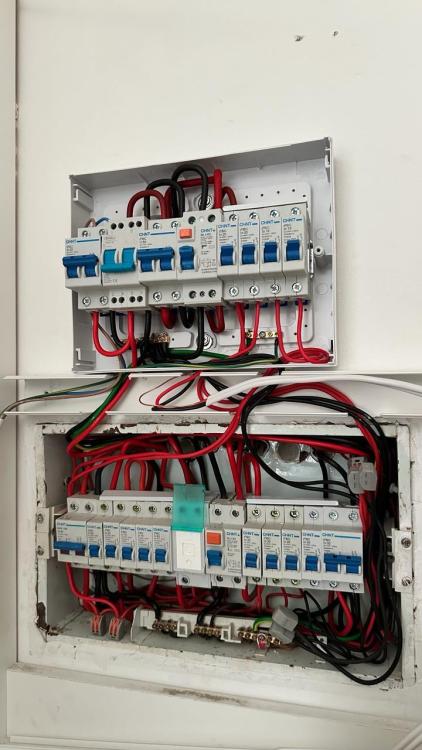
Hi @TaliaB Thank you for the recommendation. I will definitely consider that. I already have a new 18-Way surface mount DB and was hoping to find a solution to use that without spending extra on additional hardware, but I think a 2 x 20 way DB might be the way to go to make things easier and neater. Would I just make new holes at the back of the panel and extend the existing conduit with sprague or straight connector? Just thinking about the future if i need to pull new cables in the conduit.
-
Hi all, just looking for some recommendations please. I have an additional surface mount DB which will house everything for an inverter installation (will be replaced with bigger one and surge arrestors, etc). The thing is, I want to get the wires from the existing DB to the new one through the back (the way it should be), but as you can see there is existing conduit running upwards in the wall cavity (brick wall). I can only mount it above the old one, no space to the sides. Does anyone have some recommendations on how to do this in the easiest manner and still provide double insulation for the wires? I cannot remove the old flush mount DB as it is really stuck and the conduit will slip out. Was thinking to drill a hole sideways at the back of the old DB and then also a hole through the wall of the surface mount one, and then somehow try and get a piece of sprague to join the two. How would the professionals do this with the least amount of effort, and mess? Thanks in advance