Lindsay
Members
-
Joined
-
Last visited
Everything posted by Lindsay
-
For anyone interested, I ended up changing the source priority from SOL to SbU after seeing a post somewhere on the forum here regarding this. Not sure why it would make a difference since this only changes when it uses utility/mains power due to no solar or low battery (and my inverter is not plugged into mains) but it seemed to help for the one day of sun we had after this. Unfortunately since then we've had cloud and now rain today, so I will have to see how it goes when there is more sun!
-
Hi all, I have a Mecer 3KVA 24V Plus (Axpert clone) and noticed that even though we've had some very sunny weather in the last couple of months it seldom has been charging the batteries fully - which it used to almost always do this time of the year. From what I can tell it starts charging in the morning, but seems to slow down to a few amps just after midday even when in full sun and the battery is only at a 60-70% SOC. Only very occasionally does it get to 100% SOC. It feels like this behavior actually started in summer last year but wasn't nearly as bad as it has been in the last couple of months. I started by checking the panels, but they are all still connected and the inverter does report around the maximum of 1600W coming in occasionally. On the weekend it had gradually been getting lower over a few days and at 2pm it had only charged back up to about 50%. While I was trying to diagnose the issue, the fridge kicked in with 166W load and suddenly the inverter went from reporting the solar coming in as 250W to 1000W and the fans on the inverter kicked in and suddenly the batteries started charging, going from a few amps into the batteries to around 30 amps. There are no errors showing on the inverter and bulk and floating voltages are set to 28.1V with no settings having changed recently. Just wondering if anyone has seen this behavior before or if there is something wrong with my inverter or other settings I could try change? I have considered buying a new inverter, but was hoping to hold off and keep using this one longer. Thanks in advance.
-
@Denns thanks for the specs, I have tried to download the manual from their website, but the link to their page with downloads doesn't seem to work, I will try again sometime. @Scorp007 thanks for the suggested other charging options, I'll check them out, although as Denns says I am trying to keep things as simple as I can.
-
Thanks for the advice, yes I will probably go for the larger one as there isn't a big cost difference and the extra headroom is always good, glad to hear of someone else using this brand as I was not aware of it before! Do you know where there is a manual online for these or a very thorough list of specs? I was hoping to find out how many watts these use with no load on the inverter (my current one is < 20W but I've seen a lot of newer ones have higher values). @Scorp007 thanks for clearing that up, my manual doesn't show any suggested configurations for the panels other than highlighting the maximum open voltage. It's good to hear that the higher current is ok (I have been running this fine with the current panel configuration and probably close to 30 amps at times for a few years now). While I probably won't go as high as 2400W it seems safe to go to 1800W since the current will be the same and only the voltage will be more, but still well below the maximum.
-
Yes, my LiFePO4 batteries are configured for 24v and pulling the cells out and reconfiguring for 48v with new BMS would be too much right now, but maybe like you I will at some point do that in the future. For now 24v seems fine and in summer I can run most of the house (except the geyser and sometimes cooking appliances). So to allow me to use the solar for cooking more often as well as improving usage in winter, I am going to eventually replace the MPPT inverter with one that can officially handle more panels and also higher loads on the AC side. I am looking at the "Must" brand 3.6KW or 4KW inverters that can take 4000W solar. Their price is around what you indicate above so seems well priced.
-
Reason I started this thread is that I want to upgrade my system, so starting with adding some new panels and using as many as I can with my existing inverter. Then a bit later adding a new MPPT inverter that can handle up to 4000W solar and wiring all the panels up to this. I also noticed and was surprised, that all the newer MPPT inverters seem to only go as high as 18 amps for the solar which affects how I will configure the array, probably two strings in parallel unlike the three strings I currently have.
-
@Denns it seems that when I bought this inverter, over 5 years ago, @Scorp007 says it was common to only show panel watts and the maximum voltage. There were PWM options of this type of inverter at the time, but I specifically bought the MPPT version and the manual lists MPPT multiple times and never PWM. I have a cheap 10 amp PWM solar controller in my garage as well as one for camping so I am familiar with them and matching panel voltages to be the most efficient. So the configuration for your dads house makes sense to maximise efficiency with PWM. The voltage from the Mecer inverter is definitely not just being pulled down, I have shunts installed and I see over 50 amps going into the battery at times even though the panels are capable of under 30 amps. If it were PWM in my current configuration I would be getting a maximum of 30 amps and wasting any array voltage above 27v, so probably not even getting in 900W (30 amps x 27v). In reality, as mentioned, I get around 1500W at times.
-
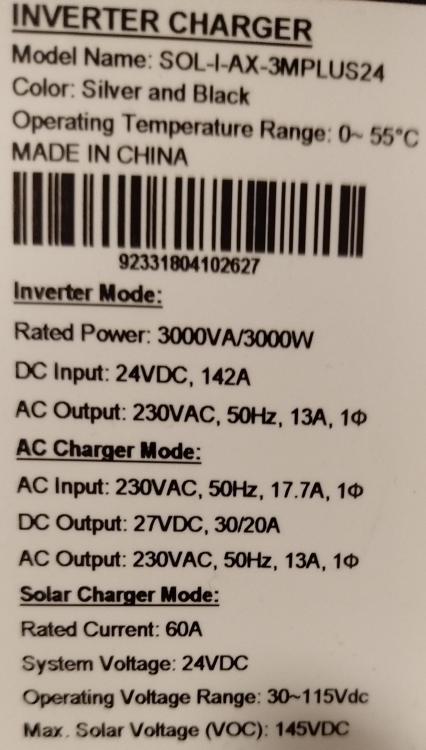
@Scorp007 that's odd that they didn't note down the maximum PV current because, with the sticker saying the solar charger operating voltage range is 30-115V, couldn't you have sized the array to the lower voltage of 30V and then arranged in parallel up to 50 amps to get to 1500W? It's also odd that the sticker on the side does not note the Watts of the array and the manual only refers to the 1500W as the "rated power", not as an absolute maximum solar array. The maximum I've logged coming in from solar in the last two weeks is 1546W when the array voltage was 70.7V: And also based on my logging it looks like the maximum current I've seen on the solar side recently is actually 27.2 amps (calculated as 1358/49.9): As far as I can tell the 51 amps shown above is on the battery/inverter side since there is no way my current panel configuration could get to that (and my calculated value is much lower). At the moment going from my current ~1500W array to 1800W would actually only be an increase in the voltage (if I did go 2400W it would be current as well). @Denns 50A on the solar side is a lot higher than I would consider, are you over your inverter specs for the current and Watts?


-
@Denns , definitely MPPT, as it says in the spec of the manual and I specifically chose for this reason. I bought it over 5 years ago now, it's a 24v model which I was first using with deep cycle batteries although now LiFePO4. It does seem that all the newer inverter/charger models, even the 24v have much higher supported PV voltages now and lower currents, usually 18amps. I've attached the sticker from the side of mine and it only says 60amp solar charging current, which I assume is on the battery side (in my original message I said 90amps which was wrong), but nothing saying 20amps or the maximum for the solar panel side on the sticker or in the manual. But I take your point @Scorp007 , possibly going over 30amps would be bad for it.
-
As the title says I have a Mecer 3KVA 24V Plus which I believe is an Axpert clone. I was looking through the manual and don't see it specifying anywhere the maximum panel current, only the maximum open circuit voltage of 145V and rated solar panel power of 1500W as well as the maximum charging current from the MPPT of 90amps (although I think I currently have this set to a maximum of 60amps). Based on my panels and the maximum watts I get, which is sometimes a bit over 1500W, it looks like over 20amps is coming in from the panels at times. My question is can I connect around 1800W of panels if the open circuit voltage is well under the 145V limit (I would have an open circuit of only 84V and the manual says the PV array MPPT voltage range is 30-115V). What if I extended it as far as 2400W? I've heard the MPPT just won't make use the extra current above its limit. The open circuit of 84V is a bit higher than I have now and I'm hoping it will start charging a bit earlier in the day and stop charging a bit later, especially in winter where currently I have to disconnect some of my loads. I know the open circuit voltage you should definitely not exceed, so I'm really just asking if there is a maximum for the current and the panel watts? Thanks in advance!
-
Yes, I have the Mecer 3KVA 24V Plus and it's setting 04 in the menu, SdS: Savings mode disable (default) and SEN: Saving mode enabled. In savings mode it pulses about once a second and tries to sense a load, and as @Flouw says, the load has to be over a threshold for the inverter to turn on, about 100W in my experience.
-
Thanks all for the responses... It's definitely not the BMS as it was still powering my DC loads at the time, but maybe you are right and there is something odd with the Mecer, I can tell it switched off at exactly 22.99V and when I woke up and checked it half an hour later it was unresponsive to any button presses. Only after the battery voltage either got around 24.2V (from my charging) or because the solar panels were starting to get some sun (it was after 7am at this point) did the fans in the Mecer suddenly briefly spin up and it powered on by itself in sense mode. Yeah, I'm not going to let it get so low in the future. Oddly I think the Daly BMS I got with the LBSA battery kit has cutoff set quite low, I think 2.5V per cell, maybe even lower. It seemed to charge up ok yesterday, not full, but ran ok through last night, although only with DC loads and I left the inverter in sense mode and haven't put the fridge back on it. It's a Mecer, which I thought was an Axpert clone, it's one of the first settings in the menu on the inverter and works as you describe, can't really keep it in this mode though for TV's/fridges. I don't really have any of my 12V systems near anything that's mains, my lights run permanently on the 12V, some network equipment like the router as well. I guess if someone uses a mains powered laptop and plugged it into the LAN then that might be a concern? Do you have a suggestion for isolated step-down regulator? I do have the 24V wires fused at 3 amps before they get to the buck, but I know that really only protects against shorts.
-
Thanks for trying to help, hope someone else is able to help me out with an answer.
-
I'm afraid I don't understand what you mean, as I said, I know the AC will not be used as a charging source as that part of the unit no longer works and is not plugged in. What I'm asking is If the unit has turned off (unresponsive to any button presses on the front panel) by itself due to low battery voltage overnight, when the sun comes up and the solar panels start producing power, will it switch on by itself despite the low battery voltage and start charging the batteries again?
-
Hi, I have a quick question regarding the behaviour of the 24V Mecer / Axpert solar charger / inverter. I'm using this with LiFePO4 batteries and custom charge settings, however I only have 1500W of solar panels and 5.1kWh battery. I'm running a fridge, TV and some other DC powered items (router, lights etc off the battery - after converting to 12V DC). With all the rain and cloudiness, the charging started to decrease and not charge the battery up fully off solar so I moved my TV and then fridge onto mains and then put the inverter into sense mode (where it uses less power and will only turn on if there's a load). However I still had my DC loads running. Being LiFePO4 I wasn't too worried about the battery, but it got down to 23V in the early hours of the morning and the inverter powered off completely and pressing the buttons on the front of it didn't do anything. I was then worried about what would happen when the sun came up the next day. Was the battery now so low that the inverter/charger circuitry wouldn't switch on just with the solar power and start charging? Since my mains charging circuitry on the unit doesn't work anymore, I ended up getting out a lab power supply and charging the battery with a few amps until the voltage got a bit over 24V and then the inverter powered on by itself. But I really would like to know, if it switches off and becomes unresponsive when the battery is below 23V, whether or not it will switch on again by itself when the sun comes up and start charging the battery? Or do I need to manually get the battery back past some threshold voltage first? Thanks in advance!
-
Thanks, I will check them out
-
I guess they are not available anymore
-
Can anyone recommend a supplier of LiFePO4 DIY kits? Middle of last year I bought a 24v 5.1kWh DIY kit with Daly BMS from lithiumbatteriessa but seems they no longer sell to the public and they say none of their resellers are selling the kits to the public I'd prefer another 5.1kWh kit over buying individual parts and, if possible, to buy from somewhere in Cape Town so shipping is not necessary. Thanks in advance.
-
Yeah, even at a couple amps they seem to get very hot, so will attach a heatsink, or will point a fan at it
-
Thanks everyone for the responses, I didn't expect so much feedback! While I was going to try the light bulb/resistor option, I now realise that I do have some buck converters that do CC/CV which I should be able to use. I bought these when my solar was DC only and was using these to convert the 24V (from deep-cycle at the time) down to 12V to use with lighting, router etc: CMU DC/DC BUCK/LIPO CHG 1.25-36V - Communica [Part No: CMU DC/DC BUCK/LIPO CHG 1.25-36V] So maybe it would be better for me to use this on the low cell? I could then set it to 3.6V and the current to 3-5A. Has anyone set current on these before? The website says I should set my multimeter to current and put it in series across the output...would that not just be a short circuit and damage the multimeter or the buck or would the current protection on the buck then kick in? (I think I've have seen people measure the current output of solar panels in this way - but I always worried that something would get damaged). 10A current with a multimeter measuring the output short circuit current file (directly to the two leads to the output can), while adjusting the constant current potentiometer allows the output current reaches a predetermined charge current value;
-
@iiznh I don't think it's a bad connection, but you are right, I should measure them with my multimeter just in case. Assuming that's not the issue, I'm not sure how I should limit the amps when charging since I don't have anything other than solar to charge the battery bank with....l guess I could limit the charging amps within the settings of my solar charger/inverter? I've also read up that maybe I should set the charge voltage from my solar charger/inverter to a lower voltage. At the moment I have it around 28.0 absorb and 27.6 float (I'll have to check that though). Lower voltage apparently would mean the highest voltage cells wouldn't hit their maximum voltage so soon and the BMS might carry on charging. But I still think that it would not be able to balance such a big difference and I'll need to do the resistor/bulb thing. Regarding the calculation, I was going to connect the resistor over 3 or 4 cells, so the voltage would be higher, but it would still be small load per cell, so could reduce the resistance down closer to 5 ohms and/or use them in parallel (they are only rated 50W) @Leondavibe I'm only 8s, so I might be doing 3 on the one side of the cell and 4 on the other. 4 cells might be just ok on a 12v bulb. I'm not actually sure what the resistance of a 12v bulb is offhand, and how many amps it will burn off. Thanks for the diagram, you are right, it seems like it could take quite a while! I log my individual cell voltages to a database, so it will be interesting to see how long they stay balanced after doing all this!
-
I've seen the bulb thing on youtube or online that you are describing in the first approach. I've got an 8s pack, so was going to try the same thing, just using a 20ohm, 50W load resistor. I'm mostly trying to raise the voltage of one cell in the middle of the pack, so might be able to put a resistor across all the cells from it to the -ve and from the other side of this cell to the +ve. But, yeah, if I'm hoping to get all cells exactly even it may take a long time with moving resistors around. Did you do the second/quicker approach after the BMS considered the pack fully charged and with the BMS and inverter etc still connected and on? I get how it was quicker, but I would be very nervous about attaching my car charger to the 3 cells in case I accidentally connected something wrong! Would certainly have to also keep a close eye on it like you said.
-
@Leondavibe Can you please explain more about how you charged it, did you disconnect the cell or sense leads from the BMS or leave it connected/on while applying a charge to the cell? I have a similar issue with my DIY battery bank and a low cell, and think I could get more Ah if I was able to get the bank better balanced.
-
Hi, Hope someone can help me here with my unbalanced cells. Since I set up my DIY LifePO4 battery from lithiumbatteriessa and attached the Daly BMS about a year ago, I have had one pair of cells that has never charged as high as the rest (I have a 2p8s - 24V battery bank). There are differences also between the other cells, but this pair stands out. When it starts charging from the sun this pair is initially above the rest of the batteries, but then the others overtake it later in the day and it ends up 0.2V lower when the BMS seems to stop charging. Once the sun has set and there is an ongoing load of 150-250W they do seem to settle down with very little difference between cells, usually less than 0.01V. I know that the cells do start to differ more as the state of charge gets very low, especially under load. It seems, based on shunts and BMS Ah counting, that I am about 10% short on the full 5.1kWh capacity. I saw a Youtube video which David Poz uploaded this week where he also had some lower voltage cells and didn't get the full capacity out of a new battery. He opened it up and attached a resistor to the highest voltage cells to bring them down and force the BMS to start charging again. Eventually he got the cells better balanced and the full capacity from the battery. I'm not sure how long it would stay in balance after this, but I'd like to give it a try if it might help. I don't feel like the Daly BMS has done anything towards balancing these cells in the last year, maybe because they were so far out to start with and it can only balance in the mA range and is turning off when some cells get to a high voltage. I definitely don't want to unscrew all my batteries and put them in parallel, partially because I don't have a CC/CV charger and also because of the hassle and fear of stripping the threads on the aluminium posts on these batteries which seem very soft. I realise I will have to wait until the pack is fully charged during the day and then sit there and attach the resistor to the highest cells and wait for the lower voltage cells to charge. Would a resistor like this be suitable? I think if I bought a 20 ohm / 50W one, I should be able to put it over several cells at a time rather than buy multiple resistors to put one on every other cell? RB50 10R - Communica [Part No: RB50 10R] Thanks in advance!
-
Interesting....I have the LCD touchscreen plugged into the Daly as well as RS485, maybe that causes me to occasionally lose bytes as well. I've only monitored it during the night, but will at some point start monitoring it all the time and see if I also see odd values when it's almost fully charged. Talking about SOC, when I got the Daly BMS the RemainingCap shown on the LCD was set to 29.8Ah. I noticed that the SOC meter on the LCD almost always showed 100% SOC. It was only after a couple of days of rain, where the batteries were low that RemainingCap changed and went below 29.8Ah in total, that the SOC value started moving lower. So I thought if I set the RatedCap (total capacity) in the SetParameter page on the LCD touchscreen from 29.8Ah to 200Ah, my actual capacity, it would show correctly. However now it sits on 100% SOC all the time, even when it's down to less than half the capacity. There is also a SOC value on the SetParameter page, I'm not sure why you'd set that, but it always says 100% and if I adjust it and save it jumps back to 100%. I know SOC is never completely accurate, but seems pointless for this big meter in the middle of the LCD to always show 100%. Just hoping someone has some experience with this and can help me out here! Thanks.