Leonb
Members
-
Joined
-
Last visited
Everything posted by Leonb
-
Yes. Ive seen some posts on the Nad issues. Just strange that something new pops everytime the previous component is replaced. It had no issues for 10years. And quite expensive to replace unit, about R35k new. So I hope to get to bottom of root cause.
-
Ok, so at the repair shop the amp also went into protection mode, so either: 1) the power at my house is damaging a component every time I bring the amp back from the repair shop, or 2) the repair shop is not playing open cards It is the NAD authorized repairer in Cape Town, so not a round the comer repair shop. They are having another look at the problem now.
-
I'm taking the amp back to repair shop today. Want to see with my own eyes if it powers up normally. If it does, I have mny questions they need to answer, i.e. whar components did they replace the first time round and why.
-
Directly into wall. And I tried many differnt wall plugs just to test.
-
Kettle trick did not work.
-
Speakers and all other cables already disconected. Only power cable. Why the boiling kettle?
-
Just tried this. No differences. Still go inuo protection.
-
So who can solve a problem like this....?
-
Strange. So I bypassed the inverter, and amp still went into protection mode. So it must be something else in the power supplied that causes this. Any ideas what to look for? I measured the voltage and it is around 220 volts which seems ok.
-
The inverter is only backup power, no solar.
-
Hi I have a strange issue where the amp of my sound system (NAD T758) goes into protection mode for no apparent reason. I sent it in for repairs, only to have it going into protection mode again. When the repair shop test the amp at their premises, the amp works fine. So after a few time back an forth, the repairer asks me if I run my system off an inverter, and that this is likely the issue. I have a Sunsynk 5kw inverter. The amp ran fine for the last 2 years it was on the inverter, first time now giving the issue. Has anyone measured the power output "quality" of Sunsynk inverters? Do they usually give clean and proper sinewave output? How can I check this on my inverter. Doe a normal electrician have access to an oscilloscope to check? Anyone else experienced something similar before?
-
We have a 5kw Sunsynk inverter paired with a 5kwh Sunsynk battery. No solar panels yet due to roof limitations (asbestos). In the absence of load shedding like the ~6 months to date, what do I do: 1) keep running house through inverter with battery at 100% (is this bad for the battery to stay at 100% and not have discharge/charge cycles?) 2) switch off system and bypass 3) any other setting for battery SOC, etc Thanks
-
Is there any advantage of using bi facial solar panels over mono facial for a rooftop installation?
-
Hi. It is a permanent N/E bond at the Inverter, on the inverter output. The Earth is taken from the Main DB. The distance between the Main DB in the house and Inverter installation (garage) is about 15m. There is a N/E bond at my property on the grid side of the municipal meter where it enters the house. Just FYI All the plug points in the house that are fed from the inverter have zero voltage between N and E when islanding. Some of the LEDs are on a chandelier (10) and they all flicker at the same time. The LEDs are on a dimmer, so at first I thought the dimmer might be issue, but I replaced it with a new "Shuttle dimmer" and it still flickers when running on inverter. Strangely, some times the flicker is only slight, overtimes its very bad. There are also other LEDs lights that flicker, so its not only the ones on the dimmer. But there are also LEDs that do not flicker, or at least not as noticable.
-
I still have some of my LEDs in the house flickering continuously when running from the inverter/batteries. Any ideas what this could be? Would mixed neutrals (between essential and non-essential wiring) somewhere in house DB or in roof cause something like this? If so, how could I confirm if this is the issue. Any test or other way without needing to physically track and trace every wire in the house?
-
Hi Old thread but relevant to what I'm planning. Can different orientated panels (3 x landscape + 6 x portrait as in pic above) be used on the same string?
-
Just an update. FYI I managed to get the guy out that issued the COC (installer missing in action - too busy for these "small" issues). He rewired the relay, but still did not solve the issue. Came out again. Seems that actual relay was also not working. See photo of damaged wiring He did permanent bond on inverter output, and all is working now. No more glowing LEDs or strange voltage readings.
-
Thanks I'm just wondering if a permanent bond is not the better route after all...
-
Yes, thanks, I have. From these and other threads I now think I understand how this relay/contactor works. My installer obviously not. I dont really want to rewire the box myself, and rather let him do it. But will as last resort. Which of the two options is better: 1) using grid, or using ATS240 from inverter to operate the relay?.
-
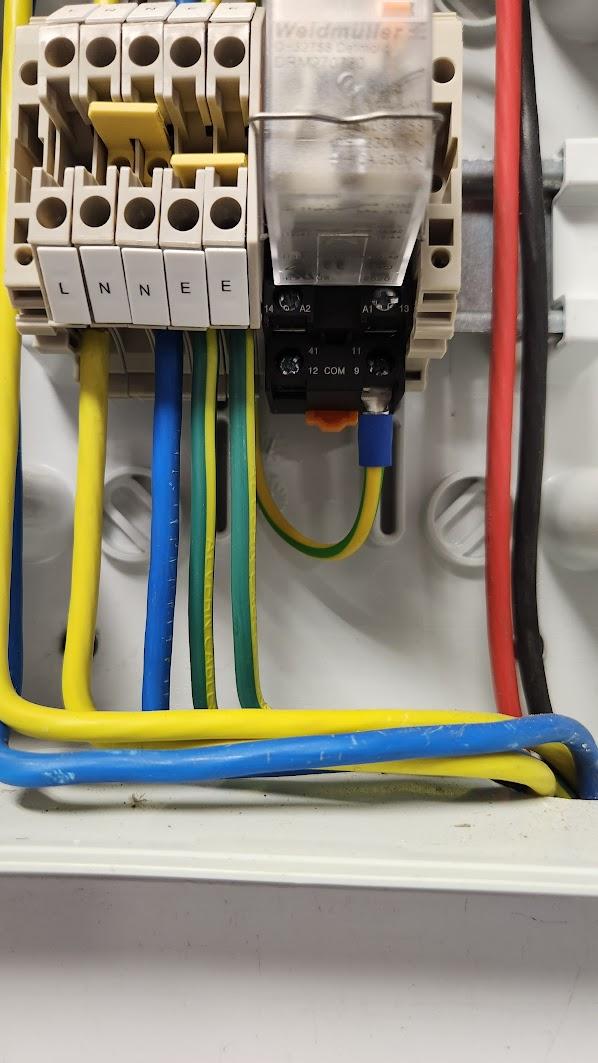
Ok. Reading up a bit on this relay, I'm now convinced this installation is a f up. Either: 1) the eskom grid L/N need to be connected to the relay (A1 and A2) with the black wire (blue lug) on connector 1, or 2) the relay is powered from the inverter ATS240 pins, with the the black wire (blue lug) on connector 5. On my installation nothing is connected to the relay to energize or de-energize it, so it cannot make a N/E bond when eskom drops. Why the installer connected the grid to 5 and 8, I have no idea.
-
Two more photos, one from the top, the other from the bottom. To me this wiring does not make any sense. I mean, when the relay/contactor closes, it needs to create a bond between the E and inverter N. From the bottom view there is no N connected to relay, so where/how is this bond made when the grid falls away? Does anyone maybe has a photo of how this box looks prewired, i.e. off the shelf. From the wiring diagram it states that grid L should be on no 4 and grid N on 5. This also doesn't make sense to me. How does 4 and 5 work together?


-
Hi Cab someone that understands this contactor please check if mine is wred properly? Blue/yellow is from inverter and red/black from grid. I'm trying to follow the wring diagram, but not sure. And installer isnt pitching. Many thanks.

-
Hi. SoI bought a new multimeter (still cheapie, not Fluke) nd get the similar readings as before. Also the values change significantly when I switch around teh pos en neg leads. For example, with black lead on N and red lead on E, I get 0 V. When I switch the leads around, I get 90 V? This is during loadshedding. During normal operation when Eskom is online, all reading are as expect, and even with leads switched around.
-
What type of cable is used to supply and return the power between your db and inverter over the 15m? Is it 2 seperate 2 core cables, or one 4 core surfix cable?
-
Thanks. I will try to borrow or buy another multimeter, and revert.