


Tinbum
Members
-
Joined
-
Last visited
Everything posted by Tinbum
-
The JK BMs has comms.
-
Battery charging should not just be controlled by battery voltage. The BMS takes into account individual cell voltages, cell temperatures, charge currents, discharge currents etc etc. I think this thread has shown the information in the inverter lies.
-
Lots and personally I think it's dangerous not to use it. The manufactures don't put communication in their bms's just for fun. It is the first line of defense in protecting a battery. I use communication and I've never had a single over voltage or any error on any battery. The case here, I believe, is a faulty inverter and I think even with manual settings the batteries would have gone over voltage.
-
I noticed from your postings that you had the inverter repaired some years ago. Perhaps it's something to do with that? I wonder if they require calibration and that wasn't done?
-
I'm pretty sure it's because your inverter isn't following what the bms is requesting. I don't have your inverter but know you could set it with manual settings rather than communicated settings. That does have disadvantages though. As your setup looks to have had this problem for some time, maybe from installation I'd leave it alone until you've spoken to your installer. They should be the one sorting it and the last thing you'd want is them saying it because you've altered settings.
-
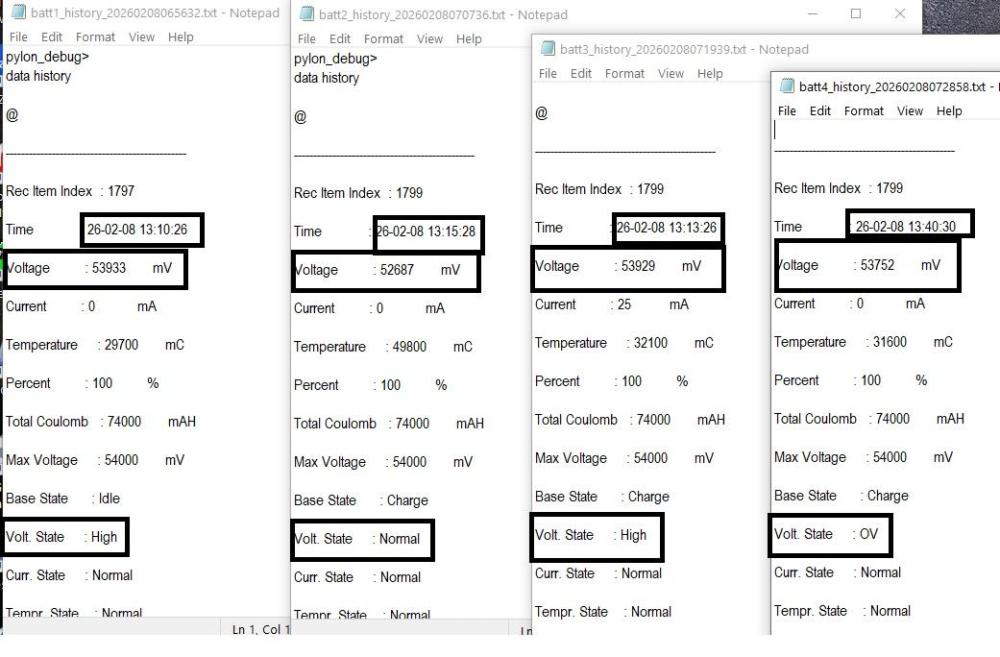
That is actually OV not 0V standing for "Over Voltage".
-
Don't agree with AI that your BMS has failed- that's wrong. Not even looked at any other things it says. Just had a very quick look at the logs and the main think that is obvious is;
-
I don't use SA. Where does it get its data from? I'm suspecting the inverter. Your graphs dont show the voltage going up to 54v but the batteries do. Could the inverter be misreading voltage? Probably. It may well be worth just putting a voltmeter on the batteries to clarify. I think I would be going back to the installer saying you suspect the inverter has a voltage reading/control fault and has ruined your batteries.
-
I seem to remember earlier on in this thread noting something about the firmware and new batteries that seemed to have reverted back to the old chips. edit- it was here; https://powerforum.co.za/topic/31125-brand-new-pylontech-us3000c-syserror-system-error-4096-alm-led-on/#findComment-212158
-
All the cases of swollen batteries need to be looked at properly. If a battery is subject to excessive voltage it is not surprising if the battery suffers swelling. If the battery is requesting 53.2v but the inverter isn't and is supplying more then should the battery manufacturer replace it under warranty? In many cases it appears it is an inverter problem. If I had that problem and was wanting a warranty replacement then I would approach it two ways. 1 try to claim new batteries from the inverter manufacture due to failure of the inverters voltage control. 2 Claim from Pylontech because of their bms's inability to physically protect the cells from overvoltage. Regarding cell balancing I've never experienced any problems with cells going out of balance, and I don't think you would in a well designed/ specked system.
-
That was all ready discussed here in my second post;
-
A good example of why I don't use AI. The example highlighted being taken from wrong information given/suggested on this very forum!!! Question- Have SunSynk 8kW users reported battery voltage going too high? Yes — there are reports from users of SunSynk systems, including 8 kW models, where the battery voltage appears to go unusually high or triggers over-voltage faults, though it’s not clear how widespread this is. Here’s what’s been discussed by installers and owners online: 🔋 User/Community Reports1. DC high voltage fault (battery) Some SunSynk users have reported seeing a DC over-voltage fault (e.g., F55 / DC_VoltHigh_Fault) where the battery voltage spikes above expected limits — one example was a reported jump to ~62.6 V on a system with a BMS over-voltage set at 56.8 V. The inverter logged an over-voltage fault but then recovered. 2. Reports of potential overcharging with certain battery brands In forum threads, users hypothesize that certain combinations — SunSynk 8 kW inverters with Seplos-based BMS batteries like some Pylontech or Shoto packs — may allow the battery to be driven to high charge voltages that risk exceeding safe cell charging levels. One long-running thread suggests this may be a real issue rather than just user error, though there’s no official confirmation. (https://powerforum.co.za/topic/17822-sunsynk-overcharging-batteries-pylontech-shoto/?utm_source=chatgpt.com)
-
Glad you find it a lauging matter! How about an actual apology for saying things like 'Here is a more concise version as it seems you are having trouble understanding what the issue is.' That was my first post in this topic! And your post;
-
You only have to look at; Pwr OV Times : 6923 Pwr HV Times : 15041
-
Quote at the bottom of AI. "AI responses may include mistakes. Learn more" We have already seen his batteries at 54v in earlier posts.
-
It has everything to do with incorrect charge voltage. The battery requests a max charge voltage and if the inverter doesn't follow it then the fault is with the inverter. They always recommend the master battery being the battery with the latest Firmware. Pylontech have changed the max voltage requested from 53.2v to 52.8v so he is better off going with the latter as his inverter seems to overrun and having the lower value may help to protect the other batteries slightly. Limiting the amps to 90A will do nothing as at near 100% SOC the amps are way less than that anyway and the battery will limit them to a lot less that that. I'm certain they will say the cell has been damaged because the battery has been subjected to over-voltage- it's not the battery causing the over voltage. The cell over voltage is a result of the battery over voltage. Pylontech are normally ok with their warranty claims when it is a battery fault but I can't see them accepting this as one. I don't need to use AI to see results.
-
I think you are really going to struggle to get any warranty for the battery(s) as the log is showing many over-voltages of 54v. The fact that they are limited at 54v is probably that the battery bms has shut off at that voltage. Regarding current settings- the bms sends those to the inverter to limit them to what the battery can charge or discharge. If I recall it's normally a max of 37A per battery and for charging it tapers down as the battery becomes full. You screen shot shows 148A which ties up correctly. Setting lower values though may help the longevity of the batteries. Regarding SOH- a set of mine, that I do use quite hard, are at 96% but that's after 5 years. The ones that have a lighter usage are at 98%. Battery capacity setting shouldn't really have any effect on anything. You SOC should be the value from the battery and not any inverter calculation.
-
Could you post a log for one of the other batteries? edit, are you using a latest firmware battery as the master?
-
That should be the case but his cells were showing 54v so clearly something is wrong.
-
52.8v is the newer firmware setting.
-
They should all be identical. 3 of your batteries are showing 54v and the problem battery is less. You have a setting on your inverter of a float voltage of 55.2v which is way too high if the inverter is following that. If it being controlled by the bms then the max voltage you should ever see is 53.2v or 52.8V. You should look at the battery logs to see how many over voltage errors their have been. Above 55vthe battery will suffer physical damage and shut off.
-
Their is something wrong if all the screenshot are taken at the same time as the overall voltages are different.
-
My first impression is that you are charging to a too high voltage!! Your overall voltage looks to be 54v. Max Pylontech will request is 53.2v or 52.8v depending on firmware.
-
I'm not sure why you have a hub in there, you don't need it. Also probably worth updating the firmware in the US3000C's as that will reduce the max charge voltage requested from 53.2v to 52.8v.
-
Good detective work!!

