slipx
Members
-
Joined
-
Last visited
Everything posted by slipx
-
Hi @MikeBham I'm not seeing that. INFO ESPHome 2026.6.5 INFO Loaded validated config cache for inverter.yaml, skipping validation. INFO Starting log output from inverter.local using esphome API INFO Successfully resolved inverter.local in 1.097s
-
Hi. Only a maximum of 2 at the moment
-
V7.2.0 ## What's Changed 🚀 Exciting New Features * feat: add custom labels for daily charge and discharge closes #637 * feat: add custom labels for autarky and ratio * feat: add Chisage inverter image closes #769 * feat: add SRNE HES inverter image closes #732 * docs: add ecoflow example by @windmueller in https://github.com/slipx06/sunsynk-power-flow-card/pull/756 * docs: sigenergy.rst: Simplify text by using links by @reedy in https://github.com/slipx06/sunsynk-power-flow-card/pull/762 🐛 Patches & Bug Fixes * fix: essential_load4_extra entry in sigenergy.rst closes #773 * fix: load 6 not clickable and unecessary rendering of static icons closes #764 * fix: missing defaults in editor * fix: sungrow dispatch run code #739 * fix: localisation of custom labels when using defaults * fix: typo in OnGrid Status by @Roving-Ronin in https://github.com/slipx06/sunsynk-power-flow-card/pull/758 **Full Changelog**: https://github.com/slipx06/sunsynk-power-flow-card/compare/v7.1.3...v7.2.0
-
Hi @MikeBham its probably a config issue. You can display up to 2 batteries. Make sure you define battery 2 options as well as entities. If you need assistance have a look at the documentation https://slipx06.github.io/sunsynk-power-flow-card/index.html
-
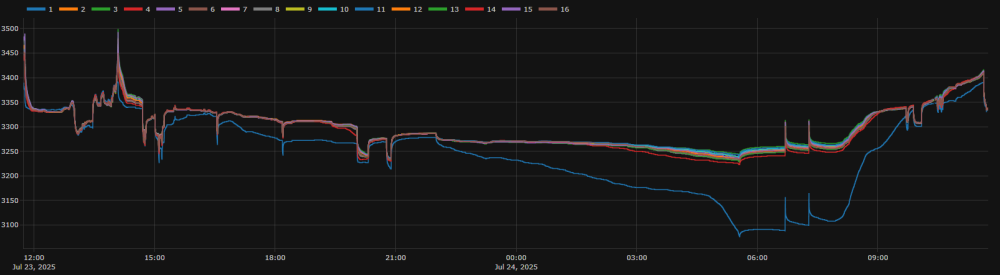
@-cK- Sure. Here you go type: custom:plotly-graph title: Battery 1 Cell Voltage hours_to_show: 24 ha_theme: true refresh_interval: 10 entities: - entity: sensor.battery_pack_1_cell_01_voltage name: 1 - entity: sensor.battery_pack_1_cell_02_voltage name: 2 - entity: sensor.battery_pack_1_cell_03_voltage name: 3 - entity: sensor.battery_pack_1_cell_04_voltage name: 4 - entity: sensor.battery_pack_1_cell_05_voltage name: 5 - entity: sensor.battery_pack_1_cell_06_voltage name: 6 - entity: sensor.battery_pack_1_cell_07_voltage name: 7 - entity: sensor.battery_pack_1_cell_08_voltage name: 8 - entity: sensor.battery_pack_1_cell_09_voltage name: 9 - entity: sensor.battery_pack_1_cell_10_voltage name: 10 - entity: sensor.battery_pack_1_cell_11_voltage name: 11 - entity: sensor.battery_pack_1_cell_12_voltage name: 12 - entity: sensor.battery_pack_1_cell_13_voltage name: 13 - entity: sensor.battery_pack_1_cell_14_voltage name: 14 - entity: sensor.battery_pack_1_cell_15_voltage name: 15 - entity: sensor.battery_pack_1_cell_16_voltage name: 16 layout: showlegend: true hovermode: x unified height: 500px yaxis: tickmode: auto nticks: 20 fixedrange: true legend: bgcolor: rgba(0,0,0,0) itemsizing: constant font: size: 11 defaults: entity: show_value: false hovertemplate: "%{y}" line: width: 1.5
-
v7.0.0 Latest What's Changed🚀 Exciting New Features Performance & Efficiency OverhaulThe card's performance has been optimized to feel more fluid, responsive, and efficient. Smoother Visuals: The user interface now groups updates together, resulting in smoother animations and a less "jerky" experience. Smarter Updates: The card now actively monitors only the devices and information visible on screen, significantly reducing unnecessary processing. Optimized Rendering: Significant changes have been made to how visuals are rendered. This includes a much faster method for displaying icons and "guarding" complex interface parts so they are not re-drawn unless something changes. Faster Initial Load: By pre-computing settings and caching visual templates, the card now loads much faster after the first time. Conserved Resources: The card now pauses animations and data updates for off-screen elements or powered-off devices to save processing power. Editor Experience ImprovementsThe editor has been updated to be more intuitive, helpful, and clean. More Guidance & Clarity: Helper text has been expanded throughout the editor to better explain what each option does. Fewer Errors: The editor now sets limits on number fields, helping prevent invalid or out-of-range values. A Smarter, Dynamic Interface: The editor is now more intelligent, hiding or showing certain options based on other selections. This keeps the interface clean and focused on what's important. Improved Color Selection: The color pickers are now more reliable and show a live preview of your chosen colors, taking the guesswork out of customization. Full Changelog: v6.9.2...v7.0.0
-
This is in my sensors.yaml file but I'm using the Open-Meteo Solar Forecast integration. If you are using Solcast the change required is in the last post https://github.com/dbuezas/lovelace-plotly-graph-card/discussions/422 Remember to update your sensors - platform: template sensors: energy_production_today_sum: friendly_name: "Energy Production Today Sum" unit_of_measurement: "kWh" device_class: energy value_template: >- {% set sensor1 = states('sensor.energy_production_today_2') |float %} {% set sensor2 = states('sensor.energy_production_today_3') |float %} {% set total_watts = sensor1 + sensor2 %} {{ total_watts }} attribute_templates: watts: >- {% set sensor1 = state_attr('sensor.energy_production_today_2', 'watts') %} {% set sensor2 = state_attr('sensor.energy_production_today_3', 'watts') %} {% set ns = namespace(output={}) %} {% for time, value in sensor1.items() %} {% if time in sensor2 %} {% set sum_value = value + sensor2[time] %} {% else %} {% set sum_value = value %} {% endif %} {% set ns.output = dict(ns.output, **{time: sum_value}) %} {% endfor %} {% for time, value in sensor2.items() %} {% if time not in sensor1 %} {% set ns.output = dict(ns.output, **{time: value}) %} {% endif %} {% endfor %} {{ ns.output }} wh_period: >- {% set sensor1 = state_attr('sensor.energy_production_today_2', 'wh_period') %} {% set sensor2 = state_attr('sensor.energy_production_today_3', 'wh_period') %} {% set ns = namespace(output={}) %} {% for time, value in sensor1.items() %} {% if time in sensor2 %} {% set sum_value = value + sensor2[time] %} {% else %} {% set sum_value = value %} {% endif %} {% set ns.output = dict(ns.output, **{time: sum_value}) %} {% endfor %} {% for time, value in sensor2.items() %} {% if time not in sensor1 %} {% set ns.output = dict(ns.output, **{time: value}) %} {% endif %} {% endfor %} {{ ns.output }} energy_production_tomorrow_sum: friendly_name: "Energy Production Tomorrow Sum" unit_of_measurement: "kWh" device_class: energy value_template: >- {% set sensor1 = states('sensor.energy_production_tomorrow_2') |float %} {% set sensor2 = states('sensor.energy_production_tomorrow_3') |float %} {% set total_watts = sensor1 + sensor2 %} {{ total_watts }} attribute_templates: watts: >- {% set sensor1 = state_attr('sensor.energy_production_tomorrow_2', 'watts') %} {% set sensor2 = state_attr('sensor.energy_production_tomorrow_3', 'watts') %} {% set ns = namespace(output={}) %} {% for time, value in sensor1.items() %} {% if time in sensor2 %} {% set sum_value = value + sensor2[time] %} {% else %} {% set sum_value = value %} {% endif %} {% set ns.output = dict(ns.output, **{time: sum_value}) %} {% endfor %} {% for time, value in sensor2.items() %} {% if time not in sensor1 %} {% set ns.output = dict(ns.output, **{time: value}) %} {% endif %} {% endfor %} {{ ns.output }} wh_period: >- {% set sensor1 = state_attr('sensor.energy_production_tomorrow_2', 'wh_period') %} {% set sensor2 = state_attr('sensor.energy_production_tomorrow_3', 'wh_period') %} {% set ns = namespace(output={}) %} {% for time, value in sensor1.items() %} {% if time in sensor2 %} {% set sum_value = value + sensor2[time] %} {% else %} {% set sum_value = value %} {% endif %} {% set ns.output = dict(ns.output, **{time: sum_value}) %} {% endfor %} {% for time, value in sensor2.items() %} {% if time not in sensor1 %} {% set ns.output = dict(ns.output, **{time: value}) %} {% endif %} {% endfor %} {{ ns.output }} energy_production_d2_sum: friendly_name: "Energy Production D2 Sum" unit_of_measurement: "kWh" device_class: energy value_template: >- {% set sensor1 = states('sensor.energy_production_d2') |float %} {% set sensor2 = states('sensor.energy_production_d2_2') |float %} {% set total_watts = sensor1 + sensor2 %} {{ total_watts }} attribute_templates: watts: >- {% set sensor1 = state_attr('sensor.energy_production_d2', 'watts') %} {% set sensor2 = state_attr('sensor.energy_production_d2_2', 'watts') %} {% set ns = namespace(output={}) %} {% for time, value in sensor1.items() %} {% if time in sensor2 %} {% set sum_value = value + sensor2[time] %} {% else %} {% set sum_value = value %} {% endif %} {% set ns.output = dict(ns.output, **{time: sum_value}) %} {% endfor %} {% for time, value in sensor2.items() %} {% if time not in sensor1 %} {% set ns.output = dict(ns.output, **{time: value}) %} {% endif %} {% endfor %} {{ ns.output }} wh_period: >- {% set sensor1 = state_attr('sensor.energy_production_d2', 'wh_period') %} {% set sensor2 = state_attr('sensor.energy_production_d2_2', 'wh_period') %} {% set ns = namespace(output={}) %} {% for time, value in sensor1.items() %} {% if time in sensor2 %} {% set sum_value = value + sensor2[time] %} {% else %} {% set sum_value = value %} {% endif %} {% set ns.output = dict(ns.output, **{time: sum_value}) %} {% endfor %} {% for time, value in sensor2.items() %} {% if time not in sensor1 %} {% set ns.output = dict(ns.output, **{time: value}) %} {% endif %} {% endfor %} {{ ns.output }}
-
Hopefully it was stored correctly. You should probably try charge it ASAP. I wonder what the SOC and SOH will be?
-
Hi @Gambit I'm running this python script on a raspberry pi https://github.com/Tertiush/bmspace/tree/main/pace-bms-dev
-
Battery 2 was sent in for repair. When it comes back I need to sort out battery 3. Cell 1 is not holding voltage.
-
You will need to buy the cables separately as they don't come with the battery. You will also need the RJ45 for battery comms
-
Pleasure. Out of interest do you know when that sunsynk battery was manufactured that you bought from Voltex . I heard they were trying to clear old stock.
-
https://www.jendustries.co.za/sun-batt-lv
-
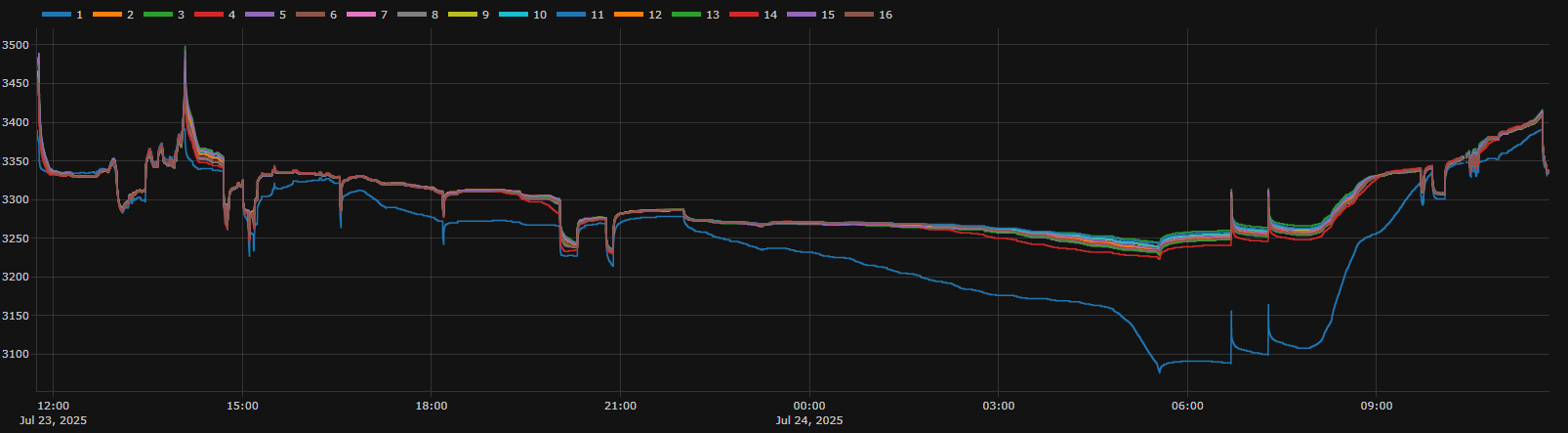
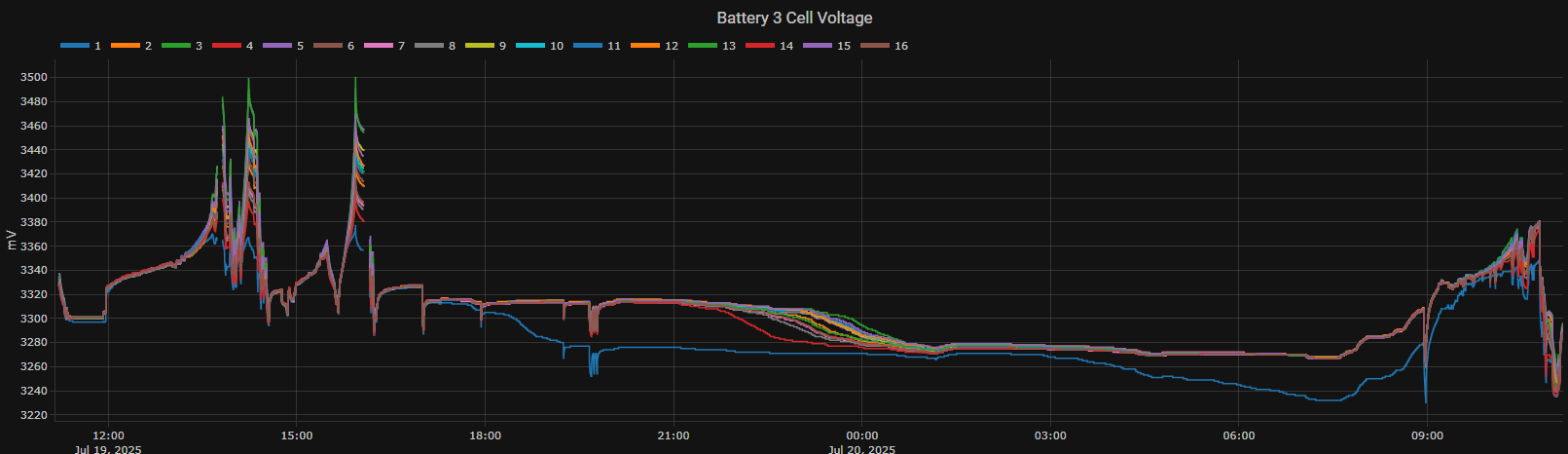
Apart from the weak cell 14 on battery 2, looking at all the batteries over a 24 hour window I've noticed that cell 1 on the third battery is also always below the others. Its this something to be concerned about and is it a sign of a weaker cell? Does not cause the battery 3 SOC to deviate much?


-
There is no active balancing on the BMS and I was not able to correct that cell even after lowering the balance threshold.
-
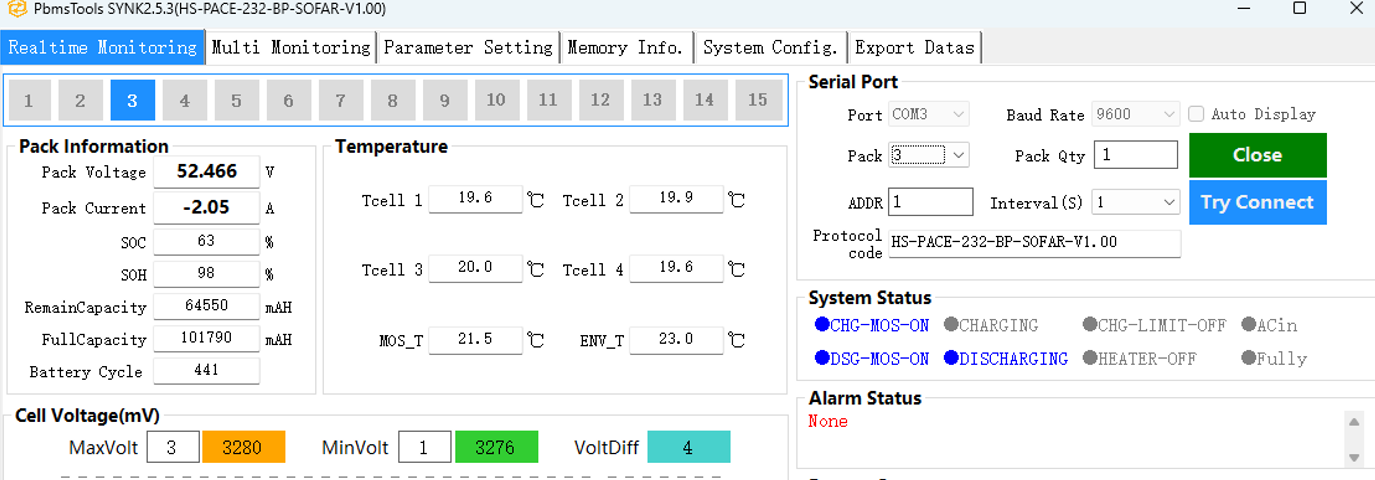
Checked PBMS Tools and the balance threshold is set to 3.4v and the balance cell voltage delta is 30 (less than my current reading of 42). I'm assuming it will use a combination of these two settings to balance. Set the balance threshold to 3.32 and now all the cells are balancing except the "weak" cell. Will see how it goes overnight.
-
I have access to PBMS Tools and yes they do use Pace. I'll post a screenshot and maybe you can help guide me
-
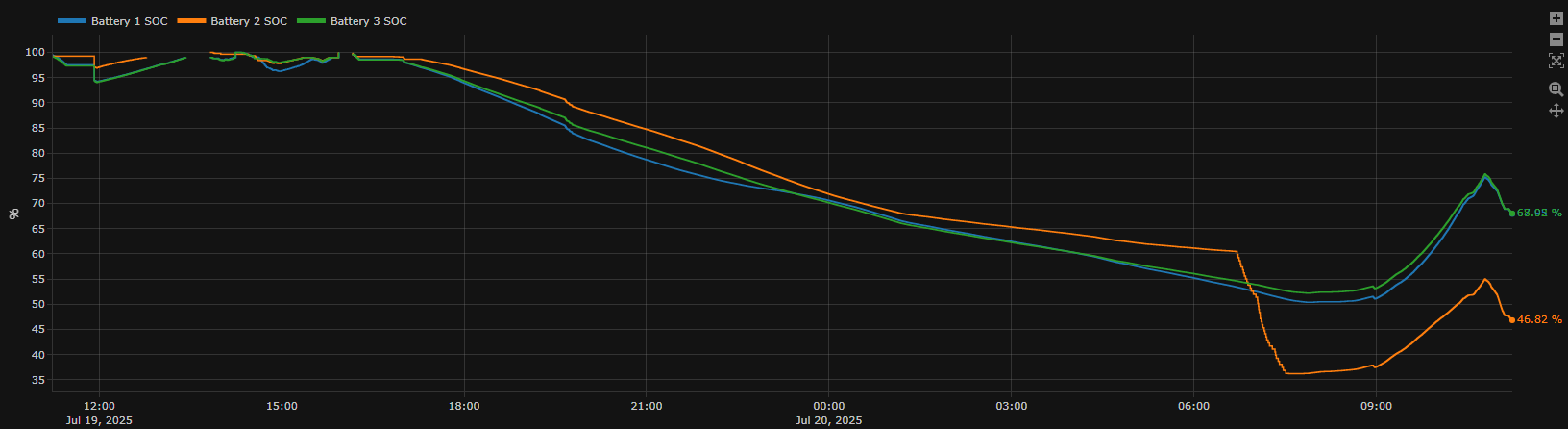
What's the best way to diagnose/repair this cell (green line) that does not want to come to the party. Its one of three Sunsynk batteries. I've been keeping them fully charged to try correct the unbalance. Is it worth removing the other two batteries and charging this on its own and then cycling? I noticed this because my batteries would force charge from the grid early in the morning and you can see the reason below when that cell voltage drops to 3V. My initial thoughts are it must be faulty and I have no choice but to book the battery in for repairs and wait the 6 weeks? You can see how the SOC rapidly dops and increases with the grid charge


-
Yes that makes more sense. It also becomes very complex trying to do all the calculations on multiple batteries. When people ask for extra toggles or info that's not part of the default card I usually suggest the stack in card
-
What battery are you connecting to.? I got the same error trying to connect to my Sunsynk 5.32 batteries when using only the pins 1,2 and 3. It worked when I joined the wires together i.e. 1 and 8 , 2 and 7, 3 and 6.

-
The cheapest 48kg swap out with delivery that I could find in JHB Northern Suburbs is R1600. Where do you get it for R1250?
-
Yes

-
The installer updated.
-
We’ve just added an Eenovance battery to a system with two Sunsynk batteries. The new battery is the master. Apart from the battery looking different it is working 100%. The older Sunsynks had their BMS updated before the new battery was added.
-
You can read it directly from the battery using the RS232 port. Needs a cable and PbmsTools.