onobeka
Members
-
Joined
-
Last visited
Everything posted by onobeka
-
Thank you Coulomb!
-
Question for the ones who have reversed the airflow: did you notice a significant reduction of the temeperature as reported by the inverters? Mine are Easun iGrid Sv4. They have the dust filters at the top, which do a good job. Afrer two years I opened them to blow the dust out, but there was not much dust. Mine are also in a garage/workshop which is dusty by design. This prevented me to reverse the fans so far. However, I added a third one and the space where the inverters are located became pretty packed. From the logs I have in HA, during the night they run at 33C while during the day they can get to 50C. I am running an aircon in the garage and the temp is generally 22C.
-
Indeed, it does not make a difference. Meanwhile I can sell to grid so I've tuned my automation such that I am always selling a little bit and consuming the rest via the safe margin of 0-500W that goes to the grid. For the other issue, I've set the inverter back to 2A charge, briefly, when I see that it's set to max (80A in my case, although maximum would be 120A) and the battery is discharging. This way, it will start again going to 10, 20, 30 ... 80A.
-
I would have expected that the AC charge would behave the same as the solar charge, trying to keep the battery at float, but it clearly does not. Maybe it is related to the fact that the inverter in the discussion(which does not have any PVs) is set as “Solar first” for charging mode?!?. I can set it to “Solar and utility simultaneously” to see if it makes a difference.
-
Thank you Coulomb! Indeed, SA recognizes it as an Infini inverter. I can continue like this. I do understand that with a Growatt SPF (5000 or 6000) ES it would be possible to set the max charge current in increments of 1A, yet that would be again a hassle to integrate and I am pretty sure I may reach another inconvenience. Speaking about inconvenience, I've noticed something else that looks a bit weird. With the current setup, when the battery is near full or full, even if the max charge current is set to 80A, the inverter can push as much as the battery accepts, for example: 7A. At some moment the battery starts to discharge, because the sun starts to set, however the inverter will remain stuck at 7A charge, while the max is still 80A and the battery is 90%, of course the battery voltage dropped as well to 50V while the bulk/float are set at 52V (15s 940A battery mix of 3xus5000 and 2 DIY 320A MB31 cells with JK BMSes). Now, if I would stop/start the inverter, after a restart it would go back to 80A. Or, without the stop/start if I set the max charge to 2A (lower than the 7A) and then back to a higher than 7A, let's say 50A, it would charge again with 50A. This is solvable via a Home Assistant automation, of course. Still, I find it strange.
-
Hello, I have a different type of inverter, the Easun iGrid SV-4 and I am trying to set programmatically the maximum grid charge current. I can do so via Solar Assistant by using MQTT yet I am still bound to the dreaded: 2,10,20,...120A fixed values. I would like to be able to set these values with finer grain. I've tried SolarPower and WatchPower and in there the dropdowns are still bound to those fixed values, however when a change is operated through the LCD menu, the change is gradual with some random intermediate values, which are displayed also in the applications. So, if I would go the ESPHome route, provided that it would work for my inverter as well, is there a chance to set an integer value between 2 and 120A without being forced to stick to the predefined values? Thank you very much. I am using this inverter as a controllable power supply to charge the battery from the grid (a grid-tied inverter) in order to consume all production and feed less to the grid.
-
Does anyone know what the new version brings in terms of bug fixes? My two inverters (Easun iGrid SV4s) are running 76.01. I am tempted to update to 76.03 provided that there are benefits, given the risk of bricking the inverters. Maybe something like the premature float issue?
-
Hello, I have currently three Pylontech us5000 moduels that work fine with the Voltronic copy of the inverters (Easun) or Solar Assistant. Since I've moved away from PYL mode (as I cannot change the voltages), I run my battery bank in USE mode with lower voltages (52/52.5V). Also I have two inverters in parallel and in PYL mode, one would complain about not seeing the battery (I only have one BMS cable coming out of the batteries). Soon I will be building a DIY battery, 15S and I need to choose a BMS for it. I will add it in parallel with the Pylontech bank. I am hesitating between JK (active ballancing) and Seplos. I do not envision communication with the inverter yet it would be nice to be able to connect the second battery to Solar Assistant. As the interface looks like, this would not be possible as I can select just one battery model there. Is there a BMS that would map on the Pylontech protocol, or the other way around? I also have Home Assistant, so the other option would be that I would see the new BMS directy in HA (where I also see the Pylontech via Solar Assistant and MQTT). Do you have another suggestion? Thank you!
-
Alright, the battery was replaced. I've charged the first module to 100% (as the others also were), to get to the same voltage and I will set them in parallel. There's almost no difference in between cell voltages of the new module (0.014V) at 100% and no temperature increase. Thank you very much for all your support!
-
MeDat, I know that they are buying time, they’ve said though to try that and if the phenomena is still there they will change it. So, I’ve sent new logs on Friday and yesterday. Obviously, nothing changed. I will wait for their answer next week. Until then, I am back on 51.7V float and 52V bulk. There was no balancing today, not that it needed to, voltages remained aligned. However, the BMS temperature spiked again to 38.5C. I have no idea why. It seems there are two issues with that module. I hope they will replace it.
-
Yes, now they are back on 53.2V (PYL) mode. I am hunting now
-
I guess, they want to try to escape replacing the battery. Less hassle for them, more for me. Anyway, I've changed it and I wait for the phenomena to happen again, now in pack #2 :).
-
They've asked to make this battery a slave and move it in the rack, to check if the temperature issue still happens. To me this is pointless as the temperature is a consequence of the overvoltage. In case the phenomena remains they said they will replace it. I've tried to make them realize this is irrelevant. So, I guess I need to put in some elbow grease. For now, I've lowered the float to 51.8V and bulk to 52V to see how it behaves. At 51.8V the balancing is active and that cell is not overshooting.
-
And here it is, this time there's no doubt. It is Over voltage.


-
Thank you MeDat, that is probably correct, there are no errors stored. Today I might have a chance to catch the event of 3.6+V with some logs.
-
Maybe I am, indeed. I do not like that transitory regime and it’s clear that it must not be this way: the other two modules.
-
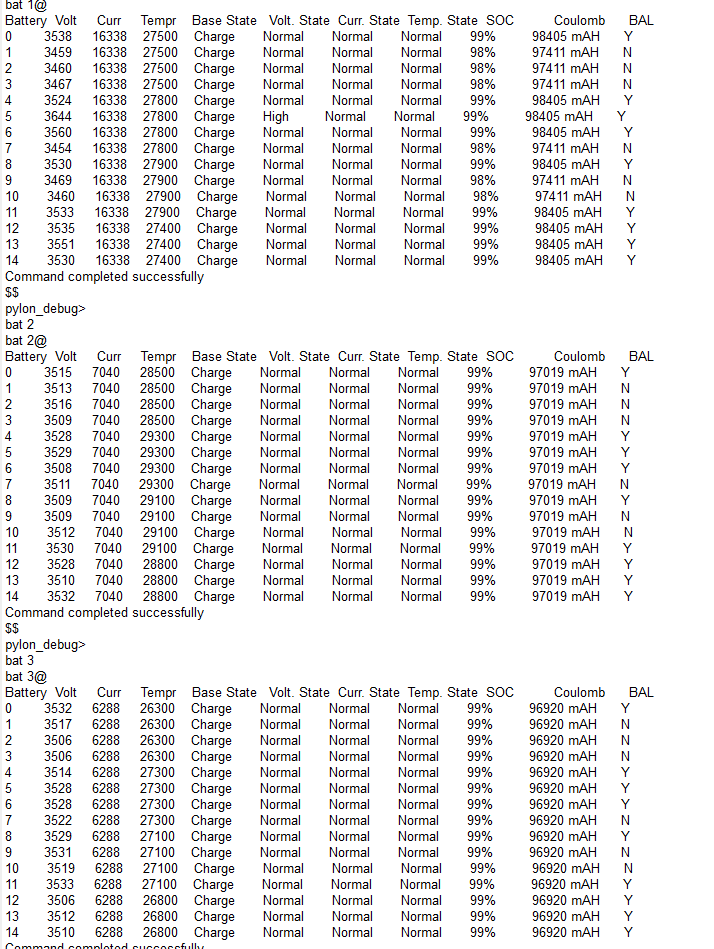
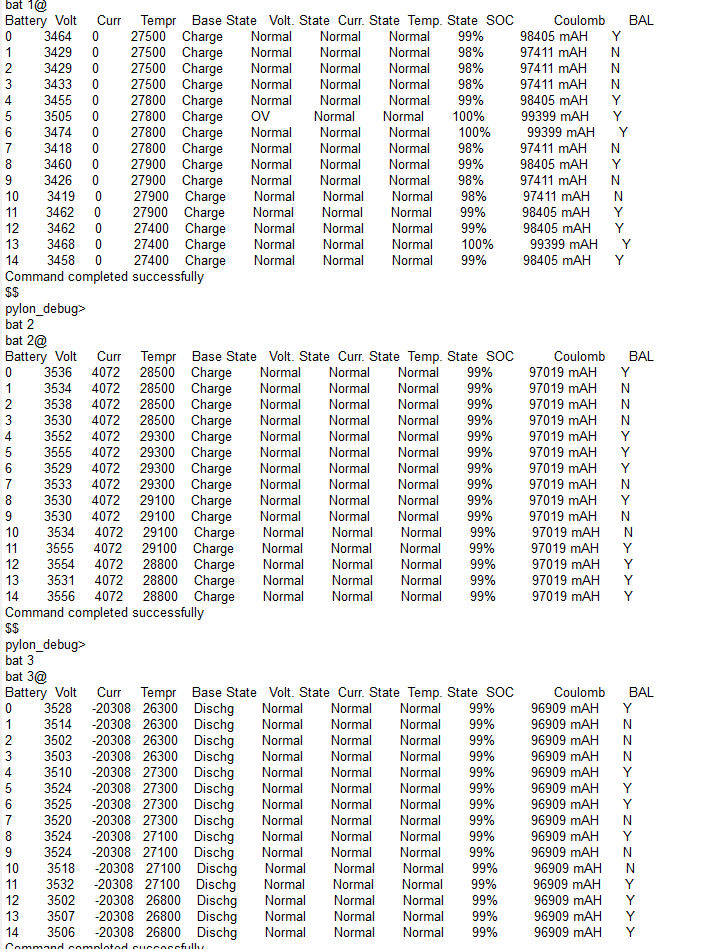
Ok, so I discharged them a bit: And starting charging them back, you can see cells flagged with "Y" on balancing: 3mins later: Another 3mins later: 3mins later, once more: And ...3 mins later, balancing has stopped. Probably I would need to catch a deeper discharge (next day) and catch the moment I am interested in, when one or more cells go to 3.6V+.


-
@MeDat, thank you! Here is some information. The charging is already completed, I did not catch the 90-100% SOC. So it seems the balancing not active right now. I need to be on guard when the drift happens and check then.


-
Here si a picture of a lower module voltage: and another one:


-
Tinbum, l’ve answered that already. Check the pictures if you want to see the exact voltage of the module when a cell is 3.62V. Otherwise, if I run the maximum voltage at 53.2 or 52.5V, one (or more) cells will still go to 3.6 or beyond. It does not matter!!! Why do you insist to go back and learn how lithium cells work? Where did I give the impression this is not known by me?
-
Regardless if it is 52.5V or 53.2V. Since the modules are in parallel and the overall voltage rises, the module in question has to raise the voltage too. I believe pylontech did a lousy job of matching cells. Because some cells in the module are raising their voltage slower, some others take the penalty and have to go to 3.62V. Those cells seem also “gutted” as they will stay at 3.46-3.47V for those 15-30min and then suddenly go to 3.53V. Check the pictures in the first post once more with this in mind, you will see it. Bellow 3.45V the cells are also balanced with that delta of 0.02V or less. Something happens above certain voltage. So, if I would run them at 51.75V or less probably I will not see this behavior. Yet, that means no balancing as the balancer starts at 3.45V. Pylontech support said yesterday that they’ve passed my case to R&D and they’ve asked if there is a heating source next to the modules. I run my batteries in my garage, which is unheated. Thus, I insulate the rack and run some terrarium film heaters (20W) each to keep them at 23C when they are not charging, when needed. Spring-autumn I remove the insulation and heating, they operate at 18-27C.
-
That’s what happened since the moment I got the new battery in October 23 and that is what is happening now. The winter was pretty dark, so there was not much chance of charging. Since february the battery is at 100% daily at noon with 4-5h of floating at high voltage, either 52V like before (use mode) or 53.2V like the last two weeks in pyl mode. Yes, some balancing takes place, but it seems to be brief and the next day the event of cells drifting is present again and again. Some cells in the first module will see every single day for 15-30min voltages of 3.62V while the others will linger at 3.47V. After that period all cells will be in 3.55-3.53V for a total of 53.2V. During that period, the module temperature also rises to 40C from otherwise 25C. This never happened for the other modules. However their cells will still be in 3.55-3.53V, no not perfectly balanced either. Maybe the issue is misunderstood. My issue is with that voltage drift and high module temperature. This cannot be good if it happens every single day, right? So, at the end of the day we can say that they are balanced if we accept that 0.02V differences means balanced. Then you say: keep them for hours or days at 52V float, yet charge only from solar. How could this work if the batteries will discharge over night?!? Maybe you mean to use the inverter is SUB mode (not SBU as currently) or to charge from the grid or to shut down the batteries ocer night. I appreciate your intention to help. Thank you!
-
Doing it for days while the battery is in service means, charging also from grid, right? I am only using OSO(only solar). Or, otherwise disconnect the battery and use a DC charger. I see the current limiting every day when they go beyond 90-ish% SoC. I have no way to know what the BMS it’s saying other then what I see in SA or … if I woul connect a laptop to the battery, which I am doing at best once a few months if I get stressed again over this issue.
-
I am not following. You’ve said the same thing as I did wrt. BMS limiting the current. Please read again. Wrt. Victron equalization, it’s exactly as I’ve said. I can ask it to do equalization at 54V when the batteries are already at their claimed 100% at 53.2V. So, they will go to 54V which means the cells will still absorb some power, mainly voltage, not much current as they are lifepo4. This means that the BMS will still allow some form of charging above what it previously stopped. I know it is pointless charging as the curve is very steep. Maybe I need to force them to 54V for a longer period, like 8h to force equalization. 3.6V is still safe. I did not do this, except a very brief test.
-
I did not set those values. There are the values for each module and also the cumulated values (first table, where it says Recommended ...). The ones for the individual modules are always 100A/100A, that is the battery capacity in fact, us5000 is an 100Ah battery. For the recommended values: I can see though that once the battery is above 90-95% (not always the same level), the max recommended charge current is reduced to 20/10/2A. Sometimes I can see that it's actually respected by the currents that go in the batteries, while other times, it's not. Also I think that is the current per battery, not the sum of the three modules. Also, I have charged the three batteries before with 140A (total), so even the 100A is not respected. I start to believe that the BMS communication with the inverter (which only is in effect in PYL mode) does not control charging, it tells SOC and warnings/errors. In USE mode, the SOC is calculated in the inverter based on the voltage settings but it's not reflecting correctly the battery SOC (which I can see in SA). When the batteries get full, the BMS is limiting the current, but it's not asking the inverter to limit the charge. This I consider normal and without this behavior one could not safely operate in USE mode. I also have a Victron charger connected to the battery bank, in which I can force an equalization mode on the battery. However, it's the BMS who will allow current to go in the cells or not, the SmartSolar charger can only output a certain voltage and sustain a certain maximum current for a period of time. So if the batteries refuse to balance pylontech should change something.