BluePeter
Members
-
Joined
-
Last visited
Everything posted by BluePeter
-
Hi all, I'm in Johannesburg, have a new Solar installation and am looking at putting in a Heat Pump. 8.8kW Inverter, 4 x 4.8kWh batteries, and 14 x 600W panels. 200l Geyser 50l Geyser (occasional use by gardener) Thinking about an Alliance 3.6kW heat pump. On clear(-ish) days I have more than enough energy to heat the main geyser, I turn it on after about 09h30 or so. Takes 2-2.5 hours to heat. When it's raining, I need Eskom to help with power. Another problem is if someone turns on both geysers, while running the pool pump. Then washing machine and kettle and so forth causes too much load, and the inverter trips. I see 5 options: Solar Thermal like Evacuated Tubes - Cost saving is good, higher up front cost ~ R20-30k Solar PV - Newer technology - Cost saving is okay, higher up front cost ~ R20-30k Heat Pump - Cost Saving is excellent, higher up front cost ~ R25k Gas Geyser - Cost Saving is not that good, lowish up front cost ~ R10k Ceramic element - Cost Saving is not that good, very low up front cost ~ R3k Article below shows Heat Pump as the best cost saving. But it's sponsored by a Heat Pump manufacturer. Not disputing the calculations, just taking the source into account. The two Solar solutions work best when it's sunny, and this is when I don't need to save energy. Also, if I run out of hot water on a rainy day, then I'll still be heating with a 3.6kW element. So, I'm thinking... 3.6kW equivalent heat pump - draws 1.2kW, so keeps the load lower. Also take the 3.6kW not 5.4kW equivalent. This is a case when bigger isn't better, I don't care if it takes 2.5 hours to heat the water as long as I'm not tripping my Inverter. Alliance and ITS seem to be the leading Brands. A few plumbers I spoke to say Alliance is the best, just wondering about other's thoughts? Gardener's geyser I'm happy to heat with a normal element, mainly needed on sunny afternoons anyway. It's too far from the main geyser to parallel the two geysers. https://zpenergy.co.za/comparison-of-pv-solar-thermal-gas-and-heat-pump-water-heating/
-
You sure? Their site says R 27,500 for the UP5000
-
Consumer Protection Act If the issue occurred within 6 months of the purchase, then it's your right to determine whether you want to Replace, Repair or Refund. If you choose Repair, and the repair is not successful then the provider may choose to Replace or Refund. I almost always opt for Replace.
-
I bought 2 x UP5000 4.8kWh batteries for R 26,000 each. Solar Solutions. Good prices for genuine items, but not a professional setup. Funny collections, backyard style.
-
Yes, agreed. I expect to break even in 5 years, as we use a lot of power. But if it's 7 years then it's also okay. Energy inflation will be higher than our cost of capital (18% Eskom increase in June!). But there's a lot of other value. Some are monetary: less restaurant bills when I can't cook, being able to work in the evenings when my business needs it, less appliances that blow. Others are lifestyle: watching a family move on a Sunday night, helping kids with homework, ungrumpy wife. Worth every cent of the investment.
-
I have 14 x 600W Canadian = 8.4kWp I'm regularly generating over 7kW at about 11h00. Usually around 7.6 - 7.8 between 12h30 and 14h00. Sometimes getting 8.2kW around 13h00, but difficult to measure as my batteries are charged by then, and the load is much less.
-
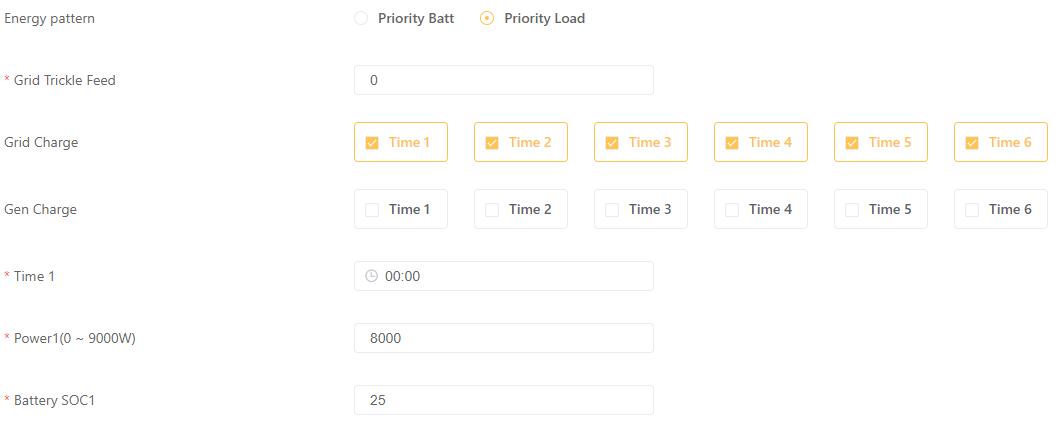
Reviving this topic. I'm assuming the Timer options override this setting... Any thoughts? Anyone?
-
Wow! This is really poor. All they are doing is protecting their revenue, no attempt to solve the energy crisis. My setup I would feed more to them. Significantly more, like >20kWh a day, at the moment. Thanks for the information, I will try to see what Ekurhuleni's policy is.
-
Yes, so 4500 cycles * 4.5 kWh = 20.25MWh. At R 2.89 (now) / kWh that's R 58,500 in saving. Battery is R26,000. Even, 4000 cycles * 4 kWh = 16MWh. At R 2.89 (now) / kWh that's R 46,200 in saving. This is not taking Eskom price increases into account, R3.41 from June...
-
That's interesting... Agree with points 1 and 2. But not sure how batteries lower the ROI compared to not having a battery. I get the round trip cost, storing grid energy in the battery to deliver later isn't really effective. But surely storing free Solar energy and using this instead of the grid is a saving? Am I missing something here? Regarding dumping excess Solar into heating water, are you using Smart Switches for this?
-
We could always insist that visitors bring a fully charged battery! Thanks again.
-
Price on the 3.6kW equivalent heat pump is R2k less than the 4.5 and 5.4 models. It's not material. So the question is to heat faster, but with higher load, or slow and steady. Is bigger / faster always better? A load of 1.8kW compared to 1.2kW is worth it for faster hot water, I guess. Good point about heating water in Winter... didn't think about that. Thanks!
-
Thanks, good to understand your setup. Unfortunately, I'm fairly similar to you, except I generally think less, and just do... To use an apt metaphor, in life I don't test the temperature before getting into the bath. I jump in with both feet, and then deal with whatever I find. But I think there's enough maths in all this to be able to make informed decisions, which is why all this input from others is so valuable. Appreciate the response.
-
It's definitely worth extra thought. At the moment we turn the geyser off (manually, will fix that) around 16h00. Kids shower in the evenings, I'm early morning, the wife a bit later (she goes running at 04h30, not entirely sane). We haven't had an issue with hot water so far. Lot's to think about, that emotional decision to buy still prejudicing my choice... Thanks!
-
Damnit! Already made the emotional decision to buy the heat pump, it's like R16k. Feeling all self righteous that I made the proper decision and now you come along and make a perfectly valid point. Hmmmm. Definitely need to give this heat pump thing more thought... Thanks.
-
Awesome 1. Good point, I'll double check the cable sizes. I don't think it's a problem though, I saw them, they're huge! 3. Any thoughts about Panel angle? 4. Good advice, will set to 15%. Where did you get this data / information that they shutdown around 10%? Generation. Yes, agreed. This is what I'm getting, I'm too new at this to project anything yet! I did see some data that showed big differences in generation in the Cape through the season, but little variance in Johannesburg as the shorter days are offset with absolutely clear days. I'm not making any assumptions yet, but here's the graphs: https://mybroadband.co.za/news/energy/451432-why-south-african-solar-power-systems-can-underperform-in-winter.html And thanks for your input!
-
Afternoon all! We have just installed a new system, and seems that we got most of it right. Now busy learning, and tweaking and finding more stuff to spend money on! Any comments are welcome, my thoughts are to double batteries, add a heat pump, and some automation to optimise when we use the power. Setup 1 x 8.8kW Inverter - SunSynk 2 x 4.8 kWh batteries - Pylontech UP5000 14 x 600W Solar Panels - Canadian We're adding 2 x 4.8 kWh batteries - Pylontech UP5000 1 x 3.6kW Geyser Heat Pump - probably ITS 3 x WiFi smart switches (for pool pump, geyser, and underfloor heating) Observations Base load through the night ~ 500W Increases with morning activity a bit, but not much. Pool pump at around 09h00 adds .75kW Base load during the day is just under 1.5kW Power hogs Geyser adds 3.6kW usually between 2-2.5 hours, doing it manually while still learning the installation. Usually start it between 09h00 and 10h00. We have 1 x 200l that serves the whole family. The load varies between about 4.8 and 5.2 kW. Kettle. Induction Hob. Dishwasher? Washing Machine? Microwave? Occasionally we see an extra 3kW, pushing us to 8kW. What else could draw that much for 15-20 minutes? Daily Load We're averaging about 40kWh per day. About 65% from Solar About 35% from Grid Evening and early morning about 6 hours at 1.5kW Night about 8 hours at 500W So 13kWh of storage needed, call it 15kWh to be safe. Generation We're averaging around 25-30kWh by lunch time over the last week which has had a fair amount of cloud and rain, then batteries are fully charged, geyser is done, and we're easily serving anything that's drawing. So we're getting plenty extra that we're just dumping. Ooops! Max discharge (and charge) rate was set at 40A by the installer. So stuff shut down when we used just under 2kW during load shedding at night. Fixed this, now at 100A. 50A per battery (cos it's parallel). Shutdown was set to 20% capacity and Reset to 20%. Now to 10% and 20%. Thoughts We don't need to be 100% off the grid. To avoid having to pay Eskom a few R100 a month because of rain or cloud is just not worth the extra investment. W're charging the batteries to 50% from the grid at night, for cover 4 hours load shedding. 4.5 kWh (nominal) should be enough if we don't do anything weird. It's not enough for cooking etc. As long as we are still using some grid, then the ROI on a battery is about 5 years. 4.8kWh x R2.89 per day is just over 5 years for a R 26,000 battery. It's clear that two more won't be a waste. At the moment our maximum load during night load shedding is just under 4kW. Sometimes it's a bit tight... We have an Induction hob and a gas hob for cooking. The induction is very efficient, but it can draw serious current for short periods. Like 31A, roughly 7kW! We rarely use it at those levels, but the 4kW discharge needs to be increased as we usually cook at night. Putting in a a heat pump reduces that load from 3.6kW (for 2 hours) to about 1.2kW. Seems like a no brainer, will even allow water heating for emergencies like daughters sleepover parties, wife's mud wrestling, and so forth. We feel that we're generating enough kWh during the day. Seems that we need to address: 1. Storage for the night 2. Power hogs at night 2. Load Questions? 1. Battery setup will take 200A maximum discharge, but this would go over the maximum 8.8kW of the inverter. Is 180A cutting it to fine (48V * 180A) and should we rather set to 160A. 2. Can we just mirror the discharge rate for the charge rate? 3. How many people adjust their panel angle each month / season? I saw a calculation that showed 88° in Summer, down to 40° in winter. Is this significant or not worth the effort? 4. Is 10% right for the shutdown? Should it be higher than 5% or is it okay if the specification for Depth of Discharge is 95%. Do we need some wiggle room here? 5. Is 20% good for Reset? I understand the Reset to be when it powers back up again, and that this should higher than shutdown so it doesn't flap when storage hovers around the shutdown limit. What is reasonable for this gap? 5%? 10%? More? Thank you for making it this far, any other obvious tips, please!