


Elbow
Members
-
Joined
-
Last visited
Everything posted by Elbow
-
yes, that’s how mine ended up hooked up. it’s not perfect because if my grid browns out then the inverter isolates but there is still enough volts to hold in the commutator. but 99% better
-
They are coming tomorrow to install mine. What I will do is turn the oven and and off at one minute interval and see if there is an issue - that big swing in load will be enough to trigger a bit of feed-in while the inverter tries to follow the load swing.
-
For your info my infinisolar inverter allows the neutral to float when it is isolated from the grid and providing power to essentials via the panels or batteries. That is, the inverter does not tie neutral to earth when operating in that isolated mode. (When the inverter is grid tied the neutral on the essentials side is connected to the neutral on the grid side which is tied to earth back at the council connection point so there is no issue there). What I did is that I used a contactor - the contactor coil is powered by the grid mains - so normally the contactor is held on. I have a normally closed contact on my contactor that I put across neutral / earth on the essentials side. So when the mains power disappears the contactor releases and the neutral / earth on the essentials side is connected. Its not perfect since the mains voltage can (and here it does) brown out at the inverter can isolate but there is still enough volts to hold the contactor in. But its better than nothing.
-
My install was DIY. At the time I did mine in 2019 it was my responsibility to prepare circuit diagram, to provide info on the equipment, a COC from an electrician and also a test / signoff report from a Professional Electrical Engineer. I did all that and sent in with the forms and got the commission approval in return. Nobody from the electricity department has ever been here to look. Steve
-
Yes - my commissioning letter contained the same info - I discussed it with @Rautenk at the time. It seems they took a year and a bit to get around to it in my case. Steve
-
I did ask Daniel at SSEG South about switching to a full grid-tied install. Sadly it seems they treat it like a new application and my inverter - which was on the 2019 list - is no longer on the current list so they won't accept the application. So I'm stuck as I am except if I buy a new inverter
-
Good luck with the fun project. I think I was among the first 10 people to get a DIY system all signed off and approved by council thanks for fantastic help here on Powerforum and from some fantastic help from others.
-
That is my main concern. It seems my inverter does quite a poor job of stepping back its generation when the house load goes down suddenly. My existing meter doesn't have this "reverse flow = tamper" option enabled so doesn't care that there is some feed-in (its less that 1kwh / day typically but there can be a burst of say 2kw if a heavy load like oven or geyser goes off suddenly. You don't have your inverter installed yet? I'd love to see someone who has a grid-tied setup flip their oven on for a minute / off for a minute repeatedly and be sure that it doesn't trip. Where did you get the info on the benefits of the Ontec unit? Thanks, Steve
-
Hi All, The CTCC and a company called Elex Khanyisa have left me a note saying that they want to replace the electricity meter in my house where some may remember I have an all signed-off and approved SSEG setup with grid-tied hybrid inverter but with grid feed-in blocked. Now my inverter is a Infinisolar - branded Renesola. My inverter's regulating of feed in is not perfect - inevitably, if a big load goes off in the house - eg the stove thermostat opens and the oven elements go out - then my inverter will be making a couple of kilowatts too much and looking at the data it looks like the inverter takes up to a minute to reduce feed in and during that time power does go out to the grid. Here's a chart: You can see that 3.5kw of load disappeared and the inverter took a minute to throttle back and during that time you can see that we did reverse feed power to the grid. Now I suppose this is inevitable, but this inverter does seem slow to respond. My existing Landys&Gyr Sabre ED meter seems fine with this - the anti-tamper flag about reverse power is not enabled. My understanding is that the meter actually bills me for this power as if it was forward flow - so if anyone is losing its me. But I'm obviously worried that a new meter may not behave the same since I've heard of the meters tripping "permanently" into a tamper mode with reverse power, and I'm just imagine how little the council will understand or care about this, and how tolerant my family won't be with this behaviour. I already queried sseg.south with a fairly detailed explanation of my concern and they breezily said "since the meter is upstream of your SSEG system it can't affect it", so they didn't even understand my concern. I had a little exchange with Karel Rautenbach and we thought maybe to bring the issue up here. Is anyone engaged with this? They've said I must respond, can't say no or they'll disconnect me, and etc. Right now it seems like my only short term option is to allow them to do the replacement - try to make it "tamper" while they are here and attempt to refuse them from going until its working properly. If they can't make it work for me then to put the old meter back in the meantime. If it is OK then I carry on as is. If it does cause the new meter to tamper I will have to disable the hybrid mode where power is pushed to the grid side entirely. This will cost me about 5kwh generation per day or R350 rand or so. In the long term my options seem to be: Replace inverter with one proven to work OK behind a Conlog with the tamper mode enabled. R25k cost maybe? Move the thermostatic loads - geyser, stove, and? so their usage isn't seen by my ET112 smart-meter that regulates the inverter - losing generation Some complicated design so that when reverse flow is seen I immediately dump it to a waste load, or to the geyser - complicated, touchy Just switch to the CTCC feed in tariff, pay for the fancy meter and embrace feed-in - R10k for the meter, and the council makes you do the whole approval process again. Anyway - frustrating since I don't know what the council gets from switching out my meter.

-
The inverter will only What I did was to make a "forecast" with the help of NodeRed and a weather API. This helps me show a "potentially available" solar power. I actually made a bar graph display and put it visible in the kitchen so its easy to see, ideally, when to run the appliances This also gives me an idea as to how much solar power goes "to waste". It makes it clear that I need more batteries.
-
Hi, I'm late to this thread but with the same ambition - which is to be able to manage when my geyser runs via software control. I have any number of Sonoff smart switches - my thought was to use that to switch the coil side of a contactor and actually switch the geyser with the contactor. Am I supposed to switch both live and neutral - there is already a 2 pole isolator switch. The other part of this is to be able to measure the water temperature in the geyser. What options to do that? Again - easy to hook up a probe and get a reading back - but how to get the probe into (or near enough) the water?
-
2014/5 used i3 BEV can be had for the R350k price point and will do something like 120km with care. Certainly you can thrash it and certainly still get 60. Choose the REX and you can go much further. OP did say new but I'm not sure why.
-
It's 9S1P. 7x335W panels, 2x405W. The inverter max voltage is 500V Steve
-
Hi all, Here's the question: I want to upgrade my system - currently its a single string of 9 72-cell CS 335W panels going into an Infinisolar hybrid. I have in mind the Sunsynk 5.5 machine - which has two solar inputs. So I'd put the existing string on the one input and then build a new string for the other. Only the 335W panels aren't in stock. So I have a quote for 405W panels. Now I have two spare 335W panels - so my question is if anyone has practical experience with putting 2 72cell panels at 335W together with 7 405W Electrically I don't see why it wouldn't be fine. Obviously I need to check the total Voc. and confirm the short circuit current of the bigger panels is OK for the smaller ones. Its only 2 of the smaller panels so that would perhaps slightly decrease the total current flowing since their internal resistance must be a bit higher? Are there other effects I'm not thinking of. I guess it saves me say R5k so I don't want to be penny wise and pound foolish! Thanks, @Elbow
-
I think back to back with the old board is a great idea - I guess the trick is to chisel through without damaging the cabling. For ours we put the new board on the side but it did require extending many of the tails to reach. Back to back the cable lengths wouldn't need to change.
-
Hi, My Renesola / Infinisolar inverter just errored off, with error 6, which is apparently Over temperature alarm. Hard to argue since it reported 94 degrees 😮 I guess the heat is mainly generated by the actual DC->AC inverter. Load shedding started 12. My "essentials" load was around 400W. The batteries were still charging with about 1700W coming from the panels in total. going like I say 400W to the essential loads and the rest to the batteries. I got it going again and the batteries finished charging and its now reporting 77 degrees. So looks like the cooling is marginal when it is running without the grid. What do you think - is it just time to shut down, open up and clean out dust? Fans are definitely working but maybe the air isn't getting where it is needed. Looking over a long period you can see that the max temp has been getting hotter...

-
So Pres Ramaphosa just announced that municipalities can buy power privately. So who is the contact person at CoCT - want to offer to put up another 6 or 7 kW to sell to them...?
-
After power came on here just after 10pm my inverter re-tied, then voltage browned out down to 193 volts and the inverter isolated again. I suppose when power comes back every geyser in the neighbourhood comes on and there is a ton of load. Still, frustrating since my batteries are quite low and there is a chance I might lose my essentials supply.

-
Hi, I made a NodeRed flow that attempts to predict available solar power. It does it using a node calls "Solar Power Forecast Plus" that takes your position, panel alignment etc and predicts the power that should be available. I then took a www-request node to request weather info from darksky.net, and attempted to factor in the cloud cover to try to come up with a prediction. The resulting info I send into MQTT to EmonCMS so I can chart it and so on. My flow looks like so: An export of the flow is also attached if anyone wants to play. The MQTT message generated looks like so - EmonCMS can import it nicely: You can see that right not the ideal available power is 3019W. Darksky says there is 98% cloud cover, so my estimation gave 1243W achievable. The formula is a guess, I used: actual = ideal * (1 - 0.6*cloudCover); I'm finding that Darksky overstates the amout of cloud - so my estimates are too pessimistic. Still - here's how it came out compared to actual yield this morning: You can see Darksky saying 98% cloud. Nevertheless my actual yield was close to the "ideal" figure. The actual weather reported at Cape Town Airport is FACT 060900Z 16011KT 130V190 9999 FEW030 21/11 Q1015 NOSIG - ie few clouds at 3000ft. Looking out the window there seems to be high clouds but its a bright day. Did anyone try to do something like this before? solar-prediction.flows.json


-
I've learned not to keep my hobby projects as hobby projects. I remember my MythTV system 20 years ago. Everyone would tell me I should make systems and sell them. I was smart enough even then to know that what satisfied me would not satisfy a "it needs to just work" customer. I hardly noticed the quirks. I've also done VOIP for nearly as long and in that space it took some time to get the wrinkles out and to be able to deliver service that just works. We are there now, but its always harder than you think to get tech to the "just works" stage.
-
Yeah, it's nearly 20%
-
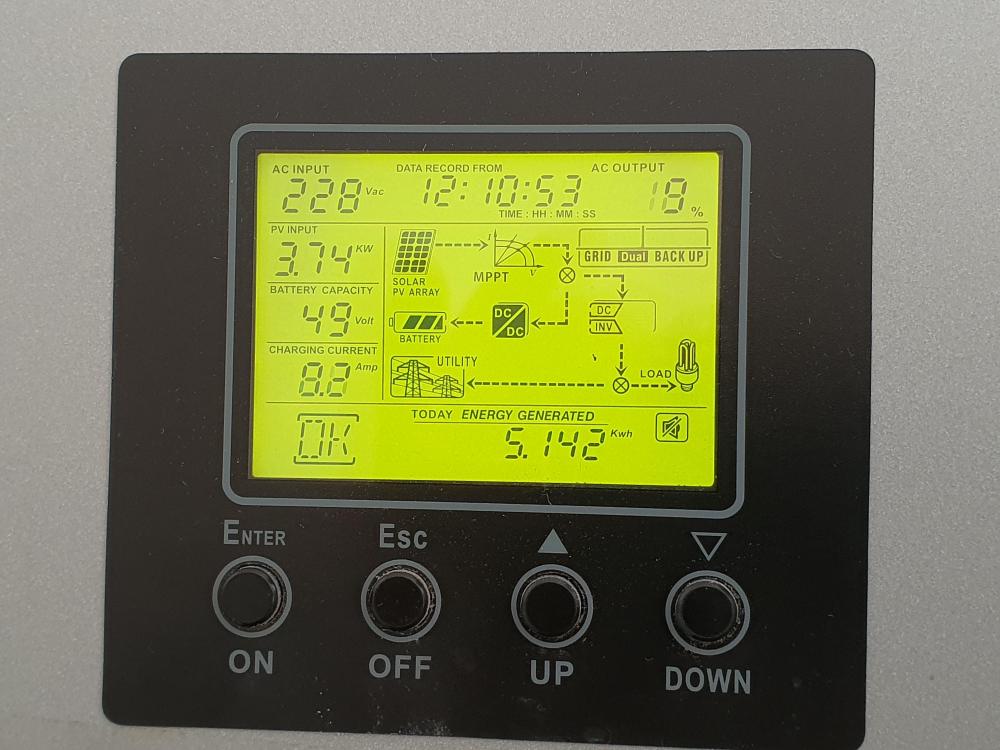
Been raining since early in Cape Town (yes, I know...). Sun appeared from behind the clouds for a bit and I see I'm getting way above my panels rating:
-
I worked from this: https://github.com/MindFreeze/hassio-axpert @Coulomb sent doc links - I'm sure he knows them better than the manufacturer.
-
Just to keep things interesting for Cape Town solar geeks. My permission to commission my system contains this sentence: Groan. I have an existing Landis+Gyr prepaid meter. Now these meters can be configured to cut the power if they detect reverse energy (its considered as a tamper attempt). Mine though has that set off. So it bills me for reverse energy if I overshoot - and of course when the iron is being used or the oven then I do see some overshoot when the iron or oven thermostat turns off. So its a concern for me that they want to swap the meter - since I may end up with trip problems if a heavy load goes off in the house and it takes my inverter too long to back off the power and enough reverse energy flows to trip the reverse energy detection.

-
Hi @Ironman, You will find various photos etc if you look back through my posts. I've been a pain on Powerforum I'm sure but the ou manne and others have been fantastic with advice and referring me to good guys to help me - most of whom are on this forum. My system has a "Renesola Replus" hybrid inverter. These were being cleared out a few years ago at a great price. Its a Voltronic Infinisolar OEM. It is on the CoCT magic list of approved devices though it does not meet the latest standard so I needed to get my approval complete before the end of 2019. Its rated 3kVA but that really only becomes a limitation when the power is out. When the power is present the inverter really connects the grid and essentials together and then the DC/AC inverter feeds both. Practically that means that even on the essentials side you can exceed 3kVA. (Obviously if the grid disappears in that state the inverter will trip so its to be avoided). I have 9 Canadian Solar 350W panels - I could probably have used 10 but my inverter maximum voltage is 500v and I didn't want to take a chance. So 9 means 3150kW. COCT rules would have allowed me 3500. In practice I think 10 of these would have been fine. I have 2 2.4kWh Pylontech US2000B batteries. I used 80A fuses in both + and - and also fitted a Victron battery monitor. I probably didn't need a battery monitor since the batteries are smart but its handy at a glance to see the charge state etc. My inverter has a "grid" connection and an "essentials" connection. The essentials goes to a sub-board and all my lights, my computer dedicated circuit and some plugs around the house are connected to that. On the grid side are the high load stuff. I elected not to feed in to the grid. So to get that right I fitted a Carlo Gavazzi ET112 meter and a modbus card in the inverter. The inverter reads the nett power flow from the meter and uses that to try to balance what it feeds in so that it doesn't feed back into the grid. After buying the ET112 I discovered it was not compatible with my inverter's modbus card - I'm stubborn and a programmer so I wrote a program that runs on a Raspberry Pi and converts the format so that the inverter is happy. Paperwork wise in Cape Town: It starts with a form and a basic diagram of what you intend to do. You then get a permission to install letter (I did have to hassle them to get it). You then do the install, and you may "test". Once done you will need to have a COC for the electrical work, and there are requirements to be able to isolate, to mark main switches, and etc. In that process I had to improve my ground for the house. We also established that my supply from the council is out of spec - heavy load in the house and the voltage at the point of connection sags to something like 195V. Council came and stuck a meter on the supply and didn't do anything to load it down and shrugged and said its OK and that was the end of that. You also need a Professional Engineer to sign off that the required automatic isolation works properly - the requirement that the inverter disconnects from the grid if the grid goes off. He also checks grounding, isolation points, labelling and etc. @Rautenk did that testing for me - with careful testing which is a bit tricky in the case of a hybrid. Then you need to do a "single line diagram" which is a sort of circuit diagram of the house electrics. Karel gave me an example and pointed me at something called profiCAD and I did the diagram. Took some time but was quite fun. Lastly, you sign a new supply contract and send all this stuff off the the council who I suppose study it carefully (?) and issue the permission to commission the system. And you are all official. Whether that's a good thing remains to be seen! I did discover that my inverter doesn't ground neutral when disconnected from the grid and supplying from solar or batteries. So in that case neutral floats at 115 volts or so relative to ground. We've had lots of disussions here about that, especially because my inverter uses a switching inverter and not a transformer creating a question about whether its OK to connect the output neutral to ground. But mine, at least, seems perfectly happy. Apparently the inverter is approved, but I didn't think that was safe so I fitted a contactor that links neutral and ground if the grid drops out. In June I got 315kWh from the panels - so about R800 worth at the higher Cape Town rate. 425kWh in October - R1100 maybe? In the summer I don't have enough daytime usage to use up the available energy, and I don't have enough batteries to save it all for overnight - so sometime I'll buy another Pylontech. On a sunny day with lots of demand in the house I saw as much as 22.6kWh from the panels (October 25th). I guess I spend R65k and of course many hours. It was a fun project so I'll pay myself R0. So on that basis I guess it pays itself off after 6 years.


