riazarbi
Members
-
Joined
-
Last visited
-
Just following up on this. To answer open questions: My BMS was communicating correctly Batt Type > Charge, discharge amps were set correctly Batt Charge > Amps was set correctly Shut Down settings were correct I have 5kwp panels, a 5kw inverter, and a 12.5kWh Felicity battery. Equalisation was originally at 90 days, but I set it down to 0 and did a full reboot and waited a few days - no effect. I experimented with totally turning off everything related to charging - gris charge, grid signal, timer, unchecked all the timer boxes etc. Nothing worked - the grid would keep the battery at 100% no matter what. I waited for 2 weeks in this situation, disconnected from Eskom. Turned on Eskom again, it went right back to 100%. I finally requested a firmware upgrade, from 3.3.8.4 to 3.3.8.5. Immediately upon application of firmware and reboot, old behaviour was restored, and inverter works as expected. I'm pretty confused about how a component's behaviour can change _before_ a firmware upgrade, only to be fixed with a firmware upgrade. Reminds me a bit of this story https://www.404media.co/polish-hackers-repaired-trains-the-manufacturer-artificially-bricked-now-the-train-company-is-threatening-them/ (which is a wonderful read) Anyway, is there any was to back up my sunsynk's settings? I can see there is an upload function. I'd like to back up the settings now, so I can restore if behaviour changes again.
-
Also, thanks for schooling me on the Power column! I had an incorrect assumption on that one.
-
That was my initial thought. But it persisted for several days, which I thought was too long. Although, with these high levels of load shedding, maybe it could never get to ‘equalised’?
-
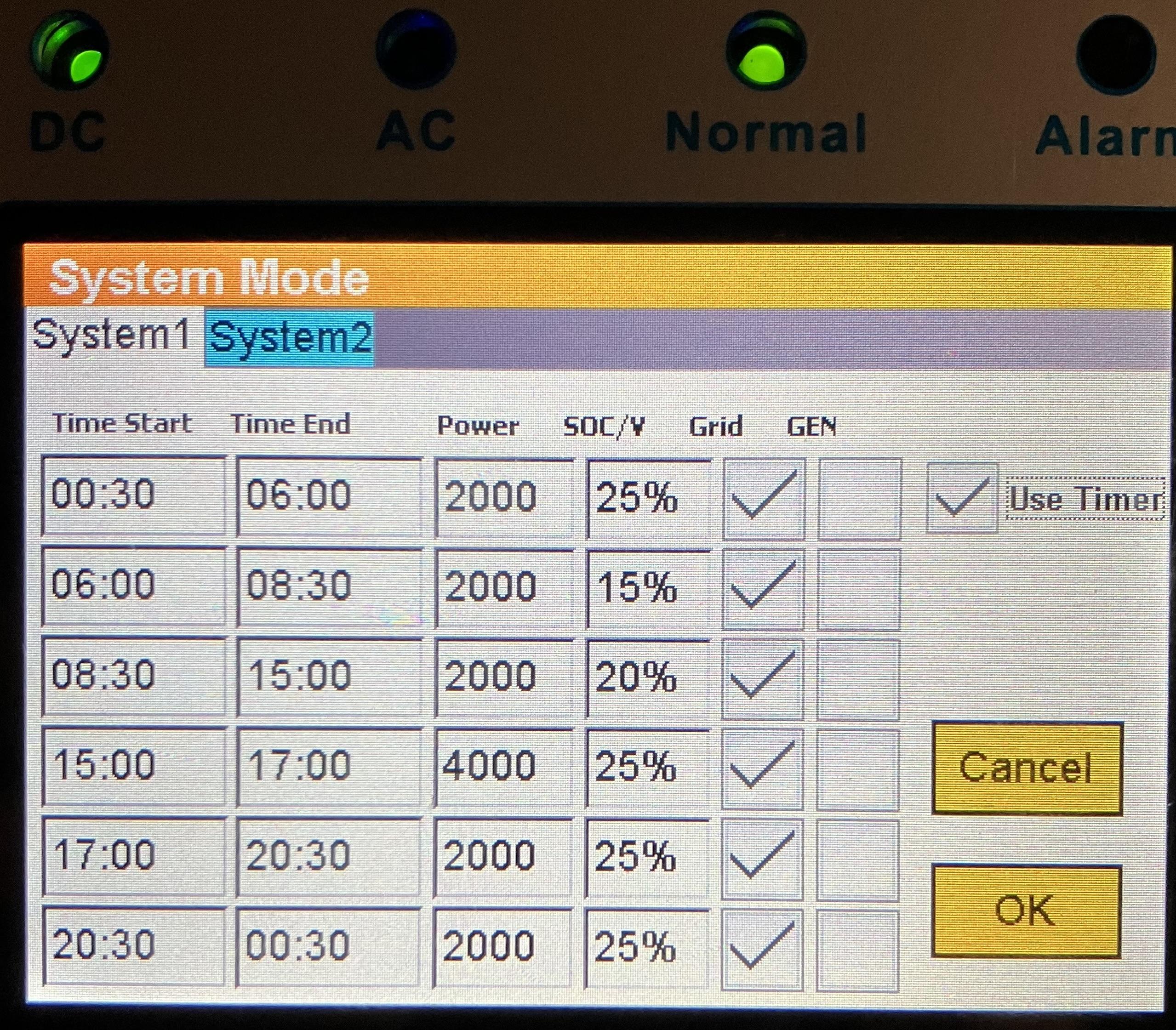
The 2000/4000 is the wattage limit that the grid is allowed to supply if the battery falls below thie percentage state of charge. When the timer is used for charge mode this limits the amount of current that will flow from the grid. I use 2000/4000 to limit how much I spend from grid charging. Installer says they didn’t make any changes. Turning off Grid Charge has stopped my battery getting sent to 100% from grid perpetually. But it also means if my battery dips below the timer limits due to load shedding the inverter will not use the grid to bring the battery back up to the desired state of charge - it will just ‘limit the drain’ by supplementing from the grid until the sun can bring the state of charge back up again.
-
Alright, I’ll give it a shot. A bit unnerved that this sort of thing could happen out of the blue. Hopefully changing the times will fix it!
-
For sure, I’m aware that the app is flakey. The timing is just a little suspicious, so I thought I’d mention it. Here is my system mode screen. Unchanged for the last 3 months. currently I am dealing with this by just turning off the grid, but that will bite me next rainy day.

-
Hello. I have a 5kw Sunsynk inverter connected to a 12kwh Felicity battery (and the grid, and solar panels). This setup has worked well for the last 3 months or so, and the inverter communicates well with the battery, so I use the ‘Lithium Battery’ setting. The energy supply priority is as follows: solar supplies what can; if it cannot, battery supplies down to 25%, thereafter grid supplies. On the 1st December my inverter suddenly started charging my battery from the grid at 1420 in the afternoon, took the SOC to 100%, and then stopped logging data to the app. We did not notice any of this as our power supply was fine during this period. It resumed logging data at 1155pm. I just thought it lost WiFi connectivity or something. But since then, my supply priority has changed. Now, the grid keeps the battery at 100% at all times. If there is solar, my grid usage diminishes, and if there is not solar, my grid usage increases. The only time my battery supplies energy is during load shedding, at night. I don’t understand how behaviour can just suddenly change like this. I am the only person with access to the setup and I did not touch it. So, questions - 1. Has anyone else experienced sudden changes in power supply priority with Sunsynks in the last week? 2. Any advice on how I can get behaviour back to normal? I’ve poked around a bit, but nothing has worked thus far.
-
-
Perhaps I missed something, but there seems to be a bit of confusion around whether one is dealing with apex or someone else. Could a forum member ‘in the know’ post a link to the alibaba store or similar to clear it up?
-
-
People try to DIY things for a host of reasons - sometimes cost doesn't come into it, you just DIY something to learn and to see how something works for yourself. Or, maybe you want something that you simply can't get otherwise. If you are simply comparing the cost, time, and effort involved in getting a modern vehicle on a par with an EV you can buy off the showroom floor, there is no question that you are better off buying one. You might be able to build one cheaper, but you certainly won't have any of the benefit of a large multinational corporation providing warranty support and replacement parts if something breaks. So why would a rational person convert an EV? Some reasons I have encountered on forums: 1. A technical drive to reverse engineer an OEM system and liberate the components ('hacker ethos') - see openinverter.org 2. A desire to modernise an otherwise irreplaceable vehicle (sentimental or otherwise) - see electricclassiccars on YouTube 3. To develop for a niche application that the market doesn't serve yet - electric game viewing vehicles come to mind
-
-
Not documenting anywhere yet, PsyCLown, as I view it as a jinx to create forum threads about EV conversions - so many forums are littered with good intentions and no results. That said, I am keeping notes, and will happily post them once I actually have something to show for my efforts. For what it's worth, I am going the route of using salvaged EV components from the EU and open sourced controller hardware. I have bought all the components except the BMS and cells, which I must still figure out. At present my components are sitting in a shippers office in Germany until I get a permit from ITAC (a South African govt agency) to allow me to bring in used goods. Once (if) I get that permit the shippers will ship via sea to Cape Town. In terms of difficulty, I'd say that I am finding shipping and customs clearance as difficult as actually doing the conversion. It is really, really hard and expensive to get EV parties into SA. In terms of costs, shipping is probably 40% of the total cost thus far - EV bits in other countries are cheap!
-
Sure did. I even mentioned it in the post.
-
Hello, I am looking at these modules on batteryhookup.com - https://batteryhookup.com/products/samsung-24s-lithium-ion-6kwh-module-3x-8s-modules They are designed for large scale UPS systems, and contain Samsung SDI cells. I intend to use them for an EV conversion, and I intend purchasing 8 of them to get 48kwh. Shipping is the same no matter how many I buy (up to 16 modules) so I am thinking of putting together a group buy to save on shipping. These are new, never cycled batteries. Here are the salient specs: Nominal capacity: 6kwh Chemistry: Lithium-NMC Arrangement: 3 x 8s 2kwh modules in series Max current: 200a (3C) Call capacity: 68ah Bottom voltage: 74.4v Top voltage: 98.4v Cost per module: $420 BMS: There is a BMS, but it is proprietary, so you'd probably need to run your own BMS. There is a YouTube video on the listing to show you how you could do it. Shipping (total): $2500 Customs charges: UNKNOWN Please look at the specs on the link above for more info. For 8 modules, I am looking at $5680 including shipping, which is $732 per 6kwh module. If we buy 16 modules, it works out at $9220, or $576/module. If you are interested in participating, please let me know.