The Bulldog
Members
-
Joined
-
Last visited
Everything posted by The Bulldog
-
Register 43052. Value 0 to 10000 = 0% to 100% of nominal. Set a value based on your desired export - wait a bit, check again, keep adjusting until you get what you want. 100% refers to whatever your panels can supply at any given time so you will need to adjust this continuously.
-
I am not 100% sure about what you are asking. I think you are asking about your single phase system feeding into the net and drawing that power via the other two phases back into your house ? Well yes, sort of. If you are setup as SSEG and can feed back you will be credited for the power you feed in on that one phase but charged for the power you draw from the other two phases unless your meter is setup for net metering (it most likely will not). If you happen to have one of those old ferris wheel meters then you are OK (but are feeding in illegally - those meters always do net metering). If you have a prepaid meter it likely will trip if you feed in any power. Can you do it after the meter ? Yes you can but you need a somewhat more complex system using for example three Victron multiplus charger/inverters and a battery bank. With these you can shuttle power between the phases via the DC bus all the while maintaining proper phase relationship. Tying the three phases into one as suggested above is quite possible as long as the now single phase supply is big enough to handle your loads and of course you do not have any appliances that require three phase supply with the phase shift. Basically in most cases this is limited to three phase motors - aircons, lifts, pumps and the like.
-
COCT is increasing tariffs by 13.5% for home users, absorbing some of the increases forced on by Eskom. Those that are feeding in will see a 3.5% increase in what the city pays you for power you feed in. So you in fact contributing to the above subsidy by a fair margin. A further note: Any "green" credits for your production are for the benefit of the city. You cannot offset this against your own business or similar.
-
So that means alternative got over 15% cheaper. Way to go Eishkom !
-
Well in my case after they installed the meter my own accounting differed hugely with theirs (in their favor). I did read the meter registers in the kiosk and found the meter reading to agree with the SAP system. However a short look further I noticed that they reversed one of the phases. That's of course not a good idea. I took photos and sent them to COCT electricity east explaining the issue. Never got a reply. Eventually had enough of that and broke the seal and fixed the issue myself. Probably would have sent a tamper alarm but I took photos of the before and after (lots of them just in case). Since then my own accounting and theirs match closely. BTW with a three phase system at 100A you are only allowed a total of about 17KVA feed in - not 10KVA per phase. Your capacity can be higher but you have to prove that your system will never push more than the authorized limit. I actually have a three phase 150A feed but had to downgrade it to a 100A feed as otherwise they wanted to force me onto a commercial tariff. That would have completely screwed me over...
-
Well I guess the Mafia is worse - at least COCT stops short of dunking your feet in cement and throwing you over the peer wall... What meter have they given you ? In my case I can view the registers on the meter itself no problem as well as the corresponding readings on their website. It takes a bit of figuring out what is what as it has various time/day of week based tariffs so you have to figure out which registers to add to get to the totals. Yes the 600Kwh step is a nasty one - did catch me during the Winter as well - now I am wiser, I will set my system up to supplement with battery when needed to avoid that. Regarding three vs one phase - single phase does make it easier but it does seem my meter does a proper 4 quadrant job of metering so if say one phase is feeding out and two are feeding in (quite common in particular during low light scenarios) it seems to account import/export at net value.
-
That is correct - you have to pay COCT for the privilege of "selling" them your power. Like it or not - the cards are stacked against you.
-
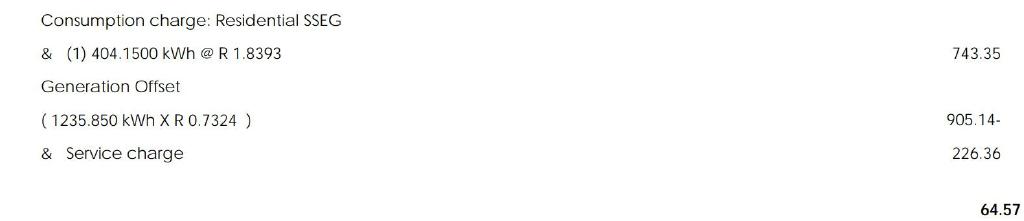
Well just received COCT bill for the month (up to 16th of October) - about the middle split for my annual estimation. As you can see I am feeding in more than three times what I am taking at night. Obviously I am producing more than what I am feeding in as the property consumes power during the day - the feed in being the excess. This compares well with my estimates - I should be able to get relatively close to net-zero as averaged over a solar year but probably will not quite get there unless I add a few more panels. But since I already have 42 panels on the roof it is getting a tad crowded so I would have to align additional panels facing west - a bit less efficient but not too much. Considering this is the maximum size COCT allows for a residential installation and tariff you can see their calculations just allow net zero for this - anything smaller and its not worth your while. So the notion that COCT does not really want you to do this is a fair conclusion to make. It took a year of fighting to get this signed off and in total it cost around half a million bucks. To be fair that includes a large battery bank and related inverters as well. Total installed inverter capacity is 30KW.
-
There has been zero communication from COCT. We will have to wait and see. You are permitted to feed in as much as you like - subject only to the restriction on maximum power you may feed in based on size of your connection. The limitation is monetary - so if you somehow manage to get to zero Rands as averaged over one year - you would have fed in three to four times what you actually took from the grid - slightly dependent on the size of your connection - the fixed daily charge is the same regardless of the size of your connection. If you have a single phase 65 amp feed - just forget the whole thing and just use your power yourself or start looking at using batteries. This whole notion of using the grid as your battery - Hah ! Yeah right - it must be the Worlds most ineffective battery. You can do it if you feel your excess power is going to a "good home"...
-
-
It is effectively impossible to get to net zero if you sign up to feeding in in Cape Town. Unless you use batteries to assist you during times of low or zero production. That partly defeats the object. The problem is the vast difference between what COCT pays you for a KW/h and what you pay COCT for a KW/h - plus the increased daily charge (which you have to recover first using your measly income from COCT) plus the not insignificant cost of the bidirectional meter (about 15K in my case including installation). Add to this the limitation of just how much you can feed in at any point in time based on the size of your connection. If you decide to jump through the hoops and feed in legally you are best served by viewing your contribution as a "donation". Because that's exactly what it is. I have a three phase 100A feed and am pretty much maxing it out - I may just be able to break even over a year - not counting the cost of the meter. I doubt that I will be able to get to the point were COCT would owe me. In this scenario I have not utilized by batteries (saving them for loadshedding only) and am not even thinking of the cost of panels or inverters. I have 12KW/h of panels installed and have capacity to do another 5Kw/h before hitting the limit. Might do it just for fun...
-
Tends to vary a lot mostly based on complexity of your installation. A simple single phase with a single compliant inverter is not an issue. The problem usually starts rearing its ugly head if your installation is complex and has multiple systems. Now it does not fit the available molds and the fighting starts...
-
Correct - my connection was a three phase 150A. That caused trouble with my SSEG application as they only allow up to three phase 100A for ordinary single households. They actually did not tell me there was an issue - but simply proceeded to register this as commercial connection and yes - that is completely out of line. You have to use quite a bit of power FROM them before this makes sense. Got it changed to 100A - all they do is they came and took my very nice 150A three phase breaker away at the gate and replaced with three individual 100A breakers floating in mid air (the breakers did not fit the previous bracket so they just left it like that) and just for good measure broke the door right off the meter kiosk and just left it lying on the ground. Apart from wiring the wireless meter incorrect of course - they swapped one of the phases input to output around causing quite a bit of head scratching on my side as my accounting did not balance at all with that of COCT. I export a lot more than I use - but the reversed phase charges me for the export ! It left me wondering how this works with COCT customers that don't have much understanding of these things - how many are equally badly wired by COCT's electricians but would never know it...
-
Frequency shifting to control the Solis inverters works great - been doing that for quite a while now. Yes, you need an inverter that is able to do so AND you need to be able to control that frequency shifting process (setting the frequency limits) so you can balance the operation to perfection. You cannot change the limits in the solis (at least I don't know how) but if you look at the NRS test results which they publish you can see nicely how it works. So you need to be able to configure the other side to prevent this to become just a glorified on/off switch with sort of a ramp in the middle. There is more to this - your inverters must be able to use your batteries as load dump as regulation is not instant - this means your battery charging, battery capacity and inverter instantaneous power generation comes into it. This means your inverter cannot be a simple one - it needs a bit of brains to be able to control and handle this. If all of this is in place it does work well though and is a simple solution.
-
As to the question of if the landlord can sell your his solar electricity legally, probably yes provided it is below 1MW/h. This article gives a bit more detail: https://www.businessinsider.co.za/residential-complexes-can-now-rent-solar-panels-and-pay-for-the-electricity-instead-of-the-hardware-heres-how-it-works-2019-12 As for fitting your own panels - your lease agreement will provide the answer. You do not own the roof or any other part of the building. You can only do what the lease agreement does not prevent you from doing. If it is not specific then common law would ask you to consult the land lord. If he says "no". That's that. You do have the option not to renew the lease.
-
COCT budget now includes a R0.25 "incentive" per KW/h to feed in. Still not cost effective for a solar powered home to feed in excess power (it costs you more than you will get back for most homes). But at least a step in the right direction. In my opinion: 1) Vast difference between what you get for a supplied KW/h vs. a KW/h used from grid. Fine, I can accept that one. 2) Around R15.000 charged to supplier for a bidirectional meter (you will never be able to amortize that cost - dead loss to the solar supplier). 3) Increased monthly fixed charge for the pleasure of supplying power (this one I do not get at all). Effectively this means Eskom is still favored as supplier by municipality - small scale solar supply effectively discouraged (while trying to project "green" image).
-
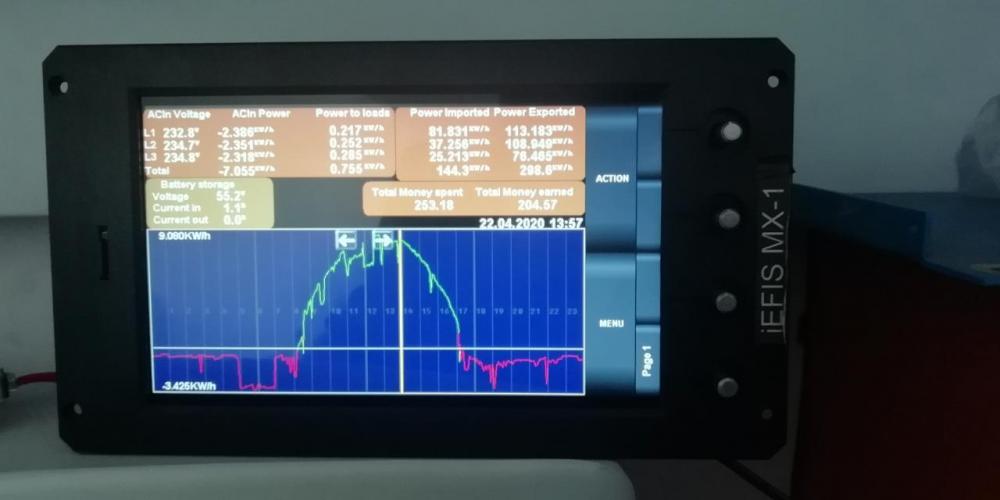
So how are you doing with your solar system during lock down ? Perfect time for me do do what I wanted to do for some time but never had the time for. To recap - got three 5KVA multies on a three phase feed with a Solis 15KVA three phase grid tie with 10KWp of panels on the roof. I "stole" one of our MX1 aircraft EFIS flight instruments and repurposed it a bit. This is the original prototype of the MX1 EFIS intended for low cost applications. Normally it would be fitted in an aircraft cockpit and gives you all of the primary flight information (altitude, airspeed, attitude etc), does the autopilot, navigation, engine monitoring and so forth. Pretty much an all in one glass panel. Made in Somerset West and exported around the World (one of many models we do). Anyway, at its heart it is a STM32H7 processor with a LCD touch screen. I took the normal EFIS software and threw out a million or so lines of code to end up with a skeleton but functional system and hacked around the Solis and Victron communications buses and connected these to the MX1. The MX1 software is largely user configurable - you design your own displays from provided items so I added all the various bits from the inverters. You can do up to 9 screens - you select which screen you want to view using a rotary control. Here is my "main" screen. My system is approved to feed in so I want to see how I am doing. This is the last few days (but we had some rain and overcast so I am a bit negative on the financial side but still feed in far more than I use). Other screens are dedicated to solar production stats, daily stats etc. The graphs show a day at the moment but the system stores up to a year of data and you can scroll through each day and touch the graph to see what you were doing at that point in the day. The MX1 is also able to control the inverters including throttle the solis if needed. Using ESS I can shunt power from one phase to another or utilize the battery in whatever way I please to optimize the system as a whole. It can also control switching units via Wifi to switch loads in and out depending on conditions. For example you could setup such to put excess power into a geyser depending on water temperature and potential PV power which the MX1 can calculate (if the Solis is throttled). These switches then work in a priority chain with power export being the last item as that is the most inefficient way to use the power (COCT pays peanuts for the power). Fun project so far - still work in progress of course - the more I add the more ideas I get. Pic below shows my current main screen (Battery stuff needs work - still need to connect to BMV). Graph shows import/export of power during 24 hour day - yellow line is current time - into to the right of that is yesterday (so it always shows the last 24 hours).
-
Yes. I have had a similar case just on a much bigger scale. I had Victron Multiplus inverters that are not NRS097 approved with Solar charging the batteries via MPPT. COCT rejected this outright. By moving the panels to a grid-tie that was compliant the Mutiplus became a simple UPS with batteries charged from grid (and solar indirectly). That was acceptable to COCT even though there was no change in how the inverters were wired. The moment your batteries are not DIRECTLY charged by solar but this goes via the grid (or not at all) you have a UPS. Provided it complies with SANS.
-
That's not a SSEG. That's a UPS. Covered by SANS codes and has nothing to do with PV.
-
Using ESS is unfortunately out of the question as that would violate my systems approval by COCT (My three Victrons are 5KVA Multiplus and not NRS-097). I am only allowed to use them as UPS. One way to solve my problem is to simply drop out the grid during the times when power shunting between phases is needed and let the Mutis take over the supply. During this time my Solis grid tie can still generate power and since I can throttle it (and have to) using its RS485 bus I know what the potential generation is (from the amount I have to throttle) so I know when to reconnect to the grid. It's not a huge issue - in monetary terms it works out to perhaps R80 maximum loss to my side a month - it's more the principle of it. ESS with external control via a MK2-RS232 which I have is attractive as it opens up a lot of other interesting possibilities - but I don't think I'm allowed to use it. It strictly would not violate COCT's SSEG rules as it does not form part of the solar system anymore - but it would not be a UPS to NRS codes either.
-
Now that I am live with a legal COCT SSEG feed and a AMI meter I have got the first account and can clarify one of the questions nobody has been able to answer at COCT. The AMI meter is setup by COCT to do PER PHASE metering. Not NET metering (like a old fashioned three phase meter would do). The AMI meter is perfectly capable of doing NET metering but parameterised by COCT not to do so. This means if you feed out on one phase to use the power on another phase (a very common occurrence) you will get charged full tariff for your own power while getting a credit for the same power on the feed-in tariff. In other words COCT is selling you your own power at 2.6 times the rate it is giving you (The power has just moved between phases via the utility transformer up the road - COCT did not get that power anywhere else). In my setup this happens usually when house loads and generation are relatively close to each other, not a problem once power generation ramps up and each phase generation exceeds the house loads. I'll have to investigate how to work around this - have some ideas.
-
From a DA mailer received in my inbox this morning. • His team is on track to make the Western Cape the first loadshedding-free province in the county, ramping up efforts for everybody to generate and sell renewable power onto the grid. Hmmmmm, yeah right... Not like this they are...
-
9 months to get this approved. The mind boggles. Now I feel a bit better, seems I was not doing too bad...
-
Sent you a PM to your e-mail address.
-
About 15 months in my case. But it is for a big system and I tried to get them to accept the Victron Multplus fitted with Ziehl relay for the NRS-097 compliance part. That turned out to be a no-go much to my consternation and I had to implement an alternative that used a gird-tie for the solar part and then use the Victrons as UPS so that took a bit of time. There were some other hold ups - one of them was that I had to downgrade my 150A three phase feed to 100A as they wanted me to go onto a commercial tariff (never mind that I was on a normal household tariff before). The commercial tariff however is so badly skewed in COCT's favor it would have cost me a fortune in daily charges with no hope of ever producing enough Solar power to offset that. Anyway, all is now sorted eventually. I worked out that I need to feed in around three times the power I take at night to break even on an annualized bases. My batteries are still in as new condition but they are now no longer utilized except during load shedding. I have a lot of scope left now to tweak the system if needed (for example I could still supply just the base load from batteries at night) as well as add up to another 5 or 6KW worth of panels. But that is future - right now the system is running real sweet.