


demaniak
Members
-
Joined
-
Last visited
Everything posted by demaniak
-
Hi @MrVolt. Yes, running the ESS assistant. I don't know about "standard", but it has many advantages. To the best of my knowledge, the MultiPlus 2 does not require the separate Ziehl device for anit-islanding. it has certified built in protection mechanisms. But @plonkster or @The Terrible Triplett could probably elaborate with more technicalities than I.
-
Well, all I can do is tell you about my experience/reasoning, @deapsquatter Let me try to summarize: I based on my decision on the info I already pointed to above - so you can draw your own conclusions from all of that Maybe the guru's here could elaborate on how "hard" a requirement the 2 Pylons are. I mean, the docs does state you want 2, but maybe there are some "iffs and butts" involved? This is really just my own thinking at this time... your mileage may vary, use with caution! I'm currently coming to the conclusion that with my current battery size, I might be better of switching to "keep batteries charged", until I put up more panels. Maybe - still thinking it over. Essentially, if you just want to primarily be able to ride out load-shedding (which was/is a priority for me), then a smaller bank still makes sense - you just want 2.5 hours , twice a day, and be able to recharge in between. But to get optimal use out of ESS, I figure you kinda want to harvest and use PV during the day, store excess, and then use that excess during the evening. So in total produce 90%+ of your actual usage in a 24hour period. A "small" bank limits this ability. So - depends on your specific needs. Another thing to take into consideration possibly: your initial cost might be lower for the BYD (assuming the Pylon x2 requirement holds true), but after that, you can add a single US2000, at a lower cost than a single BYD module. Prices fluctuate - keep that in mind. Also, both batteries need specific cabling, cabinets, fuses etc. Should be fraction of the cost of the actual battery, but still, something to keep an eye on The BYD must be connected on CANbus (afaik). If you then also want to use a MPPT with a Venus device, it apparently must be a Venus GX, not the Color Control. It is explained in the Victron-BYD docs linked above. If you are DIY'ing it, I would suggest you study both those links for the finer installation points! And chat with the smart people here. It's really early days for me, but so far I'm happy with the BYD. BYD is huge in the Chinese EV market btw. Reputation seems solid as far as I could make out. But Pylon reputation is also apparently excellent - I do'nt think you will really go wrong with either (ignoring budget considerations!).
-
A few more random thoughts and comments Why not Pylontech? First, cost. This sounds strange, because Pylontechs are cheaper than BYD, right? This is true, BUT, for the Victron inverter, I would need to start with 2 2.4 Pylons (see https://www.victronenergy.com/live/battery_compatibility:pylontech_phantom ) BUT, with BYD - I can start with a single module (see https://www.victronenergy.com/live/battery_compatibility:byd_b-box ). This means the upfront cost for going BYD is actually lower than for the cheaper Pylons. Go figure. Next, according to this ITP Renewables testing lab, BYD has (had?) a slight advantage over the Pylons in a few areas. It really is not that much of a difference, but it was enough to put me over the edge. I have attached their 2018 report for your viewing pleasure. Changes in house hold behavior Fancy way to say we are trying to make sure we run the dishwasher and washing machine during daylight hours. Oh, and we also dug out these fancy Hot Water Batteries (I understand some people refer to them as "thermos flasks"). Before boiling the kettle, check if there is hot enough water stored. If you do boil the kettle, dump whatever is left into the flask. Magic. Pool pump timer and Geyserwise control is a given. Battery-Testing-Report-September-2018.pdf
-
How did that work for you @Mstott?
-
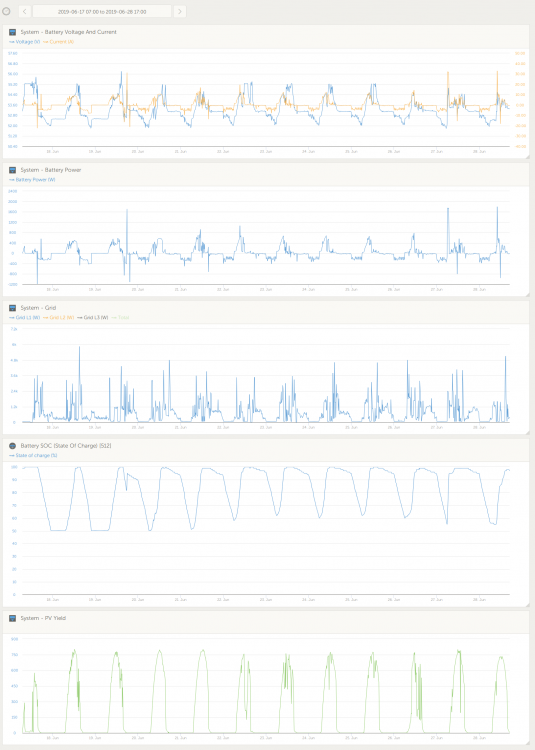
Alright, here are some nice graphs from the VRM. If you look carefully, you can actually see where/when I tweaked something
-
Now that WOULD be interesting! Compare apples with apples kind of thing.
-
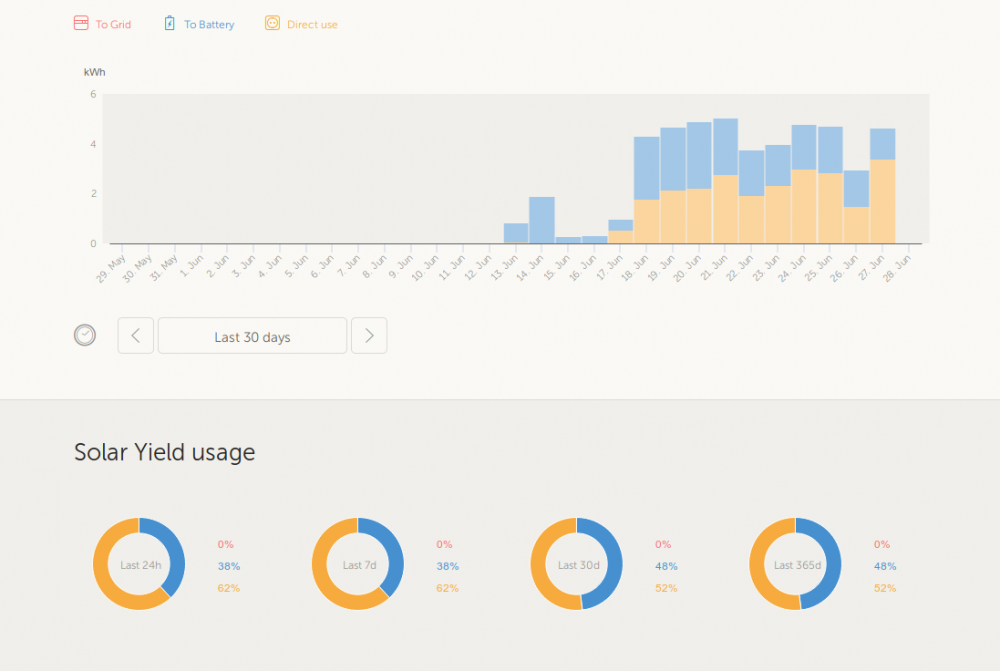
The (sometimes more useful) graph attached. In case you are wondering: yes, I need more panels.

-
Hi @liceman For what it's worth, here is what the graphs look like for my (brand new) 3x330W JA panels. The absolute best day netted me 5.03kWh - but that is currently an outlier. Average is sitting somewhere between 3 and 4kWh per day - assuming I can keep the loads stable enough to get the panels producing at max. That translates roughly to (at peak - 12 noon) something like 750W coming down (i.e. 250 per panel).
-
I might have gotten lucky... I have a BEC42, with recent Victron install. Currently running with grid-set point of 70W - no trips to date. I have observed (via the remote console) something like 250W (or more maybe) flowing the wrong direction (electric stove element that switched on and off) - touch wood, no trips to date. Either the duration (or the quantity) of the feed-in was not enough to trigger the alarms, or maybe by some miracle the feature was not activated.
-
Just to be clear - I was referring to the Tshwane prepaid meter config! The rest is fun (well, for me at least), and the info IS there (Victron documentation is pretty damn good in general!)
-
@The Terrible Triplett - I will play around with it August - I have to travel July, would prefer not to leave the family with "untested" config.... I will NOT hear the end of it. Firmware versions seems update2date for now, but I will keep on top of it. Thanks @plonkster - I saw the "keep batteries charge" bug kept being mentioned, but I never (where I read) with the actual details. Anyway, DVCC is definitely switched on now. Good to know about your conlog experience - gives me a bit more confidence for when I start dropping the grid set point Aug As far as I can make out, I got a BEC42 installed. It's rather annoying that you have to infer/discover these sort of configuration details via experimentation - but I guess for the vast majority of consumers the knowledge would be meaningless, so why bother publishing.
-
Introduction This forum has helped me a LOT with information, tips and tricks, and eventually with my decision making process. A massive "thanks" to everybody that contributes (questions and answers!) So I figured I'd share my experience with the first days with my newly commissioned solar system, in the hopes that it might add a bit to the pool of knowledge, and help some other newbie in the future. The System 3KVA Victron MultiPlus II 48/3000/35-32 VenusGX running ESS 1 x SmartSolar MPPT 150/85 990W array (3 x JaSolar 330W Poly) 1 x BYD 2.56 Lithium-Ion Batteries 1 x Carlo Gavazzi ET112 Energy Meter Notes It was officially switched on 17 June 2019. Based on the sage advice of members on this forum, and my own thinking,the system is as small as I could make it, and still have something usable. The plan is to extend, based on gathered data - and of course as finances allow. The current planned ending spot is: total of 9 330W JA panels at least one additional BYD 2.56 unit This was not a DIY job - fiddling near mains with any piece of metal (like a screwdriver) freaks me the HECK out. Also I'm one of those feckless "software types", so there's that 😛 Generally I'm happy with the installer's services, but then again, maybe I just don't know better We have a 80amp municipal breaker, and new Conlog pre-paid meter, courtesy of Tshwane. Production, consumption and storage Short version Best (single) day: 5.03kWh produced. At peak, I have seen 900W from the panels, but generally 750W is what I see as "good" currently. We consume about 20kWh per day (looking to bring that down a touch still) House "idle" consumption is between 150 to 450 Watts (these are the 24/7 loads) We have "spiky" loads that peak anywhere from 1.2kW to 5kW (as measured by the GC energy meter) Battery can handle the "idle" consumption for about 6 hours (i.e. between 00:00 and 06:00) I'm trying to find a good "staggered" setup of loads during sunlight hours to keep the panels busy during peak sunlight hours - it is a challenge! Longer version I'm lazy now - if there are questions, I'll gladly try to provide details Snags and things Victron VRM and Venus remote console Make sure you have access. Learn it. Love it. Read the manual before changing things! Remote Console can be laggy at times. Have patience. Or build a new interface based on MQTT... ESS Initially the installer set the "Limit inverter power" setting to "safe" limit to product the battery. This made sense to me - don't hit the battery with massive spike loads, maximize battery life. Good. Only problem is, as far as ESS is concerned, this "limits DC to AC" conversion. Period. So that includes MPPT supplied DC. So the nett effect was that MPPT supplied power to loads was also capped. Not so good. My eventual work-a-round was to drop the "Limit inverter power" setting, and then set up "Charging Schedules". The main intent of these schedules is to charge from mains (well, AC to be precise), but the nice side effect is that while the schedule is in effect, the battery is NOT discharged. BUT, MPPT power can still flow freely to the batteries, AND flow unthrottled to loads. Set the "Stop on SOC" value of the schedule to some low value (even below the minimum allowed SOC), and it won't charge from the grid. The schedules keep the batteries away from loads, until 00:00. Then the house gets fed from battery, until 06:00 - then the schedules kick in again. You can also set the "Limit charge power" setting to limit AC to DC flow (i.e. how fast you charge from mains). UNLESS you have DVCC turned on... DVCC Ok, so initially this was NOT turned on. Based on what I read the last two days, it looked like it sorta probably SHOULD be turned on (with the BYD bats). Asked the installer...he said "yes go ahead turn on". So I did that - can't really say I see much difference, except that the "Limit charge power" vanished. And I did not notice - so today I charged the battery with mains power to 95%. Oh well - ultimately does not matter I suppose, since it was a "good" direct PV usage day, so PV was not wasted. So what was added is a "Limit charge current" setting. As far as I understand it, this is a "global" limit on how much amps is allowed to flow to the batteries - but SHOULD not cap the wattage supplied to power loads from MPPT. I will see tomorrow how that plays out. Conlog prepaid meter I was actually pretty worried about this thing tripping when those "accidental" grid feed-ins happened (when big loads turn off). To prevent this, we had a grid set point of 150W at first. No trouble presented it self, and eventually dropped that to 70W. I have now observed short periods of "accidental grid feed-in" of upwards of 250W (electric stove element that turns on and off during use). Fingers crossed - nothing tripped or blew up to date. Conclusion (for now) Educate your self, ask questions, verify answers (you now, "trust, but verify" ). Read the manuals! You will need to figure out how to stagger your loads during the daylight hours, in order to optimize your production, usage and storage Data - you want it. Whatever system (or components) you eventually install - make data capture and analysis a priority! I learned quite a bit from watching the remote console display (and switching things on and off!). Looking at the PV yield and consumption graphs (VRM), is helping me setup up sane "charge schedule" settings. It is also helping me to conclude that "yes, I really actually DO need more panels". I mean, I *knew* that, but know I have STATS to back me up! Data for the win! Apologies for the lack of photos currently - I'll upload some if anybody asks
-
Hi @deapsquatter - as plonkster pointed out to me in another post, assuming you have a Venus device,you can achieve useful behavior with the "Scheduled charging" options. Two notable, intended, attributes of a charge schedule is: while the schedule is in effect, the battery is not discharged you can set the SOC where mains charging should stop (and if that setting is below the current SOC - mains charging is halted) I have been experimenting with schedules, generally works well. @Mstott - bottom line is, if you want full yield from your panels, you need load for them to push into. Some load options: house consumers (lots of variables in that soup, things are switching on/off all the time in a normal house hold). Heating water seems to be a popular option to dump excess PV? battery. This is where I now see where "panel and battery sizing" becomes important. Also...expensive. grid feed-in (NOT an option for me , sitting in Pretoria). I am also having some challenges with keeping production/consumption/storage in balance currently - I guess that's half the fun of generating your own power! Makes you think on how that works at scale (i.e.... Eskom..)
-
Hi @Mstott I see similar PV yield graphs when my house loads are not consistent enough to keep the panels producing at full throttle. AND I also saw that when I still had the "Limit inverter power" setting on. Good to protect the batteries, less good to maximize your yield. Ofcourse, you might also see this on semi-cloudy days! Hope that helps.
-
Well, for what it's worth, attached is what I could scrape from my new MultiPlus 2 in a +-24 hour period. My VRM portal ID cleverly obfuscated with a bunch of x's Looks like "system/0/Ac/ActiveIn/Source" is what I'm after. For now. multiplus2_mqtt_topics.txt
-
Hi! First, thanks for a very interesting, educational, and occasionally entertaining forum! 2ndly - to the matter at hand. I'm curious if anybody has any experience and/or knowledge of wisolar (wisolar. co) (the company) and/or their products? I'm stitting with an estimate from them, but it is pretty light on component details (inspite of me asking for more info). Thanks in advance!


